


Guangzhou Rural Commercial Bank: The Harvester of Famine in a Land of Abundance
If most bank stocks in the A-share market represent the top students of China's domestic banking sector, then those mainland banks listed only on the H-share market are a different story. It is not an exaggeration to say they are in dire straits; many banks have already been delisted, such as Jinzhou Bank and Shengjing Bank.
Top students are similar, but failures have their own unique causes.
If the failure of Jinzhou and Shengjing is related to the collapse of the regional economy, what about Guangzhou Rural Commercial Bank? Sitting in the economically developed hinterland of Guangdong, what is the root cause of its poor management?
01
A Continuous Decline
Since its IPO, Guangzhou Rural Commercial Bank's stock price has basically trended downward. The P/E ratio has gone through a cycle from compression to expansion, and the P/B ratio has also continued to fall, currently at only 0.25 times. The root cause lies in the company's performance.
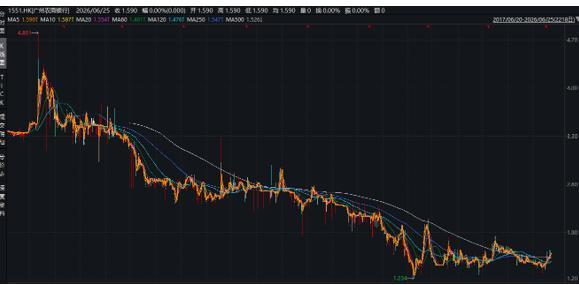
Chart: The PE of Guangzhou Rural Commercial Bank has experienced a journey from compression to expansion since listing, but the stock price has basically declined continuously.
Guangzhou Rural Commercial Bank is controlled by Guangzhou state-owned assets and was listed on the H-share market in June 2017. The development of regional banks often mirrors the local economy.
Guangzhou Rural Commercial Bank's total assets are still expanding, reaching 864.154 billion yuan in 2019 and 1,380.008 billion yuan in 2025, a growth of 59.69%. However, net profit dropped from 7.52 billion yuan in 2019 to 2.081 billion yuan in 2025, a decrease of 72.32%. 2020 was almost a watershed moment for its development.
02
The Vicious Cycle of Cleaning Up While New Risks Emerge
As of the end of 2025, Guangzhou Rural Commercial Bank's total assets were 1.38 trillion yuan, of which loans accounted for 0.68 trillion yuan, or 51% of total assets; 30% consisted of financial investments, including financial assets measured at fair value through other comprehensive income, fair value through profit or loss, and amortized cost, with the remainder held at the central bank or interbank deposits.
The net interest margin (NIM) at the end of 2025 was 1.08%, down 3 basis points from the previous year. Compared to the national banking sector's overall NIM of 1.42%, this is a gap of 34 basis points. In terms of asset and liability pricing, the average yield on interest-earning assets was 2.76%, placing it in the lower-middle tier compared to A-share listed banks. Although the gap with large state-owned banks is not significant, it is notably lower than joint-stock banks and similar rural commercial banks. The average cost rate for interest-bearing liabilities was 1.73%, better than some joint-stock and city commercial banks, but significantly higher than state-owned large banks, China Merchants Bank, and Postal Savings Bank. The core weakness lies in the low yield on loans.
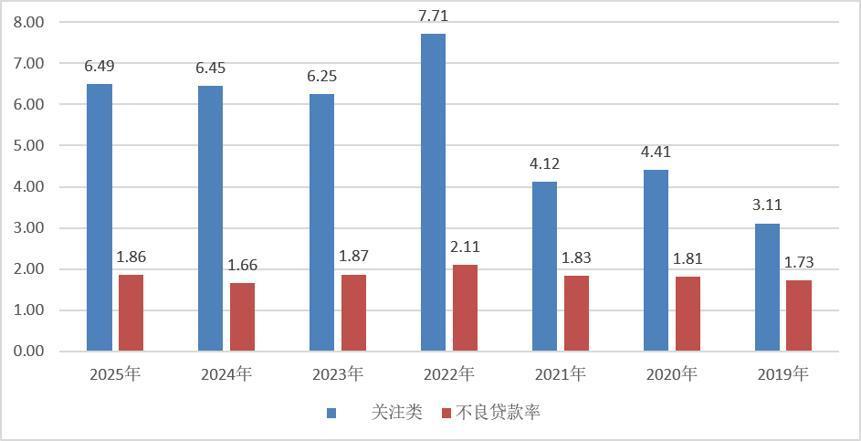
Chart: Watch list ratio and non-performing loan ratio from 2019 to 2025, unit: %
Superficially, the non-performing loan (NPL) ratio is 1.86%, about 36 basis points higher than the overall banking sector's NPL ratio, which is still within acceptable levels. However, the watch list ratio peaked at 7.71% in 2022 and has since been continuously reduced, yet remained at 6.49% in 2025, significantly higher than the overall banking sector's watch list ratio of 2.18%.
It is worth noting that Guangzhou Rural Commercial Bank did not disclose loan migration rates in its annual report. Such a high watch list ratio itself invites speculation.
From the perspective of loan structure, there is a structural divergence of "corporate improvement, retail pressure." The NPL ratio for corporate loans has been continuously reduced from 2.7% in 2022 to 1.2% in 2025, but the NPL ratio for personal loans instead rose from 1.64% in 2022 to 4.12% in 2025.
The improvement in the NPL ratio is related to the continuous transfer of large asset packages over the past three years. The total transferred creditor rights amounted to 48.012 billion yuan, accounting for approximately 6.81% of the total loans in 2025, with a discount rate of around 65%. The low discount rate may hide other secrets.
According to the details of the asset package in November 2025, the proportion of loans overdue by more than 90 days totaled 19.39%, while the NPL ratio accounted for 17.85%. According to regulatory requirements, loans overdue by more than 90 days must be classified as non-performing. The fact that the proportion of loans overdue by more than 90 days is greater than the NPL ratio in its classification indicates that its classification is not prudent enough.

Chart: Three consecutive years of transferring large asset packages from 2023 to 2025
Against the backdrop of increased transfers of non-performing asset packages, the balance and proportion of restructured loans at Guangzhou Rural Commercial Bank have also continued to rise. Previously, regulators required restructuring loans to be classified at least as substandard. The "Commercial Bank Financial Asset Risk Classification" issued in July 2023 adjusted this to "at least classified as special mention." Restructured loans are more likely to deteriorate during economic downturns. The balance of restructuring loans grew by nearly 8 billion yuan from 2022 to 2025, and the proportion increased by 1.66 percentage points.
The disposal of billions in risk remains difficult to alleviate because incremental risks continue to emerge. The customer structure and risk control standards have not fundamentally improved, trapping the bank in a vicious cycle of cleaning up while new risks emerge. The provision coverage ratio for non-performing loans also dropped from 184.34% in the previous year to 161.85% in 2025.
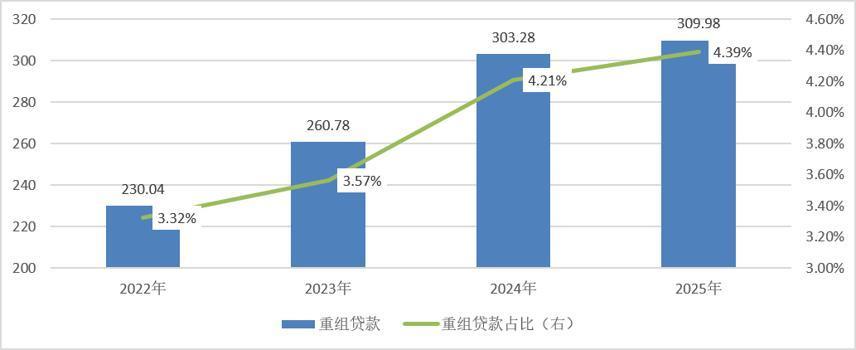
Chart: The balance and proportion of restructuring loans continue to rise
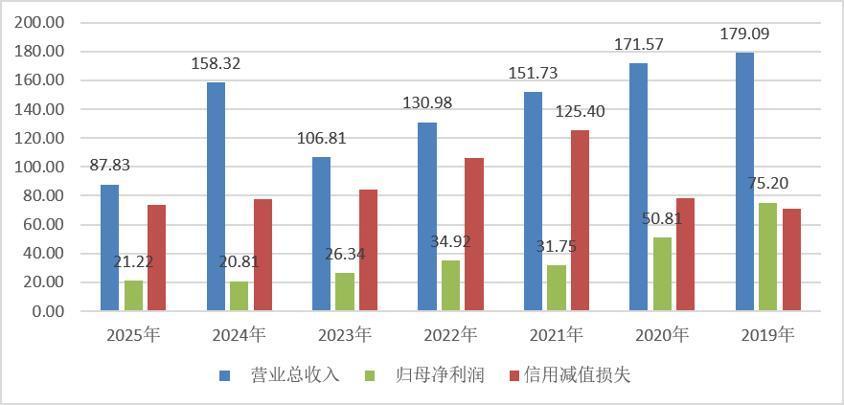
Chart: Revenue, net profit, and credit impairment losses of Guangzhou Rural Commercial Bank in recent years
The root cause of the continuous decline in profits in recent years, besides the industry-wide narrowing of interest margins, is fundamentally the impairment losses under deteriorating assets.
02
Dual Collapse of Human Error and Strategy
The root cause of poor management lies first in historical legacy issues and personnel turmoil, reflecting periodic failures in internal controls.
Since 2019, core management members such as the former chairman, president, and vice presidents have been investigated one after another. The alleged crimes all point to corruption, exposing deep-seated problems in internal governance. The losses brought about are multi-dimensional, far exceeding the amount of corruption itself, causing systemic damage to the bank's assets, performance, reputation, and strategic development.
The bank had previously issued loans exceeding 1.1 billion yuan to the major shareholder of the listed company Hongda Xingye, secured by stock pledges. After the loan defaulted, the bank accepted the stock as debt repayment at a high price of 3.43 yuan per share—when the market price was only 2.84 yuan. Hongda Xingye subsequently delisted, and its stock market value shrank to a fraction, causing the loan of over 1.1 billion yuan to vanish into thin air.
During Wang Jikang's tenure, Cissky Holdings obtained a 7 billion yuan mortgage loan from Guangzhou Rural Commercial Bank. Cissky Holdings was later prosecuted for suspected fundraising fraud, and the related loans became bad debts. The bank was even involved in the illegal fundraising case of Henan New Fortune Group. The core management team that should have steered the bank's strategy and development became targets of risk-heavy clients' hunting, directly leading to internal control failure.
Strategic errors are reflected in two aspects.
First, widespread regional distribution.
Guangzhou Rural Commercial Bank's main business is within Guangdong Province, but looking at its controlled village banks, the distribution is too scattered.
It involves eight non-local provinces and municipalities, including Hunan, Henan, Sichuan, Jiangxi, Shandong, Beijing, Liaoning, and Jiangsu. Most of these are not provincial capitals or cities specifically designated in the state plan. With numerous branches, scattered distribution, and long management chains, this completely contradicts the strategy of other city and rural commercial banks focusing on core regions. In recent years, it has promoted "village-to-branch" conversions and external transfers, attempting to reduce quantity and improve quality to stop the bleeding.
Second, a lack of forward-looking risk awareness in loan placement.
Credit business risk identification is disconnected from industry cycle analysis. Real estate loans accounted for 20.95% at the end of 2019, and the NPL ratio surged significantly in 2020. By 2025, it had reduced real estate loans by 20.428 billion yuan compared to 2019. The disposal method mainly involved large-scale asset package transfers, with the vast majority in 2024 being real estate-related assets.
The model of "aggressive expansion in the early stage, passive clearance in the later stage" not only directly caused asset losses of billions of yuan but also severely dragged down profitability and market confidence.
In recent years, the bank has continued to increase investment in leasing and business services, adding 59.605 billion yuan in 2025 compared to 2019. Manufacturing added 13.012 billion yuan, construction added 12.633 billion yuan, and resident services, repair, and other services added 12.645 billion yuan.
Looking at the trend of NPL ratio changes across industries, except for leasing and business services, the other three industries experienced a process of rising NPLs alongside increasing placements. Personal loans, which have grown year by year—mainly consisting of mortgages and business loans—have seen rising NPL exposure against the backdrop of employment challenges and salary cuts. The NPL ratio rose from 1.24% in 2019 to 4.12%.
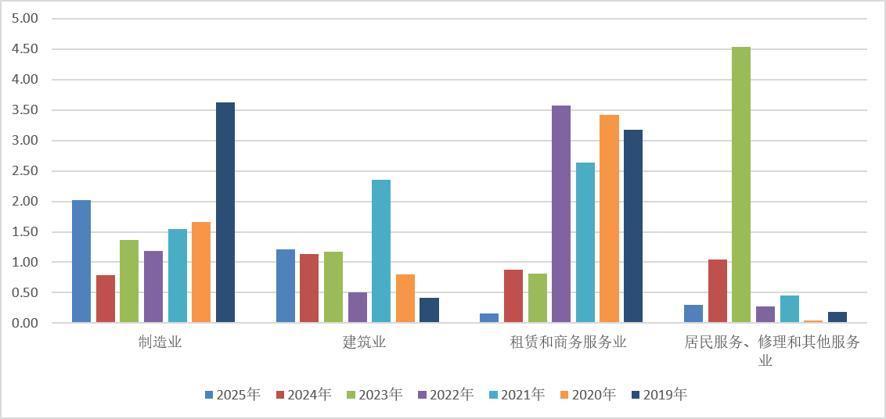
Chart: Industries with high credit placement growth, excluding leasing and business services, all experienced a process of rising NPLs alongside increasing placements.
Since the new management took office in 2021, the bank has successively launched slogans such as "Asset Quality Year," "Compliance Construction Year," and "Efficiency Improvement Year." However, from the actual business arrangement, the revenue structure is single-sided. In the context of continuously narrowing net interest margins, over-reliance on the traditional deposit-loan profit model has become a fatal flaw, while the focus of loan placement shows a trend of rapidly rising NPLs.
04
A Microcosm of the Industry
Guangzhou Rural Commercial Bank is just a microcosm of the operational difficulties faced by regional banks. Bottomed-out interest margins, high NPLs, forced fire sales, and weak transformation capabilities are due not only to the macro environment but also to the loss of control over the bank's own strategy and internal governance.
From the delisting of Shengjing Bank to the consecutive years of losses at Zhengzhou Bank, and then to the performance slowdown of Zijin Bank, every regional bank is experiencing this industry winter in its own way. This is no longer a problem of individual poor management, but a structural cycle that the entire industry must navigate against the backdrop of macroeconomic transition, interest rate marketization, and stricter regulation.
Measuring a bank's value no longer depends on the speed of scale expansion, but on its resilience to traverse cycles. This resilience stems from a healthy balance sheet, differentiated operating capabilities, and a prudent risk culture.
For Guangzhou Rural Commercial Bank, sitting on China's most fertile economic soil in Guangdong, yet delivering a harvest-deficient report card, is more worthy of reflection than any number.
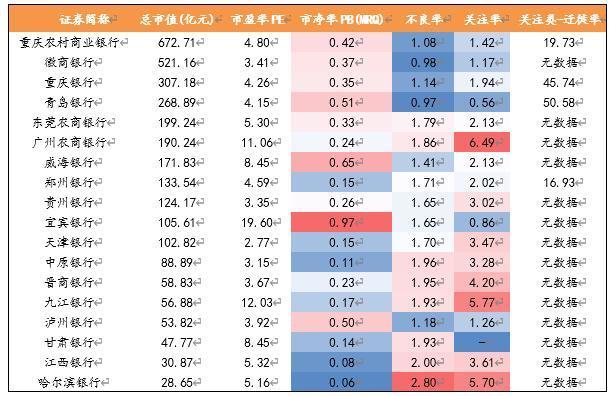
Chart: Peer comparison data
This article is written based on public information and is for information exchange purposes only. It does not constitute any investment advice.
The copyright of this article belongs to the original author/organization.
The views expressed herein are solely those of the author and do not reflect the stance of the platform. The content is intended for investment reference purposes only and shall not be considered as investment advice. Please contact us if you have any questions or suggestions regarding the content services provided by the platform.
