


 SpaceX Option
💢💢💢
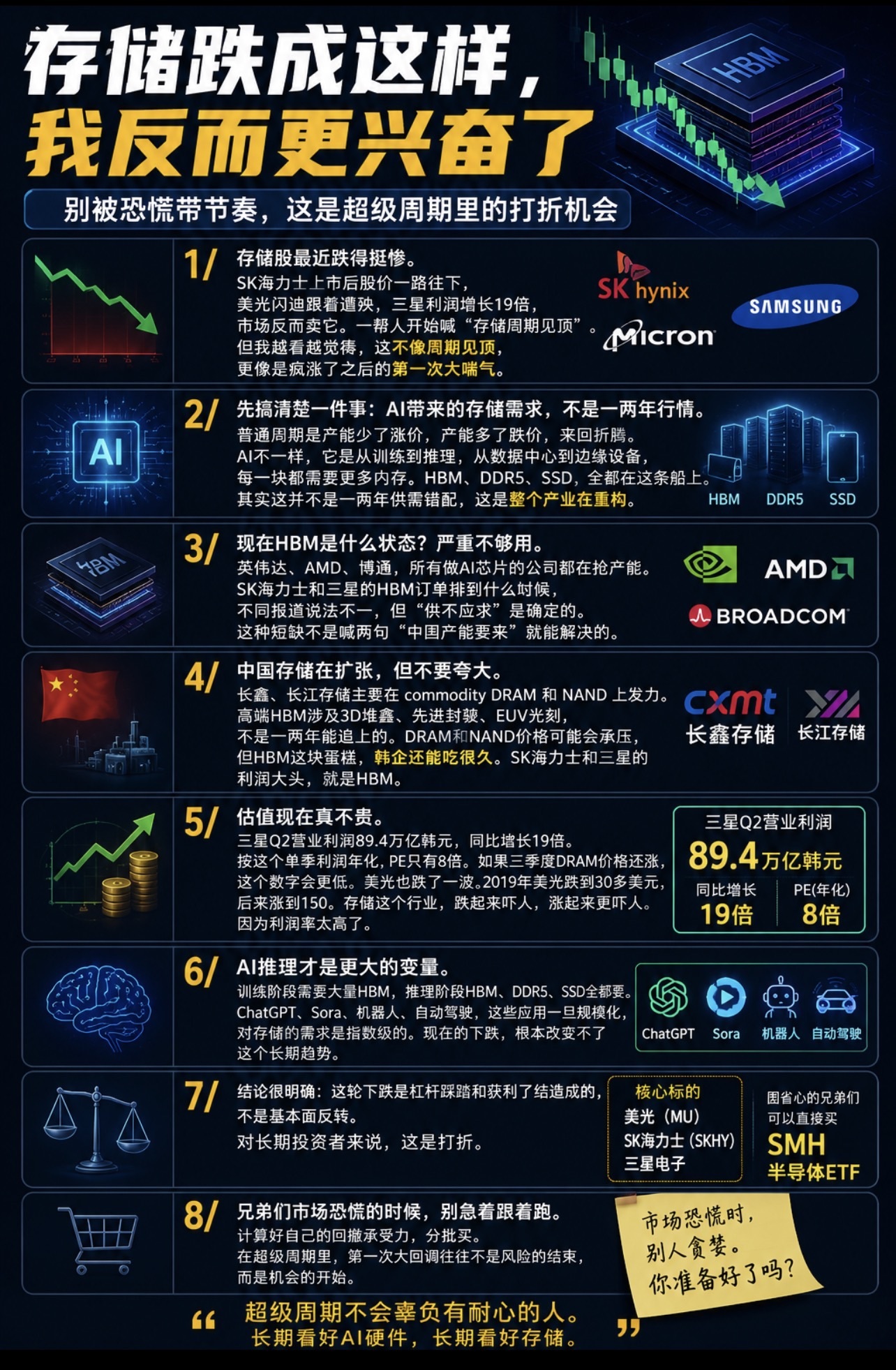
Storage prices have crashed like this, and I'm actually more excited.
1/ Recently, storage stocks have plummeted.
After its IPO, SK Hynix has been sliding back; Micron and SanDisk suffered the fallout; even though Samsung's profits surged significantly, the market still chose to sell off.
So many people started shouting:
The storage cycle has peaked.
But the more I look at it, the less it feels like the end of a cycle, and more like the first deep breath after a continuous surge.
2/ First, let's clarify one thing:
The storage demand driven by AI is not a short-term trend lasting just one or two years.
The traditional storage cycle is simple:
Insufficient capacity — prices rise; Capacity expansion — oversupply; Price drop — industry consolidation.
But the changes brought by AI are different.
From training to inference, from data centers to edge devices, every stage requires more storage.
HBM, DDR5, and enterprise SSDs are all on the same growth chain.
This isn't just a short-term mismatch in supply and demand; the entire computing architecture is being redesigned.
3/ What is the current state of HBM?
The answer remains: not enough.
NVIDIA, AMD, Broadcom, and major cloud providers are all competing for high-end HBM capacity.
Different reports have inconsistent views on order schedules, but one point is undisputed:
High-end HBM is still in short supply.
This shortage cannot be solved simply by adding a few ordinary DRAM production lines.
4/ China's storage industry is indeed expanding rapidly, but we shouldn't exaggerate the catch-up speed infinitely.
CXMT and YMTC are currently mainly expanding their share in traditional DRAM and NAND sectors.
However, high-end HBM requires not only advanced DRAM dies but also a complex set of processes including high-speed interfaces, 3D stacking, advanced packaging, and yield control.
Traditional DRAM and NAND prices may face some pressure in the future, but in the high-end HBM market, Korean manufacturers still hold a clear advantage.
This is also one of the most important sources of profit growth for SK Hynix and Samsung in the future.
5/ More importantly, storage stocks are not expensive in terms of valuation right now.
When profits grow rapidly while stock prices continue to fall, the market is essentially repricing future growth expectations.
But the biggest characteristic of the storage industry is:
Profits drop like a cliff, but rise like a rocket.
In 2019, Micron once fell to over $30, then later rose to over $150.
This industry is highly volatile, but once supply and demand enter a strong cycle, profit elasticity is equally astonishing.
6/ The truly bigger variable might not be AI training, but AI inference.
Training requires massive amounts of HBM, but when AI applications truly begin to scale, inference will not only need HBM but also simultaneously drive demand for DDR5 and enterprise SSDs.
ChatGPT, video generation, AI Agents, robots, autonomous driving...
These applications generate, call, and store far more data daily than traditional internet applications.
Training is a one-time compute investment, whereas inference happens every day, every hour, every second.
Therefore, the storage demand brought by AI inference may be larger and more enduring than the market currently expects.
7/ So my current judgment is:
This round of decline is more like profit-taking, valuation digestion, and leverage fund stampede after excessive gains earlier, rather than a complete reversal of the storage fundamentals.
Of course, having the correct long-term logic doesn't mean the stock price won't continue to fall.
Storage is inherently a high-volatility industry; anyone participating must first calculate their own drawdown tolerance.
Key targets to watch:
Micron $MUSK Hynix Samsung Electronics
If you don't want to bear the volatility of individual stocks, you can also participate in the entire AI hardware cycle through semiconductor ETFs like $SMH.
8/ Bros, when the market panics, don't rush to run with the crowd, and don't go all-in just because you're bullish.
Control your position size, keep cash reserves, and buy in batches.
Because in a super cycle, the first real major pullback is often not the end of the trend.
It's more like the market asking you: When it was rising before, you didn't dare to buy; now it's on sale, do you still dare to trust your own judgment?
The copyright of this article belongs to the original author/organization.
The views expressed herein are solely those of the author and do not reflect the stance of the platform. The content is intended for investment reference purposes only and shall not be considered as investment advice. Please contact us if you have any questions or suggestions regarding the content services provided by the platform.
