


WAIC has concluded. What are the big shots saying? Check out the notes here!
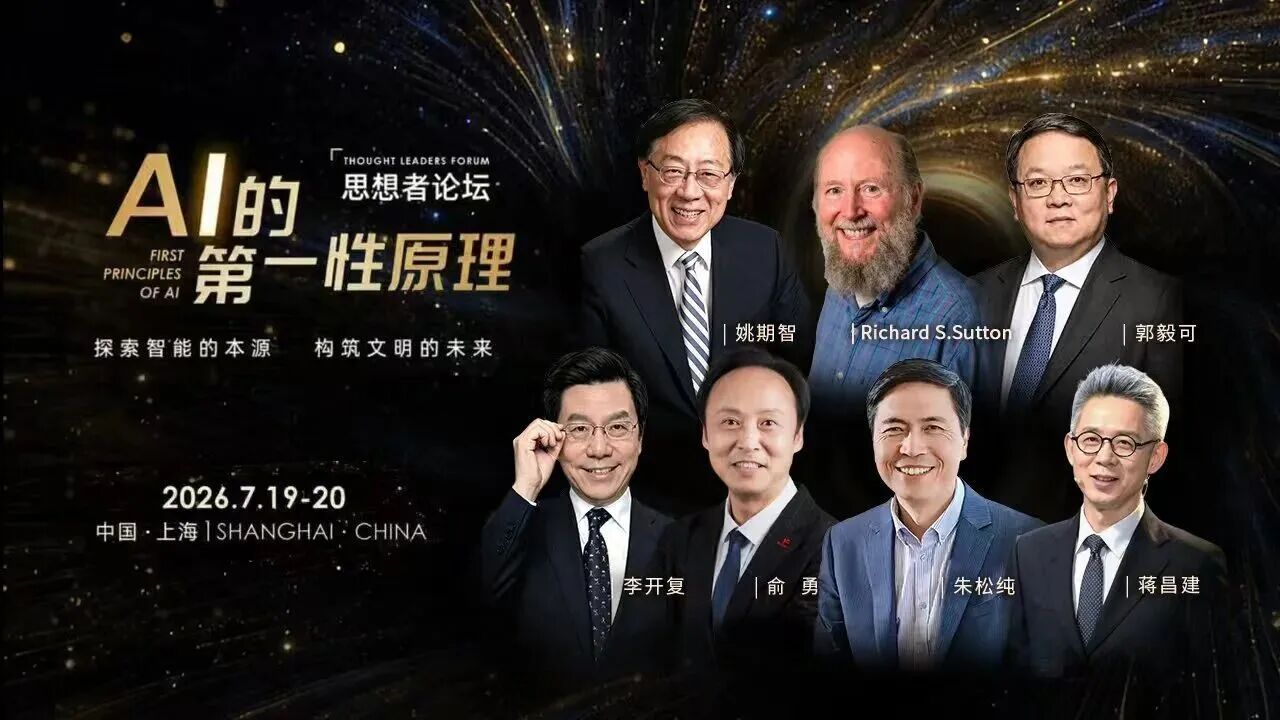
WAIC 2026 has concluded. The speeches by key industry guests are worth reading repeatedly.
01
Yao Qizhi — The Power and Limitations of Artificial Intelligence
Turing Award Laureate
The astonishing power of current AI to change the world essentially stems from a profound shift in computational paradigms. Traditional computer science relies entirely on mathematical analysis and hard-coded algorithms by researchers, whereas modern AI, centered on machine learning, has achieved previously unimaginable breakthroughs through the paradigm of "learning from data."
Faced with the objective laws of mathematics and physics, AI possesses insurmountable rigid boundaries. He cited two typical examples: in the field of information security, traditional public-key encryption systems (such as the ElGamal encryption algorithm), which have a solid foundation of mathematical assumptions, have been proven to resist attacks from any computer system, including AI; at the physical level, "Quantum Key Distribution (QKD)" technology, built using the laws of physics, can in principle completely block any purely computer-driven AI hacking attempts.
From a longer-term perspective, as two "giants" of modern technology, AI and quantum technology are heading towards a historic convergence and mutual empowerment.
Yao Qizhi stated that the first phase is "AI accelerating quantum computing." The biggest bottleneck in quantum computing over the past 40 years has been that qubits are extremely susceptible to external noise interference. Neural networks trained through machine learning and large sample sets have already successfully "learned" how to construct quantum error correction decoders, helping new quantum chips like Google's Willow reduce logic gate error rates below the critical threshold of 1%, laying a key cornerstone for stable and reliable quantum computing.
The next stage of this "binary star convergence" is "quantum computing enhancing AI," and ultimately the emergence of "quantum AI." Yao Qizhi pointed out that when future machine learning no longer runs on traditional Turing machine architectures but uses quantum machines as the foundational computing architecture to directly process and learn quantum data, humanity will gain a brand-new cognitive tool that transcends the limits of existing Turing machines.
02
Zhu Songchun — Reflections on the AI Boom, Intellectual Autonomy, and Future Prospects
President and Professor, Beijing Academy of Artificial General Intelligence
Chapter 1: Reflections on the AI Boom
I. International Narrative: From "Globalization" to "America First"
Global AI competition has long since escalated from a contest of technical capabilities or a game of markets and capital to dimensions of geopolitics and national strategy. Whether a country can build an autonomous and controllable full-stack software and hardware technology system, and fully grasp strategic initiative and narrative power, determines whether it can stand firm and lead the world in the intelligent era.
II. AGI Marketing: A Trio of Silicon Valley, Wall Street, and Washington
The "trio" of Silicon Valley, Wall Street, and Washington is essentially a strategy by the United States to leverage AI to mobilize global resource allocation. Through the grand narrative of the "AGI race" and capital bubbles, the US has successfully siphoned global capital into its local AI industry: from Wall Street to Silicon Valley, from sovereign wealth funds to pension funds, trillions of dollars in continuous funding have poured into US AI infrastructure such as data centers, grid expansion, and advanced chip production capacity. Today, the US adopts an attitude of "tolerance" towards the AI bubble precisely because it sees this point clearly: the bubble will eventually burst, but the infrastructure built during the bubble period and the gathered top global talent will permanently remain in the US, becoming immovable strategic assets.
III. Industrial Bubble: Value Overdraft and Resource Misallocation
The essence of a bubble is the premature and excessive discounting of technological value. Whenever old growth stories hit bottlenecks, capital needs to find new concepts to maintain expectations. The deep essence of a bubble bursting is not simply a return in valuation or the falsification of a technological path, but a systemic collapse of collective faith. Reviewing the rise and fall of four rounds of bubbles, the underlying logic supporting each frenzy was essentially an irrational bet on a certain "faith," and these faiths are being dismantled one by one by reality. We must face the costs of bubbles, including massive financial losses, severe misallocation of talent resources, and society's irrational expectations of technology, and draw lessons from them.
Chapter 2: Intellectual Autonomy: Building Strategic Initiative and Chinese Narratives for AGI
IV. Clarifying the Source: The Essence, Architecture, and Technical Routes of AGI
AGI should possess three basic characteristics: infinite task generalization, autonomous task generation, and value-driven behavior. Specifically, first, it possesses high generality and autonomy, capable of breaking through traditional preset task limitations to achieve autonomous goal generation and dynamic planning; second, it possesses strong embodied perception and generalization capabilities, able to complete multimodal, multi-scenario complex tasks through autonomous learning and flexible transfer in open environments; third, behavioral decisions are driven by values, ensuring that agent behaviors comply with human ethical standards and social norms. The development and breakthrough of AGI mark a historic leap in artificial intelligence from "specialized" to "general," which will inevitably reconstruct the paradigm of scientific and technological development and drive an overall leap in productivity.
V. Social Intelligence: The Next Frontier of Artificial Intelligence
The most profound characteristic of human intelligence lies not in processing language or manipulating objects, but in the fact that we live in a social world constituted by others. We engage in complex social reasoning every day:揣摩 (pondering) others' intentions, understanding subtle social signals, making trade-offs between competition and cooperation, and following or challenging social norms. The social intelligence required for agents to integrate into human society is currently the biggest missing piece in artificial intelligence and also the final barrier to reaching AGI.
VI. Strategic Layout: Deep Integration of Technological and Industrial Innovation
Promoting the deep integration of technological innovation and industrial innovation is an important pathway to developing new quality productive forces. Technological innovation provides high-quality supply for industries, while industrial innovation provides validation scenarios and commercialization soil for technology. The deep integration of general artificial intelligence into the entire process of the real economy will promote an intelligent leap in the allocation of production factors, enhance total factor productivity, and support the construction of a modern industrial system. Whether we can transform original and disruptive technological breakthroughs in the AGI field into real productive forces determines whether we can grasp strategic initiative in global technological and economic development.
VII. Industrial Tracks: Supporting Government, Commercial, and Civilian Use with AGI Platforms
The current misconception in the industry lies in blindly chasing hot topics—metaverse, large models, embodied intelligence—while ignoring real demands and long-term value. True industrial innovation should start from China's actual social structure, industrial foundation, and demographic characteristics, establishing an orderly gradient from basic research to application implementation.
Chapter 3: Future Prospects: Building a Civilization Form of Human-AI Symbiosis
VIII. Centennial Changes: Civilizational Evolution and Social Transformation in the Intelligent Era
The world today is undergoing unprecedented changes in a century. Over the past 100 years, the collision and integration of Eastern and Western civilizations have formed the main line of civilizational evolution. Chinese civilization experienced a "triple negation" and profound transformation in military industry, political systems, and ideological culture during modern history. In the future, our country will gradually achieve the "triple affirmation" of technological and economic self-reliance, Chinese-style modernization, and the rejuvenation of Chinese culture. Over the next 50 years, the main challenge in the evolution of human civilization will be the integration and symbiosis of humans and AI. We must deeply consider how to establish trust and collaboration between humans and AI? How to ensure AI is safe and trustworthy, and respond to the impact it brings to human society and civilization?
IX. How to Live: Exploring Work and Lifestyle in Human-AI Symbiosis
As smart technology drives a significant leap in productivity and social material wealth becomes increasingly abundant, the ultimate goal of the intelligent era is to liberate humanity from these constraints. In an ideal state, work is no longer a means of survival, but a process of experiencing life, realizing oneself, and enriching the spirit; people can break free from the drive of "selfish genes," truly achieving free and comprehensive development in the reconstruction of work and lifestyle, attaining a sound personality.
X. What Makes Us Human: The Pursuit of Life Value and Meaning
The arrival of the intelligent era will liberate people from a large amount of repetitive labor, granting them the freedom to pursue higher values. We should not remain stuck in anxiety about AI replacement, but should actively "establish the mind"—clarify our own value pursuits, expand our dimensional perspectives, and continuously advance towards the limit of immortal value on the coordinates of establishing virtue, merit, and words. This concerns not only personal life meaning, but also the direction and destination of human civilization in the intelligent era.
03
Zhou Zhifeng — Qiming Venture Partners' Top 10 AI Outlooks for 2026
Managing Partner, Qiming Venture Partners
Foundation Models
Outlook 1: In the next 12–24 months, top-tier models will internalize most "external" capabilities, including task planning, tool calling, multi-Agent collaboration, and some Harness engineering capabilities.
Outlook 2: Multimodal models will further evolve towards modeling interactive worlds, becoming a key technical path for AI to gain environmental perception, long-term planning, and large-scale implementation in the physical world.
Embodied Intelligence
Outlook 3: Effective data from leading robotics companies will jump from the "tens of thousands of hours" level in 2025 to the "millions of hours" level in 2027, with human first-person perspective data accounting for the absolute majority.
Outlook 4: Dexterous hands will see accelerated development. Dexterous hands with tactile perception will gradually mature and continue to reduce costs, forming a high-low combination with dual-finger gripper solutions, and gradually penetrating complex operation scenarios on a large scale.
AI Infrastructure
Outlook 5: The focus of AI computing power demand is shifting to inference. Storage, advanced process nodes, and advanced packaging capacities are tightening layer by layer. For the next two years, AI infrastructure will continue to face structural shortages, and computing power asset reserves will be upgraded to the core strategy of AI enterprises.
Outlook 6: AI infrastructure will enter a stage of system-level competition. Competition dimensions cover key links such as chips, interconnects, cooling, and power supply. In the next two years, computing chips and super-node large clusters based on new architectures are expected to emerge to achieve low-cost, high-efficiency Token production.
Outlook 7: Safety and trustworthiness will be listed alongside product effectiveness and Token costs as the three key variables affecting the large-scale implementation of enterprise AI. Safe and trustworthy AI will upgrade from an optional feature to a mandatory requirement.
AI Applications
Outlook 8: In the next 12–24 months, the business models of AI applications will accelerate their departure from the Internet era's Freemium logic, shifting towards pricing based on results and value. The core metric for measuring AI companies will shift from user scale to the commercial value created per unit of intelligent cost.
Outlook 9: In the next 12–24 months, AI application commercialization will focus on vertical scenarios and high-paying users. The efficiency side (save time) will lead the consumer side (kill time) in its initial explosion; accompanied by the continuous decline in Token costs and innovations in interaction paradigms, phenomenal AI consumer applications will gradually emerge.
Outlook 10: In the next 12–24 months, AI-Native organizations will move from concept to empirical evidence. A batch of enterprises will achieve per capita output several times that of traditional organizations.
04
Kevin Kelly — The Indivisible Emotional Connection Between Humans and AI
Technology Prophet
In the next five years, the most critical opportunities and uncertainties for AI are concentrated in three directions: robots, emotion, and agents.
No one truly knows where AI will go. Will AGI appear? Will AI cause mass unemployment? Will intelligence concentrate in the cloud or be distributed across countless small devices? Who will win, open source or closed source? These questions have no definite answers.
The three directions predicted by Kevin Kelly correspond to three main threads:
1. AI moves from the digital world to the physical world. Humanoid robots will be the most complex thing humans have ever made. Apart from humans themselves, they may be the most complex existence on this planet.
2. AI moves from tools to emotional connections. The next most surprising change might be emotion entering AI.
3. From single-point applications to the agent economy. The core issue of the agent economy is trust. Once agents start working for us, new problems will arise: who owns the agent? Who does it truly work for? Is it the company that built it, the user themselves, or other entities? More importantly, trust will become a new technological opportunity. How does my agent trust your agent? How does it identify whether a stranger agent is trustworthy to avoid being deceived?
05
Richard Sutton
Father of Reinforcement Learning
Do not focus too much attention on knowledge humans already possess, but rather focus on methods that can continuously expand and constantly create knowledge.
Today's foundation models can behave like knowledgeable conversationalists, but "knowing what humans have said" and "discovering new things in the world" are fundamentally two different things.
The world is always more complex than any single mind, and the world itself contains countless other minds. Therefore, no matter how many parameters a model has or how much data it has been trained on, it cannot truly encompass the entire world.
Future artificial intelligence will not know a person's life better than they do, nor understand their friends, relationships, and environment better than they do.
Sutton further outlined possible future development directions for artificial intelligence.
The first category consists of specialized systems with clear boundaries, such as autonomous driving cars. They only need to complete tasks in specific scenarios and do not need to possess a complete mind.
The other category is the kind of artificial intelligence Sutton truly hopes to see. Like humans, they possess "complete minds," able to continuously experience, learn, create, think, and even dream throughout their lives, and gradually form their own expertise as they continuously interact with the world.
06
Yin Qi — When Agents Enter the Physical World
Chairman, StepFun; Chairman, Qianli Technology
Whether viewed from the perspective of model technology evolution or industrial development, "agents" have become the most important keyword for the next stage of AI.
Agents will not just be chatbots; they can perceive the external physical world, understand users' deep memories and preferences, make comprehensive decisions and execute, and complete various tasks entrusted by users. Agents are becoming the smallest unit of productivity.
What they bring is not a single-point application opportunity, but three structural changes: new systems, new carriers, and new networks.
First, the new system.
Agent Capability = Model Capability × Agent Operating System Capability.
If the model determines how far the agent can "think," then the Agentic OS determines how far the agent can "go"—it connects models with data, tools, interfaces, and devices, allowing agents not only to understand the world but also to take action.
This is the agent-native operating system, which will become an important infrastructure for future human-computer interaction and industrial ecosystems.
Second, the new carrier.
The design logic of terminals is changing: in the past, machines were designed around human operation methods; in the future, terminals will be redefined around the collaboration methods between humans and intelligence. And in the future, these terminals will not exist in isolation. Computers, phones, cars, and robots will become different bodies of the same agent in different scenarios. Intelligence can exist continuously across multiple terminals, migrate freely, and collaborate to complete tasks.
Future terminal competition is no longer just about devices, but about who can enable agents to better perceive the environment and take action, truly entering the physical world.
Third, the new network.
In the Internet era, what was connected were people, information, and services; in the agent era, we will connect agents that can understand goals, dispatch resources, and collaborate. This is the A2A network.
In the future, billions of people, tens of billions of devices, and agents could all become nodes within it, forming a new type of network with larger scale and higher collaboration efficiency. For entrepreneurs, this means new industrial opportunities: agents will have their own identities and credit. People can find them, understand what they are good at, entrust tasks to them, pay for their performance, evaluate them, and cooperate with them.
When agents can autonomously seek partners, organize collaboration, and complete transactions, A2A will no longer just be a technical protocol, but will become the infrastructure of the agent economy.
When agents begin to act on behalf of humans, we must answer three questions: Who can they act on behalf of? Actions produce consequences, who is responsible? When they connect data, devices, and the real environment, how do we ensure identity trustworthiness, controllable permissions, and traceable behavior?
07
Su Hao — Physical Intelligence: From Hallucination to Reality
Co-founder, Chairman, and CTO, Sudo Technology
The hallucination of large models largely stems from lacking a "body."
What we need is a model capable of aggregating all human knowledge of the physical world. Counting from the source of cognition, physical knowledge has at least six levels of stairs, building foundations layer by layer.
The lower three levels belong to the objective world—whether there is an "I" or not, it is still there.
One is knowledge about objects: The world is composed of independent, persistent objects—a ball rolls under the sofa, you can't see it, but it's still there. First recognize "what exists," and only then can you talk about the rest.
Two is knowledge about states: What do these things look like right now? Where the ball is under the sofa, its weight, whether it is soft or hard, all belong to this level.
Three is knowledge about dynamics: How does the world change on its own? Balls roll, water flows, released objects fall down. And "force" is at this level—you cannot see it with your eyes.
The upper three levels arise because of the "I"—each level is the appearance of the lower three levels bound to a "subject."
Four is knowledge about function: What use is this thing to me? Handles are for gripping, cups are for holding. The same chair is "sit-able" for humans, but not for ants. Objects become "vessels" only because of the subject.
Five is knowledge about goals: What do I want the world to become? The ball is under the sofa; I want it back in my hand. Where the ball is, is the state; where I want it to be, is the goal. The difference between "is" and "should be" in the goal state is just one character, yet it spans the entire subject.
Six is knowledge about behavior: Knowing what to do and actually being able to do it with your hands are two different things—carrying a cup of water across the room without spilling requires finesse; tying shoelaces and using chopsticks require skill. These abilities are not written in books; they grow in the hands.
Three Judgments
First, the breakthrough for physical intelligence lies not in the model's architecture, but in the aggregation of knowledge.
Second, the industry's focus will shift from "how stunning the demonstrations are" to "how reliable the operation is."
Third, physical intelligence will turn AI from a "reader" of science into a "creator" of knowledge.
The copyright of this article belongs to the original author/organization.
The views expressed herein are solely those of the author and do not reflect the stance of the platform. The content is intended for investment reference purposes only and shall not be considered as investment advice. Please contact us if you have any questions or suggestions regarding the content services provided by the platform.
