



Investment Guide Amidst Gold's Wild Swings: How to Distinguish Noise from Trends and Grasp the Core Logic?

Investment Guide Amid Gold's Wild Swings: How to Distinguish Noise from Trend and Grasp the Core Logic?
Recently, the gold market has experienced severe volatility, with the London spot gold price hitting a high of 5598.75 USD/oz and a low of 4402.06 USD/oz. After reaching a record high, it quickly corrected, leaving many investors confused by the alternating rise and fall: Is this volatility a short-term fluctuation or a signal of a trend reversal? What key driving factors lie behind it? This article will systematically analyze the core logic of gold's volatility from multiple perspectives including market dynamics, policy expectations, and capital flows, providing a reference for rational judgment by investors.
I. Panorama of Market Volatility: From Record High to Sharp Correction
On January 30, 2026, international gold prices plunged sharply after hitting a record high. London spot gold closed down 9.25% for the day, with an intraday maximum drop of nearly 13%, touching a low of 4670.36 USD/oz. In the previous month, gold prices had accumulated gains of over 28%, making this crash a focal point for global financial markets.
On February 2, gold prices continued to fall by -4.52%, reaching a low of 4402.06 USD/oz. Meanwhile, the US Dollar Index rebounded for two consecutive days to 97.47, firmly holding above the key support level of the 97 mark, reflecting the market's repricing of Fed policy expectations—after the nomination of the new chair candidate, expectations for aggressive interest rate cuts cooled, driving a short-term strengthening of the dollar.
II. Analysis of Short-Term Volatility: A Phased Adjustment Amid Multiple Resonating Factors
Recent gold price fluctuations have been interpreted differently by the market: some view it as a technical correction after a rapid rise, while others warn of potential changes in fundamentals. Investors should note that the supportive factors often mentioned by the market are not absolute; gold prices are still influenced by multiple variables, requiring careful risk assessment.
Specifically, short-term fluctuations are mainly driven by two factors:
- Adjustment of Macro Policy Expectations As discussions about the new Fed chair candidate intensify, market expectations for a more cautious monetary policy stance have strengthened, pushing up real interest rate expectations and strengthening the dollar, putting pressure on the non-yielding asset gold. Furthermore, the Fed's decision to keep rates unchanged without a preset clear path has also led to a revision of expectations for rapid easing, exacerbating the divergence between bulls and bears.
- Market Trading Structure Amplifies Volatility The rapid price rise in the earlier period accumulated a large number of profitable positions. Against the backdrop of tightening regulatory and risk constraints, some capital chose to take profits. Combined with technical selling pressure triggered by algorithmic trading, this has collectively intensified short-term price volatility.
III. Long-Term Support Logic: Structural Allocation Value Remains Solid
From a long-term perspective, the pricing logic of gold is undergoing a structural shift—from primarily tracking real interest rates in the past to more comprehensively reflecting the credit status of the US dollar and global risk premiums. This shift forms an important support for its long-term allocation value.
Core support comes from the long-term trend of global reserve asset diversification. Amid the ongoing evolution of geopolitical and economic landscapes, central banks worldwide, based on considerations of optimizing reserve structures and reducing reliance on a single currency, continue to increase their gold holdings. This long-term, stable gold-buying behavior provides structural demand for the market and also highlights gold's unique role in the official reserve system.
However, investors must note: central bank gold-buying strategies may adjust with the environment, and their demand support does not mean gold has an absolute "bottom" or can completely avoid volatility. Gold prices are still influenced by multiple factors such as interest rates, dollar movements, and market risk appetite, and may experience significant fluctuations.
Additionally, uncertainty in the global macroeconomic environment has also strengthened gold's safe-haven value. With insufficient momentum for global economic growth and various potential risks becoming prominent, gold, as an asset not dependent on any entity's solvency, is increasingly recognized by investors for its function of hedging macroeconomic uncertainty and diversifying portfolio risk.
Taking the People's Bank of China as an example, its gold reserves have achieved 14 consecutive months of increases, becoming a microcosm of the global central bank gold-buying wave. This round of increases began in November 2024, with gold reserves reaching 74.15 million ounces by the end of 2025. During this period, the central bank adopted a "low-volume, frequent" strategy, steadily adding to its holdings against the backdrop of repeatedly hitting new highs in international gold prices, both controlling purchase costs and sending a clear signal of continuously optimizing its reserve structure.
IV. Investment Implications: Distinguish Noise from Trend, Allocate Rationally
In the current high-volatility environment, distinguishing between short-term price changes and long-term logic is crucial:
- Short-term volatility is often influenced by factors such as policy expectations, capital flows, and technical aspects, representing a manifestation of the market's phased rebalancing.
- Long-term value is based on gold's inflation-hedging and safe-haven attributes, as well as its strategic role in global reserve diversification, giving it a risk-diversifying function in asset allocation.
Some investors participate in the gold market through financial instruments such as gold mining ETFs. These ETFs primarily invest in a basket of gold mining company stocks, providing a convenient way to gain exposure to the gold industry. As mining company profits are more sensitive to gold price changes, the volatility of such ETFs is typically greater than that of physical gold, amplifying profit potential while also bearing higher risk.
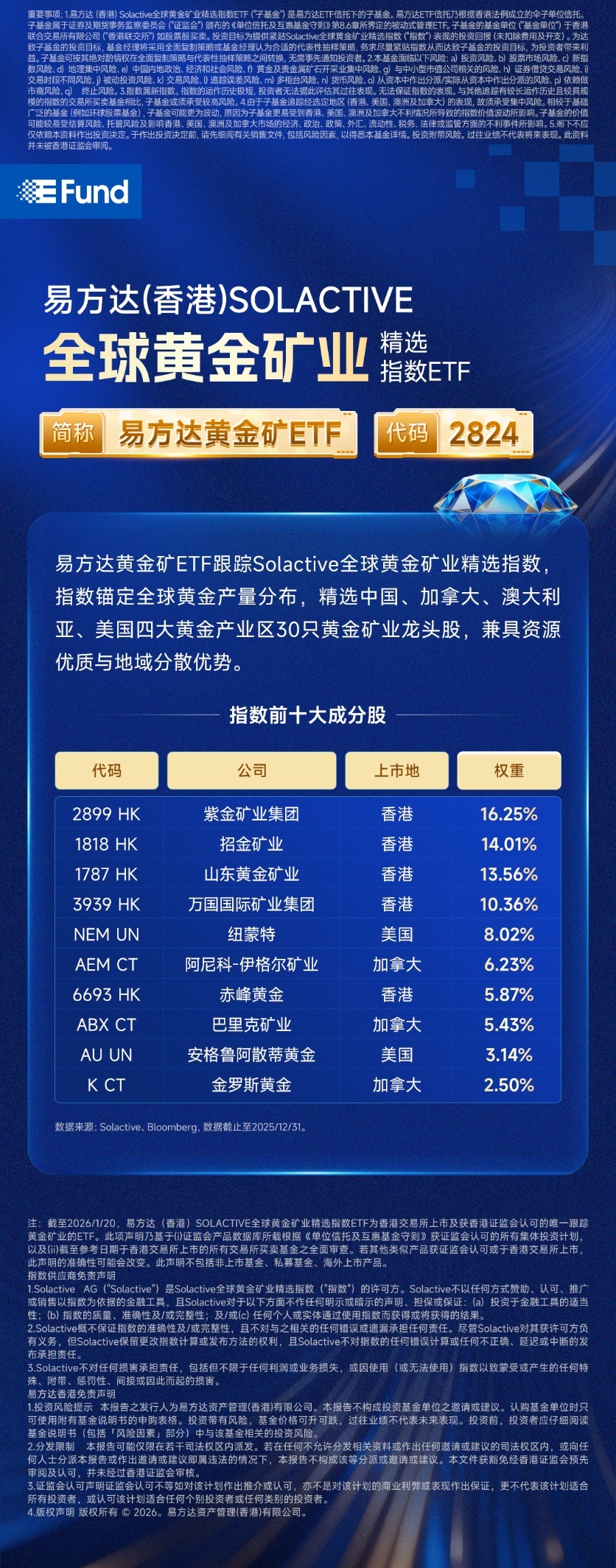
E Fund Hong Kong Disclaimer
Investment Risk Warning The issuer of this report is E Fund Asset Management (Hong Kong) Limited. This report does not constitute an invitation or recommendation to invest in fund units. Subscription for fund units must be made using the application form accompanied by the fund prospectus. Investment involves risks. Fund prices may rise or fall, and past performance is not indicative of future results. Before investing, investors should read carefully the investment risks related to the fund in the fund prospectus (including the "Risk Factors" section).
Distribution Restrictions This report may only be distributed in certain jurisdictions. This report does not constitute such distribution or invitation or recommendation in any jurisdiction where distribution of such materials or making any invitation or recommendation is not permitted, or where distribution of this report or making any invitation or recommendation would be unlawful. This document is exempt from pre-vetting and authorization by the Hong Kong Securities and Futures Commission and has not been reviewed by the Hong Kong Securities and Futures Commission.
SFC Authorization Statement SFC authorization does not imply a recommendation or endorsement of the scheme, nor does it guarantee the commercial merits or performance of the scheme, nor does it mean the scheme is suitable for all investors, or that the scheme is suitable for any individual investor or any class of investors.
Copyright Statement Copyright ©️ 2026. E Fund Asset Management (Hong Kong) Limited.
The copyright of this article belongs to the original author/organization.
The views expressed herein are solely those of the author and do not reflect the stance of the platform. The content is intended for investment reference purposes only and shall not be considered as investment advice. Please contact us if you have any questions or suggestions regarding the content services provided by the platform.
