



Swire: The Decency and Troubles of Old Money
In August 2026, just like in the past century, the sea breeze of Victoria Harbour is still wrapped with the heat of capital flows, but for $SWIRE PACIFIC A(00019.HK), this British trading house over two hundred years old, the wind direction has changed somewhat.
In the history of East Asian commerce over the past century or so, countless trading houses have come and gone like the tide. Jardine Mathison has retreated to Bermuda, while Hutchison Whampoa and Wheelock & Co. have successively fallen into Chinese capital hands. Among the four major British trading houses that once dominated Hong Kong, only $SWIRE PACIFIC B(00087.HK) remains active on the capital markets by Victoria Harbour with its family background. It does not engage in radical capital games or 狂热 scale expansion, yet it has navigated complex political and economic turmoil, geopolitical shifts, and economic cycles.
But longevity does not equal perfection. This old-line family conglomerate from Liverpool has avoided several devastating crises through strong risk restraint and asset iteration capabilities; on the other hand, its ingrained cultural inertia, conservative decision-making, and strategic wavering have repeatedly caused it to miss windows of opportunity, even paying a heavy price in public opinion and commercial 博弈. What exactly allows an integrated enterprise bearing the imprint of the old era to survive cycles, and in what posture should it welcome the new era?
The Survival Paradox Amidst the Great Filter of Times
In 1816, John Swire founded a small import-export trading house in Liverpool, UK, which marked the starting point of the Swire Group. In 1866, his son John established a new trading house in Shanghai, naming it "Swire" (Taigu) – reportedly inspired by the "Great Luck" couplet on Chinese doors, coming from a phonetic translation or typo, later endowed with the meaning of "grand and eternal," and formally entering the Chinese trade map. The Far East trade at that time was an arena for numerous British trading houses, with tea, silk, shipping, docks, and insurance forming the basic portfolio of early British trading houses.
Among the four major British trading houses, Swire was actually a latecomer. Jardine Mathison had taken root in China earlier with deep foundations; Wheelock & Co. and Hutchison Whampoa expanded rapidly, making large-scale layouts in shipping and real estate. From the 1970s to the 1980s, the Hong Kong capital market ushered in a magnificent wave of Chinese capital acquisitions. Pao Yue-kong besieged Wharf Holdings, subsequently taking over Wheelock & Co.; Li Ka-shing acquired Hutchison Whampoa; to avoid risks, Jardine Mathison relocated its registration to Bermuda, continuously shrinking its core assets, and the once-commercial empire gradually lost its former edge.
Three old-line trading houses have successively ended their chapters, but Swire alone was not acquired by capital, remaining under the top-level control of the Swire family. The market often simply attributes Swire's survival to luck, but opening up its development history, the divergence in fate created by its business philosophy indeed has traces to follow.
The decline of other trading houses often cannot escape two types of destiny: one is being addicted to short-term leverage 狂欢, making large bets on single-cycle industries, where debt crushes enterprises after the shipping bubble bursts; the other is facing changes in the times, wavering in mindset, either frantically selling off core assets and fleeing in panic, or blindly crossing boundaries to invest randomly, exhausting the commercial foundation accumulated over a century.
Swire walked a different path: accumulating initial capital through Yangtze River shipping and sugar industry in the early stage. When the Quarry Bay shipyard and sugar refinery declined with urban iteration, instead of sticking to old tracks, it turned the large industrial land freed up into long-term holding commercial real estate – Swire Properties business was thus passively born, precipitating industrial land into an asset package that generates continuous rent. Similarly, after the decline of the main shipping business, instead of hard resistance against industry downturn, it incubated and laid out aviation, beverage franchising, and aircraft maintenance, reshaping the old-era trading house into a cross-industry integrated enterprise group.
The integrated enterprise model itself has been criticized in global capital markets; diversification easily leads to business dispersion and management redundancy. But Swire's diversification has clear boundaries: it rarely touches pure financial speculation, does not chase hot spots, and pursues tangible cash flow for every core business, preferring heavy-asset, long-cycle, franchise-barrier tracks such as real estate holding for rent, aviation hub supporting maintenance, Coca-Cola bottling franchise rights, etc., all possessing strong cash flow attributes.
Family governance is another layer of its moat. The Swire family maintains control over the group's top level; the UK-based Swire Group controlled by the family holds 74.83% voting rights in Swire, but sets up a professional manager system and family inheritance mutual check. There are strict threshold return rate constraints within the group; any project must pass capital return calculation, refusing blind money-burning expansion, implementing the cautious financial management style of old money. Management believes in slow money logic, can accept projects not profitable for a long time, but will not accept bottomless risk exposure. It is precisely this caution that allowed it to dodge macroeconomic crises multiple times.
But survivors do not equal winners. Swire's cycle-crossing has never been "invincible," but constantly stepping into pits, correcting errors, and holding onto the base amidst huge era uncertainty.
What Swire Did Right: Three Firewalls Withstand Century Shocks
Reviewing Swire's two-hundred-plus year commercial journey, surviving crises multiple times may be supported by the following three layers of underlying capabilities: dynamic asset iteration, a strong operating cash flow base, and a risk-averse decision-making culture.
1) Proactively or passively completing asset iteration, transforming obsolete assets into the next generation growth engine.
Swire started relying on the Far East agency business of Blue Funnel Line, with shipping being the foundation, followed closely by sugar. As Hong Kong's urban industrialization advanced, shipyards and sugar refineries no longer possessed industrial value, and large tracts of industrial land became the biggest hidden wealth. Swire did not choose to sell off land for cash in one go, but shifted to holding-type commercial real estate; Swire Plaza was the pioneering work, establishing the model of long-term holding of core commercial district properties and stable rent collection.
This logic extends to the mainland market. Sanlitun Taikoo Li, Guangzhou Taikoo Hui, and Chengdu MixC are not simple copies of Hong Kong shopping center models, but combine urban culture to create block-style commerce, transforming land assets into high-quality properties that continuously generate rental cash flow. Even with the ups and downs of the real estate industry, these core location properties can still contribute stable cash returns.
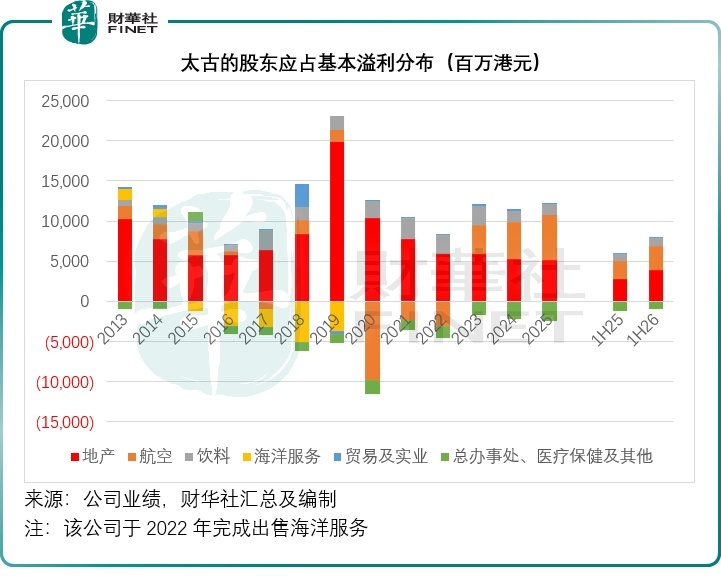
See the figure below, the real estate sector is its most core profit source; even in 2019 during social unrest and the three years of the pandemic, the real estate business propped up its overall profit level.
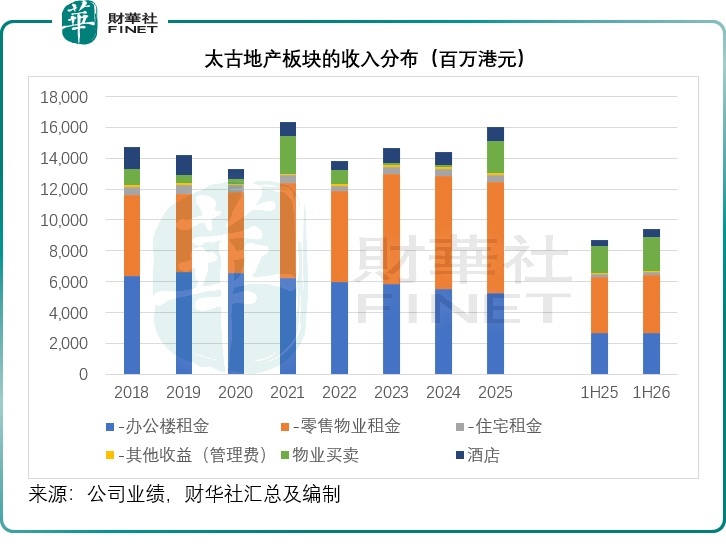
In the real estate sector, due to holding a combination of high-quality office buildings and retail properties, even during social turmoil and the pandemic, Swire could still maintain stable rental income. See the figure below, office building rents and retail property rents remained roughly stable, accounting for the majority of Swire Properties' revenue.
Besides this real estate base, Swire's layout in other sectors also focuses on the rigidity of business needs; the aviation sector is the same. Acquiring equity in $CATHAY PAC AIR(00293.HK), laying out Hong Kong Aircraft Engineering Company (HAECO) aircraft maintenance business, is not just about passenger aviation, but constructing an upstream and downstream asset matrix for aviation. Passenger aviation has strong cyclical fluctuations, but aircraft maintenance is a rigid service industry, capable of hedging the huge ups and downs of passenger business.
Obtaining the Coca-Cola (KO.US) bottling franchise right for the beverage sector, deeply cultivating the Chinese mainland and Southeast Asian markets, the fast-moving consumer goods beverage business has extremely strong anti-cyclical attributes, becoming the group's cash cow, coinciding with Buffett's investment philosophy.
Swire's transformation has a significant feature: it does not create entirely new tracks out of thin air, mostly relying on existing geopolitical resources and local operational capabilities to find new growth points from stock assets. Not blindly chasing windfalls, but revitalizing existing chips in hand.
2) Extreme emphasis on operating cash flow, refusing high-leverage bets on cycles.
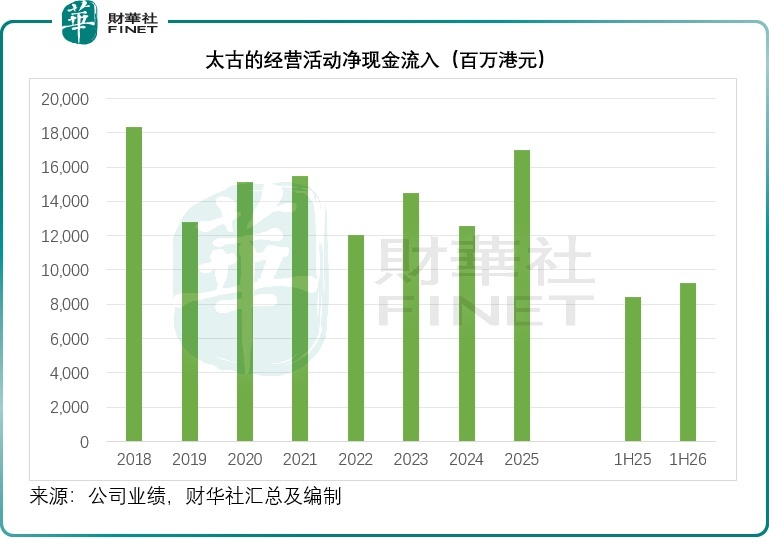
Compared to many contemporary conglomerates, Swire's balance sheet has long maintained restraint. It also expands and makes large capital expenditures, but always treats operating cash flow as a safety cushion. The first half of 2026 financial report shows that the group's net cash inflow from operations was HK$9.217 billion, and pre-financing net cash inflow was HK$8.899 billion, maintaining healthy cash-generating ability despite volatile macroeconomic environments.
See the figure below, even in the troubled year of 2019 and the three years of the pandemic, Swire could still maintain annual operating net cash inflows exceeding ten billion.
The real estate sector best embodies this logic. $SWIREPROPERTIES(01972.HK) is based on holding properties for rent; although it also does some residential sales to obtain one-time profits, it does not learn the high-leverage, high-turnover building-selling model of mainland real estate developers. Even during the housing market upcycle, it restrained large-scale leveraged land acquisition. This model sacrifices scale expansion speed, but avoids the devastating blow of debt explosions during market downturns.
Swire announced a HK$100 billion investment plan in 2022, investing in property development and residential sales projects in Hong Kong (HK$30 billion), the mainland (HK$50 billion), and Southeast Asia (HK$20 billion) over the next decade. By the end of July 2026, approximately HK$69 billion had been deployed. However, we see that it maintained positive cumulative free cash net inflow for the three and a half years since 2022. According to our estimates, from 2022 to the first half of 2026, Swire's cumulative net cash inflow from operating activities reached HK$65.339 billion, while pre-financing cash inflow amounted to HK$31.803 billion, reflecting that its operating net cash activity mainly driven by property rents is sufficient to support these investments.
3) Pragmatic flexibility in geopolitics, flexibly adjusting regional layouts.
From the rise of post-war Hong Kong to returning to the mainland market after reform and opening up, Swire has always maintained a pragmatic business posture. It clearly understands the unpredictability of the geopolitical environment and does not bet everything on a single market. Using Hong Kong as its headquarters, it simultaneously makes large-scale layouts in mainland core cities and continues to increase stakes in Southeast Asia. Swire Coca-Cola has recently accelerated Southeast Asian expansion – completing the acquisition of bottling businesses in Thailand and Laos in 2024, further expanding coverage of the Southeast Asian service population; meanwhile landing smart green bases in Kunshan and Guangzhou in the mainland, with new factories in Hainan under continuous construction; HAECO has laid out a new maintenance joint venture project in Vietnam, and the Xiamen Xiang'an new hangar has been put into production, extending aviation maintenance business outward, forming a regional risk diversification pattern.
The above three characteristics may build the confidence for Swire to cross cycles. But this conservative system also comes with huge side effects.
The Cost of Conservatism: Cultural Shackles and Strategic Lag
Caution achieved Swire's century-old foundation, but also made it appear sluggish and miss opportunities in multiple industrial transformations. More seriously, when facing potential crises, Swire often lacks the decisiveness to cut off flesh to save the body, causing originally controllable risks to evolve into spreading crises.
1) Long-term lag in mainland market strategic rhythm, missing the golden development window.
Management itself has admitted that Swire Properties missed the golden age of low-cost land acquisition in the mainland. Entering the mainland market was not late, but project implementation speed was extremely slow. Cooperation for Guangzhou Taikoo Hui started very early, but took a long cycle to open; demolition and approval for the Shanghai Dazhongli project consumed a lot of time; Sanlitun opening was delayed, encountering obstacles in early recruitment; Chengdu MixC also experienced difficulties such as equity adjustment and extended development cycles.
The root cause lies in two aspects: first, the rigid processes of old-line British enterprises, with long decision-making chains; the family and headquarters far overseas have a time lag in understanding the mainland market, adapting slowly to local cooperation models and policy rhythms; second,骨子里 risk preference is too low, daring not to make decisive bets in the rapidly changing mainland market. Overly pursuing meticulous craftsmanship and extreme quality comes at the cost of expansion speed falling far behind peers.
Although almost every landed project of Swire has become a city benchmark with excellent rental return performance, the number of projects is scarce, and market share is limited. Only with the recent opening of Qiantan Taikoo Li and the promotion of planning for Xi'an and Wuhan projects has it gradually sped up, but it may have also missed the window period of rapid industry expansion.
2) Historical baggage of the aviation sector, organizational cultural 顽疾 repeatedly igniting public opinion crises.
Cathay Pacific is one of Swire's most important assets and also a frequent "risk point" triggering public opinion. The aviation industry itself is strongly cyclical; Cathay suffered heavy losses during the pandemic, enduring the crisis with difficulty relying on shareholder 输血. Although Cathay's performance significantly recovered in the first half of 2026, contributing considerable non-recurring income and overall profits to the Swire Group, the fragility of the business has not disappeared.
More tricky than financial fluctuations are the legacy problems of internal corporate culture. As an airline with an old-line British background, the historically formed language system, promotion culture, and employee values have triggered public controversies multiple times. The outbreak of public events is not just an individual problem of 个别 employees, but a concentrated exposure of the enterprise's long-term internal governance and lagging cultural transformation, severely affecting the brands of both Cathay and the Swire Group.
3) Multiple occurrences of ineffective investments in diversified businesses, insufficient decisiveness in disposing of non-core businesses.
Historically, Swire's marine development business encountered a downturn in the oil and gas industry, resulting in large asset impairments; the retail business of the trade and industry sector fluctuated multiple times, with weak profitability in some 细分 businesses. Integrated enterprises naturally tend to have "business tails," with 大量 non-core small businesses continuously consuming management resources. Swire's conservative culture, on one hand, avoids 疯狂 gambling, but on the other hand, it also 容易出现 issues with insufficient decisiveness in disposing of assets. Some inefficient businesses, due to historical emotions and internal group interests, have not been thoroughly cleared for a long time, continuously eroding overall resources.
Serious Challenges of the New Century: Old Order Meets New Reality
Consumption structures are reshaping, regional and industrial maps are migrating, and old business paradigms are being replaced by new rules. This century-old trading house stands at the starting point of a generation, possibly facing new challenges.
1) The real estate sector may show a growth ceiling.
In the Hong Kong office market, rents remain in a recovery channel, with renewal rent declines narrowing, but overall supply pressure exists long-term. In the first half of 2026, Swire Properties' Hong Kong office rental income was roughly flat at HK$2.449 billion; occupancy rates for Swire Tower offices rose to 98%, overall Tai Koo Tseng occupancy rose to 90%, and Tai Koo Tseng Phase II occupancy reached 80% for the first time. In Hong Kong retail, core malls like Swire Plaza maintained 100% occupancy, with Hong Kong retail rental income increasing by 2% year-on-year to HK$1.196 billion. Against the backdrop of Hong Kong residents developing the habit of traveling north for consumption, this performance is acceptable, but the Hong Kong market space has already peaked, and growth can only be hoped for from the landing of mainland projects.
However, the mainland commercial real estate track is no longer what it used to be. New generations of local commercial operators are rising rapidly, consumption trends are iterating faster, and competition in national trends, new retail, and experiential commerce is heating up. In the past, Swire formed barriers 凭借 international aesthetics and strong brand recruitment capabilities; now local rivals have caught up quickly. Swire's projects remain excellent, but the gap with competitors is narrowing. Meanwhile, mainland land acquisition costs and construction costs continue to rise, with huge capital expenditures for new projects and extended return periods.
Furthermore, residential sales can contribute 阶段性 profits but cannot serve as a long-term sustainable growth source.
2) Uncertainty in aviation business has not been eliminated.
Geopolitical conflicts, oil price volatility, and fierce competition among regional airlines continue to squeeze the aviation industry's profit margins. Cathay Pacific has achieved consecutive profitability, but competition in the Asia-Pacific aviation market is becoming increasingly fierce, with mainland and Southeast Asian airlines continuously 抢占 market shares. HAECO, the maintenance business, has increased investments in Vietnam and the mainland, opening new growth points, but global aviation maintenance track competition is also intensifying. Once again encountering external shocks, the aviation sector could become the group's biggest drag on performance.
3) Involution in beverage business.
Swire Coca-Cola possesses a massive franchise territory, adding new factories in Kunshan, Guangzhou, and Hainan in the mainland, while expanding the Southeast Asian market. However, competition in the beverage industry is white-hot, local beverage brands are rising, and consumption habits are changing, with traditional carbonated beverage growth potentially slowing down. Swire Coca-Cola needs to continuously invest in new products and new capacity, increasing capital expenditure pressure, while profit margins face squeezing, challenging the future growth space of this traditional cash cow.
4) The family integrated enterprise model is undergoing continuous questioning by the capital market.
The general trend in global capital markets is encouraging specialized companies focused on business lines, with integrated enterprises generally suffering valuation discounts. The Swire family controls the company, ensuring long-term strategic stability, but it also brings market concerns: will management prioritize the long-term survival of the family rather than short-term shareholder returns? How to balance the family's long-term perspective with the demands of secondary market investors is an unavoidable proposition.
5) Cultural and public opinion risks of cross-regional operations.
As a British-background enterprise rooted in Greater China, Swire must continuously face scrutiny from local social public opinion. Both the real estate and aviation core sectors directly face C-end consumers; any public crisis can quickly evolve into a brand crisis. Enterprises need to complete deeper localization, not just investing in building factories, but a comprehensive iteration of organizational culture, value stance, and public communication systems. Past lessons have proven that no matter how good the commercial performance is, shortcomings in cultural governance can bring huge brand losses.
Of course, not everything is negative news. Swire still holds cards that other enterprises cannot easily replicate: irreplaceable high-quality real estate assets in core cities of Hong Kong and the mainland; Coca-Cola's massive bottling network; HAECO's aviation maintenance barrier; robust cash flow and healthy debt levels; and the cross-regional commercial experience accumulated by the Swire family over two centuries. It has enough resources to cope with challenges, but the test lies in whether it can break free from the inertia of its own organization and let go of the path dependence of the old era.
Epilogue
The Hong Kong stock market has never lacked enterprises chasing windfalls; soaring to the sky when the wave comes, vanishing without a trace when the cycle recedes; but a sample like Swire, having completely walked through two centuries, witnessing several rounds of great power and commercial landscape changes, is precious. Understanding Swire's successes and failures is essentially understanding the eternal proposition of the capital market: how to balance risk and expansion, how to handle historical baggage and era changes, and how to find balance between long-term family survival and public shareholder interests.
The capital market needs more enterprises with the ability to cross cycles, and also needs an objective and fair evaluation system, seeing both the enterprise's hard strength to weather storms and not avoiding its historical shortcomings and realistic challenges. The upcoming 13th Hong Kong Stock Market Top 100 Selection, precisely uses multi-dimensional, objective standards to examine various participants in the Hong Kong stock market, not only chasing short-term performance explosions but also deeply examining long-term operational quality, risk management capabilities, industrial value, and sustainable development strength. Whether it is a century-old integrated enterprise or emerging growth forces, they will all undergo market testing under the same fair evaluation system, helping domestic and foreign investors dig out Hong Kong stock value targets that can truly withstand the test of cycles.
Author: Shi Yidian
The copyright of this article belongs to the original author/organization.
The views expressed herein are solely those of the author and do not reflect the stance of the platform. The content is intended for investment reference purposes only and shall not be considered as investment advice. Please contact us if you have any questions or suggestions regarding the content services provided by the platform.
