


 Likes Received
 Posts
PostsSelling puts at the current market price, but the strike price is 108.90
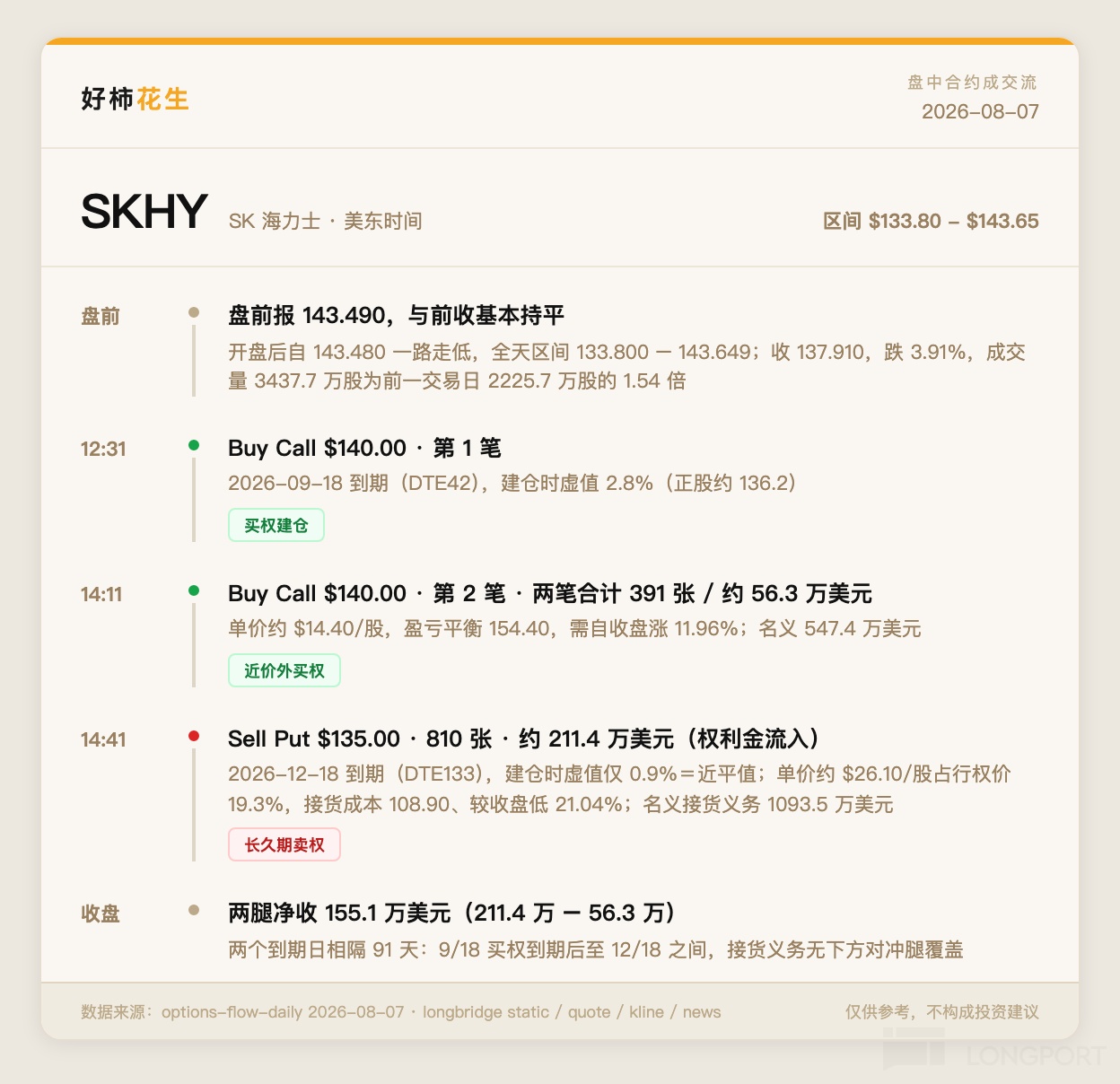
On the same afternoon, two contracts appeared on SK Hynix's order book: one expiring in 42 days and another in 133 days. The bought contract bets on a rise, while the sold contract only requires that it doesn't fall too sharply. There is a 91-day gap between the two.
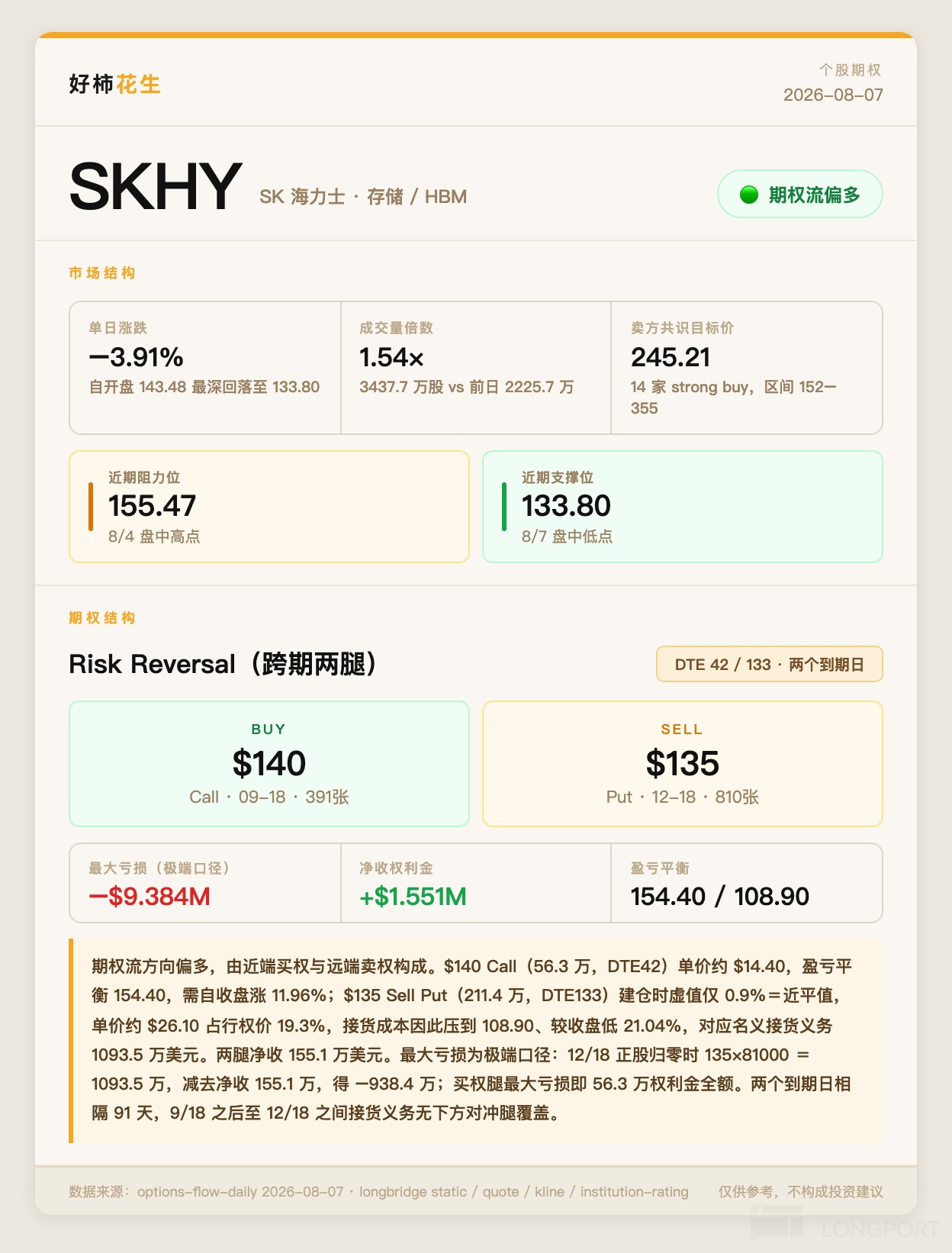
Let's lay out the numbers first. The long position is a $140 Call expiring on 9/18, with 391 contracts, a premium of approximately $563,000, a unit price of $14.40, and a break-even point of $154.40. The short position is a $135 Put expiring on 12/18, with 810 contracts, collecting $2.114 million, a unit price of $26.10, and an acquisition cost of $108.90. The net credit from both legs combined is $1.551 million.
My initial focus was on the strike price of the sold option. At the time of placing the order, the underlying stock was around $136.2. The $135 strike price was only 0.9% lower than the current price—almost at-the-money. Selling puts close to the current price appears to be actively maximizing the probability of assignment. However, when time value is factored in, the conclusion reverses: the four-plus-month duration makes this contract worth $26.10, accounting for 19.3% of the strike price. This effectively lowers the true acquisition cost to $108.90, which is 21.04% lower than the closing price on 8/7. The assignment obligation for 810 contracts amounts to $10.935 million, but to trigger it, Hynix would need to fall by another 21% from its current level.
"Selling at the money" and "assignment below 21%" refer to the same trade. This is where long-duration put selling is most easily misinterpreted—the strike price looks dangerous, but the cost line is actually far away.
The logic for the call leg is completely different. With 42 days left, a $140 strike, and a break-even of $154.40, the stock needs to rise 11.96% from the close to break even. Meanwhile, this stock is in a downtrend: it hit an intraday high of $155.47 on 8/4 and an intraday low of $133.80 on 8/7. Over three trading days, the volatility was nearly 14%, with the day closing down 3.91% and volume reaching 1.54 times the previous day's. The capital for buying calls was deployed during the decline, not chasing a rebound.
So, the overall structure roughly means this: spend $563,000 near-term to bet on a rebound within two months, and exchange a $10.935 million assignment obligation for $2.114 million in cash, betting that the price won't drop below $108.90 before year-end. Buy elasticity near-term, accept support far-term, and account for these two events separately.
News flow has been on the side of the short puts these past two days. On Monday, during the Asian session, reports emerged that SK Hynix plans to launch a $70.6 billion shareholder return plan, potentially including $28.3 billion in share buybacks. CLSA maintained an "Outperform" rating, stating that the worst case has passed. Morgan Stanley raised its FY2026 EPS estimate, believing the severe adjustment in semiconductor stocks may have ended. The consensus target price among 14 institutions is $245.21, 77.8% higher than the 8/7 close, with the lowest estimate still at $152.
What concerns me more is the soft spot of this trade, which lies not in valuation but in the time gap. After the 9/18 Call expires, there are still three months until 12/18. During this period, the assignment obligation is naked—any sell-off in between lacks corresponding downside protection. Moreover, SK Hynix is currently stuck in several unclear issues: Samsung's HBM4 is reported to have reached golden yield rates, potentially surpassing market share; JPMorgan attributes this round of declines to NVIDIA's configuration cuts and half-price discounts; and the company itself is deeply embroiled in labor-management confrontations. These are not valuation issues but problems of market share and pricing power. Once confirmed, the consensus number of $245.21 will move first.
The maximum loss under extreme scenarios must also be stated: if the stock goes to zero by 12/18, the Put leg requires accepting 10.935 million shares at $135 (135 × 81,000), resulting in a net loss of -$9.384 million after deducting the net credit of $1.551 million. The Call leg loses at most the $563,000 premium paid. Only by placing these figures alongside the "net credit of $1.55 million" can the full picture be seen.
I have placed this trade on my watchlist, monitoring two levels. One is $133.80, the intraday low on 8/7—if broken, the 42-day Call is essentially worthless, as there isn't enough time left for a 12% rally. The other is $108.90, the assignment cost line; only when the price falls there does the short put side truly need to answer for it. Another date worth noting is when the $70.6 billion shareholder return plan changes from "reported" to a formal announcement. If this occurs after 9/18, the call leg won't get its chance.
The copyright of this article belongs to the original author/organization.
The views expressed herein are solely those of the author and do not reflect the stance of the platform. The content is intended for investment reference purposes only and shall not be considered as investment advice. Please contact us if you have any questions or suggestions regarding the content services provided by the platform.
