



Citi analysts are calling for "short the deposits, long the light"! Is connectivity the third volume-driving chip for AI?
Nvidia's new AI cabinets "less memory, more optics" have caused optical communication stocks to surge rapidly. What exactly is this about? Once you start talking about it, terms like optical modules, optical replacing copper, 800G/1.6T, and CPO come up in a long string, confusing people in just a few sentences.
In fact, you can understand it this way: three types of connections—inside the chip, between cabinets, and cross-region—and two media: copper and light!
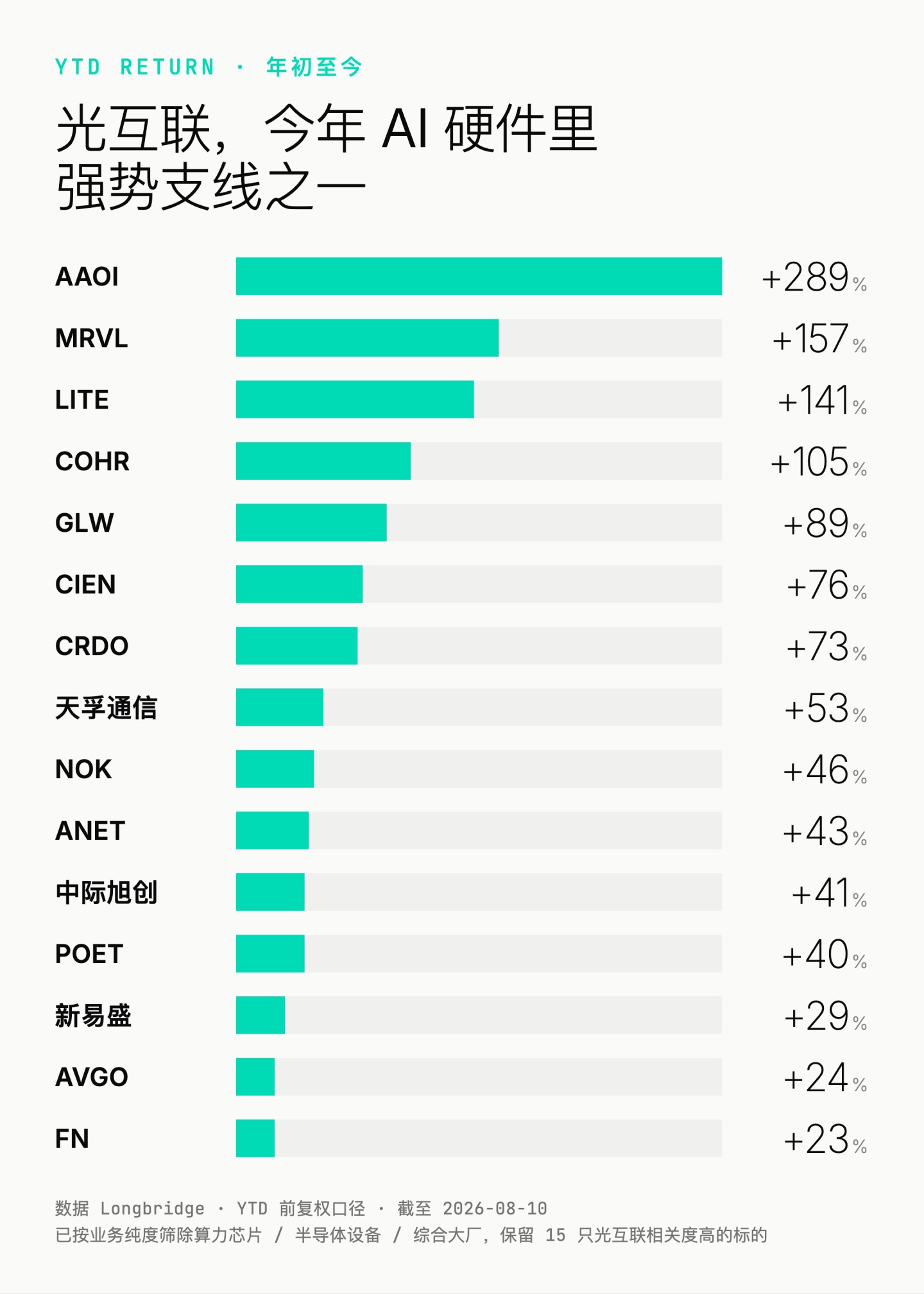
1. Copper travels centimeters, light travels kilometers
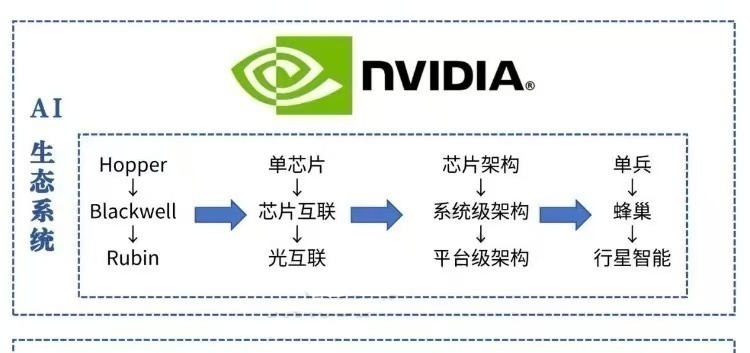
Following Nvidia's related reports, the market suddenly shifted focus: Oh, it seems we don't need to obsess over single-card performance anymore; the cards are already powerful enough, and the bottleneck has become "how do cards communicate at high speed with each other".
However, the high-speed memory (HBM) paired with GPUs is both expensive and in short supply. Instead of stuffing one card full of memory and struggling, it's better to pull in more cards and cabinets, connecting them with faster cables to compute together. Thus, the discourse power of "connections" has increased.
The drawback of copper wires is that they can't travel far. They work fine for centimeter-level distances on boards, but signals attenuate and generate heat when stretched out. Optical fibers, on the contrary, can run for kilometers and offer higher bandwidth. So as systems get larger and larger, more and more connections are switching from copper to light.
(1) Common 400G / 800G, pluggable, embedded on circuit board substrates (PCBs)
The ones that can be quickly assembled and scaled up are the current traditional optical modules (top left in the figure), with the most expensive part being a digital processing chip (DSP), supplied by giants like $Broadcom(AVGO.US)$ZJ INNOLIGHT(03308.HK).
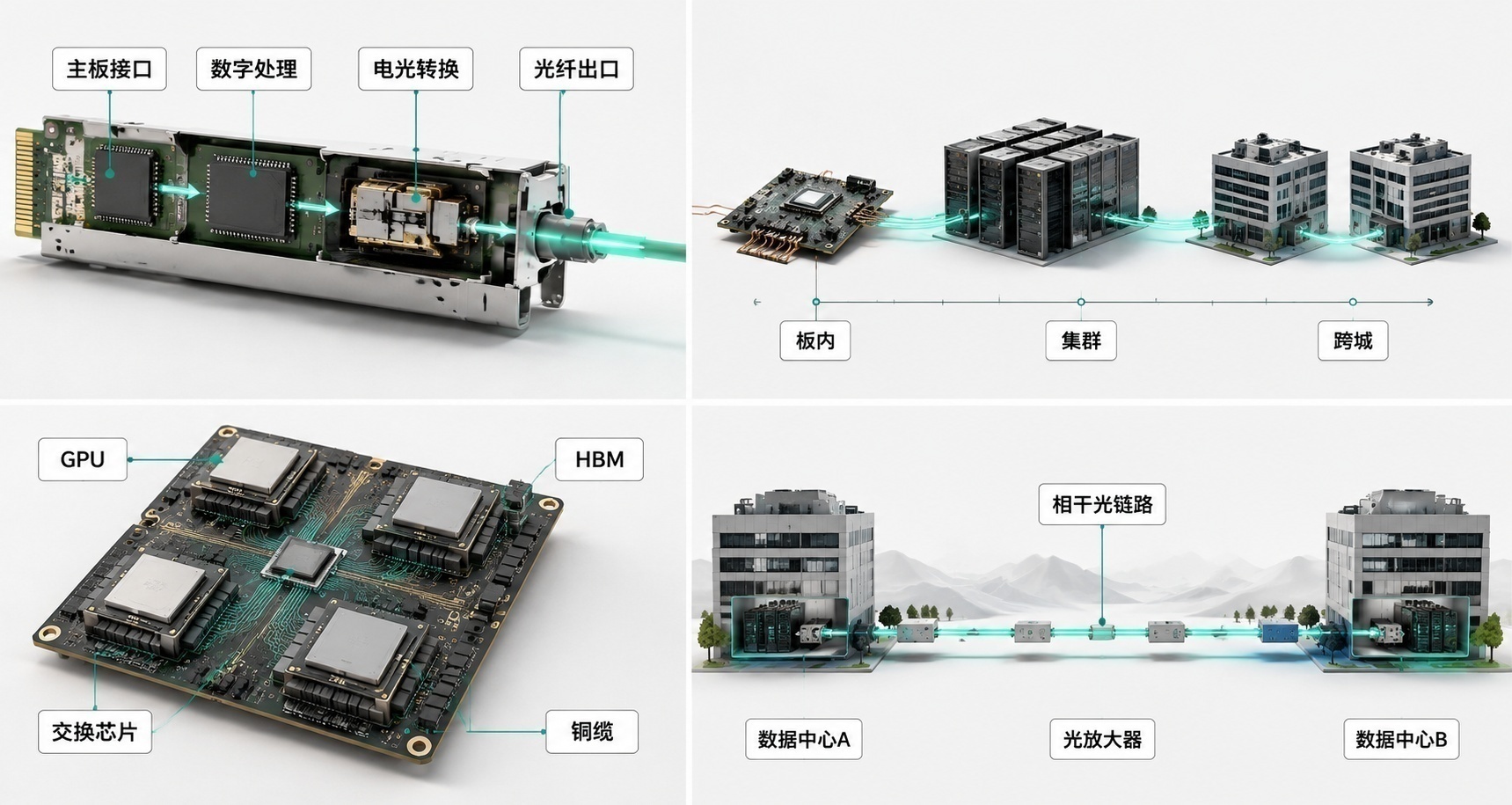
(2) 1.6T migration requires CPO, directly attached next to the GPU, replacing copper cables with optical fibers
Whoever buys the accessories for assembly can produce their own branded products, leading to no barriers for anyone in the end. Moreover, optical modules are only popular in AI servers and cannot be expanded to other fields like industry. Therefore, optical chips have emerged, also boosting a base material for mounting chips—Indium Phosphide (InP).
Storage prices (such as HBM, DDR5) remain high, while optical interconnects can indirectly reduce storage costs redundantly configured to compensate for communication latency by improving overall network efficiency.
In short:
- Three cores inside an optical module: PIC manages the optical path, EIC manages power supply driving, and DSP manages digital signal transmission and reception.
- Four positions for electro-optical conversion points: Pluggable → LPO → NPO → CPO. The closer to the chip, the more power-saving, but packaging, heat dissipation, maintenance, and yield rates become harder. They will likely coexist for a long time.
- Upstream: Silicon photonics itself does not emit light; it relies on materials like Indium Phosphide (InP) to act as the "base," corresponding to $AXT(AXTI.US).
From within a board to across cities
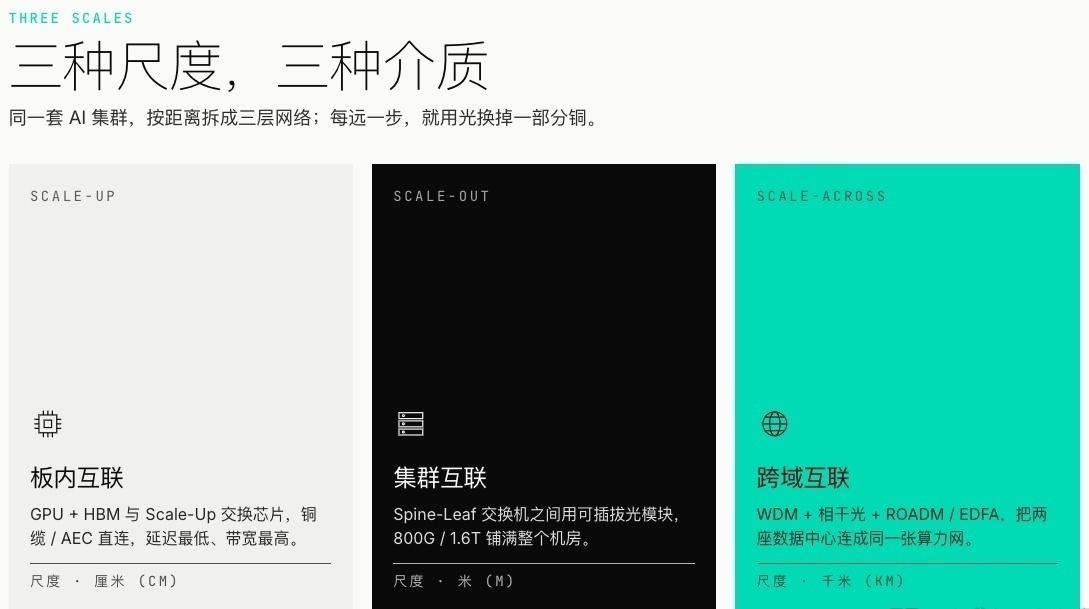
(1) Scale-Up (How to connect within a board, centimeter to meter level)
Focusing on high density and low latency, currently experiencing "copper retreat, light advance".
Compute power: $NVIDIA(NVDA.US) $AMD(AMD.US); $Broadcom(AVGO.US) (leader in switch chips and CPO solutions); $POET Tech(POET.US) (pure CPO engine) $Intel(INTC.US) (giant with the deepest commercialization of silicon photonics technology).
High-speed copper cables $Amphenol(APH.US); Cabinet internal copper/optical transition $Credo Tech(CRDO.US); Backplane connectors $TE Connectivity(TEL.US) (system-level).
High-density optical fiber/glass substrate: $Corning(GLW.US). The glass substrate used for packaging is essentially a 夹层 (interlayer) punched and embedded into the base, serving a supporting role.
Advanced packaging equipment (supporting 2.5D/3D & silicon photonics/CPO) $Applied Materials(AMAT.US)$Lam Research(LRCX.US).
(2) Scale-Out (How to connect between cabinets: meter to hundred-meter level)
This layer is the main field for traditional pluggable optical modules, with specifications moving from 800G to 1.6T, doubling bandwidth per generation.
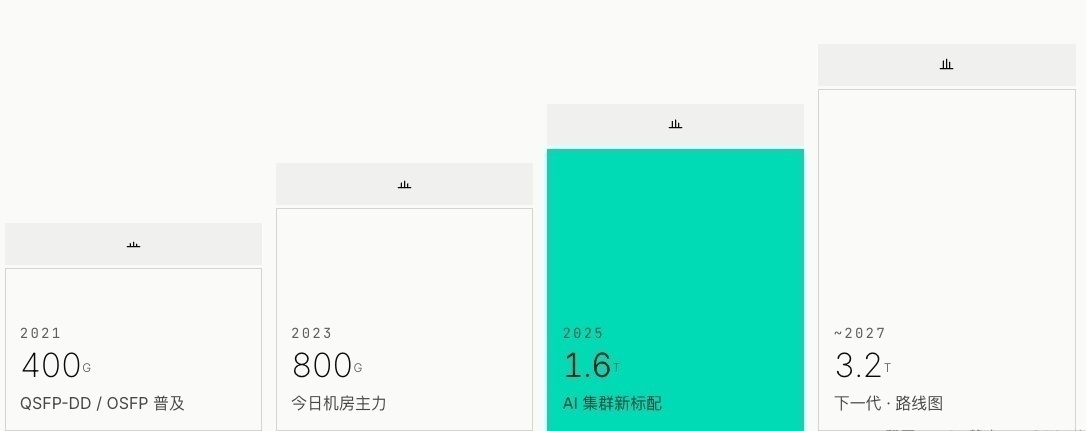
Optical modules/lasers: $Coherent Corp.(COHR.US) $ZJ INNOLIGHT(03308.HK) $Eoptolink(300502.SZ) $Applied Optoelectronics(AAOI.US) $Lumentum(LITE.US).
DSP chips $Marvell Tech(MRVL.US) $Broadcom(AVGO.US); Foundry $Fabrinet(FN.US) $TFC(300394.SZ); White-box switches and data center networks $Arista Networks(ANET.US) $Cisco(CSCO.US).
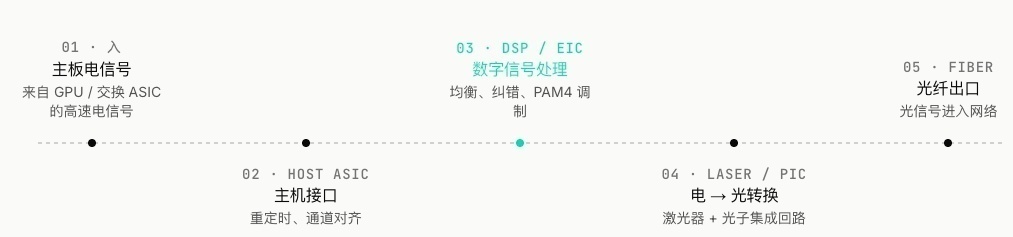
How does it work inside an optical module? Electrical signal in, optical signal out. Treat it as a "translator," where each stage determines speed and power consumption.
(3) Scale-Across (How to connect across domains and cities: kilometer to hundreds of kilometers)
Multi-data center cluster (DCI) joint debugging, cross-city computing power scheduling, and ultra-long-distance transmission rely on coherent light and wavelength division multiplexing to connect several data centers into a single computing power pool.
$Ciena(CIEN.US) Global leader in coherent optical transmission, WDM, and DCI network equipment.
$Cisco(CSCO.US) Possesses top-tier DCI and coherent DSP capabilities after acquiring Acacia.
$ZTE(00763.HK) Full-stack leader in communication equipment, possessing strong DCI and coherent transmission equipment capabilities.
$Nokia Oyj(NOK.US) European backbone network and coherent transmission equipment supplier.
Scale determines medium
When models cannot fit into a single machine, the bandwidth and distance of interconnection become the new computing power bottlenecks.
- Three scales: On-board (cm) / Cluster (m) / Cross-city (km). Distance determines whether to use copper or light.
- Optical modules/chips are key components. DSP · Laser / PIC · Fiber, a signal chain determines speed and power consumption.
- The war for bandwidth is on light, 800G → 1.6T → 3.2T. Pluggable optics + Coherent DCI are the winning moves for cross-cabinet and cross-domain scenarios.
This week, $Lumentum(LITE.US) $Coherent Corp.(COHR.US) will both release earnings reports, worth keeping an eye on.
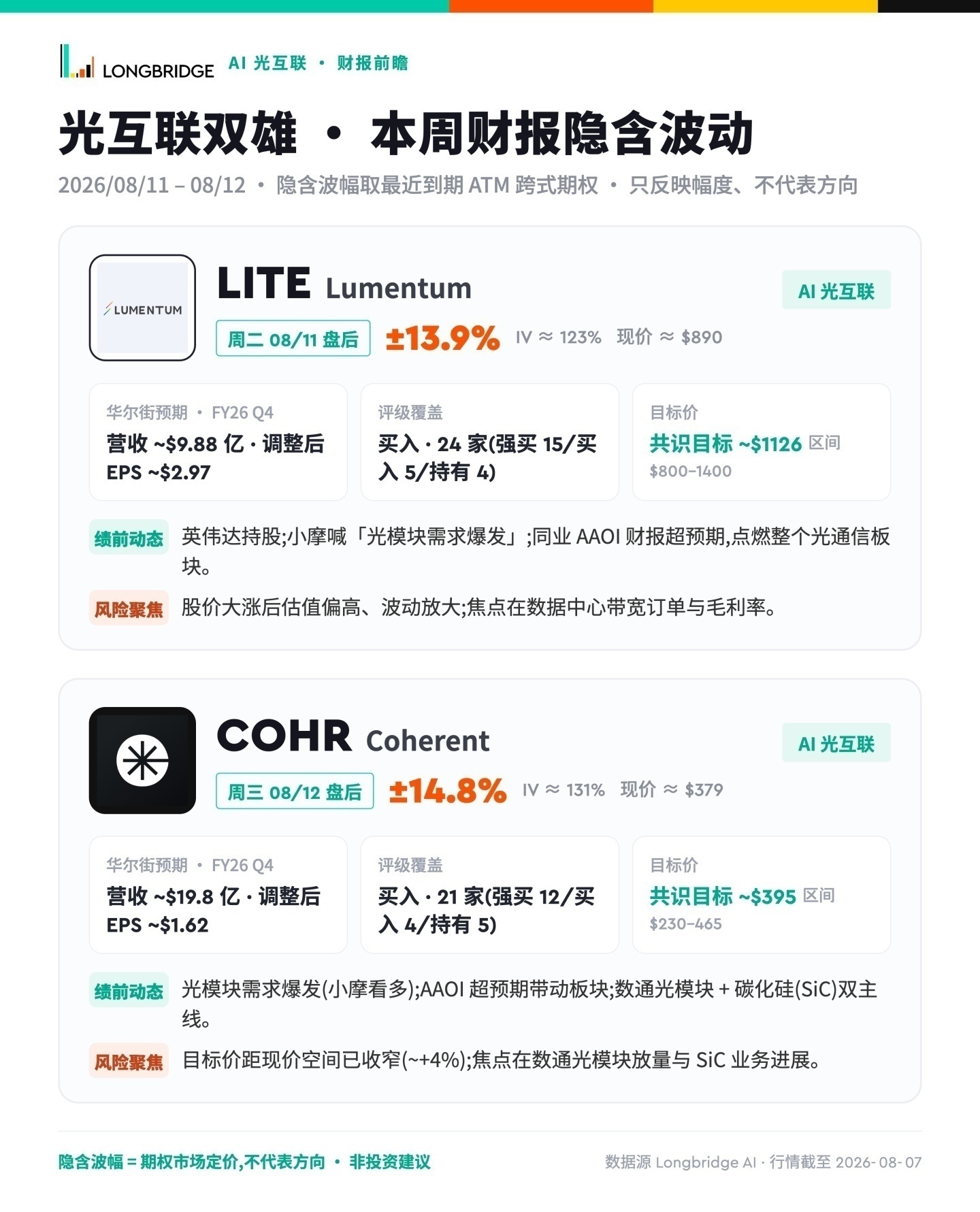
Watch volatility arbitrage for related ETFs: $LITE 2X Short ETF(LITZ.US) $LITE 2X Long ETF(LITX.US) $COHR 2X Long ETF(COHX.US).
$Roundhill Photonics & Optics ETF(LYTE.US) A portfolio highly concentrated in holdings of Chinese and American optical module leaders, including the A-share "Yi Zhong Tian".
$Tuttle Capital Pure Play Photonics ETF(FOTO.US) Tends towards small and mid-cap stocks, focusing more purely and centrally on the photonics and optical communication industry, but with higher volatility.
$Luminar Technologies(LAZR.US) Besides optical modules, it also covers materials, foundries, testing, and other links.
$Corgi Lithography & Semiconductor Photonics ETF(EUV.US) A hybrid theme primarily focused on semiconductor equipment, supplemented by some optical communications.
Dollar-cost averaging feature: Start your DCA plan immediately to steadily layout amidst volatility, Click to jump.
Fractional shares feature: Start with $1 to build flexible positions, Click to jump.
More content: Click [My] - [Opportunity Insight] to view selected opportunities.
The copyright of this article belongs to the original author/organization.
The views expressed herein are solely those of the author and do not reflect the stance of the platform. The content is intended for investment reference purposes only and shall not be considered as investment advice. Please contact us if you have any questions or suggestions regarding the content services provided by the platform.
