


Industry Analysis: The EC external rotor fan market sees an incremental growth of over $700 million in seven years, driven by a 5.9% compound annual growth rate
Industry Overview: EC External Rotor Fans Become an Important Direction for High-Efficiency and Energy-Saving Airflow Solutions
EC external rotor fans are high-efficiency and energy-saving fan products driven by external rotor electronically commutated motors (External Rotor EC Motors). Their structural feature is that the motor rotor is located externally, with the impeller directly fixed to the outer rotor, forming a compact integrated structure. This design can significantly improve heat dissipation efficiency and stability, while possessing low noise, high torque, high power density, and good dynamic balance characteristics. Through the built-in electronic commutation drive system (EC control), intelligent speed regulation and high-efficiency energy-saving operation can be achieved.
EC external rotor fans are widely used in HVAC, refrigeration cold chain, electronic communication heat dissipation, and industrial ventilation fields, serving as an important component of global airflow and energy-saving systems.
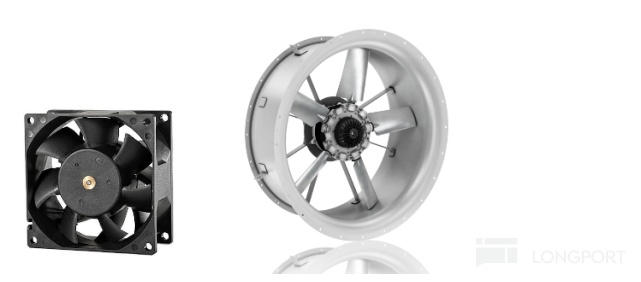
The product achieves stepless speed regulation, intelligent control, and operating status monitoring through its built-in electronic commutation control system, automatically adjusting air volume according to actual load requirements, thereby reducing energy consumption. Currently, EC external rotor fans are widely used in HVAC (HVAC), commercial refrigeration, cold chain logistics, data center cooling, industrial equipment cooling, and clean environment control, making them an important part of global energy-efficient air handling equipment.
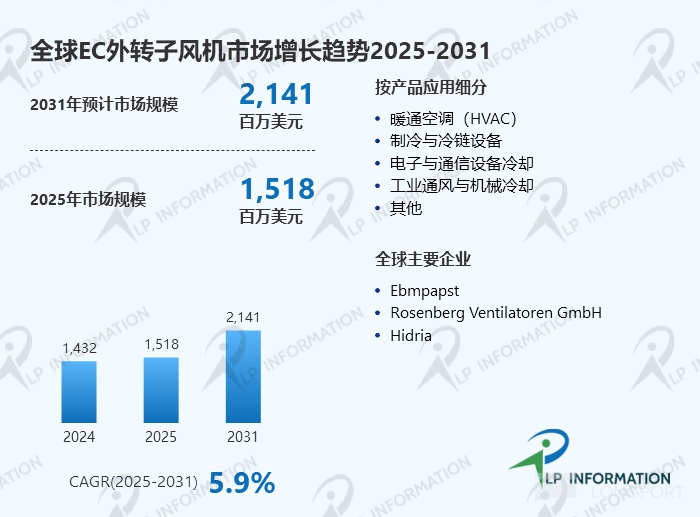
According to research data from LP Information, the global market size for EC external rotor fans was approximately $14.32 billion in 2024, expected to reach $21.41 billion by 2031, with a Compound Annual Growth Rate (CAGR) of approximately 5.9% during the 2025-2031 period. With the improvement of global building energy efficiency standards, the promotion of green and low-carbon policies, and the rapid development of smart buildings, the EC fan market will maintain steady growth.
Industry Chain Analysis: Upstream Materials and Electronic Components Support Product Performance, Midstream Manufacturing Upgrades to Intelligence
The EC external rotor fan industry chain covers multiple links including raw material supply, motor manufacturing, fan component production, system integration, and terminal applications.
The upstream mainly includes suppliers of metal materials, permanent magnet materials, electronic components, and engineering plastics. Among them, motor stators and housings usually use cold-rolled silicon steel sheets, stainless steel, and aluminum alloy materials, which affect motor efficiency, heat dissipation performance, and structural strength; permanent magnet materials mainly use neodymium iron boron (NdFeB) magnets, which are important factors determining motor performance and cost; control modules involve electronic components such as power devices, Hall sensors, microcontrollers, and communication chips. With the improvement of intelligence levels, the proportion of electronic control systems in the total machine cost continues to increase.
The midstream mainly consists of EC external rotor fan manufacturing enterprises, including motor design, impeller manufacturing, electronic control development, complete machine assembly, and performance testing. Compared to traditional fan manufacturing, EC fans have higher requirements for motor design, electronic control algorithms, dynamic balance control, and system matching capabilities, requiring enterprises to possess mechanical, electrical, and software collaborative development capabilities.
Downstream applications cover a wide range, mainly including HVAC equipment manufacturers, refrigeration equipment enterprises, data center equipment suppliers, industrial equipment manufacturers, and building energy-saving system integrators. Among them, the HVAC field remains the largest application market, with continuous increases in demand for high-efficiency fans in air conditioning units, fresh air systems, and air handling equipment.
Industry Dynamics: Intelligence, High Efficiency, and System Integration Become Development Trends
In recent years, the EC external rotor fan industry is developing from a single power component towards an intelligent air management system.
First, intelligent control has become an important direction for product upgrades. Traditional fans mainly focus on air volume and power, while new-generation EC fans are integrating IoT communication, sensor monitoring, and intelligent algorithms to achieve remote adjustment, fault diagnosis, and operational optimization. For example, through Modbus, CAN, 485, and IoT interfaces, fans can connect to building automation control systems to achieve energy management and centralized equipment maintenance.
Secondly, high efficiency and low noise have become key points of market competition. With increasing requirements for operating environments in commercial buildings, hospitals, laboratories, and data centers, there is growing demand for low-vibration, low-noise, and high-reliability fan products. Enterprises are improving fan operating efficiency by optimizing impeller design, motor structure, and control algorithms.
Additionally, the development of new energy vehicles, energy storage equipment, and data centers has brought new application opportunities. High-power electronic devices require continuous heat dissipation, increasing the demand for miniaturized, high-reliability EC fans, providing new growth space for the industry.
Favorable Factors Analysis: Energy-Saving Policies, Building Upgrades, and Digitalization Needs Drive Market Growth
Global Energy-Saving Regulations Promote High-Efficiency Fan Replacement
Improving energy efficiency has become an important goal for the global manufacturing and construction industries. Major economies such as Europe, the United States, China, and Japan continue to raise building energy consumption standards, promoting the adoption of more efficient core components in HVAC systems. Compared to traditional AC fans, EC external rotor fans can reduce energy loss and improve system operating efficiency, thus gaining more applications in new buildings and old system renovations.
In particular, in green buildings, zero-carbon buildings, and energy-saving renovation projects, high-efficiency fans have become one of the important equipment for improving building energy utilization rates.
Smart Building Development Increases Demand for Smart Fans
With the rapid development of smart buildings and automated management systems, there is increased demand for fans with adjustment capabilities and data collection functions. EC fans can automatically adjust their operating status according to environmental changes, achieving precise air delivery and energy-saving operation, highly aligning with the development direction of smart buildings.
Cold Chain and Data Center Construction Create New Demand
The global cold chain logistics, food storage, and pharmaceutical transportation markets continue to expand, increasing the demand for high-reliability refrigeration equipment. At the same time, artificial intelligence and cloud computing promote the expansion of data center scales, requiring more efficient and stable air circulation equipment for server cooling systems, further expanding the application scope of EC fans.
Unfavorable and Obstructive Factors Analysis: Cost Pressure and Supply Chain Dependence Remain Industry Challenges
Although EC external rotor fans have obvious technical advantages, market promotion still faces certain limitations.
First, the initial cost of products is relatively high. Due to the use of permanent magnet motors, electronic control modules, and high-performance materials, their manufacturing costs are usually higher than traditional AC fans. In some price-sensitive markets, customers may still prioritize low-cost traditional solutions, affecting the short-term popularization speed of EC fans.
Secondly, fluctuations in core material prices affect corporate profitability. The prices of neodymium iron boron magnets, power semiconductors, and high-performance electronic components are affected by the global supply chain, and changes in raw material costs may compress corporate profit margins.
Furthermore, differences exist in standards for fan energy efficiency, safety certification, and electromagnetic compatibility among different countries and regions. Enterprises entering overseas markets need to invest in high certification costs. Meanwhile, small and medium-sized enterprises lack technical deficiencies in electronic control technology, software development, and system matching, limiting their expansion into the high-end market.
Industry Policy Analysis: Green Low-Carbon and Intelligent Manufacturing Provide Long-Term Development Support
Global energy transition and green development policies are creating a favorable development environment for the EC external rotor fan industry.
Europe continues to promote building energy-saving regulations, raising energy efficiency requirements for HVAC systems, promoting the application of high-efficiency fans. The US market is driven by energy efficiency standards and data center construction, leading to growing demand for energy-saving air circulation equipment.
China has been actively promoting the implementation of the "Dual Carbon" goals in recent years, accelerating green building, intelligent manufacturing, and industrial energy-saving renovations. With the improvement of building energy efficiency standards and the upgrade of HVAC equipment, the application space for high-efficiency EC fans in commercial buildings, industrial plants, and public facilities continues to expand.
At the same time, intelligent manufacturing policies promote the digital upgrade of industrial equipment, driving fan products towards intelligent control, remote management, and system integration.
Market Competition Landscape: International Brands Occupy the High-End Market, Local Enterprises Accelerate Technological Breakthroughs
The global EC external rotor fan market competition is relatively concentrated. European enterprises occupy an important position in the high-end market 凭借 long-term technological accumulation and brand advantages.
German enterprise ebm-papst is an important participant in the global EC fan field, possessing strong competitiveness in HVAC, industrial ventilation, and energy-saving systems. Rosenberg Ventilatoren GmbH, Hidria, and other enterprises also have a certain influence in the European market.
In recent years, Chinese enterprises have accelerated their layout in the EC fan field, expanding market share through cost advantages, local supply chains, and rapid response capabilities. Some enterprises already possess independent R&D capabilities for motors, electronic control systems, and fan structural designs, and are gradually entering the domestic large-scale HVAC equipment supply chain.
Future industry competition will shift from pure price competition to competition in efficiency, intelligence, reliability, and system solution capabilities.
Regional Market Analysis: Mature Markets in Europe and America are Stable, Asia Becomes the Focus of Growth
The North American market is one of the important consumption areas for EC external rotor fans, mainly driven by commercial buildings, data centers, and energy-saving renovation demands. The US market has a high acceptance of high-efficiency HVAC equipment, with large buildings and industrial users paying more attention to long-term energy costs.
The European market has strong energy-saving policy drivers, with stable demand for high-efficiency fan products in countries such as Germany, France, and the UK. European enterprises have advantages in technical standards, product certification, and the high-end market.
The Asia-Pacific region has become an important area for future growth. China, Japan, South Korea, and Southeast Asian countries are promoting urbanization construction, industrial upgrading, and data center layouts, continuously increasing demand for high-efficiency ventilation equipment. Especially in the Chinese market, green building, new energy industries, and intelligent manufacturing development provide long-term growth space for EC fans.
Future Development Trends: High Efficiency, Intelligence, and Modularization Become Industry Directions
Overall, the EC external rotor fan industry is upgrading from traditional fan products to intelligent energy-saving air management systems. Future market growth mainly comes from three directions:
First, continuous improvement in product efficiency. Enterprises will improve energy utilization efficiency by optimizing motor design, magnetic material application, and control algorithms.
Second, continuous enhancement of intelligence levels. Future EC fans will integrate more IoT, big data, and artificial intelligence technologies to achieve predictive maintenance and intelligent regulation.
Third, continuous expansion of application scenarios. In addition to traditional HVAC and refrigeration fields, data centers, new energy equipment, industrial automation, and medical environment control fields will become new sources of growth.
According to analysis by LP Information, with the continuous promotion of global energy-saving policies and the development of smart buildings and green manufacturing, EC external rotor fans will gradually replace some traditional AC fans, becoming an important technical route in the future airflow equipment market. Enterprises possessing core motor technology, electronic control capabilities, and global service systems will gain greater advantages in long-term competition.
The copyright of this article belongs to the original author/organization.
The views expressed herein are solely those of the author and do not reflect the stance of the platform. The content is intended for investment reference purposes only and shall not be considered as investment advice. Please contact us if you have any questions or suggestions regarding the content services provided by the platform.
