


 Likes Received
Sci-Tech Chip Design ETF SPDB (589250) covers nearly 50% across both storage and AI chip tracks
On August 7, SK Hynix announced that the company will build new wafer fabs in Yongin and Cheongju, South Korea, to meet the continuously growing demand for memory chips in the AI era. On the same day, the company's board of directors approved investments of 35.2 trillion KRW and 19.1 trillion KRW respectively for the construction projects of the "Y2" fab in Yongin and the "M17" fab in Cheongju, totaling approximately 54 trillion KRW (about $38.4 billion). The SSE STAR Chip Design Theme Index (950162) precisely anchors the core link of chip design within the semiconductor industry chain, providing investors with an efficient tool for one-click layout of core domestic chip assets. SPDB Yuanta STAR Chip Design ETF (589250) closely tracks the SSE STAR Chip Design Theme Index (950162). For individual investors who are bullish on the STAR market chip design sector but have not met the 500,000 RMB account opening threshold for the STAR market, the SPDB Yuanta STAR Chip Design ETF (589250) offers a low-threshold participation method—starting from just 100 shares. As of August 7, the annualized return of the SSE STAR Chip Design Theme Index (950162) over the past three years was 38.4%, significantly surpassing the annualized return of the STAR 50 index during the same period, which was 21.64% (Data source: CSI Index, as of 2026.8.7).

In terms of track purity, digital chip design accounts for 79.31% and analog chip design accounts for 14.86% of this index, totaling 94.17%, making it one of the indices with the highest chip design purity in the entire market (Data source: Wind, as of 2026.8.7). In terms of earnings growth, the net profit attributable to parents of this index increased by 191.96% year-on-year in 2025, and by 260.14% year-on-year in the first quarter of 2026, showing outstanding growth potential (Data source: Wind). As of the close on August 7, the SPDB Yuanta STAR Chip Design ETF (589250) rose by 3.76%, closing at 1.297 RMB, with a trading volume of 12.69 million RMB and a turnover rate of 11.38%. From August 4 to August 7, the SPDB Yuanta STAR Chip Design ETF (589250) rose for four consecutive days, with a range gain of 16%.
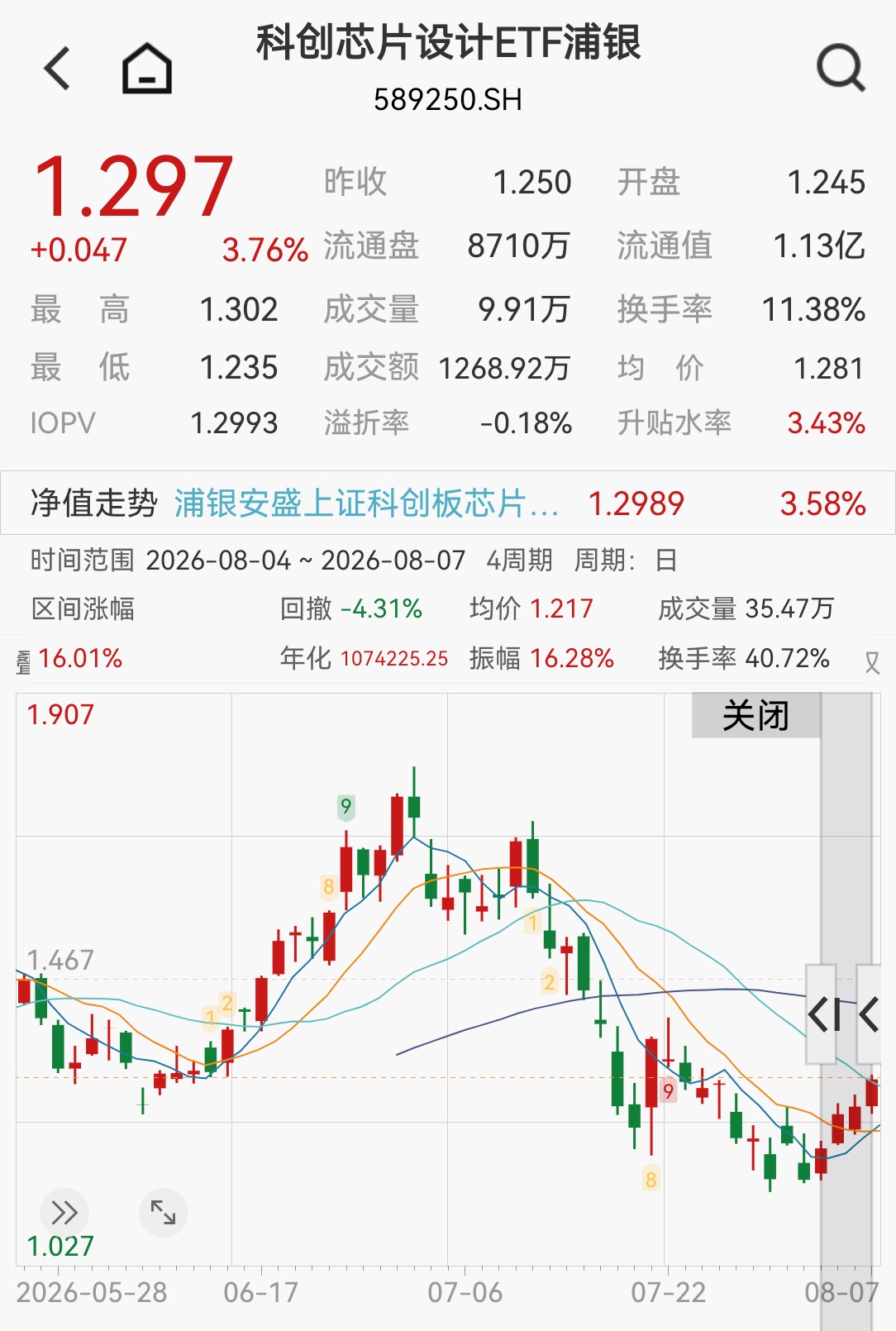
The SPDB Yuanta STAR Chip Design ETF (589250) closely tracks the SSE STAR Chip Design Theme Index (950162). Among the index's weighted stocks, Xinpeng Micro rose 12.25%, Raytron Microelectronics rose 9.34%, ASR Microelectronics-U rose 8.39%, Juheng Shares rose 6.95%, VeriSilicon rose 6.14%, Amlogic fell 1.6%, and Bestech fell 1.47%. The SPDB Yuanta STAR Chip Design ETF (589250) had a total net inflow of 21.7766 million RMB in the past month, with an average daily trading volume of 15.77 million RMB. The SPDB Yuanta STAR Chip Design ETF (589250) closely tracks the SSE STAR Chip Design Theme Index (950162). The index was published on July 26, 2024, with a base date of December 31, 2019, and a base value of 1000 points. It selects securities of 50 listed companies involved in chip design within the STAR market as index samples. (The index's annual price changes from 2021 to 2025 were 7.73%, -42.51%, 4.75%, 35.54%, and 60.00% respectively. Historical performance does not predict future results.) [One of the major features of this index is its pure track] The SSE STAR Chip Design Theme Index (950162) excludes Main Board and ChiNext stocks, while avoiding semiconductor materials/equipment, manufacturing, and packaging/testing segments, anchoring on chip design, the most innovative sub-sector in the semiconductor industry chain. Digital chip design accounts for 79.31% and analog chip design accounts for 14.86%, totaling 94.17% (Data source: Wind, as of 2026.8.7). [Explosive Earnings Growth: Net Profit Attributable to Parents Surged 260.14% YoY in 2026 Q1] From the perspective of earnings realization, this index is not purely conceptual speculation—the full-year revenue in 2025 was 130.296 billion RMB, up 37.03% year-on-year; net profit attributable to parents was 13.109 billion RMB, up 191.96% year-on-year. The first quarter of 2026 continued the high-growth trend, with revenue of 40.018 billion RMB, up 58.72% year-on-year; net profit attributable to parents was 6.425 billion RMB, up 260.14% year-on-year. (Data source: Wind) [High Elasticity: Linked to STAR Market, Daily Price Limit of 20%] In terms of elasticity, the SSE STAR Chip Design Theme Index (950162) is linked to the STAR market, containing only chip design companies listed on the STAR market. The daily price fluctuation limit for constituent stocks is ±20%, offering greater elasticity and stronger offensive capability. During the chip sector recovery cycle in the first half of 2025 and 2026, the STAR Chip Index led with a gain of 208.24%, outperforming the CSI Chip Industry Index (185.52%) and the CNI Semiconductor Chip Index (179.67%), thanks to the high elasticity of the STAR market and the 20% price limit. (Data source: Wind, Time Range: 2024.12.31-2026.06.30) [High Concentration of Leaders: Top Ten Weights Total 63.27%, Memory + AI Chip Dual Tracks Cover Nearly 50%] Regarding index weights, the top ten weighted stocks of the SSE STAR Chip Design Theme Index (950162) account for a total of 63.27%. Among them, the memory direction (Montage Technology 9.27% + Biwin Storage 7.39% + Puya Shares 3.26%) totals nearly 20%, and the AI chip direction (Hygon Information 10.99% + Cambricon 9.26% + VeriSilicon 7.76%) totals 28%. These two high-prosperity tracks account for nearly 50% (47.93%) in total. For investors who are bullish on both memory chips and AI chips, this index can cover them with one click. (Data source: Wind, as of 2026.8.7) Regarding index weights, the top ten weighted stocks of the SSE STAR Chip Design Theme Index (950162) are as follows: Hygon Information (688041.SH) weight 10.99%, sub-track: AI Chip. Montage Technology (688008.SH) weight 9.27%, sub-track: Memory. Cambricon (688256.SH) weight 9.26%, sub-track: AI Chip. VeriSilicon (688521.SH) weight 7.76%, sub-track: AI Chip. Biwin Storage (688525.SH) weight 7.39%, sub-track: Memory. Raytron Microelectronics (688002.SH) weight 5.12%, sub-track: Analog/Sensor. Shengke Communication (688702.SH) weight 3.96%, sub-track: Network Chip. Amlogic (688099.SH) weight 3.29%, sub-track: SoC. Puya Shares (688766.SH) weight 3.26%, sub-track: Memory. Huatai Securities (688141.SH) weight 2.97%, sub-track: Analog Chip. (Data source: Wind, as of 2026.8.7) [Long-term Index Performance: Up 207% Since 2023, Sharpe Ratio 1.24 Far Exceeds STAR Market Broad-Based Indices] For investors seeking high elasticity and able to withstand volatility, the long-term cost-effectiveness of this index is worth noting—the cumulative gain since 2023 is 207.14%, compared to the STAR Composite Index at 69.56% and the STAR 50 at 73.27% during the same period; the annualized Sharpe ratio is 1.24, while the STAR 50 is only 0.74 and the STAR Composite Index is 0.73, meaning that under equal volatility, the excess returns of this index are significantly higher (Data source: Wind, Statistical Interval 2023.1.1-2026.6.12). The SSE STAR Chip Design Theme Index (950162) has risen by 207.14% since 2023, significantly outperforming STAR market broad-based indices, and its annualized Sharpe ratio is 1.24, far higher than that of STAR market broad-based indices, offering a better risk-return ratio. The comparison of cumulative gains and annualized Sharpe ratios between the SSE STAR Chip Design Theme Index (950162) and the STAR Composite Index, STAR 50, STAR 100, and STAR 200 indices is as follows: 1. Cumulative Gains in the Interval: The cumulative gain of the SSE STAR Chip Design Theme Index (950162) from January 1, 2023, to June 12, 2026, was 207.14%, significantly leading the STAR Composite Index (69.56% during the same period), STAR 50 (73.27%), STAR 100 (60.47%), and STAR 200 (69.06%). 2. Annualized Sharpe Ratio: The annualized Sharpe ratio of the SSE STAR Chip Design Theme Index (950162) from January 1, 2023, to June 12, 2026, was 1.24, while the STAR Composite Index was 0.73, STAR 50 was 0.74, STAR 100 was 60.47, and STAR 200 was 69.06. The Sharpe ratio of the SSE STAR Chip Design Theme Index (950162) is significantly superior to that of the STAR Composite Index, STAR 50, STAR 100, and STAR 200 indices, with a significant advantage in risk-adjusted returns. (Data source: Wind, Statistical Interval: 2023.1.1-2026.6.12, SSE STAR Chip Design Theme Index publication date: 2024-07-26, base date: 2019-12-31, index annual price changes from 2021 to 2025 were 7.73%, -42.51%, 4.75%, 35.54%, 60.00% respectively, gain since publication is 241.27%. Historical performance does not predict future results.) [Fund Product Information] - Fund Abbreviation: STAR Chip Design ETF SPDB - Trading Code: 589250 - Fund Manager Song Shiyi, Bachelor's from Shanghai Jiao Tong University, Master's from Renmin University of China, 12 years of securities practice, 2 years of fund management experience - Fund Management Fee 0.50% per year, Custody Fee 0.10% per year. (Data source: Fund Regular Reports, Wind, as of 2025.12.31) [Fund Company Introduction] SPDB Yuanta Fund has built a "Core-Satellite" index product matrix, with on-exchange ETFs covering hard technology and mainstream broad-based indices, and off-exchange index enhancement products comprehensively 布局 ing Beijing, Shanghai, Shenzhen, and large, medium, small, and micro-cap styles. The total asset management scale exceeds 450 billion RMB, providing investors with a one-stop multi-asset allocation tool. 1. Shareholder Background SPDB Yuanta Fund is one of the earliest bank-affiliated public funds in China. Shanghai Pudong Development Bank Co., Ltd. is the largest shareholder, holding 51% equity; BNP Paribas Asset Management Holding Company is the second-largest shareholder, holding 39% equity; Shanghai Guosheng Group Asset Co., Ltd. is the third-largest shareholder, holding 10% equity. The advantages of Chinese and foreign resources help multi-asset management. 2. Asset Management Scale As of December 31, 2025, the total asset management scale of SPDB Yuanta Fund (including subsidiaries) exceeded 450 billion RMB. Its businesses develop diversely, covering asset management businesses in multiple fields such as equity, fixed income, quantitative, and alternative investments, capable of providing investors with one-stop high-quality products and services. There are 117 public fund products under SPDB Yuanta Fund, with a managed scale of 357.506 billion RMB. 3. Differentiated Layout of Index Fund Products SPDB Yuanta Fund's on-exchange and off-exchange products form a "Core-Satellite" strategy combination. On-exchange layouts include A500 ETF SPDB (159376.SZ), ChiNext ETF SPDB (159810.SZ), Photovoltaic ETF SPDB (159609.SZ), STAR Chip Design ETF SPDB (589250.SH), Securities ETF SPDB (516730.SH), Gaming & Media ETF SPDB (517770.SH), Grain ETF SPDB (159060.SZ), etc.; off-exchange launches include CSI 300 Index Enhancement, CSI A50 Index Enhancement, CSI A500 Index Enhancement, STAR 100 Index Enhancement, STAR Composite Enhancement, and other broad-based index enhancement products, as well as the SPDB Yuanta BSE 50 Component Index Fund tracking the Beijing Stock Exchange index, achieving comprehensive tracking of all exchanges in Beijing, Shanghai, and Shenzhen, as well as all major sectors, and also achieving comprehensive coverage of large, medium, small, and micro-cap styles in terms of style. [Q&A] Q1: The STAR market threshold is 500,000 RMB. What low-threshold ways are there for retail investors to invest in STAR chips? A: The participation threshold for individual investors in the STAR market is relatively high, requiring investors to have an average daily asset of no less than 500,000 RMB over 20 trading days (excluding margin financing and securities lending), and investment experience of no less than 24 months. For investors who do not meet this threshold, the minimum investment threshold for the STAR Chip Design ETF SPDB (589250) is only 100 shares, allowing for lower-threshold investment participation with convenient trading. Q2: Compared to the STAR 50 ETF, how is the long-term return of the index tracked by this ETF? A: The SSE STAR Chip Design Theme Index (950162) has gained 207.14% since 2023, while the STAR 50 gained 73.27% during the same period, with the latter's gain being less than 40% of the former's (Data source: Wind, as of 2026.6.12). The core difference lies in the fact that the STAR 50 covers all industries in the STAR market, with limited chip exposure; whereas the SSE STAR Chip Design Theme Index focuses on chip design companies in the STAR market, with higher track purity. Q3: What is the difference between chip design indices and semiconductor equipment indices? A: The SSE STAR Chip Design Theme Index (950162) excludes semiconductor materials/equipment, manufacturing, and packaging/testing segments, anchoring only on chip design, the most innovative sub-sector in the semiconductor industry chain—digital chip design 79.6% + analog chip design 15.4% = 95% (Data source: Wind, as of 2026.5.29). If you are bullish on the chip design segment, this index is one of the purest choices among similar ones. Q4: Memory chips have risen so much. Does this index still benefit? A: In the top ten weights of the SSE STAR Chip Design Theme Index (950162), the memory direction (Montage Technology 9.27% + Biwin Storage 7.39% + Puya Shares 3.26%) totals nearly 20% (Data source: Wind, as of 2026.8.7). The global memory chip super-cycle is still ongoing, and South Korea's 4,755 trillion KRW expansion plan points to doubling DRAM capacity in five years. The memory direction remains an important weight component of this index. Q5: Does this index have earnings support? A: The net profit attributable to parents of this index was 13.109 billion RMB in 2025, up 191.96% year-on-year; in the first quarter of 2026, net profit attributable to parents was 6.425 billion RMB, up 260.14% year-on-year (Data source: Wind). High earnings growth, not pure conceptual speculation. Q6: What is the core difference between this fund and other semiconductor ETFs? A: The product's underlying index layout focuses on the chip design segment of the STAR market, excluding semiconductor materials/equipment, manufacturing, and packaging/testing. The combined weight of the top ten constituent stocks is 57.15%, with concentrated computing power leaders. Q7: What standard is the tracking error of this fund controlled at? A: Under normal circumstances, it strives to keep the absolute value of the daily average tracking deviation below 0.2%, and the annualized tracking error does not exceed 2%. Q8: What are the advantages of investing in this fund? A: First, it precisely focuses on the core track of chip design in the STAR market, with digital chips and analog chips accounting for a combined 94.17% (Data source: Wind, as of 2026.8.7, industry classification is Shenwan Level III); Second, it benefits from the dual dividends of explosive growth in the global semiconductor market and accelerated domestic substitution; Third, the news side has received multiple positive catalysts, and industry prosperity continues to rise; Fourth, it allows for one-click layout of chip design leaders through ETF form, dispersing individual stock risks; Fifth, starting from 100 shares, it provides a participation channel for individual investors who cannot meet the 500,000 RMB account opening threshold for the STAR market.
The copyright of this article belongs to the original author/organization.
The views expressed herein are solely those of the author and do not reflect the stance of the platform. The content is intended for investment reference purposes only and shall not be considered as investment advice. Please contact us if you have any questions or suggestions regarding the content services provided by the platform.
