


 Likes Received
 Buffett's senior apprentice
Interpreting Duan Yongping's strategy: Why holding stock + selling Call = holding cash + selling Put?
The controversy surrounding Duan Yongping's reduction of Pop Mart holdings over the past two days has been addressed by Duan himself, who patiently explained the basics to beginners.
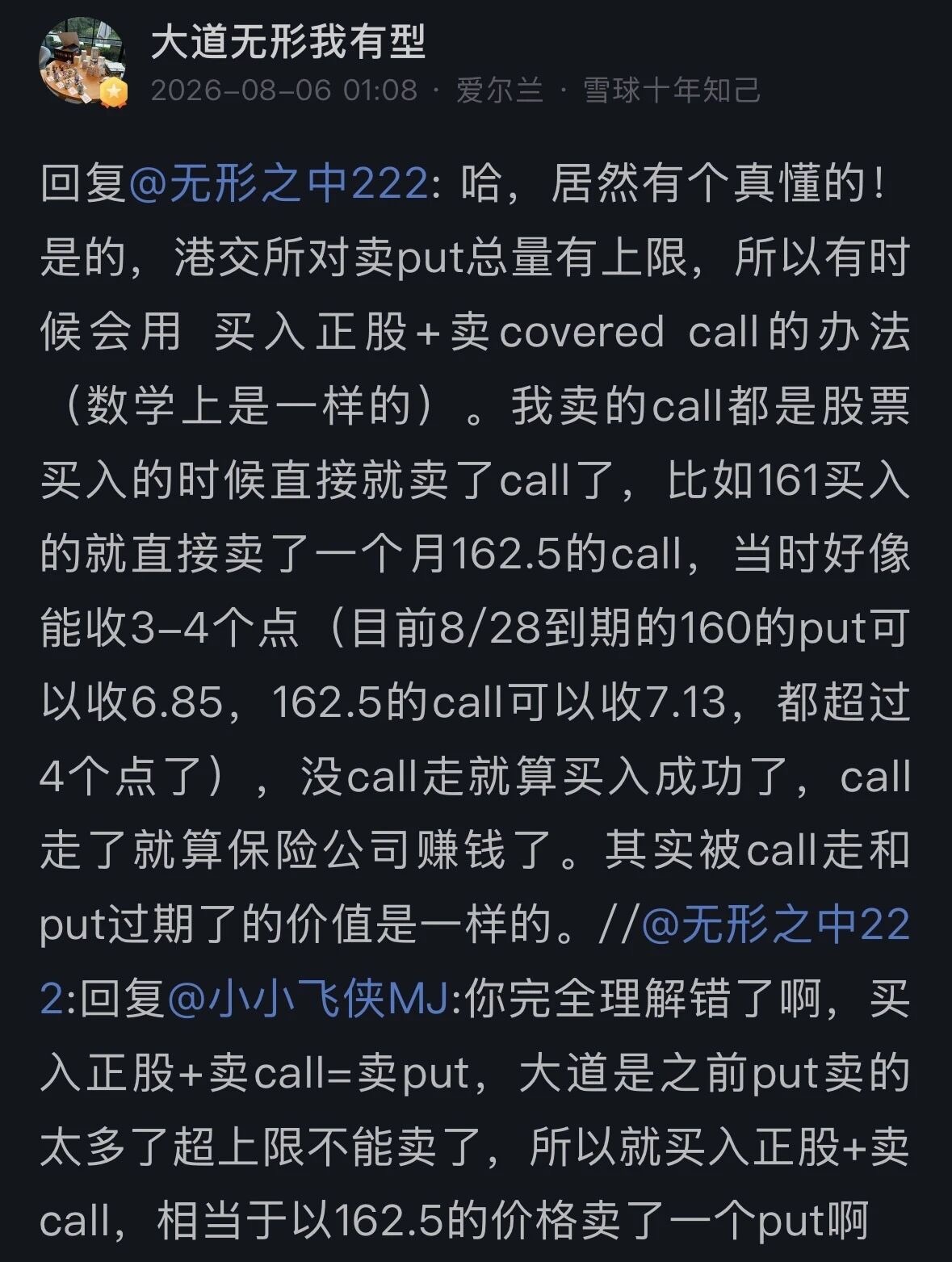
However, many people unfamiliar with options still assume he is reducing his position just because he sold Calls.
Today, I will break down Duan Yongping's operations to help everyone understand why Holding Stock + Selling Call = Holding Cash + Selling Put.
Before addressing this final question, let's answer a few preliminary ones.
First, why did Duan Yongping trade options?
Many people take it for granted that if you are bullish on Pop Mart, you should just buy the stock directly, viewing such option strategies as speculation.
In reality, for an investor with Duan's asset scale, buying Pop Mart solely through stocks is inefficient. Direct stock purchases have amount limits, waste time, and can drive up the stock price.
Since Pop Mart has options available, and Duan is very familiar with them—falling within his circle of competence—why not use them?
Second, why did Duan Yongping sell Calls?
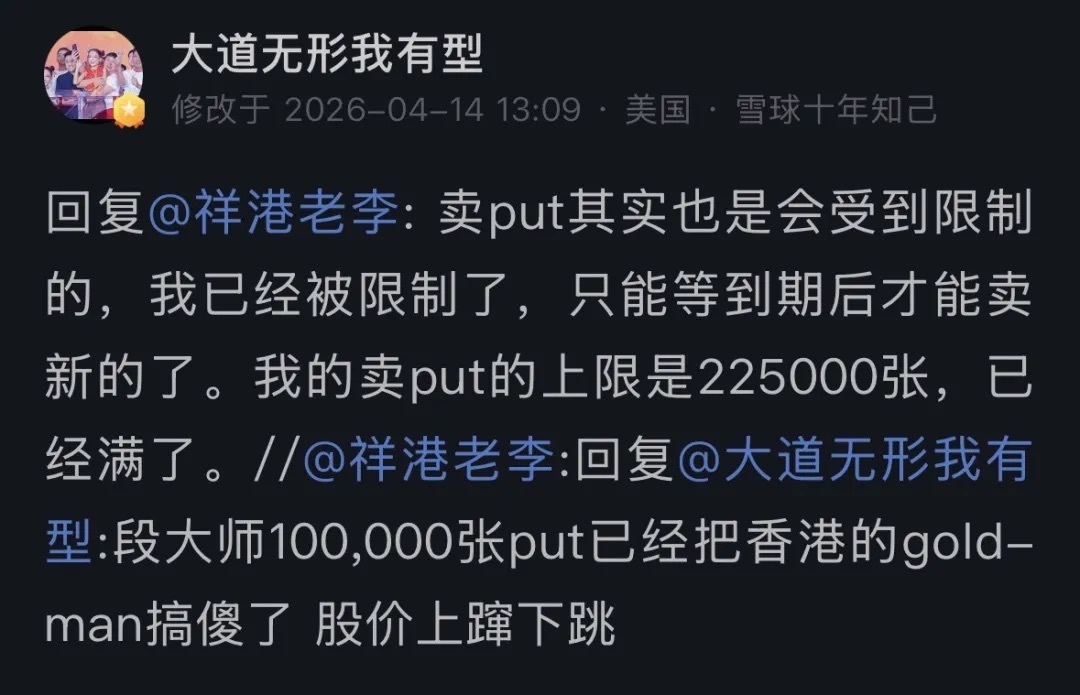
He has already responded to this. The reason is simple: there is a cap on the total volume of Puts one can sell on the HKEX.
He previously mentioned the limit on selling Puts in his account.
Finally, the question from today's title: Why does Holding Stock + Selling Call equal Holding Cash + Selling Put?
I believe even those very familiar with options might find this counter-intuitive at first glance.
But it is indeed a fact.
Let's use PDD as a concrete example.
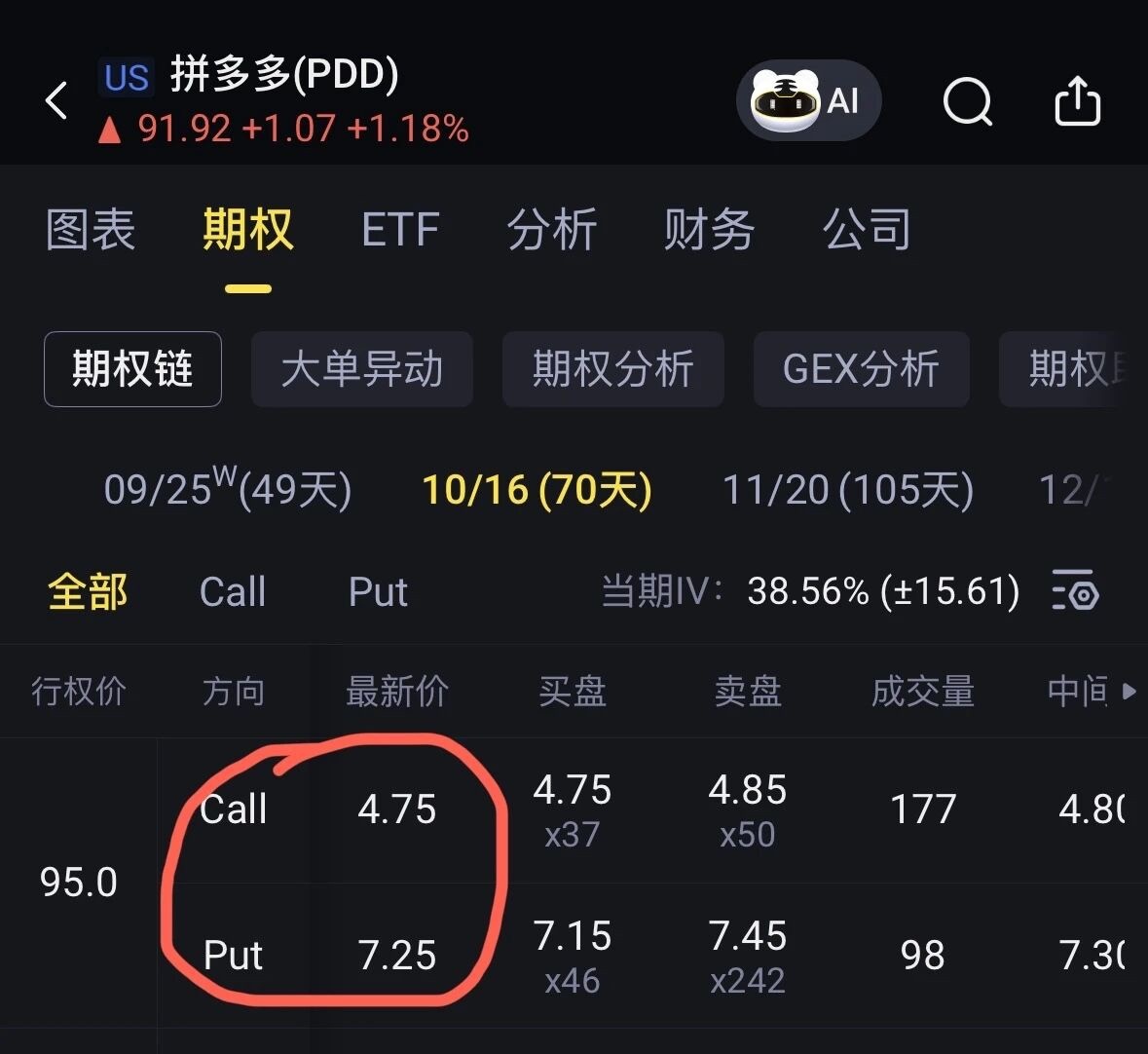
PDD's current stock price is around $91.72. Let's pick any expiration date and use a strike price of $95 for both strategies.
Strategy A: Hold Stock + Sell Call
Buy 100 shares of PDD at $91.72, and simultaneously sell one PDD 20261016 105 CALL.
Net investment is $9172 - $475 = $8697.
Strategy B: Hold Cash + Sell Put
Prepare $9500 in cash, and simultaneously sell one PDD 20261016 105 PUT.
Net investment is $9500 - $725 = $8775.
Theoretically, the net investment for both strategies is identical, approximately $8700. (In practice, slippage causes minor discrepancies.) With the initial investment clarified, let's look at the results at expiration.Scenario 1: If PDD rises to $100
- Strategy A: The Call is exercised; your stock is sold at $95, resulting in a final value of $9500.
- Strategy B: The Put expires worthless; you still hold $9500 in cash.
Both strategies yield a profit of $800, moving from ~$8700 to $9500.Scenario 2: If PDD stays flat at $92
- Strategy A: The Call expires worthless; your stock is worth $9200.
- Strategy B: The Put is exercised; you buy 100 shares at $95, but the stock market value is only $9200.
Both strategies result in a final value of $9200, yielding a profit of $500.Scenario 3: If PDD drops to $80
- Strategy A: The Call expires worthless; your stock is worth $8000.
- Strategy B: The Put is exercised; you buy 100 shares at $95, but the stock market value is only $8000.
Smart you must have noticed that regardless of the final outcome, the expiration returns for these two strategies are exactly the same.
Did you get it?
$POP MART(09992.HK)
The copyright of this article belongs to the original author/organization.
The views expressed herein are solely those of the author and do not reflect the stance of the platform. The content is intended for investment reference purposes only and shall not be considered as investment advice. Please contact us if you have any questions or suggestions regarding the content services provided by the platform.
