


In-depth Analysis of AMD: The Core CPU Business Amidst Supply Constraints + The Battle for Helios Infrastructure!
AMD's latest earnings report presents a thought-provoking situation: performance significantly exceeded expectations, yet the market has not fully relaxed its concerns.
In the second quarter of 2026, AMD achieved revenue of approximately $11.5 billion, a year-over-year increase of 50%; data center revenue was approximately $6.7 billion, up 107% year-over-year, accounting for nearly 60% of total company revenue. The company's guidance for third-quarter revenue is approximately $13 billion, maintaining relatively fast growth.
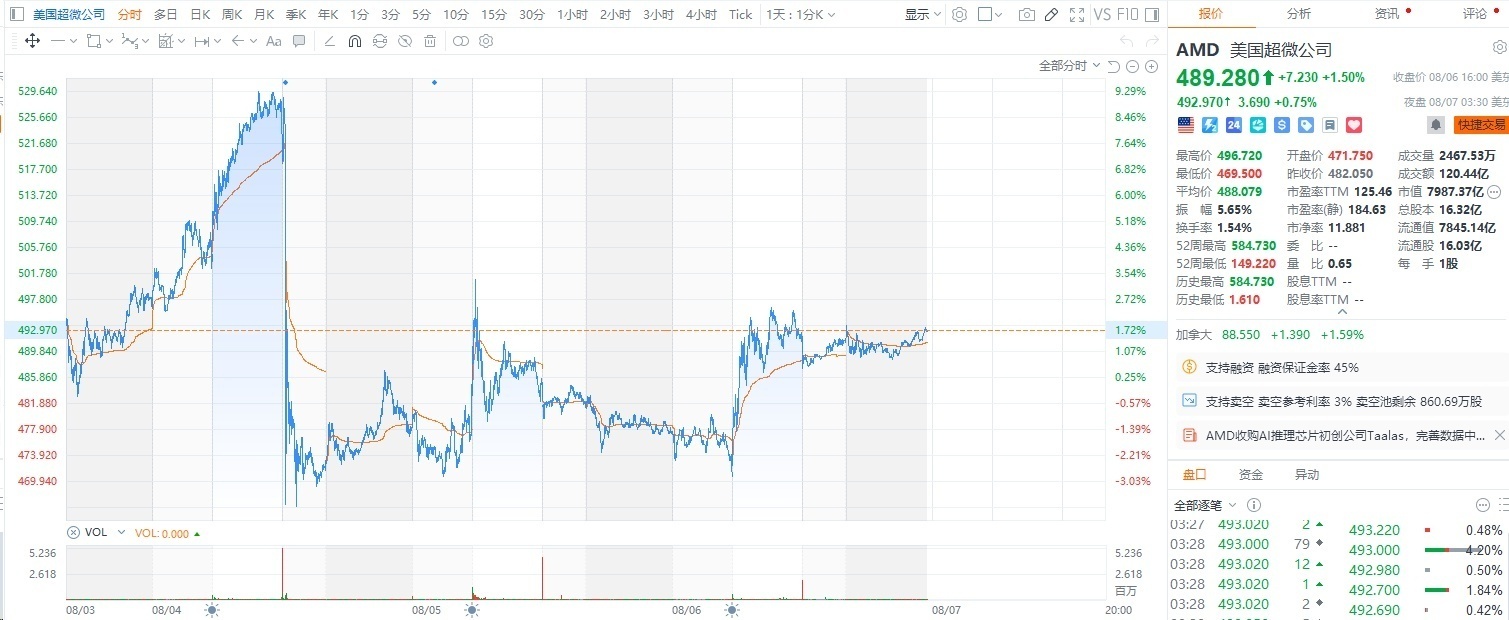
However, after the earnings report, the market's focus quickly shifted from "how fast is AMD growing" to three questions:
First, will gross margin be dragged down after the volume ramp-up of MI450 and Helios;
Second, can AMD truly complete the delivery from chips to whole-system solutions;
Third, has the current stock price already reflected future years' growth in advance;
Therefore, AMD's current investment logic is no longer simply "whether it can catch up with NVIDIA";
But rather whether AMD can transform from a CPU and GPU chip supplier into a system-level supplier of AI data center infrastructure.
The Growth Foundation of AMD Today Remains CPU!
Although Instinct GPU is the incremental engine AMD relies on most, CPU remains the core foundation for AMD's scale, profitability stability, customer relationships, and ecosystem (EPYC server CPUs + Ryzen client CPUs).
Q1 2026 Mercury Research data: AMD's server CPU revenue share reached a record 46.2% (+6.8 percentage points year-over-year), with unit share at approximately 33.2%.
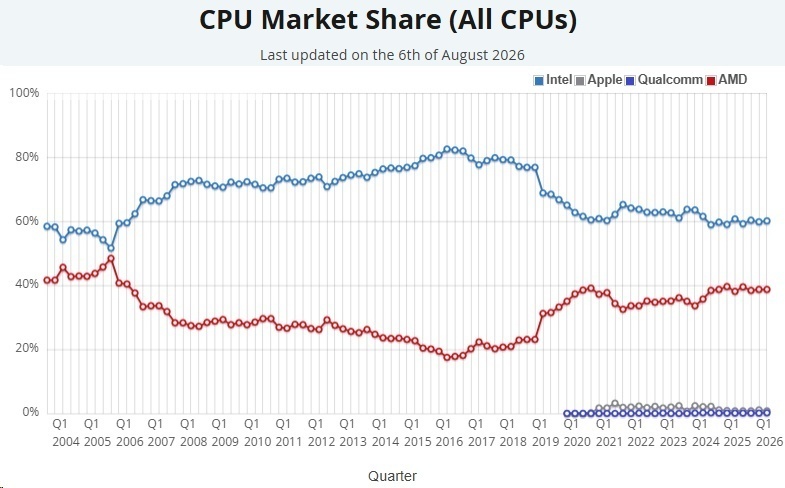
In data center business, EPYC processors have formed strong competitiveness, achieving systematic leadership over Intel Xeon 6 (Granite Rapids) in multi-threaded throughput, performance-per-watt, core density, PCIe expandability, and TCO, while maintaining advantages over ARM (Graviton, Vera, etc.). The next generation (6th Gen Venice / Zen 6) further consolidates this; Venice (2nm, up to 256 cores) is already in mass production, with large-scale shipments expected starting Q4 2026, making it one of the most advanced process technologies among current data center CPUs.
Current performance: AMD's Q2 server CPU business revenue was $4 billion (third-party estimate, not officially disclosed), representing over 70% year-over-year growth, which is the main contributor to data center business growth increments. The core reason is still CPU price increases, as cloud providers and enterprise customers continue to expand deployments of products like Turin and Genoa.
Lisa Su has emphasized multiple times that agentic AI will evolve the GPU:CPU ratio from 1:4/1:8 closer to 1:1. CPUs are not being marginalized but are seeing their core demand amplified synchronously as hosts, orchestrators, general-purpose computing, and inference companions. This can be directly verified from Amazon AWS's latest earnings report, where traditional cloud business growth is significantly driven by AI, especially the dependency of agentic AI workloads on CPUs.
The significance of CPU to AMD lies in three points.
1. CPU is a more mature business with relatively higher revenue predictability.
2. AI data centers need not only GPUs but also large quantities of high-performance CPUs responsible for scheduling and general-purpose computing.
3. CPU is the entry point for whole-system solutions. Helios integrates Instinct GPU + EPYC CPU + Pensando + ROCm.
BofA estimates that AMD's server CPU revenue will grow from approximately $17 billion in 2026 to approximately $63.6 billion in 2030. Therefore, AMD's CPU business is not merely a "fallback business" after losing out in GPU competition, but an important fundamental base enabling the company to continuously expand its data center share.
GPU Determines AMD's Slope + Ceiling!
If CPU determines whether AMD can achieve stable growth, then GPU determines whether AMD can obtain higher valuations, after all, GPU represents the future trillion-dollar market, where the cake will be much larger than that of CPU. According to Goldman Sachs' 2030 estimates, the data center AI accelerator market size may reach approximately $1.4 trillion, while the server CPU market size may reach approximately $220 billion.
AMD's current GPU business is roughly divided into three stages:
1. MI350 Series: AI GPU revenue for this quarter is approximately $2.7 billion, mainly from MI355
2. MI450 Series: MI455X (bundled with Helios) is about to ship, responsible for accelerating growth from the second half of 2026 to 2027
3. MI500 Series: After 2027
Current performance: AMD's Q2 GPU business revenue was $2.4 billion (third-party estimate, not officially disclosed).
GPU competition is no longer just comparing peak performance of individual chips. What truly determines customer procurement includes at least five dimensions:
1. GPU Computing Performance (Inference era places greater emphasis on energy efficiency and cost-effectiveness, rather than pure peak FLOPS)
2. HBM Memory Capacity and Bandwidth (Hardest to solve, supply shortage)
3. Interconnectivity Between GPUs (The expansion bottleneck needing most urgent resolution, determining cluster scale and communication efficiency)
4. Stability, Power Consumption, and Thermal Management of Rack-Level Systems (Determines TCO, the decisive factor for cloud providers today)
5. Software Ecosystem and Deployment Efficiency (Highest barrier, migration costs, tuning maturity, and developer habits determine long-term stickiness)
NVIDIA is strongest in the first item; even NVIDIA is helpless regarding the second. Currently, NVIDIA is testing multiple versions of Rubin Ultra GPU, with some alternative versions (8-layer HBM4e, 12-layer HBM4, 8-layer HBM4) having HBM memory capacities lower than originally planned.
AMD is addressing the latter three capabilities through Helios. Helios integrates Instinct GPU, EPYC CPU, Pensando network chips, and ROCm software into a single rack-level platform, aiming to compete with NVIDIA's whole-system solutions.
This means AMD's GPU business is moving from "selling acceleration cards" to "selling parts of an AI factory".
AMD's cooperation with Microsoft reflects this change. Microsoft plans to deploy AMD's Helios in Azure for frontier model inference, Azure AI services, and customer applications, while introducing AMD's next-generation EPYC Venice CPUs and Pensando networking products. AMD officially stated that Helios will begin shipping to customers including Microsoft starting in the second half of 2026.
However, recently Musk stated that SpaceX will "only use NVIDIA GPUs". SpaceX plans to continue using NVIDIA's VeraRubin architecture and apply it to ground and space computing infrastructure. This choice reflects NVIDIA's currently strongest competitive moat: NVIDIA sells not just a GPU, but an AI infrastructure operating system validated by a large number of customers.
But this does not mean AMD lacks opportunities; on the contrary, there are many opportunities. The procurement logic of Microsoft, Meta, OpenAI, and Anthropic may differ from SpaceX. Large customers have incentives to introduce a second supplier to reduce dependence on NVIDIA, improve bargaining power, and obtain more targeted system designs. AMD's cooperation with Anthropic is an example; both parties announced they would deploy up to 2GW of MI450 GPUs, with the first 1GW expected to begin deployment in the first half of 2027; AMD simultaneously committed to a strategic investment of up to $5 billion in Anthropic.
Helios Changes AMD's Business Model
Past AMD resembled more of a chip design company:
Designing CPUs or GPUs, delivering them to customers, who then completed system integration.
Helios attempts to change the model to: delivering GPUs, CPUs, networking, racks, and software together.
This brings three changes.
First, the value per single customer order increases. In the future, what AMD competes for may no longer be a single GPU card, but entire racks, batches of clusters, or even infrastructure projects calculated in gigawatts.
Second, customer relationships become deeper. Chip suppliers are usually easily replaceable, but if AMD participates in customer software optimization, network design, and system deployment, the cost for customers to switch suppliers will increase.
Third, the profit model becomes more complex. System-level sales can bring higher revenue, but early stages may be accompanied by higher supply chain, R&D, and delivery costs. The volume ramp-up of MI450 may bring pressure on gross margins. As AMD's first large-scale rack-level product, Helios also carries significant execution risk; system-level gross margins will certainly be diluted compared to pure chips.
This is precisely AMD's biggest current investment contradiction: Helios may open up a larger market, but before true volume ramp-up, it might first compress profit margins. Therefore, AMD's current capital expenditures need to be viewed rationally; this is a ticket that must be paid.
Status and Supply
Status: Sold Out + Ramp-Up + CapEx for Capacity Construction
Server CPU supply remains tight; EPYC is basically sold out until the end of 2026.
Venice (6th Gen EPYC) and MI450 series have begun mass production ramp-up using TSMC's 2nm process.
Advanced Packaging: CPU shifts to other Taiwanese partners + GPU still constrained by TSMC
On May 21, 2026, AMD officially announced an investment of over $10 billion into the Taiwan ecosystem, focusing on advanced packaging, substrate, and rack-level system manufacturing capabilities. Key partners include ASE, SPIL (developing EFB 2.5D bridge packaging, wafer-level EFB) + PTI (panel-level EFB), replacing CoWoS technology to support Venice and Helios/MI450 series. (TSMC's CoWoS capacity is highly concentrated, with NVIDIA occupying a large proportion)
EFB 2.5D primarily targets CPUs, used for the 6th Gen EPYC Venice; GPUs remain constrained by TSMC's CoWoS-L + SoIC.
HBM: Samsung Dominates
Signed multi-year supply agreements with major memory manufacturers, locking in HBM allocations needed for 2027 in advance.
The main suppliers for HBM3E in the MI350 series are Samsung and Micron.
The main supplier for HBM4 in the MI450 series is Samsung (signed March 2026).
Summary
For AMD
- Bulls look at profitability from 2027–2030;
- Bears look at gross margins and deliveries in the coming quarters;
- The market will verify the latter in the short term, rewarding the former in the long term.
Key observations:
- Whether Helios can ramp up volume as planned in Q4 2026;
- After MI450 volume ramp-up, whether gross margins will be significantly lower than current levels;
- Whether data center GPU revenue can continue to grow, rather than relying solely on one-time large orders;
- Whether customers like Microsoft, Anthropic, and Meta will shift from pilot programs to scaled deployments;
- Whether ROCm can reduce customer migration costs;
- Whether EPYC Venice will continue to expand AMD's share in server CPUs.$AMD(AMD.US) $NVIDIA(NVDA.US)
The copyright of this article belongs to the original author/organization.
The views expressed herein are solely those of the author and do not reflect the stance of the platform. The content is intended for investment reference purposes only and shall not be considered as investment advice. Please contact us if you have any questions or suggestions regarding the content services provided by the platform.
