


After three submission rounds and less than 50 million on hand, Standard Robotics has only one path left: going public.
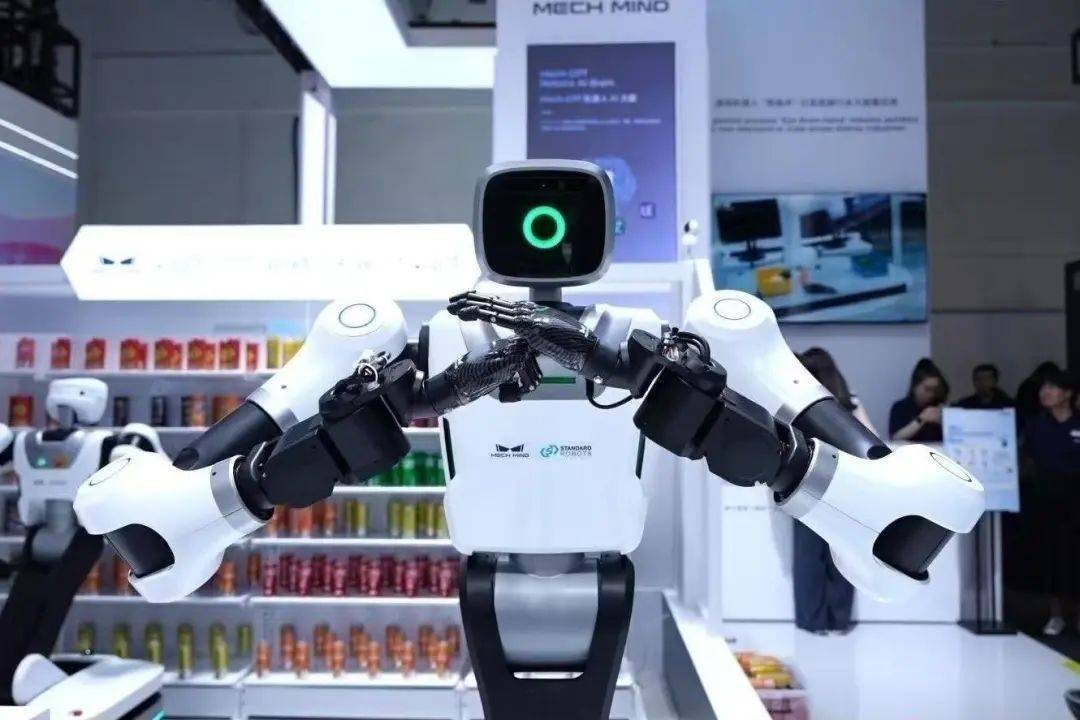
After three submissions to the Hong Kong Stock Exchange, with less than 50 million yuan in cash on hand and cumulative losses exceeding 400 million yuan, Standard Robotics' journey toward an IPO has been truly arduous.
In June 2025, the company first submitted its listing application to the HKEX, aiming to enter the Main Board's Chapter 18C special technology listing channel under the positioning of an "industrial intelligent mobile robot solution provider."
After two subsequent applications automatically expired due to failing to complete hearings within the six-month review period, the company resubmitted for the second and third times on January 4, 2026, and July 27, 2026, respectively.
The latest prospectus simultaneously updated operational data, comprehensively upgrading its narrative to stand at the forefront of smart manufacturing upgrades under the halo of being a "pioneer in industrial embodied intelligence."
However, no matter how sexy the track story is, it cannot escape the core dilemma at the operational level: insufficient self-blood-making ability in the main business and a continuously tight capital chain that has yet to be reversed.
Financial report data shows that from 2023 to 2025, the company's revenue was 162 million yuan, 251 million yuan, and 301 million yuan respectively, with a three-year compound annual growth rate (CAGR) of 36.3%. However, scale growth has not translated into profitability.
From 2023 to April 2026, the company's cumulative net loss exceeded 400 million yuan, and operating cash flow saw net outflows for three consecutive years. As of the end of April 2026, cash holdings were only 49.69 million yuan.
On one hand, there is the sexy industry narrative of robots entering factories for operations and flexibly replacing labor; on the other, there is the stark operational reality of continuous losses and pressure on cash flows.
The situation of this mid-tier robotics manufacturer is also a reflection of the industrial mobile robot industry's "financing for growth, listing for survival," relying on an IPO to stay alive.
Fierce Competition in the Track
Industrial Intelligent Mobile Robots (AMR) are a typical track characterized by "long slope and thick snow but extremely low concentration." It is currently in a reshuffling phase with contenders vying for dominance, and no absolute leader has emerged yet.
From the perspective of the track, market size is still growing rapidly, but the industry is accelerating differentiation, with the pattern of "top players eating meat, mid-tier players drinking soup" becoming clear.
According to data from Frost & Sullivan, the global industrial intelligent mobile robot solution market size was approximately 15.3 billion RMB in 2024, expected to grow to 81.4 billion RMB by 2029, with a CAGR from 2024 to 2029 as high as 39.8%.
By volume (number of units shipped), the top five global manufacturers combined hold a 35.6% market share. The number one player holds 17.3%, the second holds 8.5%, and players ranked third to fifth have shares ranging between 2% and 4.5%.
Under the same volume metric, Standard Robotics' global market share in 2025 was approximately 2.6%, ranking fifth globally and fourth in China.
Standard Robotics belongs to the mid-tier players in the industry, not a top-tier competitor, with a significant gap compared to leading firms.
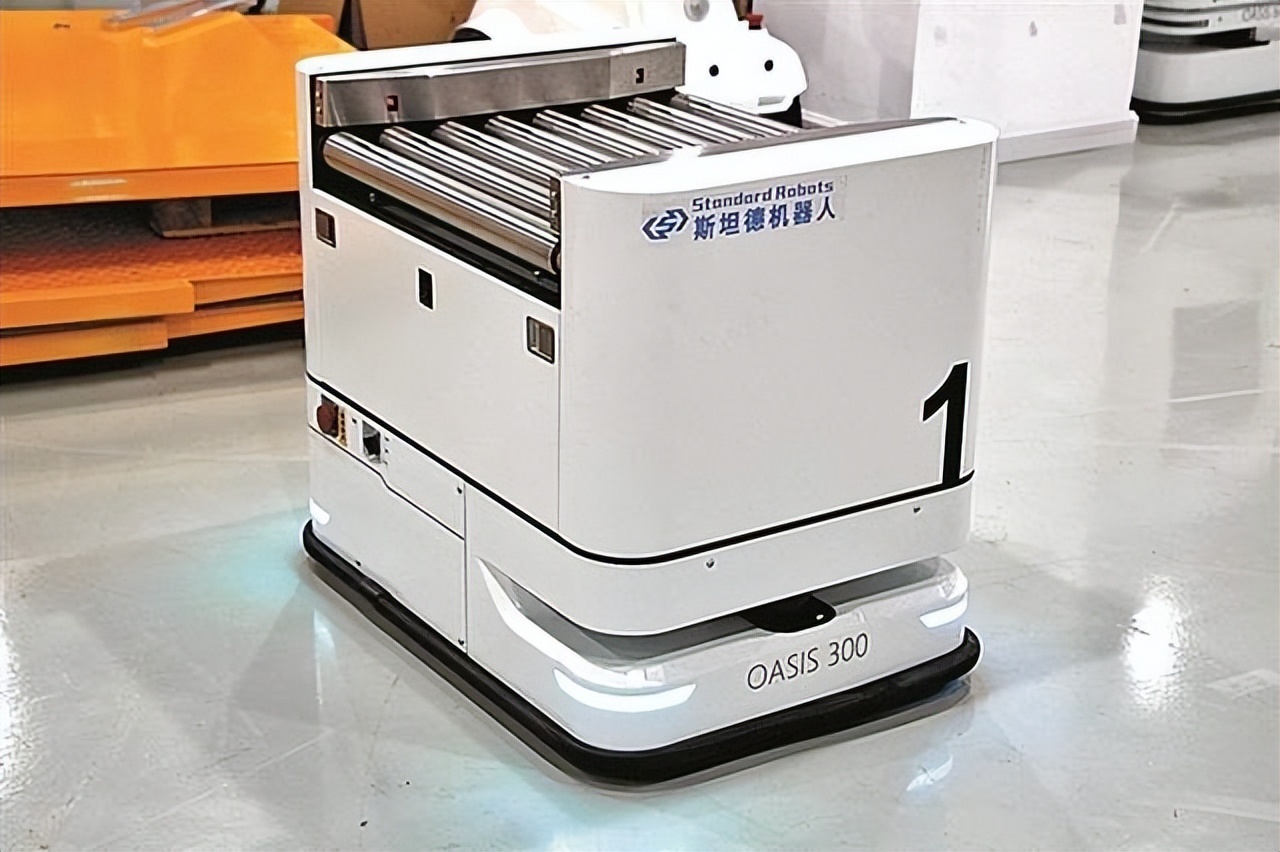
Looking at the domestic competitive landscape, the industry overall presents a "three-tier echelon" structure.
First Tier (Revenue Scale > 1 Billion): Represented by Hikrobot, Geek+, and Fast Warehouse Intelligence, backed by large group resources or sufficient cumulative financing, they lead comprehensively in production capacity, channels, and customer coverage. They are deeply bound to large-order scenarios such as new energy and automotive, acting as the dominant forces in industry price wars and technological iteration.
Second Tier (Revenue Scale 300-1000 Million): Manufacturers such as Standard Robotics,灵动科技 (Lingdong Technology), and BlueCore Technology are listed here. They generally possess differentiated advantages in 1-2 niche tracks, can secure some orders from top clients, but their overall scale is limited. This is the most fiercely contested camp in the industry, facing high difficulty in breaking upward and high risk of sliding downward.
Third Long-tail Tier: Numerous regional integrators and small-to-medium manufacturers focus on low prices and localized delivery. With low technical barriers and weak risk resistance, they are the first to be eliminated during industry reshuffling.
The industry reality is that leading players, led by Hikrobot, have already built insurmountable scale barriers.
These enterprises, having entered the "100,000-unit level," form a positive reinforcement loop through supply chain bargaining power, scenario data accumulation, and brand trust, creating competitive barriers that latecomers find almost impossible to break in the short term.
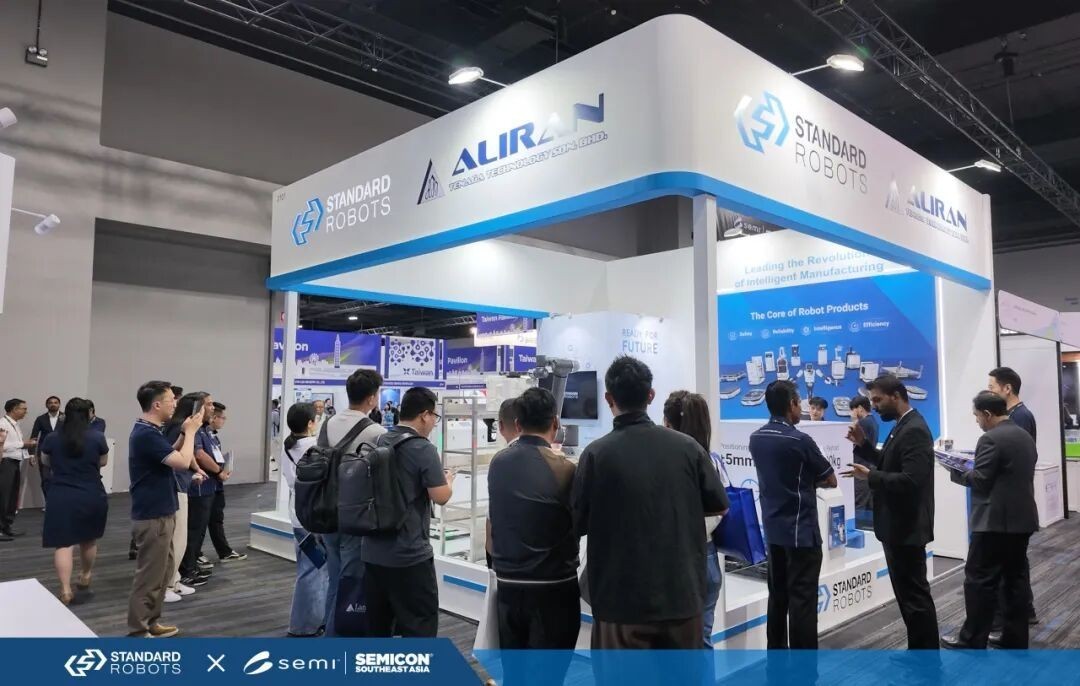
However, as a representative mid-tier player, Standard Robotics also has its own core competitiveness: full-stack self-developed technology + precise positioning in high-end scenarios.
Full-stack self-development is the moat.
Standard Robotics is one of the first Chinese enterprises to self-develop industrial robot operating systems, creating a complete "1+N+S" technical system—self-developed core controllers, SROS operating system, and navigation algorithms, supported by the RoboVerse cluster scheduling system, capable of coordinating over 2,000 robots working together in a single scenario.
This self-developed system allows the company to break free from the low-price involution of pure hardware integration, enabling rapid response to custom client needs and supporting gross margins rising continuously from 12.9% in 2022 to 40.5% in 2025.
Meanwhile, the company has laid out industrial embodied intelligence in advance, with product iteration rhythms leading peers in the same tier.
Precise positioning in high-end scenarios.
The company has simultaneously entered three high-barrier tracks: 3C electronics, automotive manufacturing, and semiconductors. It ranks in the global top three in 3C electronics and automotive manufacturing, and fifth in semiconductors, making it one of the few AMR manufacturers in China capable of simultaneously entering multiple high-end manufacturing scenarios.
These scenarios feature long customer certification cycles and high replacement costs, building a solid scenario moat, with risk resistance significantly superior to peers 深耕 ing in mid-to-low-end scenarios.
Objectively speaking, Standard Robotics is a typical mid-tier hard tech company with "prominent strengths and fatal weaknesses." It has technical strengths, but these advantages are not yet strong enough to cover its scale disadvantages.
Capital is also accelerating its concentration towards leading enterprises.
According to data from the CMR Industry Alliance and the New Strategy Mobile Robot Industry Research Institute, the global mobile robot industry completed 35 financing rounds in the first half of 2026, totaling approximately 6.498 billion RMB.
More importantly, the structure: There were 17 financing events of 100 million yuan or more in the first half, accounting for 48.57%. Capital is shifting from "wide sowing" to "focused irrigation," concentrating bets on leading enterprises with verified business models.
At the same time, many mid-tier AMR companies have had poor recent financing progress, with capital overall becoming cautious.
This is probably also the reason why mid-tier player Standard Robotics is eager to list: raising money is very difficult.
The industry has gone from the financing boom around 2021 to the current ice-and-fire dichotomy where leading companies have valuations of billions while mid-tier players struggle to raise funds. The AMR track has fully entered a capital differentiation period of "top players eating meat, mid-tier players drinking soup, and tail players exiting."
Beneath the Appearance of Revenue Growth, Operations Continue to Bleed
Financing difficulties, ultimately, stem from commercialization progress falling short of expectations.
Although the company's performance is growing, the pressure is immense, and the operational situation is not optimistic.
The prospectus shows that from 2023 to 2025, Standard Robotics' revenue increased from 162 million yuan to 301 million yuan, with a three-year CAGR of 36.3%; revenue surged 139.1% year-on-year in the first four months of 2026, seemingly showing rapid growth momentum.
But behind the glamorous curve lies a fundamentally bleeding operational base.
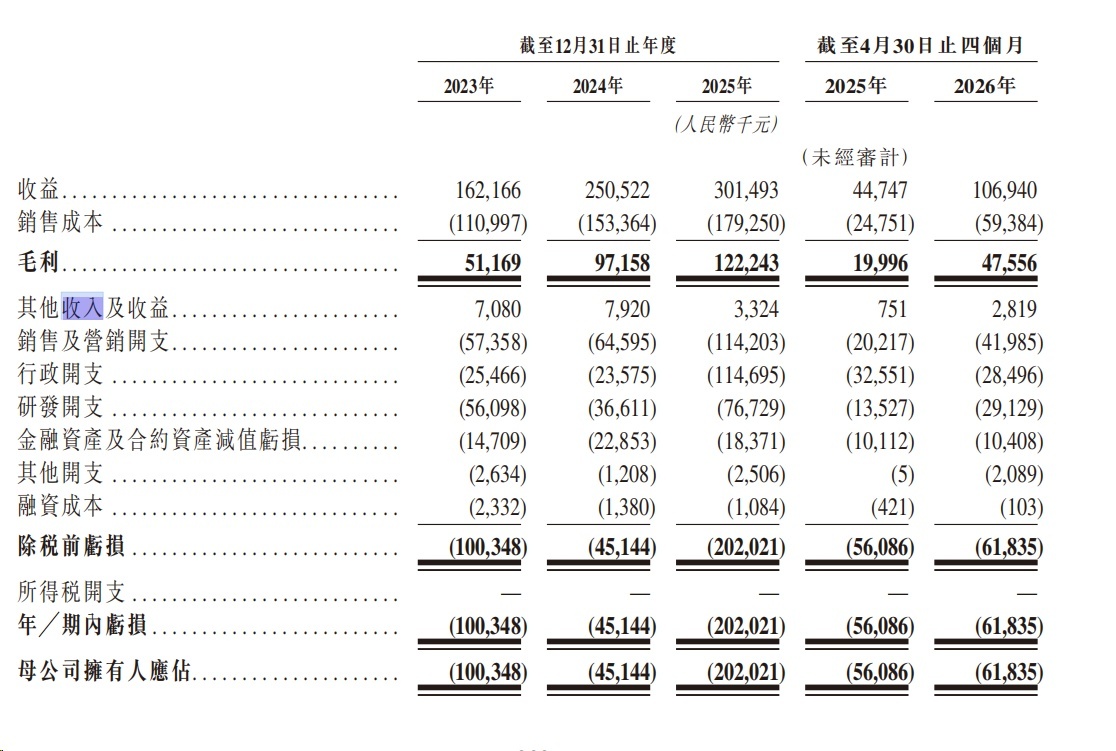
(The above chart shows core financial data, source: Prospectus)
On the profit front, cumulative net losses exceeded 400 million yuan (including Jan-Apr 2026), with losses in 2025 increasing nearly 3.5 times year-on-year. Even excluding non-cash expenses such as 147 million yuan in share-based payments, the adjusted net loss for the year still exceeded 35 million yuan. The main business itself has fallen into the vicious cycle of "selling more means losing more."
Regarding expenses, in 2025, the full-year gross profit was only 122 million yuan, while sales, administrative, and R&D expenses totaled 306 million yuan. Gross profit was insufficient to cover period expenses. Scale expansion did not dilute costs but instead continuously widened the loss gap.
Operating cash flow saw net outflows for three consecutive years, with cumulative bleeding exceeding 230 million yuan, and another net outflow of 65 million yuan in the first four months of 2026.
As of the end of April 2026, cash and cash equivalents on hand were only 49.69 million yuan. Including financial assets, the total was about 102 million yuan. Calculated based on the average monthly consumption speed in 2025, this is only enough to support the company's operations for about one year.
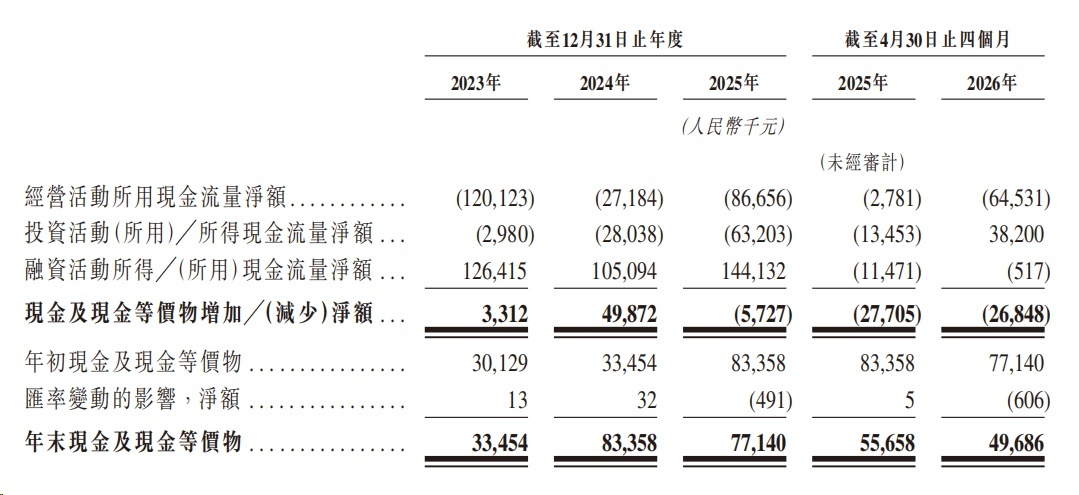
(The above chart shows the company's cash on hand, source: Prospectus)
Meanwhile, the turnover days for trade receivables have stretched to 272.5 days, taking nearly nine months to collect a single payment. Revenue growth has not translated into real cash, but rather accumulated as accounts receivable and inventory on the books, with working capital squeezed bidirectionally by upstream and downstream parties, leaving the safety margin of the capital chain nearly exhausted.
The foundation of growth is also not solid.
In the first four months of 2026, the revenue proportion from the top five customers suddenly rose to 68%, with the largest customer contributing over 30% of revenue. Short-term growth relies heavily on a single major client.
Behind the high-growth performance, there is a heavy reliance on major client orders to boost scale.
This dependence on a single major client and tight cash flow status is a common microcosm in the industry.
The industry is transitioning from a "technology verification period" to a "scaled implementation period." The focus of competition has shifted from simple parameter comparisons to a comprehensive contest of delivery capabilities, cost control, and service networks. Enterprises need to continuously invest in R&D iteration, expand production capacity, and lay out overseas channels. The intensity of capital consumption has not decreased but has continued to rise with scale expansion.
Tracing the root causes of the company's prolonged inability to achieve profitability, there are both industry-wide common issues and reasons related to its own operations.
First, the project-based delivery model is too heavy. Although Standard Robotics is transforming towards productization, solutions business still accounted for over 80% as of 2025. Each project requires customized development, on-site deployment, and debugging, resulting in high labor costs and long delivery cycles, making it difficult to dilute costs through scale.
Second, weak supply chain bargaining power. Core components such as LiDAR, servo motors, and controllers still partially rely on imports, leading to high procurement costs. Meanwhile, the company's small procurement scale results in insufficient bargaining power with suppliers, causing obvious pressure on the cost side.
Third, intensified industry price wars. As leading enterprises release production capacity, AMR unit prices continue to drop. Small and medium-sized manufacturers are forced to sacrifice profits to grab orders, further squeezing profit margins.
The combination of these factors has led to continuous financial bleeding for Standard Robotics.
Valuation Fluctuates, Industry Heads to Hong Kong Collectively
Standard Robotics' valuation curve is very interesting, like a roller coaster.
Since its establishment, the company has completed seven rounds of financing, raising approximately 747 million yuan.
The Series C round saw drastic fluctuations. As early as the Pre-Series C round in 2021, the company's valuation peaked at 2.1 billion yuan.
This coincided with the robot track bubble period, pushing the valuation to historical highs.
In 2023, when the industry winter arrived, the company's valuation dropped to 1.35 billion yuan before the Series C financing.
After completing Series C financing in March 2023, the valuation rebounded to 1.53 billion yuan. The Series C financing amounted to 180 million yuan, of which Xiaomi invested 150 million yuan.
In 2024, Series D returned to 2.1 billion. Series D was the round that raised the most funds for the company, amounting to 300 million yuan, with investors being Liangxi Investment under Bohua Capital.
However, this valuation was more a result of follow-on investment by old shareholders and backing by industrial capital, rather than a purely market-priced outcome.
The journey from 2.1 billion down to 1.35 billion and back to 2.1 billion over four years completely mirrors the capital cycle of the hard tech track from 狂热 (fanaticism) to winter and then to rational recovery.
With hard tech investment returning to rationality, early-stage financial funds are gradually exiting, while industrial capital and local state-owned capital have become the main investors.
Looking at it now, is a post-investment valuation of 2.1 billion expensive?
It depends on whether it is priced as an option for "embodied intelligence" or for AMR.
When first submitting the application in 2025, the company called itself an "industrial intelligent mobile robot solution provider." In January 2026, it changed its wording to "pioneer in industrial embodied intelligent robot solutions."
A difference of one word: the former refers to logistics equipment, while the latter refers to the hottest concept in AI.
But the prospectus tore open the packaging: In 2025, embodied robot solution revenue was only 28.736 million yuan, accounting for 9.5% of total revenue; in the first four months of 2026, it dropped to 3.9 million yuan, accounting for only 3.6%.
If it were truly standing at the 风口 (wind outlet) of embodied intelligence, a 2.1 billion valuation would undoubtedly be on the low side. But the reality is that the company's embodied robot business revenue is very small, and its core business remains traditional functional robots.
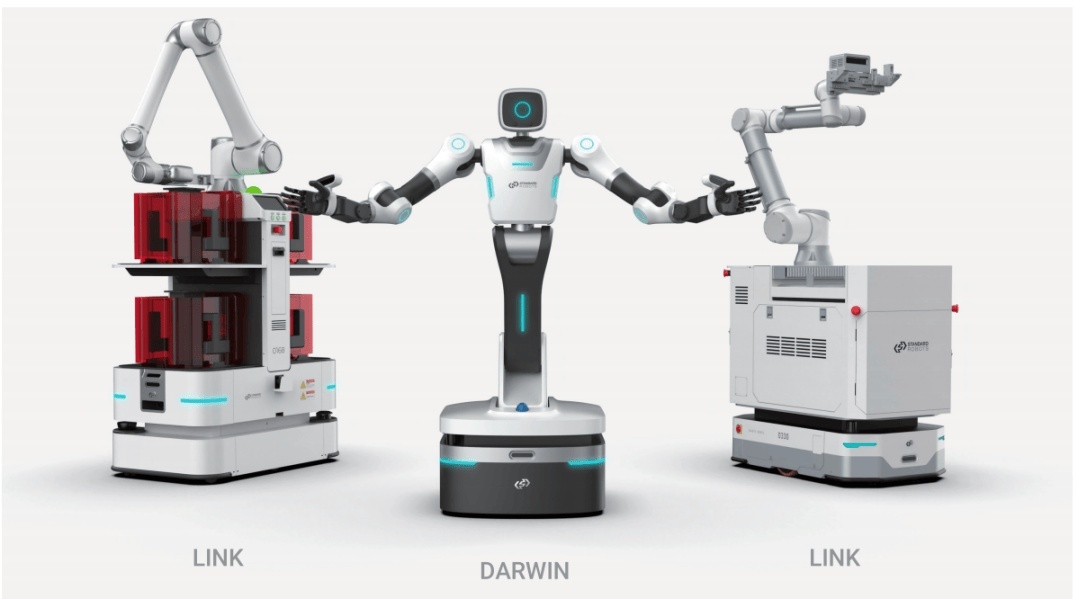
In terms of scale, the company's 2.1 billion corresponds to a Price-to-Sales (P/S) ratio of about 7 times. Horizontally comparing with the leader Geek+, whose 2025 revenue exceeded 3 billion and who is already profitable, the actual P/S ratio in the secondary market is about 4 times, with some institutional target valuations at 7 times; Hikrobot's revenue is 6.452 billion. Although not listed, some market analysts have estimated its valuation at 30 billion, with a P/S ratio of about 3-5 times.
However, Standard Robotics' revenue is only one-tenth of Geek+'s, it continues to lose money, and its customer retention rate is less than 60%. With the same P/S multiple, the gold content differs. Compared to the leader, a 2.1 billion valuation is on the high side.
HKEX Chapter 18C regulations stipulate that commercially viable companies must have a minimum market capitalization of 4 billion HKD (approximately 3.6 billion RMB) to list. Previously, Standard Robotics' primary market valuation was only 2.1 billion RMB (approx. 2.3 billion HKD). It needs to increase its valuation by nearly double in the IPO to meet the standard, which itself constitutes pressure.
The secondary market for Chapter 18C is still in a verification period, with liquidity and valuation systems not yet mature. If Standard Robotics forcibly lists at a 2.1 billion valuation (needing to rise to over 4 billion HKD), it is predicted that the secondary market will have a strong 观望 (wait-and-see) tendency.
In the entire AMR track, Standard Robotics is not an isolated case.
Peers Fast Warehouse Intelligence, HAI ROBOTICS, and UALZ collectively headed to Hong Kong for IPOs. The industry is fully entering a reshuffling period of "listing while bleeding, compensating for price with volume."
Everyone is competing for IPOs to stay alive, rushing to validate profitability models before funds run out.
Source: Chaoyang Capital Theory
The copyright of this article belongs to the original author/organization.
The views expressed herein are solely those of the author and do not reflect the stance of the platform. The content is intended for investment reference purposes only and shall not be considered as investment advice. Please contact us if you have any questions or suggestions regarding the content services provided by the platform.
