


Deconstructing Excellent Vision's $3 billion valuation: Is the price of world models expensive?
Abstract: Established for 3 years
Source: Chaoyang Capital Theory
Author: Gu Feng
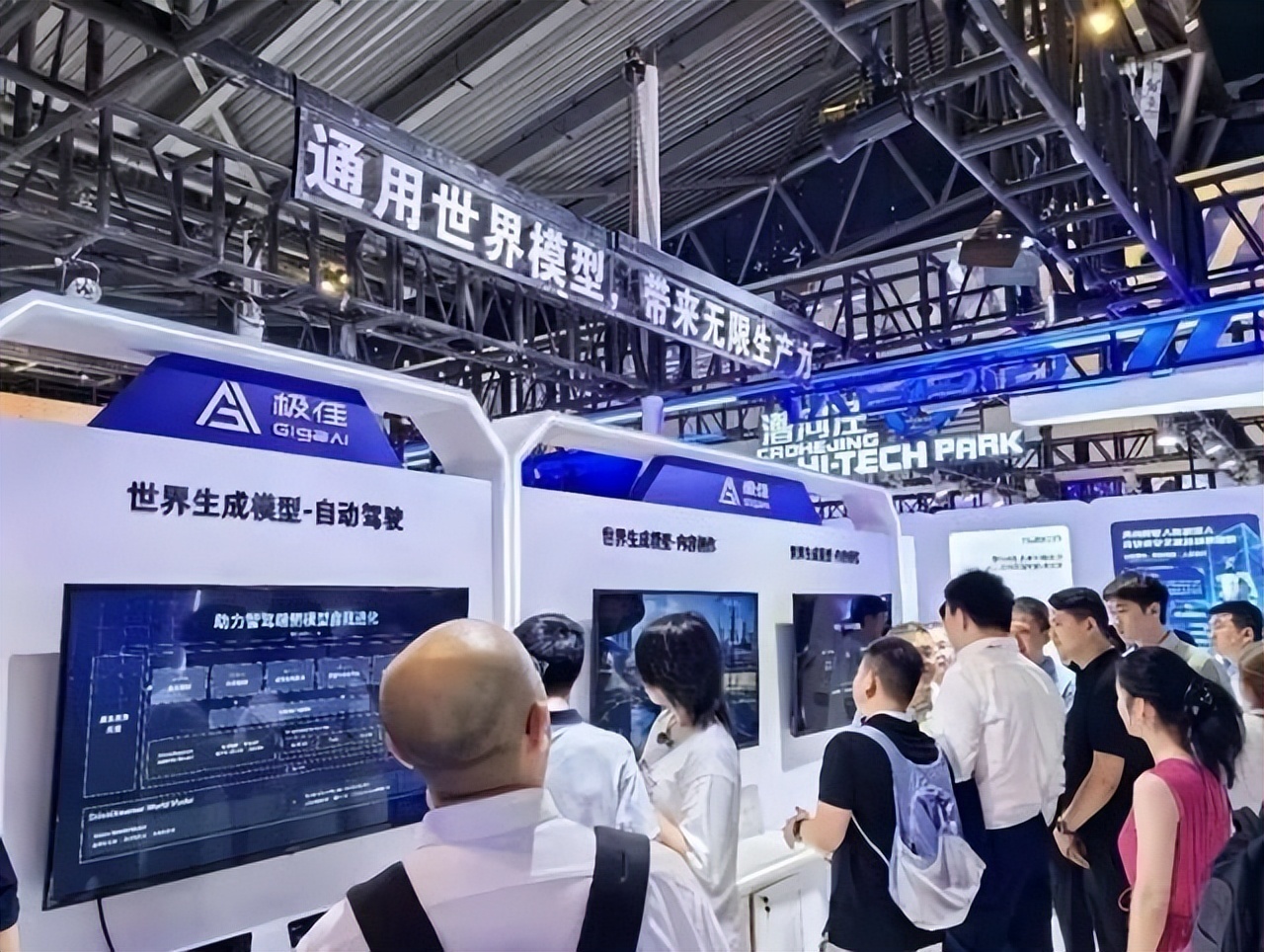
The wealth-creation myth of world models continues.
GigaVision, established 3 years ago, raised 3.5 billion RMB in three months, with a valuation of $3 billion.
At the 2026 WAIC conference, Huang Guan, founder and CEO of GigaVision (GigaAI), confirmed to the media that the company is about to complete a new round of financing, with a post-money valuation of approximately $3 billion (about 20.3 billion RMB).
However, regarding the Hong Kong stock IPO listing matter, the company explicitly stated that there are currently no undisclosed matters requiring disclosure, and no actions have been seen to publicly submit a Hong Kong stock listing application.
In terms of valuation alone, GigaVision has become the company with the highest valuation in the domestic world model track.
So, is a $3 billion valuation actually expensive?
Track soaring, capital betting crazily
Currently, capital is pouring into the embodied intelligence track, and the trend is flowing into the 细分 (niche) world model track.
A report released by KPMG China during WAIC 2026 shows: The number of financing rounds in the world model track has risen for five consecutive quarters, reaching 42 events in the first half of 2026, basically on par with the full year of 2025.
In financing events with disclosed amounts, 85% exceeded $10 million, with 17 events exceeding $100 million, 13 of which occurred in the first half of 2026.
From embodied intelligence bodies to world model brains, capital realizes that without the ability to understand the physical world, hardware strength is just a high-end toy.
World models are the breakthrough point: enabling robots to understand that water spills, boxes have weight, and actions have causality.
Looking globally, the heat of the entire track is clearly visible.
Figure AI leads with a $39 billion valuation; this company was founded in California, USA, in 2022, focusing on autonomous general-purpose humanoid robots.
Skild AI follows with a valuation exceeding $14 billion; the company was established in May 2023, focusing on the R&D of "general robot brains."
Physical Intelligence completed financing with a $5.6 billion valuation, potentially reaching $11 billion in new negotiations; this San Francisco-based company, founded in 2024, does not manufacture hardware, focusing solely on general AI models.
World Labs has a valuation of approximately $5 billion; the company was founded in April 2024 by "AI Godmother" Fei-Fei Li, focusing on spatial intelligence and world models.
Domestically, GigaVision's 20.3 billion RMB surpasses Zhi Ji Dynamics (post-money valuation of 15 billion RMB) and is basically on par with Galaxy General (post-money valuation exceeding 20 billion RMB), firmly ranking in the first tier.
Of course, core players are collectively sprinting towards IPOs. For example, Unitree Robotics obtained STAR Market IPO registration in July 2026. It raised 4.202 billion RMB, with an issuance ratio of no less than 10%, corresponding to a valuation of approximately 42 billion RMB.
Therefore, GigaVision's $3 billion valuation places it in the global top ten list within the first tier.
The track is already boiling.
What makes GigaVision able to hold its seat at this table?
To build a solid moat, follow a soft-hard integrated full-stack logic
Prior to this, GigaVision's valuation reputation was not prominent until financing accelerated starting in March this year. In three months, continuous financing rounds accumulated 3.5 billion RMB, jumping the valuation directly to 20.3 billion RMB ($3 billion), taking less than 4 months.
Ultimately, this is because GigaVision not only took a different path but also achieved industrialization landing, verifying the possibility of a commercial closed loop.
While peers cluster around building bodies, Unitree bets on mass production, and Zhiyuan Robot bets on scale.
GigaVision takes a different path, using world models as the core, extending downwards to robot bodies.
Models define hardware.
To this end, GigaVision constructed a full-stack system of "body hardware - data acquisition hardware - world model platform." In the context of full-stack layout, the world model track grants valuation premiums. Compared to pure body manufacturing or pure software model companies, this scarcity of "soft-hard integration" is a key bonus item allowing the valuation to stand at $3 billion.
And currently, this system has moved from the laboratory to the industrial site, with results already achieved in robot bodies.
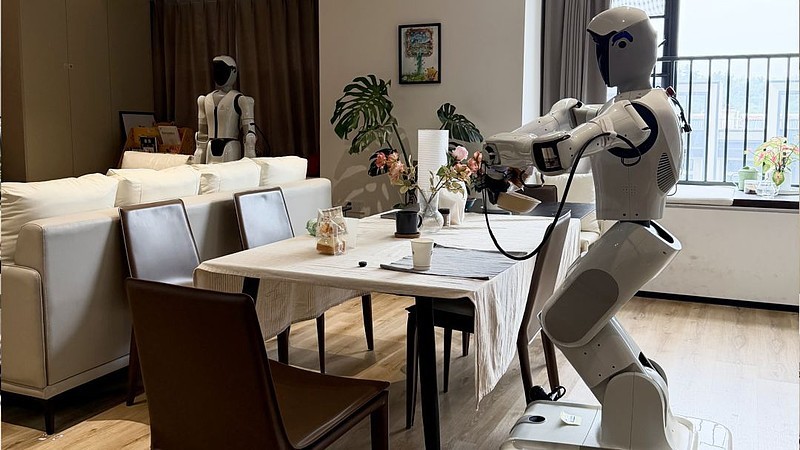
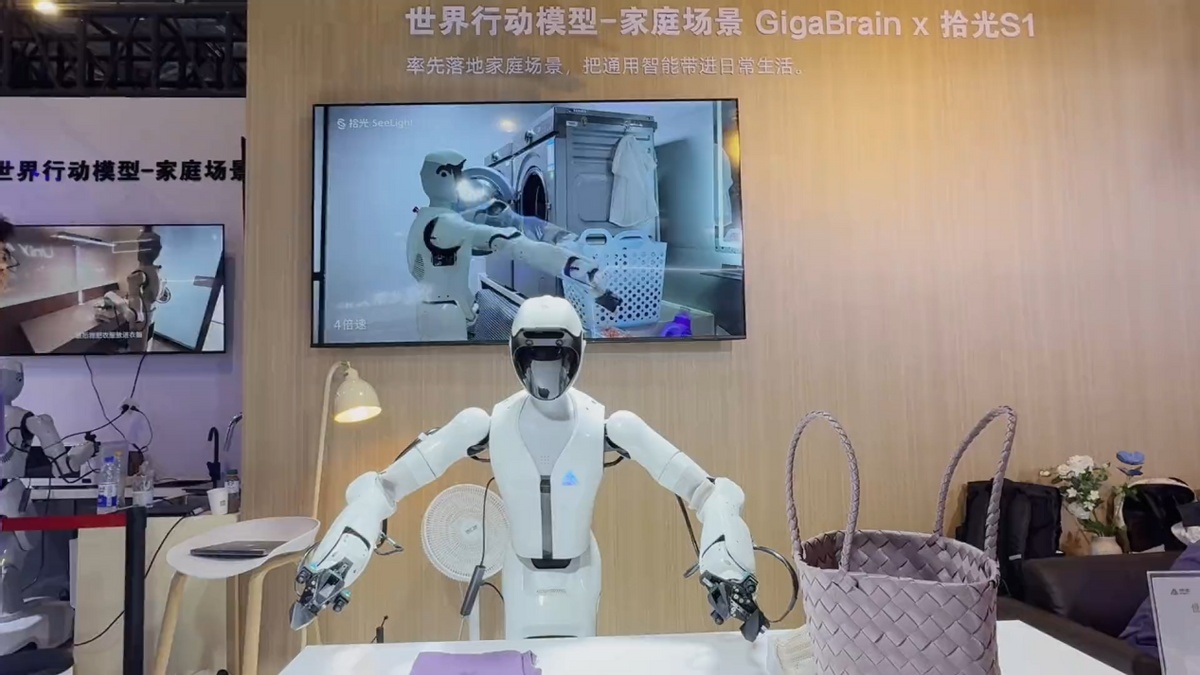
The Shiguang S1 launched by the company for home scenarios reached a cooperation agreement with Hubei Science and Technology Investment in May 2026, securing the first real order of 100 units in China.
On May 31, the first batch of robots went online at Wuhan Zhiyu Future Apartments, capable of cooking, folding clothes, and accompanying the elderly autonomously.
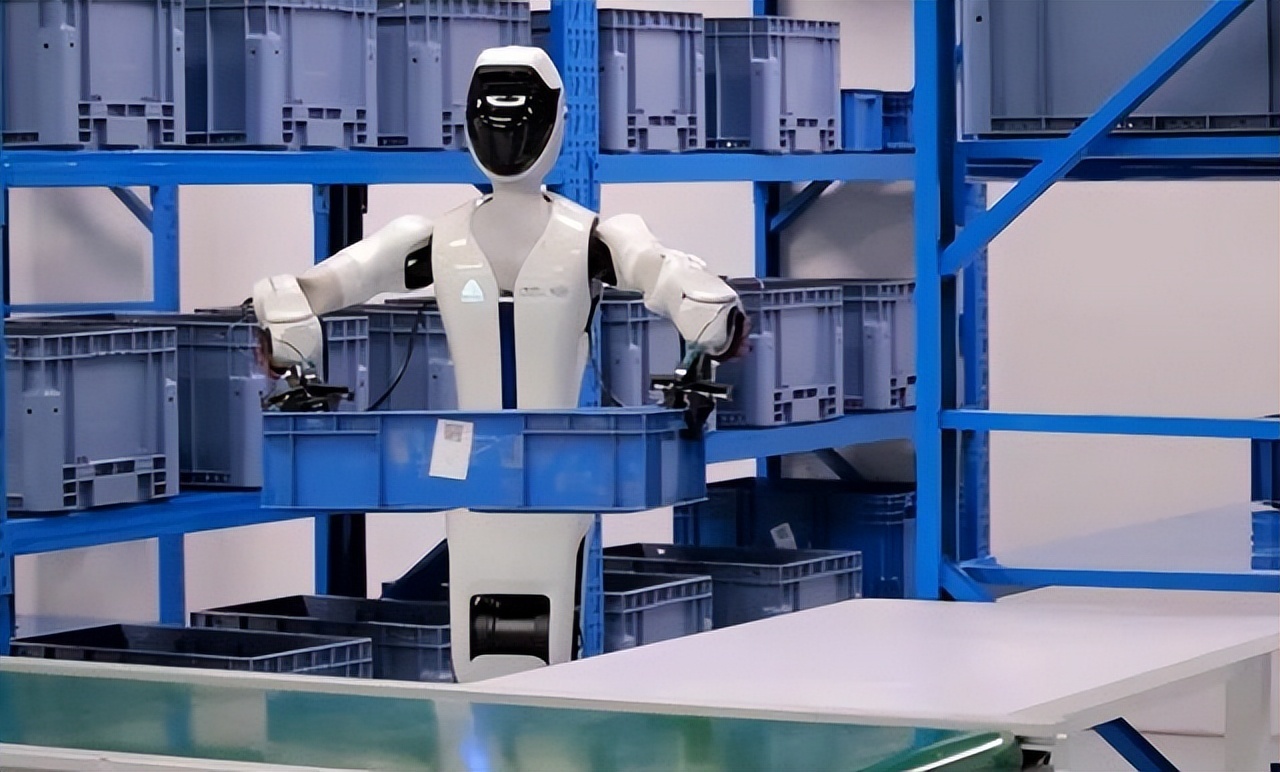
The Maker H01 for industrial scenarios demonstrated loading/unloading, handling, and joint assembly on site at WAIC.
GigaVision also collaborated with FAW Mold and Alibaba Cloud to complete China's first embodied intelligence full-process solution on a real automotive production line. Traditional scenario adaptation requires months, now compressed to weeks, showing product scenario maturity.
Data acquisition hardware has also landed.
The company's three products, M01 real-machine data acquisition, U-01 handheld data acquisition, and E-01 Ego data acquisition, cover real-machine teleoperation, handheld first-person, and third-person perspectives.
These all hit industry pain points: Where does high-quality physical data come from?
Without data acquisition capabilities, it is impossible to train a true physical world model.
Therefore, GigaVision highly values the worth of data acquisition hardware, launching self-developed products. The company expects to achieve cumulative training data of 1 million hours by the end of 2026.
The world model platform is also not pie in the sky.
GigaBrain and GigaWorld have connected with head customers such as FAW, JD.com, and China Post EMS; the DriveDreamer driving simulation product has served over 30 automakers.
In June 2026, strategic investment by industrial capital such as Wanxiang Qianchao marked that DriveDreamer officially passed automotive-grade certification and entered pre-installation mass production 定点 (designated projects).
In other words, related technologies have secured mass production orders from over 30 automakers and will soon be delivered to ordinary consumers along with mass-produced vehicles.
Fully solving how to feed data and how to train models
Supporting the above industrialization landing is GigaVision's "double pyramid" system, with two core things: how to feed data, how to train models, thereby polishing the world model platform.
Data Pyramid: Solving "what to feed".
For models to be smart, they must first be fed enough good data. But physical world data is far more complex than text; robots need to understand that water spills, boxes have weight, and these "physical common sense" cannot be found via internet search.
GigaVision divides data into five layers, from low to high: Internet video → Human data → World model simulator → Synthetic simulation data → Real machine data.
The first two layers are basic textbooks.
Internet videos let models know what "pouring water" roughly looks like; human data is collected through handheld and head-mounted devices, letting models see human operation techniques. These two layers solve "have you seen it?"
The middle two layers are mock exams. In the simulated environment generated by GigaWorld, models can practice repeatedly; falling ten thousand times costs nothing.
The top layer is real-machine combat. Data generated when Shiguang and Maker series work in real scenes flows back directly for training. This is the hardest to obtain and most valuable data—even if simulation is good, it must truly work in reality eventually.
All five layers are indispensable.
Without bottom-layer data, models are illiterate; without simulation data, training costs are unbearable; without real-machine data, models live forever in a virtual world.
GigaVision is the only company in China to fully run through these five layers.
Algorithm Pyramid: Solving "how to train".
With data, how to train? GigaVision divides it into three stages:
Stage 1, World Simulation. Understanding physical laws in simulated environments—water flows, objects fall, forces transmit. This is laying the foundation.
Stage 2, Action Alignment. Transferring abilities learned in simulation to real machines. Pouring water perfectly in simulation might result in shaking when done on a real machine. This layer solves the gap between "virtual and reality."
Stage 3, Experience Reinforcement. New data generated after real-machine work flows back to the model, getting better with more work—the data flywheel turns: the more it works, the smarter it gets; the smarter it gets, the better it works.
Most companies only do one or two layers; GigaVision did them all. GigaWorld is responsible for generating simulated environments, while GigaBrain is responsible for transferring to real machines and continuous evolution.
In March 2026, GigaWorld-1 scored 62.34 at WorldArena (the world's most authoritative physical world model evaluation platform), being the only one in the field to exceed 60 points.
Its physical adherence dimension is 16% higher than the second place; it understands best how the physical world operates. Its 3D accuracy approaches perfection. Google and NVIDIA are right behind it.
In RoboChallenge (the world's largest-scale real-machine evaluation), GigaBrain-0 won the championship with a 51.67% task success rate, leading Physical Intelligence by nearly 10 percentage points. For real robot work, it is the most reliable.
After open-sourcing core code and datasets, HuggingFace downloads broke 16,000 times in half a month.
Global developers downloaded, tested, and reproduced; peers voted with their actions.
Valuation breakdown: Is 20.3 billion expensive?
From a financing perspective, the company's soaring valuation also carries hidden dangers.
The company was established in 2023, completing a seed round of tens of millions. In 2024, nearly 50 million angel and angel+ rounds. In 2025, tens of millions of angel++ rounds, Pre-A and Pre-A+, two consecutive rounds of hundreds of millions.
In 2026, GigaVision's financing rhythm accelerated suddenly.
In March, nearly 1 billion RMB Pre-B round; in April, nearly 1.5 billion RMB B1 round; in June, another 1 billion RMB B2 round. Cumulative financing of 3.5 billion RMB in three months, valuation leaping from tens of billions to 20.3 billion RMB ($3 billion).
While valuation expands, the market inevitably worries: how big is the bubble?
Generally, for unprofitable embodied intelligence enterprises, the primary market usually uses PS (Price-to-Sales) as the core, supplemented by sum-of-the-parts valuation—different business lines given different PS multiples, finally summed up.
GigaVision has three business blocks: robot bodies, data acquisition hardware/data services, and world model platforms.
Each corresponds to different valuation logics.
Robot Body Business: Corresponds to current 15-27x.
Referencing benchmark enterprise UBTECH's predicted PS of approx. 13.88-26.7x in 2026; Unitree Robotics STAR Market IPO, based on 42 billion RMB valuation corresponding to 1.699 billion RMB revenue in 2025, PS is approx. 25x.
Humanoid robot bodies are in the early stage of industrialization, with small revenue bases and high growth rates; the market granting 15-27x PS aligns with pricing conventions for hard tech companies in HK and A-shares.
Data Acquisition Hardware/Data Services: Corresponds to current 20-30x.
Haitian Ruisheng focuses mainly on AI training data collection and annotation, PS approx. 20x; Xunce Technology focuses on real-time data infrastructure and AI data analysis, PS approx. 24x.
GigaVision's data acquisition hardware possesses dual attributes of "data infrastructure" and AI concepts; its valuation should be higher than traditional hardware companies, making the 20-30x range reasonable.
World Model Platform: Corresponds to current 30-70x.
Zhipu AI's valuation was approx. 24.4 billion RMB during its B6 round financing, corresponding to annual revenue of approx. 350 million RMB, PS close to 60x. As the "brain" layer of embodied intelligence, the technical scarcity of world models is no less than general large models; the market is willing to pay a premium for potential platform-level value.
Based on the above multiples, looking at GigaVision's existing valuation:
Robot Bodies: Assuming 2026 revenue of 250 million RMB (100 home orders with unit price approx. 200,000 RMB/unit contribute approx. 20 million RMB; industrial scene Maker series aiming for 1,000 units delivery annually, estimated at higher industrial robot unit prices, combined total reaches 250 million RMB). 15-27x PS, corresponding to 3.75-6.75 billion RMB.
Data Acquisition Hardware/Data Services: Assuming 2026 revenue of 200 million RMB (three data acquisition products sold to research institutions and peers, plus data service revenue after accumulating 1 million hours of data by end of 2026). 20-30x PS, corresponding to 4-6 billion RMB.
World Model Platform: Assuming 2026 revenue of 250 million RMB (mass production designated projects for DriveDreamer for over 30 automakers, model licensing and solution revenue from head customers like FAW/JD/China Post EMS). 30-70x PS, corresponding to 7.5-17.5 billion RMB.
Summing the three items, GigaVision's neutral valuation range is 15.25-30.25 billion RMB. Current 20.3 billion RMB sits exactly in the middle of the range.
Evidently, this price includes both the premium for technological scarcity—GigaWorld-1 ranked #1 globally, GigaBrain-0 won championships, companies achieving both simultaneously worldwide are few; and reflects the discount in the early commercialization stage—home scenes only pilot 100 units, industrial scenes 1,000-unit deployment not yet completed, model capability ceilings insufficient to support large-scale commercialization.
The 20.3 billion RMB offered by the primary market is a pricing of "believing you can succeed," believing world models are the inevitable path to physical AGI, and also believing GigaVision is currently the most likely domestic company to run through this path.

From the perspective of Hong Kong stock IPOs, 2026 is undoubtedly a capital year for the robotics industry.
As of the end of June 2026, in the Hong Kong stock market alone, there are over 40 related queued enterprises. Luoshi Robotics, Yifei Technology, Xingong Intelligence, etc., have taken the lead in listing on the HKEX. Among them, Xingong Intelligence listed on June 24, hailed as the "First Stock of Robot Brains" on the Hong Kong Stock Exchange.
HKEX Rule 18C was introduced in March 2023, allowing special technology companies to list after meeting market cap and revenue thresholds; expected market cap upon listing for commercialized companies must be no less than 4 billion HKD.
Referencing listed targets, initial PS generally ranges from 20-40x; pure AI model targets saw PS exceed 100x post-listing.
Objectively speaking, the current $3 billion is the market's early vote for the vision of "physical world AI infrastructure."
The copyright of this article belongs to the original author/organization.
The views expressed herein are solely those of the author and do not reflect the stance of the platform. The content is intended for investment reference purposes only and shall not be considered as investment advice. Please contact us if you have any questions or suggestions regarding the content services provided by the platform.
