



Youxin lands in Keqiao, the Costco of the auto industry
Saw the news of Uxin's new store signing, landing in Shaoxing Keqiao Economic Development Zone. Let's briefly discuss this store's situation:
1.
The project plans a total investment of 500 million yuan, with a first-phase land area of about 90 mu and a building area of approximately 110,000 square meters, with a capacity exceeding 2,500 units. Once completed, it will become Zhejiang's first used car remanufacturing complex.
I understand this store was established according to Uxin's Yangtze River Delta hub logic.
Shaoxing has a permanent resident population of over 5 million and nearly 2 million vehicles on the road. The local private economy, manufacturing, and commerce foundations are quite good. Based on previous calculations where 500,000 people correspond to a capacity of 1,000 units, this is slightly conservative, but fortunately, it allows for flexibility in expansion or contraction.
In terms of location, Keqiao Economic Development Zone is relatively close to Hangzhou Xiaoshan Airport, situated between Hangzhou, Shaoxing, and Ningbo. It belongs to an industrial and transportation corridor, and the park discloses a service radius of 200 kilometers for the project. It can attract cross-city customers from the Hangzhou metropolitan area, Shaoxing, and some cities in eastern Zhejiang. Adding these up, a capacity of 2,500 units is considered a relatively conservative plan.
2.
For the Keqiao Economic Development Zone store, the main focus is on its business formats.
Official news from Keqiao Economic Development Zone states that besides Uxin's warehouse-style supermarket, the Shaoxing project will also introduce sports venues, themed dining, trendy retail, and automotive experience spaces, built with the concept of an automotive lifestyle complex.
This type of large warehouse-style store by Uxin is basically equivalent to the automotive version of Sam's Club or Costco. The large-area warehouse display naturally attracts traffic, leans towards destination consumption, has a larger regional radiation radius, and rent costs can be kept relatively low.
Automobiles are still low-frequency, high-ticket durable goods consumption. Buying a car is often a joint family decision, and additionally, inspection, test drives, financing, transfer, and maintenance require considerable time. By integrating similar experiential formats like dining and sports, consumers can save a lot of hassle. From an operational perspective, this also turns the consumer's waiting time for purchasing a car into consumption time.
On June 23, the Ministry of Commerce and other departments announced 40 pilot cities for automotive circulation and consumption reform, including Hangzhou and Shaoxing. The document explicitly encouraged the integration of commerce, tourism, culture, sports, and health, as well as new scenarios and business formats. Planning the Shaoxing store this way aligns highly with the local direction for automotive consumption pilots.
Comparatively, the Xi'an large warehouse store is a standard warehouse-style supermarket. If the Shaoxing Keqiao store can be built into a regional commercial landmark, Uxin's single-store demonstration effect would be stronger, and it is estimated to accelerate introductions in other regions.
3.
Among the 12 operating or under-construction cities publicly disclosed by Uxin, 10 overlap with the 40 reform pilot cities this time.
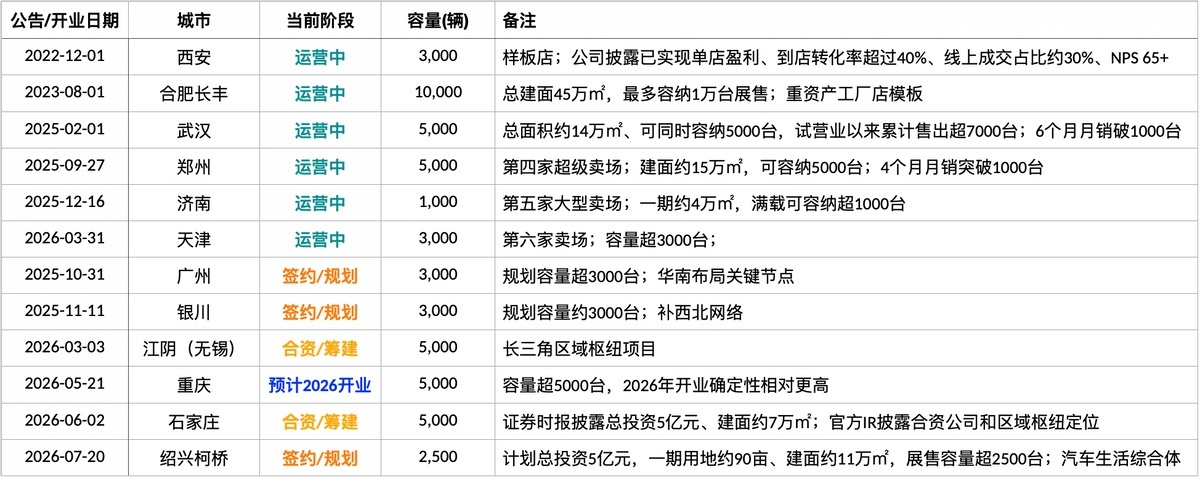
From a site selection logic perspective, subsequent stores will likely fall within the 40 automotive circulation pilot cities, where land, approvals, automotive consumption scenarios, and local industrial support are more complete, making it easier to undertake heavy-asset warehouses.
Currently, Uxin has 6 warehouse factory stores in operation. The Tianjin store opened in March this year, while projects in Jiangyin, Chongqing, Shijiazhuang, and Shaoxing have been advancing successively. Guangzhou and Yinchuan are reserve projects signed last year but still pending fulfillment. The company publicly disclosed planned capacity for warehouse factory stores has reached approximately 50,500 units. Assuming mature stores overall can maintain an inventory turnover of about 30 days, the current corresponding theoretical annual retail capacity is about 600,000 units.
According to the goal previously given by the company, there will be 4-6 new stores added in 2026. Deducting the already opened Tianjin store, 3-5 more need to be landed in the second half of the year.
4.
The China Automobile Dealers Association released the latest data: In the first half of 2026, the cumulative transaction volume of used cars nationwide was 9.7132 million units, a year-on-year increase of 1.50%, with a cumulative transaction amount of 638.53 billion yuan, and an average price per vehicle of about 65,700 yuan. During the same period, the retail volume of new passenger cars was about 8.7 million units, and the used car transaction volume exceeded new car sales for the first time. The automotive market is shifting from incremental-driven to stock circulation.
However, the used car industry has not yet fully entered a prosperous track. The single-month decline in June was 2.36% year-on-year, and the Used Car Manager Index was 43.5%, still below the boom-bust line.
Against the backdrop of continuous price cuts in new cars, small used car dealers face significant pressure to clear inventory, and the industry is still in an accelerated clearing stage.
Continuing the previous judgment, industry clearing actually benefits high-turnover large warehouses like Uxin. Low-cost land acquisition, talent reserves, and rapid store openings prepare for subsequent volume increases.
$Uxin(UXIN.US) $Carmax(KMX.US) $Costco Wholesale(COST.US)
The copyright of this article belongs to the original author/organization.
The views expressed herein are solely those of the author and do not reflect the stance of the platform. The content is intended for investment reference purposes only and shall not be considered as investment advice. Please contact us if you have any questions or suggestions regarding the content services provided by the platform.
