


67.24 million to 103 million: Heatstroke prevention index instrument sees a steady 6.3% growth, the "life talisman" for high-temperature work continues to spread
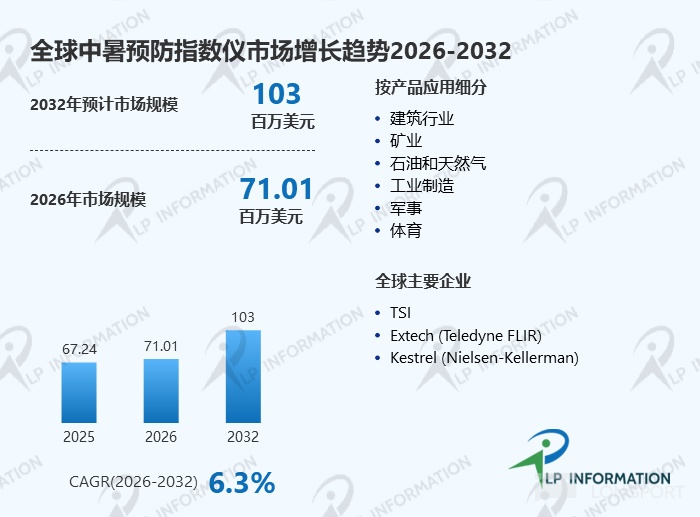
According to research data from LP Information, the global market size for Heat Stress Index Meters (Heat Stress Monitors) was approximately $67.24 million in 2025 and is projected to reach $103 million by 2032, with a Compound Annual Growth Rate (CAGR) of approximately 6.3% during the 2026-2032 period. In 2025, the global production volume of heat stress index meters was approximately 285,000 units, with an average global selling price of about $241 per unit.
Heat stress index meters are professional monitoring devices used to assess human thermal stress risks in high-temperature environments. By collecting data such as ambient temperature, humidity, black globe temperature, natural wet-bulb temperature, wind speed, and radiant heat, and combining this with models like WBGT (Wet Bulb Globe Temperature) and heat index, they comprehensively analyze actual human thermal exposure levels and output risk grades, alarm prompts, and safety management recommendations.
Different from traditional temperature and humidity detection equipment, heat stress index meters focus more on human thermal load rather than single environmental temperature indicators. These products help enterprises solve issues such as lagging risk identification, reliance on manual experience for judgment, and lack of data tracking in high-temperature operation management. They are currently widely applied in construction, mining, industrial manufacturing, oil and gas, power energy, agriculture, military training, sports events, fire rescue, and public health management.
In recent years, global climate change has led to an increased frequency of extreme high-temperature weather, enhancing the importance of labor protection and occupational health management in high-temperature environments. Enterprises and government agencies are gradually shifting from traditional "high-temperature warnings" to "thermal risk quantitative management," driving the development of heat stress index meters from professional testing tools toward digital safety management equipment.
Market Segmentation Analysis: Portable Products Dominate, Smart Connected Devices Become Growth Direction
By Product Type: Portable Devices Remain the Main Market
By product form, heat stress index meters mainly include portable, fixed, and other types. Among them, portable devices currently dominate the market, mainly used for on-site inspections, occupational hygiene testing, and outdoor operation risk assessment.
Portable products feature simple deployment, flexible use, and lower costs, making them widely applicable in scenarios such as construction sites, mines, energy facilities, and sports training. Fixed monitoring systems mainly target large industrial enterprises, production bases, and public facilities, achieving regional thermal risk management through long-term continuous monitoring.
With the digital upgrade of enterprise safety management, the market demand for future fixed devices, wireless sensor networks, and wearable thermal risk monitoring devices is expected to rise rapidly.
By Function: Penetration Rate of Networked Products Continues to Increase
By function classification, heat stress index meters can be divided into interconnected and non-interconnected products.
Traditional non-interconnected devices mainly meet immediate on-site detection needs, suitable for small-scale operation environments. Interconnected devices achieve remote data transmission, centralized management, and risk warning through communication technologies such as Bluetooth, Wi-Fi, LoRa, and Industrial IoT.
As enterprise EHS (Environment, Health, Safety) management systems gradually digitize, intelligent devices with data upload, cloud analysis, and automatic alarm functions are becoming the focus of industry development.
By Application Field: Industrial Safety Sector Contributes Main Demand
Currently, heat stress index meters are mainly applied in construction, mining, oil and gas, industrial manufacturing, military, and sports fields.
The construction and mining industries, due to long-standing high-temperature, outdoor, and high-intensity operation environments, are the primary sources of equipment demand. The oil and gas and power energy sectors, due to complex production environments, have high demand for continuous thermal risk monitoring equipment.
Military training, sports events, and public health fields focus more on personnel safety management, reducing health risks caused by high-temperature environments through real-time monitoring.
Global Competitive Landscape Analysis: European and American Enterprises Lead in Technology, Asian Manufacturers Rise Rapidly
The current global heat stress index meter market shows a competitive landscape where professional instrument enterprises occupy the high-end market, while Asian enterprises expand their market share relying on manufacturing advantages.
The North American market is mature in occupational safety, industrial hygiene, and military training, with relevant regulatory systems driving enterprises to purchase professional thermal stress monitoring equipment. Enterprises such as TSI, Kestrel (Nielsen-Kellerman), and Extech (Teledyne FLIR) have strong influence in the field of high-precision thermal environment monitoring equipment.
European enterprises pay more attention to occupational hygiene, industrial environment monitoring, and continuous data management solutions. Enterprises such as LSI LASTEM, Senseca Italy Srl, and PCE Instruments have deep accumulation in industrial-grade monitoring systems.
The Japanese market has long focused on heat stroke prevention and labor safety management. Enterprises such as Kyoto Electronics Manufacturing, SATO KEIRYOKI MFG, and A&D Company have formed a relatively complete product system, covering portable devices and fixed monitoring systems.
Taiwanese Chinese and mainland Chinese enterprises are developing rapidly in the mid-range market and OEM/ODM fields, leveraging advantages in electronic manufacturing, sensor integration, and cost. These include Tas Electronic, Hengxin AZ, Lucang Electronic, Scarlet Tech, and Shiji Jiantong.
According to market research data, in 2025, the North American region accounted for approximately 46% of the market share, the Asia-Pacific region for approximately 37%, and the top 5 global enterprises held over 50% market share, indicating high market concentration.
Main Market Driving Factors Analysis: High-Temperature Risk Management Demand Becomes Long-Term Growth Driver
Increased Extreme High-Temperature Weather Drives Thermal Risk Monitoring Demand
Global climate change is increasing the frequency of high-temperature events, exposing construction workers, mine employees, agricultural laborers, and outdoor workers to higher thermal stress risks.
Traditional management methods mainly rely on weather information and manual judgment, unable to accurately reflect the actual thermal load borne by the human body. Heat stress index meters calculate risk indicators by comprehensively analyzing environmental parameters, enabling enterprises to take early measures such as adjusting working hours and increasing cooling measures, thereby improving safety management levels.
Improvement of Occupational Health Regulations Promotes Equipment Application
In recent years, the United States, Europe, Japan, and other industrialized countries have continuously strengthened occupational health protection requirements, proposing clearer standards for high-temperature operation risk management.
To meet occupational safety supervision requirements, enterprises need to establish more scientific data-driven thermal risk management systems, leading to an increasing demand for purchasing professional thermal index monitoring equipment.
Enterprise EHS Digital Transformation Drives Smart Product Development
Industrial enterprises are shifting from traditional manual safety inspections to digital safety management models.
By integrating with IoT platforms, heat stress index meters can achieve real-time monitoring, historical data analysis, risk trend prediction, and automatic alarms, improving enterprise safety management efficiency and becoming an important growth driver for the future market.
Main Market Restraining Factors Analysis: Standard Differences and Cost Pressure Affect Industry Development
Regional Differences Exist in Industry Standard Systems
There are certain differences in high-temperature risk evaluation indicators among different countries and regions, such as WBGT calculation methods, occupational exposure standards, and alarm threshold settings.
When 布局 ing globally, enterprises need to adjust product designs and certification systems according to regional regulatory requirements, increasing market promotion costs.
High Costs of Premium Products Limit Popularization in Some Markets
Smart devices with high-precision sensors, wireless communication, and cloud platform functions have high costs. For SMEs and users in developing countries, there is still some pressure regarding initial procurement investment.
Some enterprises still adopt traditional temperature and humidity detection methods, affecting the rapid popularization of high-end thermal risk monitoring equipment.
Uncertainty in Core Component Supply
Heat stress index meters rely on electronic components such as temperature and humidity sensors, chips, and communication modules. Fluctuations in the global semiconductor supply chain may affect product costs and delivery cycles.
Enterprises need to strengthen diversified supply chain layouts to improve production stability.
Emerging Trends Analysis: Intelligence, Connectivity, and Personalization Become Future Directions
Upgrading from Measurement Devices to Comprehensive Thermal Safety Management Platforms
In the future, heat stress index meters will no longer be just single environmental detection tools but will gradually integrate data collection, cloud computing, AI analysis, and risk prediction functions.
Enterprises will focus more on overall thermal risk management capabilities, including personnel exposure time analysis, regional risk maps, and smart warnings.
Rapid Development of Wearable Thermal Monitoring Devices
With advances in micro-sensors and low-power communication technologies, wearable thermal stress monitoring devices are becoming a new development direction.
These products can directly monitor individual exposure risks of workers, showing significant application potential in military, industrial manufacturing, fire rescue, and sports training fields.
IoT Technology Promotes Popularization of Remote Monitoring
In the future, large industrial scenarios will adopt fixed sensor networks more extensively, achieving synchronous monitoring across multiple areas and improving enterprises' overall thermal risk management capabilities.
Regional Market Leadership Analysis: North America Maintains Lead, Asia-Pacific Becomes Growth Core
North American Market: Maintains Leading Position Driven by Regulations
Due to a well-improved occupational safety supervision system, industrial enterprises in North America invest heavily in thermal risk management, making it one of the largest markets for heat stress index meters globally.
Stable demand for professional thermal monitoring equipment in US construction, energy, manufacturing, and military sectors drives the market to maintain a high penetration rate.
Asia-Pacific Market: Industrial Development Brings Growth Opportunities
The Asia-Pacific region is one of the areas with the greatest future growth potential. Continuous development in manufacturing, construction, and infrastructure in China, India, Southeast Asia, etc., leads to an increase in the number of workers in high-temperature operations, constantly raising the demand for thermal risk monitoring.
Meanwhile, countries like Japan and Singapore have mature application experiences in high-temperature health management, which will drive technological upgrades in the regional market.
European Market: Emphasizes Occupational Health and Industrial Intelligence
The European market focuses more on occupational health, safe production, and industrial digital management, showing high demand for highly reliable, networked thermal monitoring equipment.
Recent Industry Development Dynamics Analysis
In recent years, the focus of the heat stress index meter industry has mainly centered on smart hardware upgrades, data management platform construction, and expansion of application scenarios.
On one hand, equipment manufacturers continue to improve sensor precision and communication capabilities, transforming products from simple measurement tools into smart safety terminals; on the other hand, enterprises begin exploring integration with industrial internet and EHS management software to improve thermal risk management efficiency.
Additionally, with rising global attention to climate risks and worker protection, the procurement demand for thermal risk monitoring equipment by government agencies, enterprises, and public safety departments is increasing.
Global Heat Stress Index Meter Industry Development Trend Outlook
Overall, the heat stress index meter market will continue to grow steadily in the future. With increased extreme high-temperature weather, stricter occupational safety regulations, and upgraded enterprise digital management, market demand will shift from traditional handheld devices toward intelligent comprehensive solutions.
The focus of future industry competition will concentrate on three aspects: first, high-precision sensing technology; second, data networking and intelligent analysis capabilities; third, solution capabilities tailored to different industry scenarios.
Enterprises possessing core sensor integration capabilities, software platform capabilities, and global service systems are expected to gain greater advantages in future market competition.
Main Product Classification
By Product Type:
- Portable
- Fixed
- Other
By Function:
- Interconnected
- Non-interconnected
By Response Category:
- Standard Response
- Rapid Response
By Application Field:
- Construction Industry
- Mining
- Oil and Gas
- Industrial Manufacturing
- Military
- Sports
- Other
Main Covered Regions
Americas:
United States, Canada, Mexico, Brazil
Asia-Pacific:
China, Japan, South Korea, Southeast Asia, India, Australia
Europe:
Germany, France, UK, Italy, Russia
Middle East and Africa:
Egypt, South Africa, Israel, Turkey, Gulf Region Countries
Main Enterprises
TSI
Extech (Teledyne FLIR)
Kestrel (Nielsen-Kellerman)
Kyoto Electronics Manufacturing
SATO KEIRYOKI MFG
LSI LASTEM
A&D Company
SIBATA SCIENTIFIC TECHNOLOGY
Senseca Italy Srl
REED Instruments
PCE Instruments
Tas Electronic
Sper Scientific Instruments
General Tools & Instruments
Scarlet Tech
Hengxin AZ
Lucang Electronic
Triplett Test Equipment & Tools
Shijun Electronic
Shiji Jiantong
The copyright of this article belongs to the original author/organization.
The views expressed herein are solely those of the author and do not reflect the stance of the platform. The content is intended for investment reference purposes only and shall not be considered as investment advice. Please contact us if you have any questions or suggestions regarding the content services provided by the platform.
