


 Likes Received
 Posts
PostsTSMC is being swept by Calls, while equipment stocks are hitting a Put wall
The direction for bulls and bears in the semiconductor sector unified last night, but structural divergence remains: at the index level, SMH saw two tranches of sold Puts to collect rent, while others added deep out-of-the-money Calls to bet on elasticity. At the individual stock level, equipment and component stocks like Corning, Teradyne, and Marvell took a combined Put wall exceeding $10M; the largest single bullish position of $5.06M went to TSMC, with Calls being swept across expirations at the same strike price. Bullish positions of $67.80M vs. bearish positions of $60.84M are nearly flat, with all the divergence hidden in positioning.
━━━━━━
$Taiwan Semiconductor(TSM.US)
Direction: Bullish 🟢
Expiration: 2026-07-24 / 2026-07-31 (main legs) / 2026-11-20 (tail leg)
Strike Price: $410 (main) / $407.5
Notional Size: Approximately $5.06 million in total (Top Long for the day)
Volume: 2,184 contracts (7/24 leg) + 2,510 contracts (7/31 leg) + 86 contracts / 44 contracts
Structure Type: Same-strike cross-expiration relay Buy Call (asymmetric calendar-style position building with near-term weight exceeding 90%)
Data Highlights: Q2 earnings on 7/16 significantly beat expectations—Revenue $40.2 billion (+33.7% YoY), EPS per ADR $4.31 vs. consensus $3.81, Q3 guidance $44.6-45.8 billion; however, the underlying stock followed the sector's decline, dropping from $434.11 on 7/10 to a low of $386.02 on 7/17, only recovering to $402.30 on 7/20. At this level, within the first 11 minutes of the morning session, $410 Calls were bought in a relay by the 7/24 and 7/31 expirations totaling $4.72M, with the strike price hugging the current price.
Bullish Viewpoint Comparison: JPMorgan characterized this 20% pullback in the SOX as "capital reallocation rather than fundamental deterioration," highlighting TSMC's earnings as a rebound catalyst and noting HBM supply tightness until 2028; early this morning, Nikkei reported further that TSMC will implement a comprehensive 5%-10% price increase for foundry services starting in 2027, with mature processes seeing up to a 10% hike, and negotiations wrapped up in July. The pre-market stock price surged directly to $417.48, already standing above the $410 strike price.
My Viewpoint: This TSMC bullish line had foreshadowing back on 6/29—at that time, someone sold a $11.46M Put expressing "it won't fall further," and later the money from options was swapped for a more aggressive posture, directly buying Calls to relay. Earnings beat, raised guidance, and price hikes landed—a triple hit on fundamentals against only sector sentiment—the $410 ATM Call used short legs with DTE4 and DTE11 to bet that "the market must acknowledge it within two weeks." This batch of money entering last night is already winning at the starting line in today's pre-market.

━━━━━━
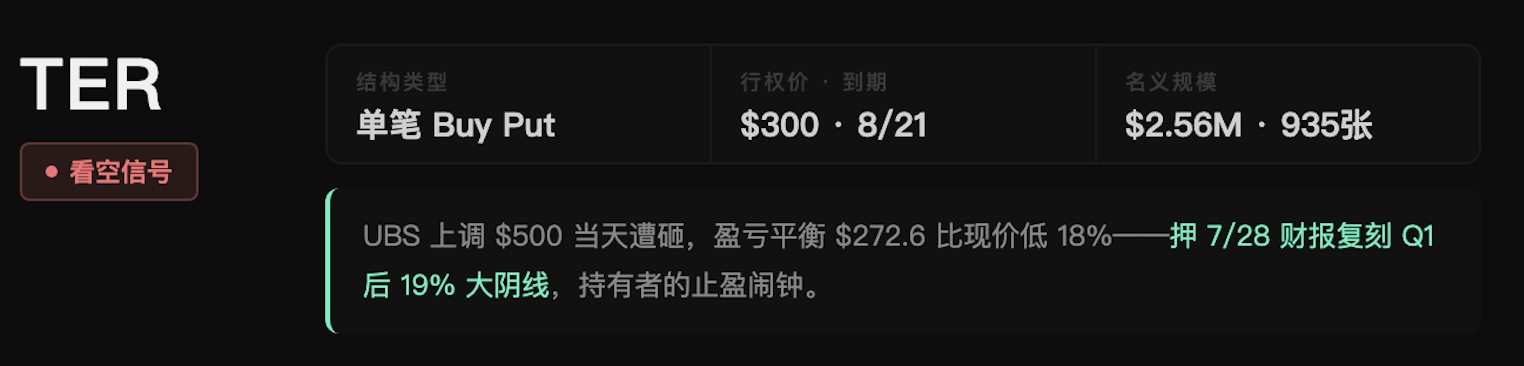
$Teradyne(TER.US)
Direction: Bearish 🔴
Expiration: 2026-08-21
Strike Price: $300
Notional Size: Approximately $2.56 million (largest fresh single order in the semiconductor equipment Put wall)
Volume: 935 contracts (avg price $27.39)
Structure Type: Single medium-term Out-of-the-Money Buy Put (OTM 11.7%)
Data Highlights: On 7/20, UBS raised its target price from $440 to $500, with the stock intraday surging to $351.23 and closing at $333.76; just during the morning rally, someone bought $2.56M worth of 8/21 $300 Puts. On the same day, a Put cluster from Corning ($4.46M), Marvell ($2.32M), Microchip ($1.27M), and Credo ($1.63M) surrounded the equipment and component chain.
Bullish Viewpoint Comparison: The bull camp is lively—up about 140% year-to-date, Cantor gave $550, and UBS just raised to $500; but Wall Street's average target price is only $399, already surpassed by the current price. Q2 earnings after hours on 7/28 are an open card: the company guided non-GAAP EPS at $1.86-2.15, with the midpoint lower than Q1's actual $2.56; the last Q1 earnings set a record, yet the stock still fell 19% the next day. Director Marilyn Matz reduced holdings by 1,200 shares on 7/16.
My Viewpoint: This Put isn't about a grand narrative of bearishness toward semiconductor equipment, but a precise earnings event short—the 8/21 expiration perfectly captures the 7/28 earnings, with a breakeven of $272.6, 18% below the current price, almost replicating the template of that 19% big bearish candle after Q1 earnings. Momentum rose 140%, the average target price is inverted by the current price, and the guidance midpoint is declining quarter-over-quarter; this combination played out once before in Q1.
━━━━━━
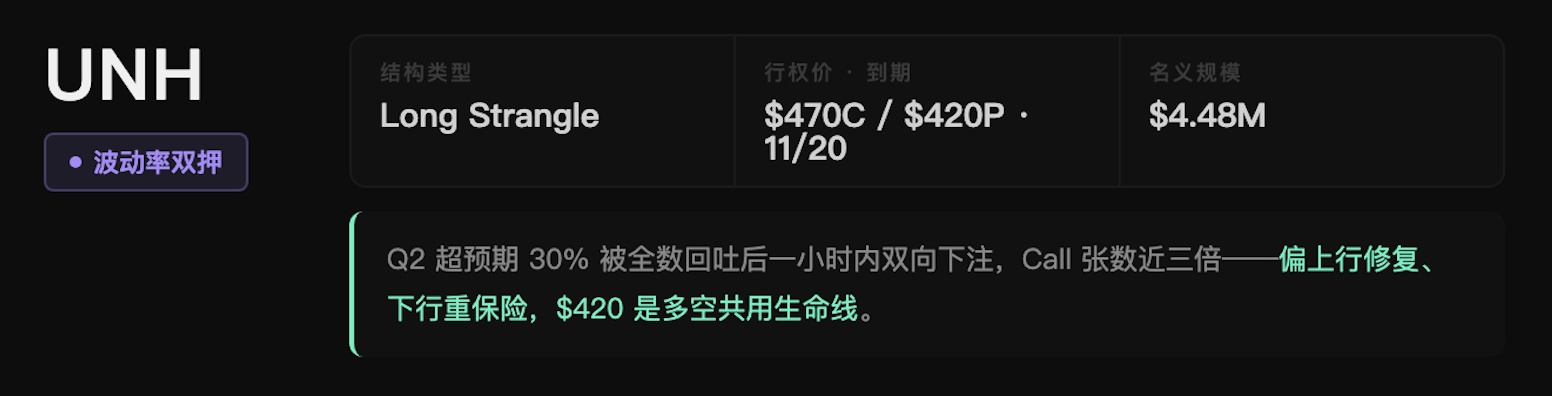
$Unitedhealth(UNH.US)
Direction: Two-way (betting on volatility) 🟣
Expiration: 2026-11-20 (both legs expire simultaneously)
Strike Price: $470 (Call) / $420 (Put)
Notional Size: Approximately $4.48 million in total
Volume: 1,717 contracts (Call ×2 split orders) + 616 contracts (Put)
Structure Type: Long Strangle (pure buyer strangle · asymmetric ratio with Call volume nearly three times that of Puts)
Data Highlights: Q2 net beat on 7/16—EPS $6.38 vs. consensus $4.91 (beating by 30%), medical cost ratio 86.7% hitting a two-year low, full-year guidance raised to $19.50-20.00; the stock opened 7% higher that day, intraday surged to $461.62, but closed with only +1.2%, giving back the entire $38 gain. Closed at $421.55 on 7/20. Within one hour of the early morning session last night, $2.65M for November $470 Calls and $1.83M for November $420 ATM Puts landed sequentially.
Bullish Viewpoint Comparison: Sellers collectively raised estimates post-earnings—Piper Sandler moved from $420 to $475, Baird upgraded the rating, and another target price was given at $529; but on the other side, Berkshire cleared its UNH position in Q1, Tepper simultaneously reduced holdings, and the company itself plans to cut another 2-3 million members after already losing 965,000 Medicare Advantage members, trading contraction for profit margins.
My Viewpoint: Even a 30% earnings beat couldn't buy a single bullish candle, indicating that pricing power for this stock is temporarily not in the hands of fundamentals—so some people simply stopped guessing direction, betting $4.48M on both sides, gambling that between now and 11/20, the Q3 earnings plus the 2027 Medicare pricing cycle must provide an answer. The detail lies in the ratio: Call volume is nearly three times that of Puts, and the $420 Put strike price hugs the $420.50 breakdown line watched by technicians—this is a posture of "leaning towards upward repair, heavy downside insurance," not panic selling. $420 is the lifeline shared by bulls and bears; before standing above the $433 resistance, this strangle profits from volatility, not direction.
The copyright of this article belongs to the original author/organization.
The views expressed herein are solely those of the author and do not reflect the stance of the platform. The content is intended for investment reference purposes only and shall not be considered as investment advice. Please contact us if you have any questions or suggestions regarding the content services provided by the platform.
