


The fake drop of Eoptolink, the true "Giant of Light"
Infrastructure, still infrastructure. After this round of earnings forecast period ends, most market views are that technology is starting to shrink its circle, among which infrastructure enterprises with performance release are the key to preserving the spark of tech growth in the future. And when it comes to technology, one cannot avoid Da Guang and other "leaders".
Since July, the electronics sector has faced de-risking pressure on the eve of the semi-annual report forecast deadline. Afterwards, some companies began to release performance information.
On July 18, Tianfu Communication submitted its results first, expecting H1 attributable net profit of 1.124 billion to 1.304 billion yuan, a year-on-year increase of 25% to 45%. The range is relatively wide, falling below market expectations. Tongguang Copper Foil and International Composite Materials, which also disclosed their results this weekend, saw Q2 performance similarly failing to meet the prior expectations of capital.
Copper foil and electronic cloth belong to the price-increase chain that was repeatedly speculated on earlier. The expectations placed by the market were already high, requiring continuous significant quarter-on-quarter growth to digest valuations. Neither of these two reports can be considered qualified.
The only one that truly exceeded the expectation line was Eoptolink. On July 19, the company expected H1 attributable net profit of 7 billion to 8 billion yuan, an increase of 77.56% to 102.93% compared to 3.942 billion yuan in the same period last year. With Q1's 2.78 billion yuan already settled, calculating based on the forecast range, Q2 single-quarter net profit is between 4.22 billion and 5.22 billion yuan, with a maximum quarter-on-quarter increase approaching 90% and a maximum year-on-year growth rate reaching 120%.
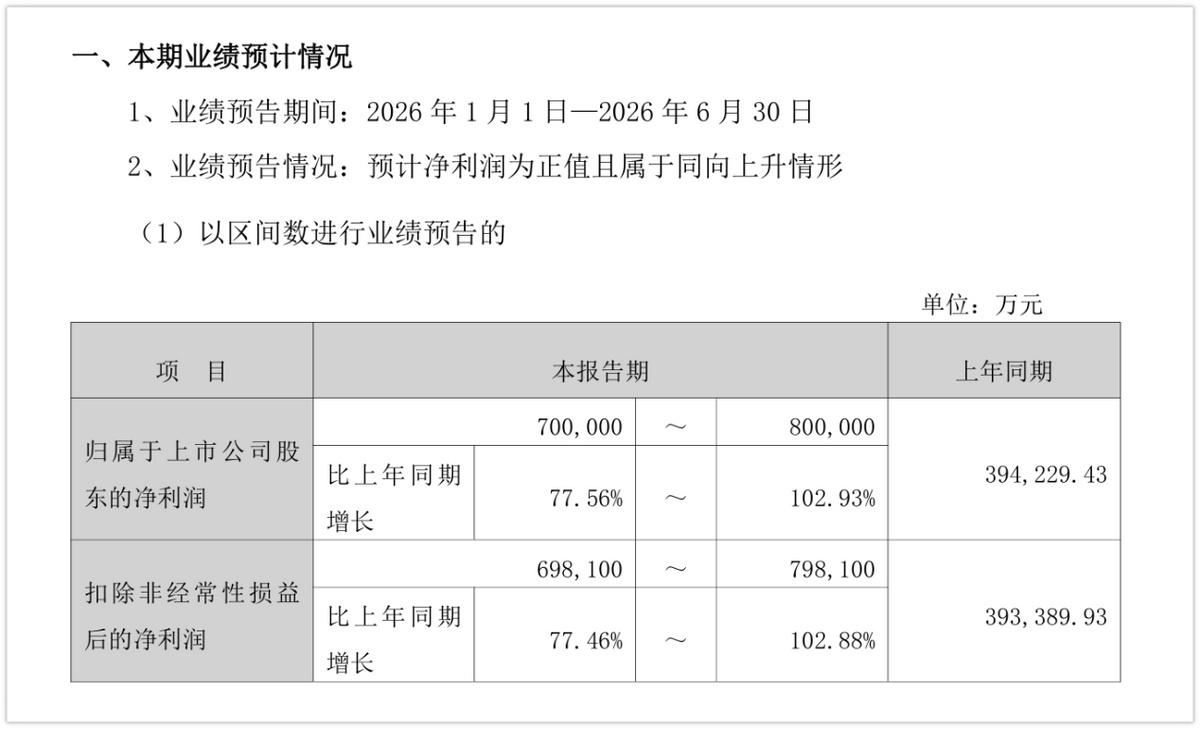
What capital worries about is intensified competition and peak demand, while the financial statements show accelerated volume expansion and profit leaps. Conflict is the source of opportunity.
I. What is lacking is not orders, but the chips to turn orders into revenue
To understand the over 50% quarter-on-quarter growth in Q2, one must first restore the real situation of the optical module industry over the past year.
The outside world easily forms an impression that in booming industries, orders are everything. In fact, amidst the AI data center construction boom, orders are precisely the least scarce resource; demands in the hands of leading manufacturers are sufficient to schedule until next year. What has always troubled them is not whether there is business, but whether they can deliver. Therefore, constraints have always come from upstream.
High-speed optical modules rely on high-end lasers with indium phosphide substrates. The overseas supply of such optical chips remains tight, with leading suppliers' order schedules extending to 2028. The overall industry supply-demand gap exceeds 30%, and upstream material manufacturers such as Yunnan Germanium Industry have even initiated price increases for indium phosphide substrates. Many companies hold orders but cannot deliver. To a certain extent, the optical module business has evolved into an allocation business for optical chips over the past few quarters.
In this allocation landscape, whoever receives more materials can turn paper orders into current revenue. The huge disparity in the Q2 earnings forecasts of several companies stems from this very reason.
Eoptolink also suffered from supply chain tensions in Q1, affecting some deliveries. However, the subsequent difference lay in the response methods. The company revealed in investor relations activities that it had made sufficient preparations and locking arrangements for core raw materials in the early stage. Entering Q2, material constraints gradually eased, and 1.6T products began large-scale shipments. The previously accumulated demand was centrally converted into revenue, causing the significant quarter-on-quarter leap.
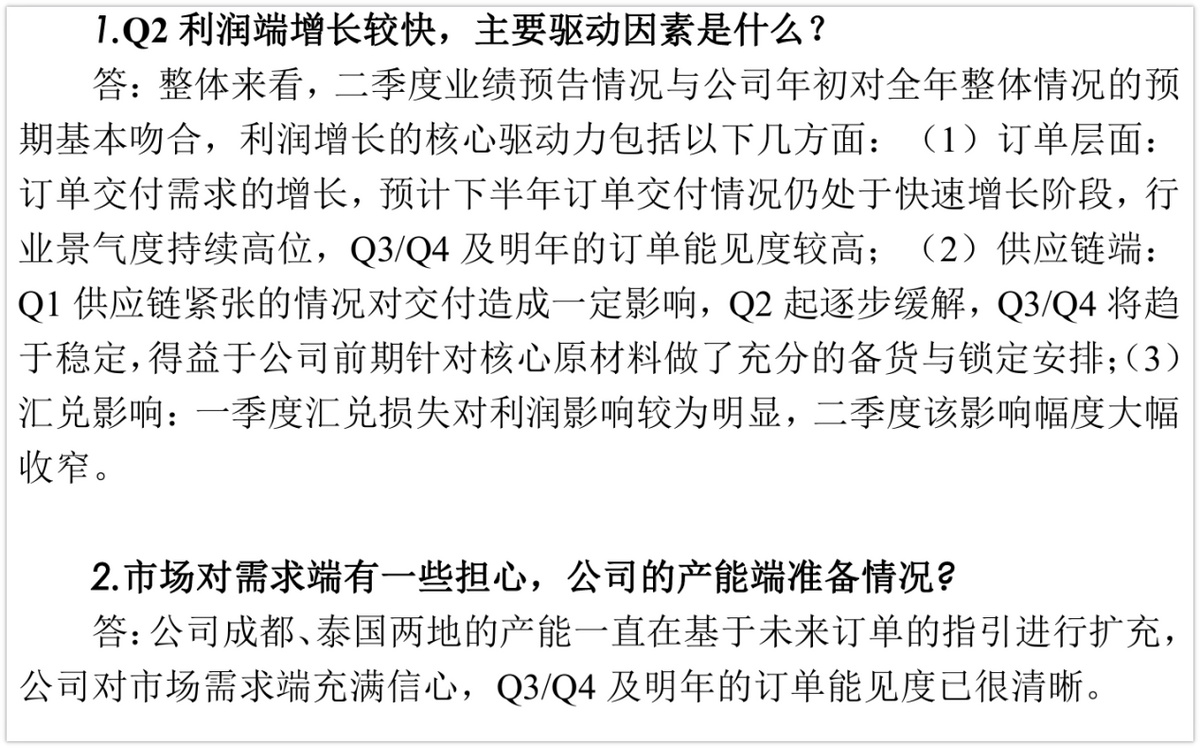
Note that management also confirmed that production capacity in both Chengdu and Thailand has been expanding according to future order guidance. Order visibility for Q3, Q4, and next year is clear. Deliveries in the second half of the year remain in a rapid growth phase. 800G has become the main shipment force, the ramp-up pace of 1.6T will further accelerate, and the share of silicon photonics products is also continuously rising.
Goldman Sachs quickly followed up after the forecast release, highlighting the nature of this beat.
Data shows that the midpoint of the earnings guidance is 44% higher than Goldman Sachs' previous predictions. For a company with a market cap exceeding 670 billion yuan, whose models are repeatedly dissected by sell-side analysts, a prediction deviation of this magnitude implies that the speed of industrial operation itself has exceeded previous tracking frameworks.
Goldman Sachs' judgment is that the growth subject comes from sales volume—high-end products were genuinely sold more, rather than book prosperity brought by price hikes. The improvement in optical chip supply removed past delivery constraints, allowing previously accumulated demand to be released. The company's 800G and 1.6T products entered a rapid ramp-up phase simultaneously, while capacity expanded synchronously. Several factors jointly pushed up output.
Based on this understanding, Goldman Sachs raised its earnings forecasts for 2026 to 2028 by 7%, 2%, and 2% respectively. Revenue expectations were revised to 51.46 billion yuan, 73.91 billion yuan, and 84.98 billion yuan. EPS expectations rose stepwise from 6.85 yuan in 2025 to 14.86 yuan, 21.62 yuan, and 24.85 yuan.
We know that in an era of abundant orders, sales capability determines growth speed; when constraints shift to the delivery link, the deciding factor becomes supply chain organizational capability. Whoever can lock in materials, schedule capacity, and deliver products to customers on time will eat the thickest slice of profit in the boom cycle.
II. The origin of delivery capability remains the company's foundation
Delivery capability cannot be temporarily supplemented; it is the product of a company's long-term experience. Eoptolink's current supply chain performance mainly comes from the company's accumulation. Interestingly, many people in the market today believe that the optical communication industry chain is actually no different from photovoltaics in the past—it's all a capacity issue, and it will ultimately be very difficult to maintain industry status. But what exactly is the barrier of "light"?
Gao Guangrong, founder of Eoptolink, was born in Leshan, Sichuan, in 1969. He worked at several enterprises, going through technical, procurement, sales, and management key links one by one, before officially co-founding Eoptolink with several partners in 2008, starting with the R&D and production of telecom-grade optical modules.
Generally speaking, those who understand technology cannot do business well, and those who understand business cannot see through technology. Gao Guangrong, however, has deeply cultivated both paths. His technical background allows him to understand the evolution direction of products, while his procurement and sales experience makes him familiar with the supply chain. Thus, Eoptolink's outperformance has some historical basis.
Eoptolink's early customers were mainly in the domestic telecom market. It listed on the ChiNext board in 2016 and entered the supply chain of North American cloud computing giants in 2019, completing its transformation to high-end optical modules for data centers. High-end optical modules are not products that can be sold just because they are made. Entering the supply system of clients like NVIDIA and Amazon involves testing and certification usually calculated in years. Producing qualified samples is one thing; undertaking orders of equal scale is another.
Therefore, although there were rumors in the market that cross-border enterprises might have 800G shipment capabilities, anyone who understands the long certification cycle knows clearly how far the distance is between shipment capability and order scale. Eoptolink's current customer list and its ability to mass-produce and deliver 1.6T products are important barriers.
At this point, we can answer the question asked at the end of the previous section. Delivery capability is not a fluke in Q2. Even if the market pays attention to every aspect of it, essentially it is only to pursue one question: How long can the boom center continue?
III. The duration of demand needs to be remeasured
Since June, research from several mainstream institutions has coincided on this issue.
Citi's in-depth report on optical interconnects released on June 24 constructed a global optical interconnect model covering communications, enterprise networks, and data centers, yielding quite aggressive conclusions.
The model calculates that global optical interconnect shipments will increase from approximately 110 million units in 2025 to 300 million units in 2028, with the market size expanding from approximately $20 billion to $92 billion during the same period, representing a three-year compound annual growth rate of 65%. Among them, the proportion of data center demand in the entire industry will rise from 71% to 89%. The demand landscape previously dominated by carrier networks has been completely rewritten, with AI data centers almost swallowing all incremental growth.
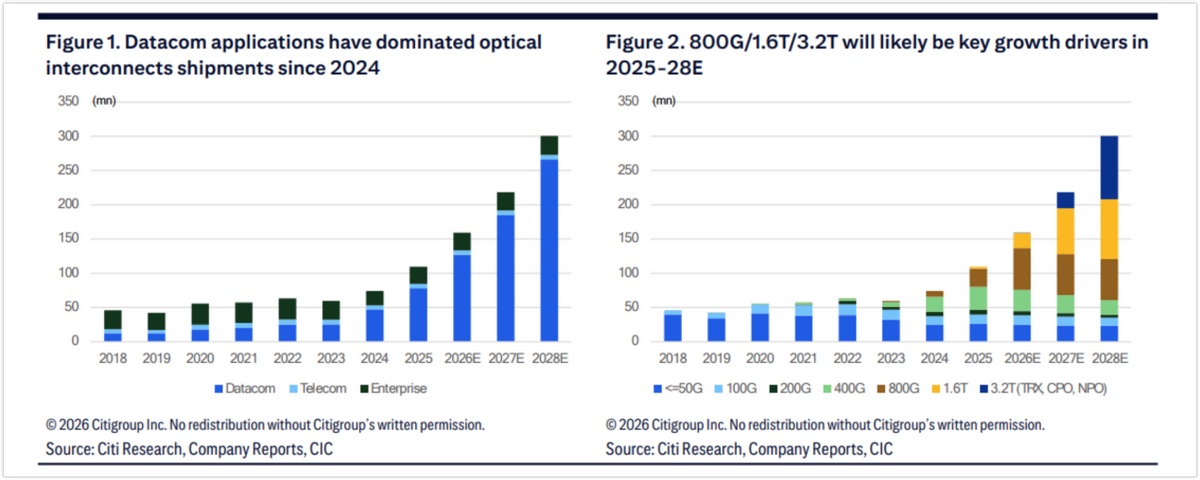
Citi's reasoning starts from an easily overlooked fact: when hundreds of thousands of computing chips are connected to form a supercomputing cluster, what often determines efficiency is not the chips themselves, but the data transmission capability between them. Large model training requires tens of thousands to hundreds of thousands of chips to work collaboratively, with data traffic growing exponentially. Copper cables are increasingly unable to support this, making optical communication the only feasible solution.
Following this clue, 800G optical module shipments in 2026 are expected to reach 60 million units. 1.6T will increase from 22 million units in 2026 to 67 million units in 2027. 3.2T will begin ramping up in 2027 and reach 35 million units in 2028. The penetration rate of silicon photonics technology will rise from 29% to 60% during the same period.
Subsequently, Morgan Stanley's capital expenditure special report on July 13 proposed new supplementary opinions.
It pointed out that the capital expenditures of the five major cloud computing giants for 2027 and 2028 were adjusted upward to 1.23 trillion USD and 1.4 trillion USD respectively. Computing capacity is expected to approach 120 gigawatts by 2028, nearly four times the expansion from approximately 30 gigawatts in 2025.
However, the most interesting judgment in the report is that Morgan Stanley raised the overall construction cost per gigawatt of computing power by approximately 20%. GB200 costs about 35 billion USD per gigawatt, with subsequent architectures rising level by level to around 50 billion USD.
The reasons for cost escalation are twofold. Besides hardware price increases inside the rack, power equipment, mechanical systems, building materials, and shortages of skilled workers are all driving up bills. Moreover, incremental costs outside the racks mainly flow towards high-speed interconnects, fiber optic cabling, and optical modules. That is to say, even if the procurement volume of computing chips remains unchanged, the value allocated to the optical interconnection part of the same gigawatt of computing power is increasing.
Both reports point to the same conclusion: the focus of AI investment is shifting from the purchase quantity of computing chips to the connection quality between chips. Goldman Sachs' framework echoes this. Starting from 2027, AI network construction will gradually move from horizontal expansion to vertical expansion and cross-domain interconnection. In the past, computing power was increased by adding the number of chips; in the future, it will rely more on faster, lower-latency communication between chips. The larger the cluster scale, the stronger the demand for high-speed optical modules.
For Eoptolink, the target price has been "respected" again by these institutions.
Citi significantly raised its target price from 353.57 yuan to 701 yuan in June. The core reason is that current market pricing mainly reflects the existing boom of 800G and 1.6T. The incremental space for 3.2T products and next-generation products such as near-packaging optics has not yet been fully accounted for. Citi expects the company's profit compound annual growth rate over the next three years to approach 190%.
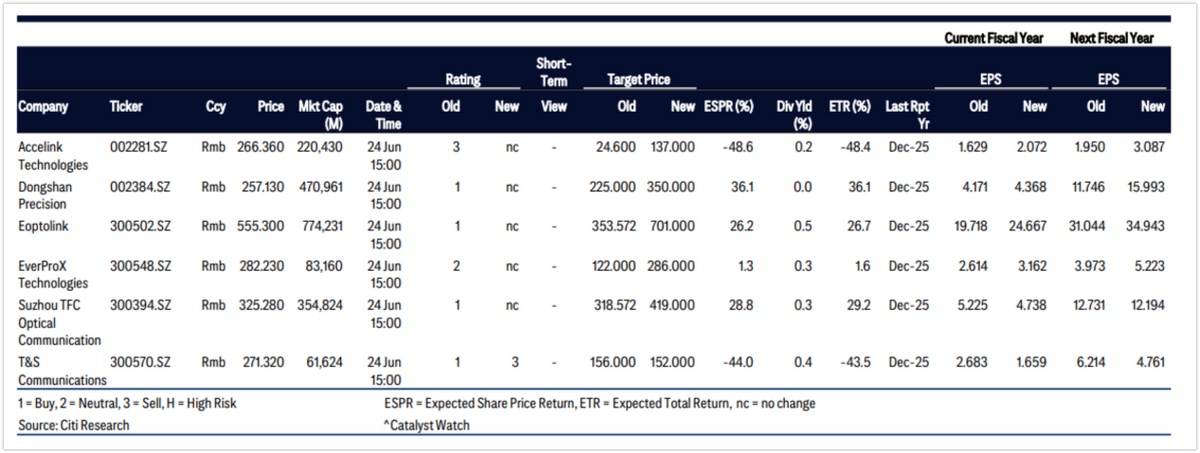
Goldman Sachs maintained a Buy rating and gave a target price of 633 yuan, representing a 31.1% upside from the closing price of 482.88 yuan on July 17. Comparing the midpoint of the earnings forecast of 7.5 billion yuan with the institutional full-year consensus estimate of 18.526 billion yuan compiled by Wind, the first half has already completed 40.5%. The second half needs to achieve approximately 11 billion yuan, averaging 5.5 billion yuan per quarter, which is an increase of about 17% compared to the Q2 forecast midpoint of 4.7 billion yuan.
All in all, optical modules themselves remain the "comfort zone" for these leaders. From market panic selling to profits accelerating realization in the forecasts, the market completed a stress test in two days. The result of the test is that after the tide of emotions recedes, the riverbed of the industry is firmer than imagined. In an era where orders are no longer scarce, delivery capability is pricing power. And as the industry's gaze turns to more distant architectural evolution, the companies that arrive at the next stop first are likely still those that turned the previous bottleneck into a moat.
Source: Pine Finance
The copyright of this article belongs to the original author/organization.
The views expressed herein are solely those of the author and do not reflect the stance of the platform. The content is intended for investment reference purposes only and shall not be considered as investment advice. Please contact us if you have any questions or suggestions regarding the content services provided by the platform.
