


Vertical sports-specific model "Keepace.ai" released, Keep debuts at WAIC
"To truly understand sports is not just knowing how to train, but also knowing what should and shouldn't be trained, and being able to clearly explain why. This, is service."
On July 17, the 2026 World Artificial Intelligence Conference (WAIC) opened in Shanghai. At a sub-forum, Wu Bowen, Head of Algorithms at Keep, delivered a speech titled "The Next Decade of Sports Technology: How AI Will Reshape the Essence of Health Services," systematically revealing for the first time the demand logic and implementation progress of the company's self-developed vertical sports model, "Keepace.ai".
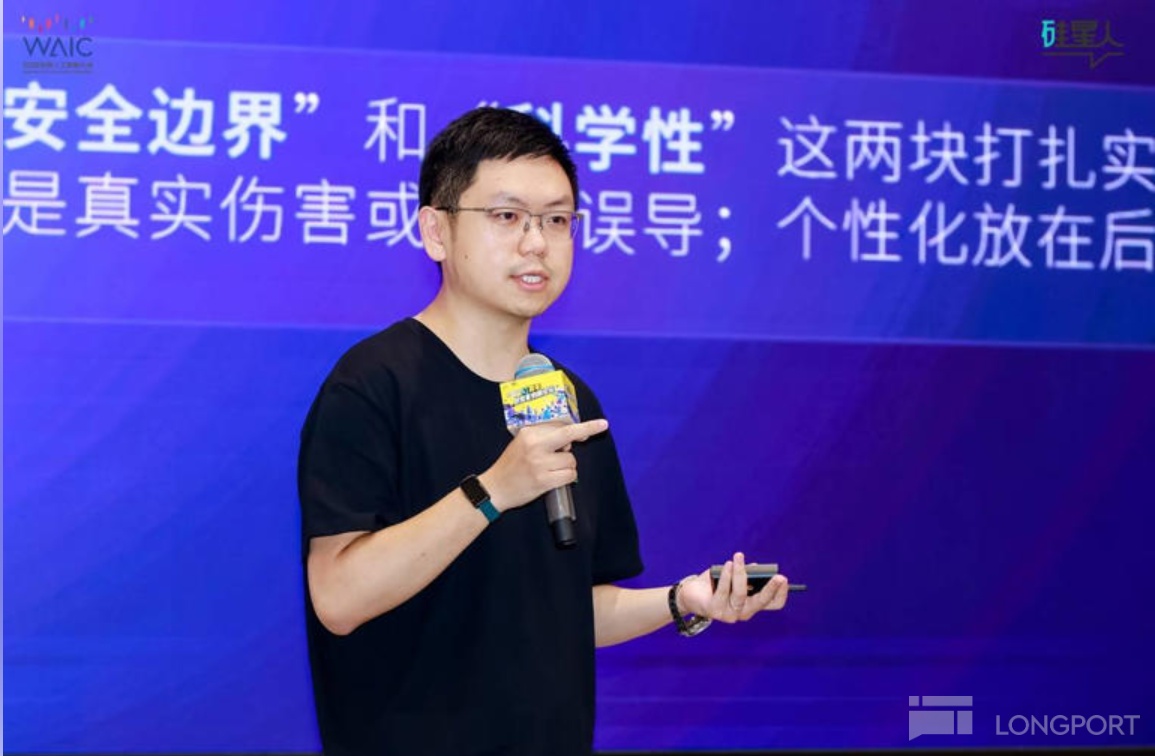
Wu Bowen, Head of Algorithms at Keep
This marks the first time since Keep announced its "All in AI" strategy in early 2025 that it has disclosed the core capabilities of its proprietary large model at an industry conference of WAIC's caliber. Keep's sharing sent a clear signal: competition in the sports technology industry is shifting from "content library size" and "user volume" to "who can truly deliver the service itself using AI".
From "Selling Courses" to "Selling Services": Why Sports Health Needs a Dedicated Model
At the beginning of his speech, Wu Bowen reviewed Keep's core barrier over the past decade—sports content services. However, he pointed out that this model has two ceilings: one is the user scale ceiling, where labor costs limit the coverage of long-tail course categories such as golf and tennis; the other is the commercialization ceiling, with member ARPU values around 20 yuan, essentially "selling courses" rather than "selling services".
The arrival of AI happens to break both these ceilings simultaneously. On the content side, AIGC can fill in long-tail course categories all at once; on the business model side, the interaction, companionship, and plan design provided by AI Coach have commercial value comparable to "personal training" services—this gives ARPU nearly 10 times growth space. When facing the user's question "Do I need to consider speed when running for weight loss?", Keepace.ai first provides the premise—the key to weight loss is a calorie deficit, then provides the conclusion: "Pace has an impact, but for most people, whether they can persist in the long term is more important than pursuing high intensity in a single session." It also corrects the common misconception of "burning sugar first then fat," pointing out that the three major energy systems work simultaneously, allocating proportions based on intensity. Every recommendation is annotated with evidence, reviewed by sports science consultants, ensuring verifiability.
In sports data interpretation scenarios, when a runner asks "After completing a synchronized 10km run, the intensity wasn't low, will it affect recovery?", Keepace.ai can identify that the average heart rate reached 89% of the estimated maximum heart rate (belonging to the high-intensity zone), proactively discover GPS drift errors where cumulative elevation gain was 5426 meters but actual elevation gain was only 21 meters, and provide recovery suggestions for the next 48-72 hours and adjustments for next training intensity based on exercise physiology rules.
Wu Bowen emphasized that behind these three capabilities lies the same logic: selecting movements, providing conclusions, reading data—every step places "safety" and "scientific basis" at the highest priority.
All in AI This Year: Profitability Validation, Data Barriers, and Model Implementation
Keepace.ai's special capabilities are built upon Keep's promotion of its "All in AI" strategy over the past year or so.
In February 2025, Keep founder Wang Ning released an all-staff letter announcing the company's entry into a new ten-year cycle of "All in AI." Since then, Keep has completed a leap from a "content platform" to an "AI-driven sports health ecosystem" at the strategic level.
Financial validation is the most direct signal. According to financial reports, in 2025, Keep achieved an adjusted net profit of 25.22 million yuan, compared to an adjusted net loss of 470 million yuan in 2024, making a strong turnaround to profitability. This is the company's first annual profit in its ten-year history. Gross margin rose synchronously to 52.2%, up 5.5 percentage points from the previous year, achieving continuous expansion for three years. Company management internally positioned AI investment as "replacement investment" rather than "incremental investment"—AI is not additional expenditure stacked on top of the original cost structure, but achieves dual goals of cost reduction and efficiency improvement through substitution of traditional content production methods and user service models.
Meanwhile, Keep's underlying architecture completed key iterations. Keep upgraded from traditional process-driven to a multi-agent system (MAS), supporting autonomous decision-making under high concurrency and complex task scenarios; meanwhile, it collaborated with professional sports institutions to build domain-level Benchmarks to guide the iteration direction of self-developed models.
User-side perception and experience are also very obvious. Currently, the landing data of Keep AI productization has formed a closed loop. By the end of 2025, the AI coach "Kaka" had generated personalized training plans for over 1.3 million users, voice running companion functions were called over 21 million times, and food image recognition processed 3.5 million images. The next-day retention rate for Kaka's data analysis function was 69%, and the contribution of the AI diet recording function to the App's overall daily active user retention was 79%.
The Next Decade: The Starting Point of Service Delivery
Keep is committed to becoming the next "national-level AI application." Ten years of 沉淀 (accumulation) of 14 billion real sports records have been broken down into a panoramic feature map of 17 types of tags and over 700 indicators. The time span and degree of structuring of this data constitute a moat that competitors cannot buy with computing power.
At the end of his sharing, Wu Bowen stated, "To truly understand sports is not just knowing how to train, but also knowing what should and shouldn't be trained, and being able to clearly explain why. This, is service."
The shift from "content delivery" to "service delivery" is precisely the competitive endpoint defined by Keep for the next decade. And the standard of Keepace.ai might serve as an observation sample for dedicated models in vertical fields, not pursuing the "all-around" nature of general models, but building its own vertical barriers on the unyielding bottom lines of safety boundaries and scientific basis.
$KEEP(03650.HK)
The copyright of this article belongs to the original author/organization.
The views expressed herein are solely those of the author and do not reflect the stance of the platform. The content is intended for investment reference purposes only and shall not be considered as investment advice. Please contact us if you have any questions or suggestions regarding the content services provided by the platform.
