



Zhongji Innolight to List in Hong Kong: The Trillion-Dollar Surge and Hidden Concerns of the AI Computing Power "Shovel Seller"

In the wave of artificial intelligence sweeping the globe, the construction of computing power infrastructure is advancing at an unprecedented pace. As one of the core "shovel sellers" on this golden track, the global leader in optical modules, $Zhongji Innolight(300308.SZ), has recently officially passed the Hong Kong Stock Exchange listing hearing. It may become one of the most watched IPOs in the Hong Kong market in the third quarter of 2026, marking a key move in this A-share trillion-yuan market cap giant's "A+H" dual-listing chessboard. However, behind the dazzling performance halo and extremely high valuation expectations, its hidden risks are equally 不容忽视 (cannot be ignored).
AI Computing Power Surge: The Golden Age of Optical Interconnect Industry
To understand the explosion of Zhongji Innolight, one must first understand the optical interconnect industry it operates in. Simply put, the training and inference of large AI models require thousands of GPUs to work collaboratively, and optical modules serve as the "bridge" for high-speed data transmission between these GPUs and servers. Without high-bandwidth, low-latency optical modules, AI computing clusters would face severe "traffic congestion".
As global tech giants 疯狂 (frantically) expand AI data centers, the demand for high-speed optical modules is growing exponentially. According to forecasts by LightCounting, hired by Zhongji Innolight, the global optical interconnect market size reached $24.8 billion in 2025, with optical modules accounting for the vast majority of the market. By 2030, this scale will expand to $111 billion, with a compound annual growth rate of 31.6% from 2026 to 2030.
Industry Chain Position and Competitive Landscape: A Leader Far Ahead
In the optical module industry chain, upstream core components include optoelectronic chips and passive optical devices, the midstream is optical module packaging and manufacturing, and the downstream consists of cloud computing vendors and AI computing providers. Zhongji Innolight firmly occupies the midstream of the industry chain and,凭借 (by virtue of) its strong technical barriers and customer binding, has established an absolute leading position.
Since 2021, Zhongji Innolight has been the global provider with the largest revenue scale in optical interconnect solutions for five consecutive years. In 2025, its share in the global overall optical interconnect market reached 21.2%, and in the high-speed digital optical interconnect market, it was as high as 28.1%. In terms of competitive landscape, Zhongji Innolight has left domestic and foreign rivals such as $Eoptolink(300502.SZ) (14.0%), Coherent (COHR.US) (12.1%), and Huawei HiSilicon (5.0%) far behind. Especially in the supply chains of top AI chip vendors like Amazon (AMZN.US) and NVIDIA (NVDA.US), Zhongji Innolight has occupied a significant share in the procurement of 1.6T high-end optical modules, making it a veritable "core supplier of AI computing power".
Valuation Game: Stock Price Decline Under High Expectations
Zhongji Innolight's listing in Hong Kong provides new support for its high valuation. The prospectus shows that the company's revenue in Q1 2026 reached 19.496 billion yuan (RMB, same below), a year-on-year increase of 192.12%; adjusted net profit was 6.616 billion yuan, a year-on-year surge of 281.16%. The single-quarter profit exceeded half of the full-year adjusted net profit of 11.848 billion yuan in 2025, and the gross margin further climbed from 41.52% in full-year 2025 to 45.55% in Q1 2026; the adjusted net profit margin also increased from 30.98% in full-year 2025 to 33.93% in Q1 2026.
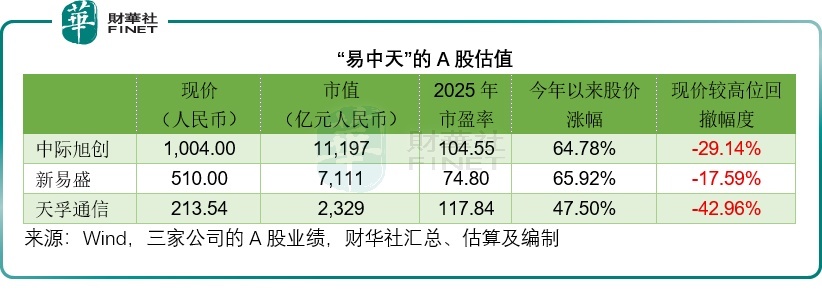
However, there is a clear divergence in capital market valuations. As of July 20, 2026, the closing price of Zhongji Innolight's A-shares was 1,004 yuan, with a total market value of approximately 1.12 trillion yuan, and the static P/E ratio for 2025 was as high as 104.55 times. Although the expected earnings growth is considerable, the stock price has surged by 64.78% so far this year, and has recently fallen back nearly 30% from a high of 1,416.88 yuan. This high-level volatility reflects, on the one hand, the market's concern that the Hong Kong listing may dilute earnings per share, and on the other hand, it shows that after a short-term surge, funds are taking a wait-and-see attitude towards digesting high valuations and the sustainability of performance.
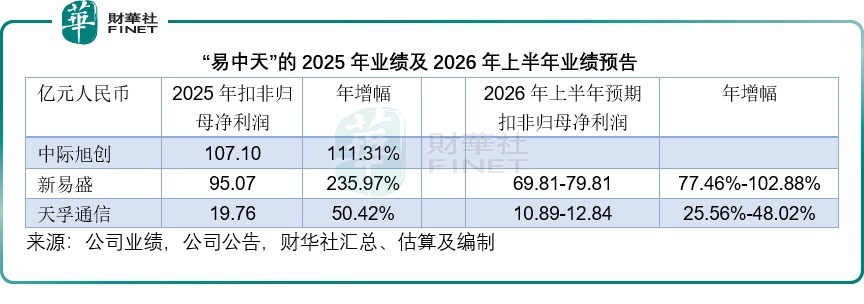
See the table below. The "Three Musketeers" of optical modules—Zhongji Innolight, Eoptolink, and $TFC(300394.SZ)—all intend to list in Hong Kong to achieve "A+H" dual listing. Currently, Zhongji Innolight's progress is the fastest, having passed the hearing. Eoptolink and Tfc Optical recently released their H1 2026 profit forecasts, expecting non-GAAP net profit to grow year-on-year by 77.46%-102.88% and 25.56%-48.02% respectively. Although high, this is still lower than their YoY growth in non-GAAP attributable net profit in 2025, raising concerns about whether their period of rapid performance growth has peaked.
Sword of Damocles Hanging Overhead: Potential Risks
Despite the soaring performance, Zhongji Innolight's business model hides structural risks that cannot be ignored:
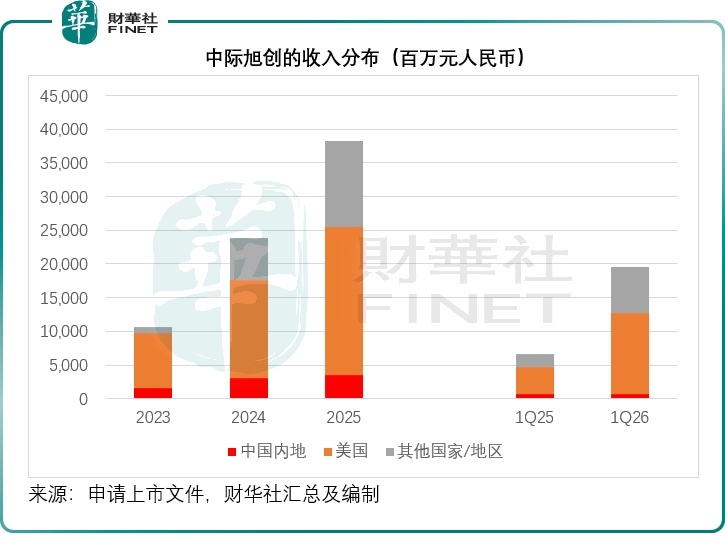
High Customer Concentration and Geopolitical Risk: Zhongji Innolight relies heavily on US customers. In Q1 2026, the revenue share of the top five customers was as high as 81.9%, with the largest customer (possibly NVIDIA) accounting for 25.1%. Meanwhile, its revenue from the United States accounted for a high of 61.71%. Against the backdrop of the current complex international trade environment, if US technology trade restrictions escalate or core customers cut capital expenditures, its performance will face huge shocks.
Upstream Supply Chain "Chokehold" Hidden Dangers: The core of optical modules lies in optoelectronic chips. The prospectus discloses that Zhongji Innolight relies highly on optoelectronic chip suppliers listed in Taiwan. In 2025 and Q1 2026, the procurement share from the largest supplier (all are optoelectronic chip suppliers listed in Taiwan; the company did not disclose whether they are the same entity) accounted for 35.8% and 38.3% respectively.
Currently, in the fields of high-end silicon photonics chips and electronic chips, there may still be a lack of domestic manufacturers capable of complete substitution. Domestic manufacturers such as Yuanjie Technology (688498.SH) have achieved batch breakthroughs in CW laser diode chips, and high-end products like 100G/200G EML are in the customer verification or R&D stage, with mass production processes accelerating. However, in the field of high-end indium phosphide optical chips, overseas manufacturers still dominate. The transition of domestic supply from "small batch available" to "large-scale substitution" still needs to go through the stages of yield ramp-up and comprehensive customer certification. The specific time depends on product verification progress and capacity expansion rhythm. This single dependence on upstream core components will constitute a huge supply chain security hazard.
Core Technology Iteration Risk: The optical interconnect industry has multiple parallel technology routes such as silicon photonics, LPO, LRO, NPO, CPO, and TFLN. Zhongji Innolight has a first-mover advantage in silicon photonics, but if the industry's mainstream route switches in the future (such as large-scale commercialization of CPO), or if downstream giants like NVIDIA and Cisco continue to promote self-developed optical modules, the company will face the risk of losing market share. Currently, NVIDIA's CPO switches have entered the mass production stage, and its share of self-developed optical modules is also expected to increase. Long-term trends show that the substitution of third-party suppliers indeed exists.
Besides the above explicit risks, there are a few hidden dangers easily overlooked by the market:
Exchange Rate Fluctuation Risk: As seen in the figure above, over 90% of Zhongji Innolight's revenue comes from overseas, mainly settled in US dollars. Sharp fluctuations in the RMB exchange rate will directly affect the company's exchange gains/losses and gross margin performance.
Capacity Oversupply Risk under Asset-Heavy Model: High-speed optical modules belong to the asset-heavy industry. The company is using raised funds to massively expand global capacity. If future AI capital expenditure falls short of expectations, or industry competition intensifies leading to price wars, massive fixed asset depreciation will severely erode profits.
Corporate Governance and Equity Concentration Risk: The actual controllers of the company are father and son Wang Weixiu and Wang Xiaodong, who have long cultivated the optical communication industry. Although professional manager Liu Sheng was recently introduced as chairman, whether the governance inertia of family enterprises will affect the company's long-term strategic decision-making and the interests of minority shareholders still requires continuous observation.
Conclusion
Zhongji Innolight is undoubtedly one of the important beneficiaries of the AI wave. Its listing in Hong Kong will reserve sufficient ammunition for the next round of technological competition. But in the carnival of trillion-yuan market cap, investors must clearly recognize that high growth and high risk are two sides of the same coin. While enjoying the dividends of AI, one must be vigilant against potential risks such as customer concentration, supply chain security, and geopolitics.
Author: Wu Yan
The copyright of this article belongs to the original author/organization.
The views expressed herein are solely those of the author and do not reflect the stance of the platform. The content is intended for investment reference purposes only and shall not be considered as investment advice. Please contact us if you have any questions or suggestions regarding the content services provided by the platform.
