


Interview with the Founder of TanYue Embodied AI Community: The Brain of Robots, Talent Scarcity, and After a Hackathon
The organizer of the Lunar Exploration Plan Physical AI Hackathon, the Lunar Embodied Intelligence Community, provides entrepreneurial services in the embodied intelligence track. It brings together researchers, developers, industry chains, and startup teams, offering activities and resource matching services for enterprises and tech innovation teams. What the community aims to accumulate is the close relationship between talent and industrial resources.
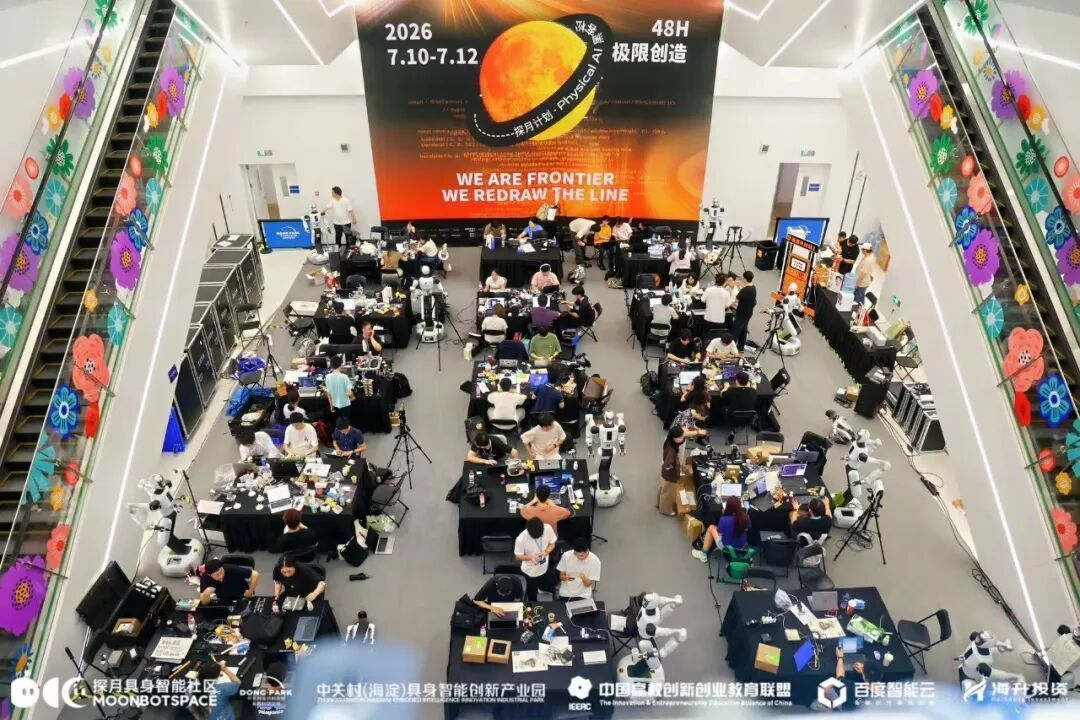
At the site of the Lunar Exploration Plan Physical AI Hackathon, some had robotic arms deal cards as dealers, while others played ice hockey. One team went to a basketball court, using data collection to record shooting motions, attempting to teach robots how humans jump and release the ball.
Embodied intelligence currently faces a rather peculiar situation. It is placed within the imagination of a trillion-dollar market, with valuations, capital, and policy enthusiasm rising daily, yet truly stable delivery and scaled implementation are still on the way. Models on screens are already quite adept at answering questions, but in the physical world, picking up a cup, moving a chair, or avoiding a temporarily moved table is not so easy.
Text has accumulated on the internet for decades, but there is no ready-made database for how the body perceives, judges, and exerts force.
Only when the brain becomes smarter does the body have a chance
Wang Mingyue worked in product and strategy at Smartisan Technology and Xiaomi, served as the head of the Xiaoai Speaker product, and also worked on whole-house smart home systems. At the end of 2024, she decided to enter the field of embodied intelligence. Instead of building a robot herself, she started from Tsinghua's Embodied Intelligence Club and created a community open to the entire industry. The Lunar Community has now been operating for over a year, with more than 50,000 members, including over 300 PhDs specializing in embodied intelligence, having organized dozens of deep-tech communities and held over 50 offline events.
Wang Mingyue's career has always been at the intersection of software and hardware. The products she previously made required embedding invisible software into visible objects. After GPT-3.5 emerged, she felt that the "brain" suddenly became smarter. Robots are no longer just combinations of mechanical structures and preset actions; they have the opportunity to be re-understood.
She does not view this as a competition that will end in five or ten years. What embodied intelligence needs is another type of data that is harder to accumulate. Language models can read the text left by humans, but robots must collide, make mistakes, and adjust in the real world to know how heavy a chair is, whether a cup will slip, or where the body should move to avoid obstacles.
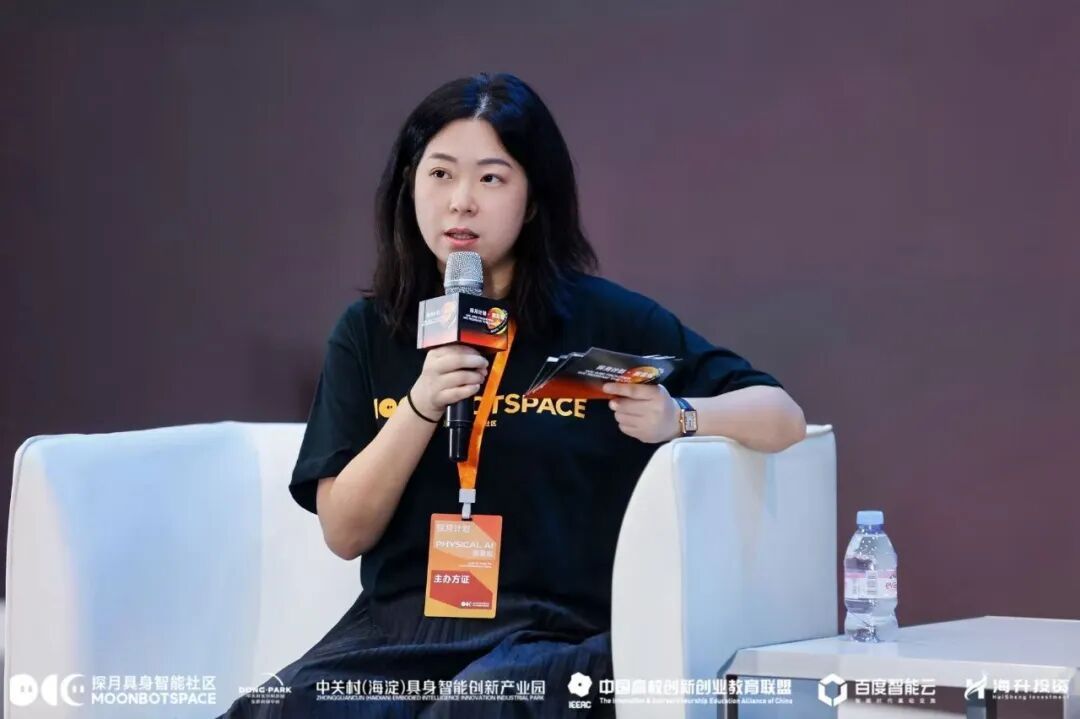
Dongcha Beating: Please introduce yourself first. Why did you transition from your past career experience to embodied intelligence?
Wang Mingyue: I am the founder and CEO of the Lunar Embodied Intelligence Community and the initiator of this Lunar Plan Hackathon. I am part of the post-80s generation, with over ten years of work experience. I worked at Smartisan Technology, then at Xiaomi doing product and strategy, serving as the head of the Xiaoai Speaker product, and also working on whole-house smart home solutions.
I have always worked on things combining software and hardware, leaning towards intelligent terminals. In 2020, I studied for an MBA at Tsinghua University. By 2024, after GPT-3.5, the "brain" became smarter, and I felt that the robot本体 (body) would become more intelligent. I was also thinking about my own career transition: how to connect my past experience with new trends. I felt nothing was more suitable for me than robots, because this is the most complex form of software-hardware integration and involves future issues of human division of labor. So by the end of 2024, I firmly decided to enter this industry.
Later, coincidentally, the club mechanism at Tsinghua came up, and I applied to join the Embodied Intelligence Club. We used this platform to connect with some top founders and resources. Later, we felt that good resources shouldn't stay only within Tsinghua, so we spun off the Lunar Embodied Intelligence Community, opening it to the entire industry.
Before this hackathon, we mostly conducted closed-door or customized events. Over the past year, the community has accumulated PhDs in embodied intelligence, professionals from upstream and downstream industries, and established connections with many founding teams of leading embodied intelligence companies. Lunar grew out of the Tsinghua system, and this event also received support from relevant Tsinghua institutions and teachers. Many tech startups have emerged from Tsinghua, but community-based organizations are relatively rare. We wanted to do something different.
Dongcha Beating: How big is China's embodied intelligence industry really? Lunar gathered a group of people so quickly. Is it more like a small circle, or is it already a mature industry?
Wang Mingyue: It is an industry with huge contrasts.
First, its imagination is vast. If embodied intelligence and robots can truly replace a portion of the labor force, the amount of GDP humans can generate, theoretically, is the amount it can generate, and it can even do things humans cannot. It is also related to aerospace and the transition of human civilization from Earth to interstellar civilization.
This is not something that can be accomplished in five or ten years. With AI and robots, humanity may one day cross from Earth civilization to interstellar civilization. The GDP at that time will no longer be confined by today's Earth-bound GDP.
Of course, this industry also has bubbles, but they need to be viewed separately.
From the perspective of revenue and profit, the industry certainly has bubbles. But from the perspective of the changes it might bring to humanity and the future, it cannot simply be called a bubble. Current technology is too complex and too early-stage. Whether for To C or To B, there has not yet been a truly large-scale, stable demand.
From the perspective of revenue and profit, it remains a small industry. From the perspective of national strategy, influence, and future possibilities, it is a large industry.
Dongcha Beating: For large models built for robots, what is the difference compared to the language models we encounter daily?
Wang Mingyue: There is currently no unified consensus on embodied large models. Large language models have developed certain consensus on technical routes over these years, whereas embodied models are still each going their own way, still in the process of debate.
I do not have a technical background, so I will share my understanding after long-term exchanges with technical experts in the industry.
Language models have a natural data advantage. With over thirty years of internet development, the text, historical records, and books left by humans can all serve as corpus. Previous multimodal models added sound and vision, but there is still a significant gap between them and truly entering the physical world to form a world model.
Embodied intelligence has a body and must interact with the physical environment, learning, judging, and deciding through interaction. Data for language models is merely the foundation; robots still lack massive interactive data from the physical world. When humans pick up cups, move chairs, or avoid obstacles, how the body perceives after encountering resistance—this data was not systematically accumulated like text was in the past.
Autonomous driving can be seen as a very vertical form of embodiment. Cars only operate in the scenario of driving, and there is already some data accumulation. However, truly general-purpose embodied models require multi-dimensional, multimodal data, which is difficult and expensive to collect.
Different routes have been tried in the industry, such as data collection and simulation data. Recently, first-person perspective data collection has also become very popular. Once data accumulates to a certain baseline, exponential changes may occur.
About a year ago, I asked many people when the "GPT moment" for embodied intelligence would arrive. Some said ten years, later changing to three to five years. At our hackathon forum, entrepreneurs, researchers, and investors gave more optimistic judgments, with some believing key progress could be seen in one to three years. This speed is accelerating, and it is not linear.
Large language models are a crucial part of embodied models, and their progress will also drive embodied models. However, embodied models naturally require more dimensions of data. Whether it will ultimately be VLA, world models, or something else, there is still no conclusion.
The scarcest resource is talent
In the buzz surrounding embodied intelligence, the thing most easily treated as serious business is "getting involved": building bodies, brains, models, and creating a company that can be valued.
But Lunar was originally not an organization designed according to a business plan; it grew out of constantly helping people find co-founders and resources.
A community is something hard to calculate clearly. The boundaries of technical projects are relatively clear, but the boundaries of a community follow the people. Some come looking for engineers, some for factories, some for financing, and some just need to meet someone who understands what they are doing.
For the community, what Wang Mingyue cares about most is not its scale, but the density of talent.
Dongcha Beating: Lunar positions itself as the Y Combinator of the Physical AI field, which is interesting. And why didn't you directly start a business, but instead began by investing in early-stage projects and building a community?
Wang Mingyue: Communities were not as popular in China during the internet era. I think one reason is that the dimensions of the internet are relatively few, and the need for people to align backgrounds is not so strong. But embodied intelligence is much more complex. Taking Tsinghua as an example, our community includes people with backgrounds in mechanics, automation, materials, chemistry, interdisciplinary studies, economics and management, law, etc. It requires multidisciplinary integration and combinatorial innovation; many problems cannot be solved by a single discipline alone.
Only when people from different backgrounds are put together can there be new inspiration and the possibility of solving complex problems. This is the necessity of the community's existence.
When I left big tech companies to run the Tsinghua club, I never planned to commercialize it into a community or organization. Later, as we continued, we found that people indeed needed this community. We were originally helping people find co-founders and resources on a non-profit basis, almost never charging money. During this process, I discovered that I am good at and passionate about doing this.
Embodied intelligence and AI are leading a new era. This era deserves to grow new brands. Brands should not only consist of technology and product companies but also include communities. Lunar was not planned from the beginning; it grew naturally.
Some PhDs and projects I invested in invited me to be a co-founder or partner. If I joined a company as a partner, I could directly bring many people and resources. But I already have feelings for the Lunar community and brand. Also, I am curious: relying on intuition and this momentum, how far can I go?
Additionally, I have done product work for over ten years and later strategy. If I were to enter another company to do product and strategy again, it would feel somewhat repetitive to me. Given my current life stage, I prefer to look at more projects and help them solve resource, personnel, and bottleneck issues. I have the patience to build Lunar far into the future, but perhaps not the patience to hold meetings every day in a single project or polish a product. My advantage is seeing what it lacks and using Lunar's resources to fill those gaps.
Dongcha Beating: How will Lunar commercialize?
Wang Mingyue: We should have no problem achieving over a million in revenue this year, with income from conferences, consulting, and other services. But neither in valuation nor in revenue will we be particularly aggressive.
We care more about talent density. If a person has substance, cognition, and professionalism, they can produce good content just by sitting at an event without much preparation. We have been to Silicon Valley and hosted events during GTC, connecting with PhDs in embodied intelligence from Berkeley, MIT, Stanford, etc., and linking with Chinese professionals working in local embodied intelligence companies. We hope to form an international talent network.
Furthermore, we believe that excessive commercialization in the early stages would harm the experience. Truly excellent people do not lack opportunities; if they feel uncomfortable here, they won't come. Currently, most interactions at Lunar are free, though bar events might charge a small fee to cover costs.
In the future, deeper services can be offered for commercialization, such as order linking, financing services, and PR services. But for now, we want everyone to form a clear perception: that at Lunar, you can make the best friends, meet people with high cognition, and even find co-founders. Investors coming here can also discover good projects. Once the brand and reputation are established, commercialization will happen more naturally.
In forty-eight hours, who can make the machine move?
Hackathons are becoming increasingly hot, attracting no little skepticism. What can be achieved in forty-eight hours? Are semi-finished products being presented? Is it just another self-amusing spectacle?
Doing a hackathon in the embodied intelligence industry is not that simple. For software hackathons, writing web pages or calling models, creative people can get started quickly. But connecting models into systems and then having systems collaborate with hardware has a higher threshold. Wang Mingyue said that among this year's participants, about 70% had full-stack development experience. Those capable of participating in hardware hackathons are a very small group.
She is unwilling to describe the hackathon as a crash course for startup projects. The ranking in the competition is not important; what matters is that through the hackathon, some people encountered hardware for the first time, teamed up with strangers for the first time, and discovered they might be able to enter this industry.
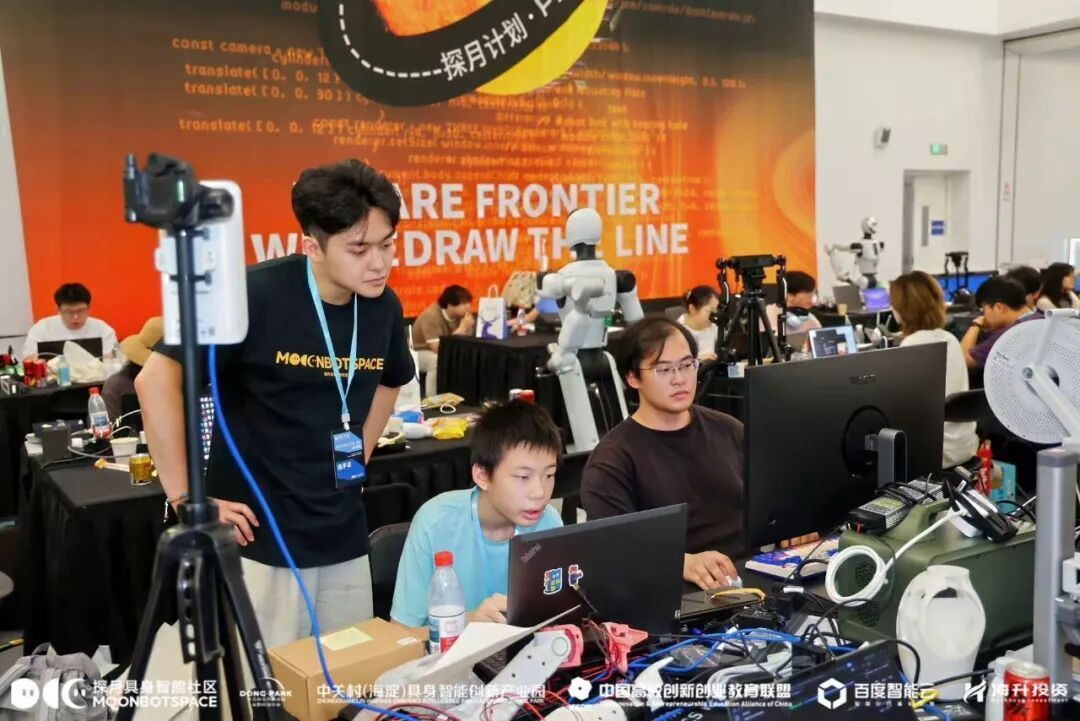
Dongcha Beating: The barrier to entry for embodied intelligence entrepreneurship is high. Will organizing such a hackathon face difficulties in recruitment and organization?
Wang Mingyue: Indeed, the threshold for some software-type hackathons is relatively low; knowing how to use AI tools and having good ideas allows one to start Vibe coding. But embodied intelligence is different. In this event, at least 70% of participants had full-stack development experience, understanding hardware, software, and models, knowing how to connect models into systems and have systems collaborate with hardware.
In China, this is a very small group. Without the depth of talent accumulated by the community over the long term, directly organizing such a hackathon would definitely make it very difficult to suddenly find so many participants.
But the other 30%, who lacked full-stack development experience, also surprised me. We must still believe in young people's ability to learn. Some contestants had never touched hardware before, but through the hackathon, they broke through their own boundaries, began to be interested in hardware, and even wanted to enter this industry in the future. This kind of change sometimes cannot be measured in money. We host an event, and by accident, we might change a person's trajectory, opening up a new continent for them. Moreover, a team doesn't need everyone to be full-stack; having cognition and collaboration skills is sufficient.
We cannot look at penetration rates statically. Today it might be a very small group, but activities, popularization, and education will make it grow larger. Many companies that have raised funding come to us, most often asking if we can recommend some talent. The current bottleneck is talent. A top university has so few students, and many want to start their own businesses.
In the future, Lunar also hopes to go deeper, doing things similar to an academy. We will strive for hardware sponsorships, giving everyone a fixed place to experiment, and thickening the talent gradient.
Dongcha Beating: What kind of young talent makes you feel they are excellent?
Wang Mingyue: Not just understanding technology; they must have aesthetics, know how to treat people and handle affairs, and know how to build a company more maturely. Beyond technical language, they possess maturity regarding business, people, and organizations beyond their age.
If I chat with a young person and I control the rhythm throughout, I would think, why don't I invest in myself and do it myself? Truly excellent young people have their own rhythm and ideas, knowing when to persist and when to learn.
I invested in an early-stage project. After investing, the project's valuation grew tens of times. The founder gave me the impression of rapid cognitive iteration. Exaggeratedly speaking, meeting him in the morning and seeing him again in the evening, his ideas might already have updated. When I first met him, I thought I could mentor him; now, perhaps he mentors me.
Viewing young people also requires a dynamic perspective. Their intelligence lies not only in technology but also in fundraising, team management, and understanding human nature.
Dongcha Beating: There is considerable criticism of hackathons from the outside. Some say mature products cannot be made in a short time, others question contestants bringing semi-finished products to compete, and some even feel there is much chaos in such activities. Under these circumstances, can hackathons still uncover projects worth long-term support or even investment?
Wang Mingyue: I think we first need to adjust everyone's expectations of hackathons. It is not a startup competition; one should not expect a team's product made in 48 hours to secure financing. Capital and the outside world should not impose such utilitarian goals on it. It is certainly related to innovation and entrepreneurship, but not in an immediate conversion manner.
Like its name suggests, a hackathon is primarily a spirit. Everyone enters a flow state within 48 hours to create; rankings are not that important. It is not the Olympics, nor does it have a set of absolutely unified standards. Participants use different equipment and have different educational and technical levels. Ranking is only because the competition needs fun and wants to reward truly creative projects, but it should not be treated like the Gaokao (college entrance exam).
A participant might be a middle school student preparing for exams, a college student securing postgraduate recommendation, or someone looking for a job. Within these 48 hours, they can temporarily forget these identities, focus with their team on a task, unleash creativity, and push boundaries as much as possible. This itself is already very meaningful. Whether there will be subsequent financing or conversion is a surprise and a gift.
Of course, we will continue to seek excellent teams. Someone might not start a business this year, but next year or the year after. Two or three years later, when they start a business and raise funds with teammates met this time, can you say it has nothing to do with this hackathon? Some discover through this activity that they like hardware and embodied intelligence and want to continue investing. These seeds may not sprout in a short time.
Forty-eight hours is indeed too short. The more ideas, the more complex the technology, and the harder the project, the worse the final presentation might actually be. Because there is no time to make the Demo look beautiful or the PPT look polished. While patrolling, I saw several projects I liked very much that didn't even make the top twenty. I was very surprised at the time, but later I understood.
This is our first year doing it. I admit the format is not perfect. We will review and reflect, and next year we might extend the time for the embodied track.
Dongcha Beating: Which projects impressed you this time?
Wang Mingyue: The champion team of the Lunar Plan Hackathon was LoopMaster, from Shanghai Jiao Tong University. Their product, "Massi Cyber Salesman," is a self-evolving sales robot. This robot can autonomously iterate sales behavior based on sales targets and a small amount of teaching, reducing sales costs for supermarkets and small vendors by 40% through a hardware sales + model subscription SaaS model.
Many projects were good not just because of a single idea, but because people from different backgrounds could debug complex equipment and collaborate. Some made robotic card-dealing dealers, others played ice hockey.
One team went to a basketball court, recording shooting motions via data collection, then inputting them into an embodied large model, hoping the robot or system would understand how humans shoot, thereby debugging the system.
Another Real to Sim project impressed me deeply. Currently, to solve a specific scenario, robots often require engineers to visit the site for surveying, which is costly and inefficient. This team used 3D glasses and algorithms to record the real environment, such as a factory in Shenzhen, feeding it back into the robot system to first build a simulation environment in the system before performing actual operations. People in Beijing might not need to travel to Shenzhen first to collaborate with that factory. Unfortunately, it didn't make the top ten, possibly because the expression was too abstract, but I liked it very much.
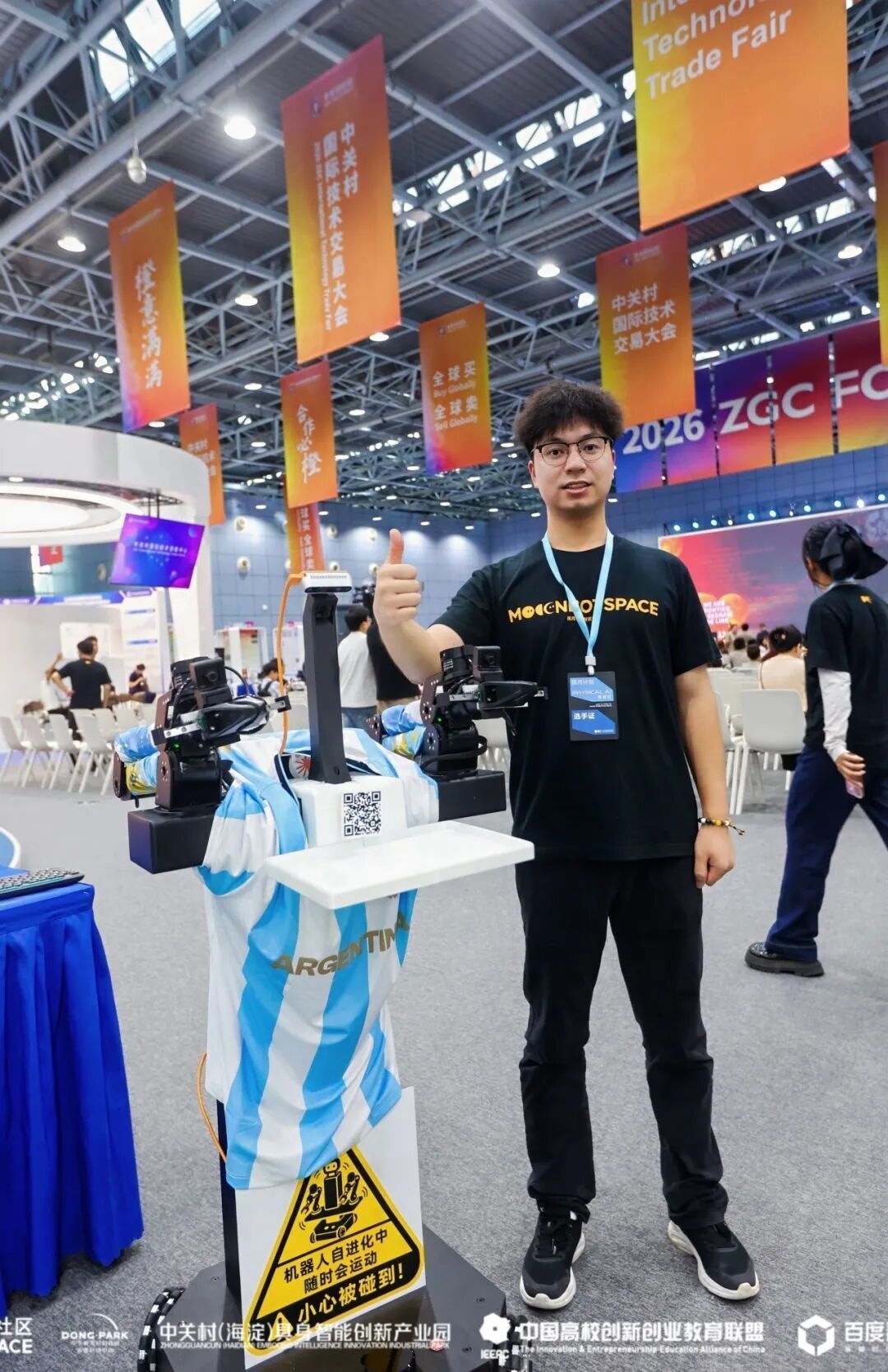
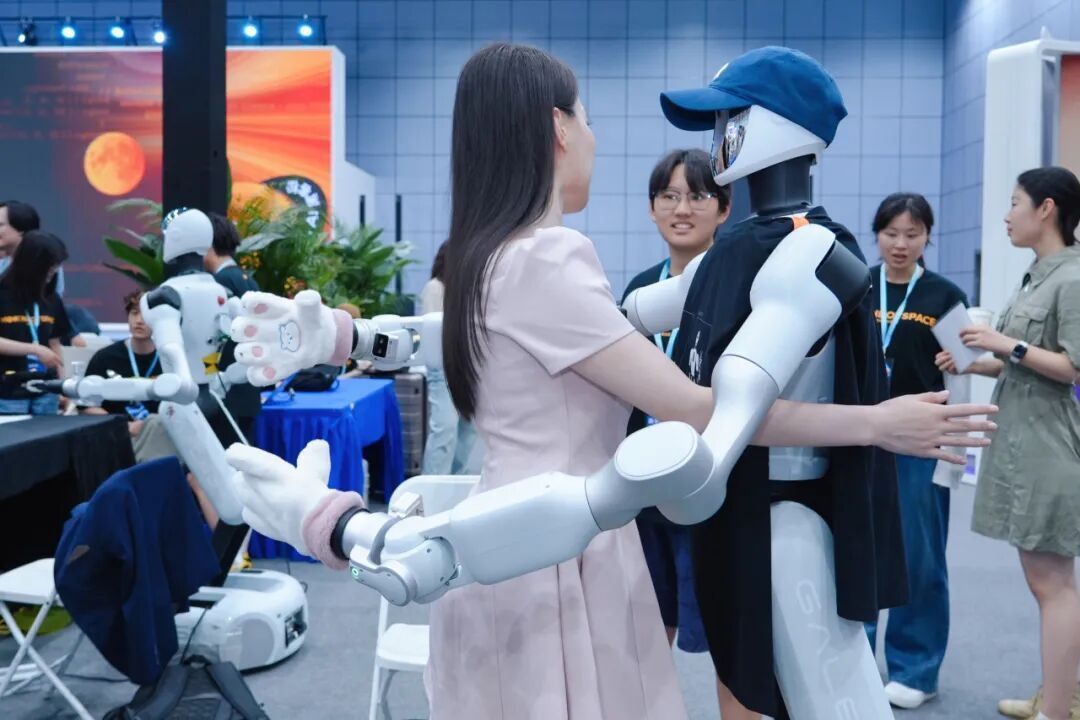
There was also a "Hug Robot" project that made the top twenty. Students put hats and clothes on a long robotic arm and hugged it. The technical difficulty of this project might not be high, but it contained culture and aesthetics. The students were unwilling to accept a predetermined form of the robot, which is interesting.
Sifting out bubbles and people together
Embodied intelligence always needs a body. The body must enter scenarios, scenarios provide feedback, and feedback returns to the product and model. Wang Mingyue believes that China's manufacturing capabilities, supply chain capabilities, and scene density give this iteration loop its own speed advantage.
At the same time, the embodied intelligence industry will face numerous challenges. Geopolitics, regulation, ethics, peer competition, and valuation bubbles will arrive just as they did in the previous AI industry.
Dongcha Beating: What advantages and unrecognized issues exist in China's embodied intelligence sector?
Wang Mingyue: Embodied intelligence must interact with the physical world, have a body, and continuously trial-and-error iterate. China's industrial chain is rich and very fast. We can quickly produce a prototype, find a scenario, put it into the market, obtain positive or negative feedback, and continue iterating. This speed is difficult for many countries, including the US, to achieve. Manufacturing capability, supply chain capability, and scene capability are strong moats.
As for disadvantages, I am reluctant to draw conclusions right now. Everyone is in the infant stage, constantly trial-and-error. Temporary ignorance and lack of talent are normal. The key is whether there is confidence and whether the talent density is thick enough.
This is also Lunar's vision. We hope to bring together those committed to doing this. They can be "little geniuses," and we welcome "big geniuses" with industry experience. They communicate effectively and team up within the community, eventually building companies, while we accompany and help from the side. Precisely because we are still in the development stage, everyone needs each other.
Dongcha Beating: Will geopolitical, policy, and ethical issues in the AI industry slowly spread to embodied intelligence?
Wang Mingyue: It definitely will, but I am not too worried. Whatever happens will happen. If an industry has no strange events or risks, it反而 indicates it is unimportant. The more important the industry, the more likely it is to have geopolitical, competitive, and various complex issues. There is nothing new under the sun; solve problems as they arise.
Dongcha Beating: You mentioned earlier that there is a huge contrast between the industry's imagination and current revenue. Looking at specific companies, the industry is still in its infancy, yet some companies have high valuations. I previously chatted with an investor focusing on companion robot projects; he worried that some products directly facing users haven't properly balanced safety, values, and commercialization speed. How do you view the relationship between valuation and product maturity?
Wang Mingyue: Any industry will have individual cases. Some companies appear to have poor value orientation, product quality, or other aspects, yet still achieve commercial success or high valuations. But individual cases cannot represent everyone.
We still hope to convey more correct entrepreneurial values. My view is that price fluctuates around value. A person's life is also like this; sometimes overvalued, sometimes undervalued. But if you know your weight and your value, you will eventually return to rationality.
If the technology is not solid, the product is not solid, and the thinking on scenarios and commercialization is not deep enough, even if there is a temporary bubble or popularity, it will eventually be forgotten by the market and people. What remains are companies with strength and accumulation.
We also hope to provide some positive guidance for newly joined entrepreneurs. Everyone must truly love this thing. Entrepreneurship has many challenges and pains; without love, it is hard to persist. For example, I love what I am doing now very much. This month, I often sleep at 3 or 4 AM just like the post-00s generation. If calculated purely by economic return, this ledger doesn't add up.
At the same time, entrepreneurs must do things that have a positive guidance effect on society and others to receive positive feedback and persist more strongly. Facing temporary setbacks or sudden waves of praise, one must remain rational and know one's own weight.
This hackathon was hotter than we expected, but our team remained relatively calm. We did what needed to be done; some things were within expectations, some were not done well, leaving room for improvement next time. We don't want to just host it once, burn bright for a while, get interviewed a few times, and call it a day. We hope to make it a brand and a series. Do the long-term valuable things well first; whether the bubble is big or small doesn't matter, let it be.
Go to Lunar
In 1970, Apollo 13 suffered an accident en route to the moon, canceling the lunar landing mission. Oxygen in the cabin was dwindling, and the ground control center needed to use plastic bags, tape, and cardboard from the spacecraft to connect a square carbon dioxide filter to a circular interface.
This history was later filmed by Ron Howard in 1995 as the movie "Apollo 13." In the movie, engineers laid out those scraps on a table, trying them one by one; no one mentioned the grand vision of landing on the moon.
When talking about this hackathon, Wang Mingyue finally mentioned a regret. The booth display session was lively, with contestants explaining their products in booths within the industrial park, but many judges went to the forum venue and missed this scene.
She said that next year they might consider canceling the forum segment, wanting to bring more judges directly to the industrial park.
The copyright of this article belongs to the original author/organization.
The views expressed herein are solely those of the author and do not reflect the stance of the platform. The content is intended for investment reference purposes only and shall not be considered as investment advice. Please contact us if you have any questions or suggestions regarding the content services provided by the platform.
