


[HK IPO] Jiangxi Biological, a leader in tetanus antitoxin, is it worth applying for?
Hello, I'm Lu Xian. I research the investment field and share overseas information.
The previous post shared about Anker Innovations. Today, let's look at a biopharmaceutical company with a relatively niche business—Jiangxi Biological. The company mainly produces human tetanus antitoxin (TAT). It is not an 18A biotech company still burning cash on R&D, but a traditional biopharmaceutical enterprise that is already profitable and has positive cash flow.
1. Overview of the New Share Issuance
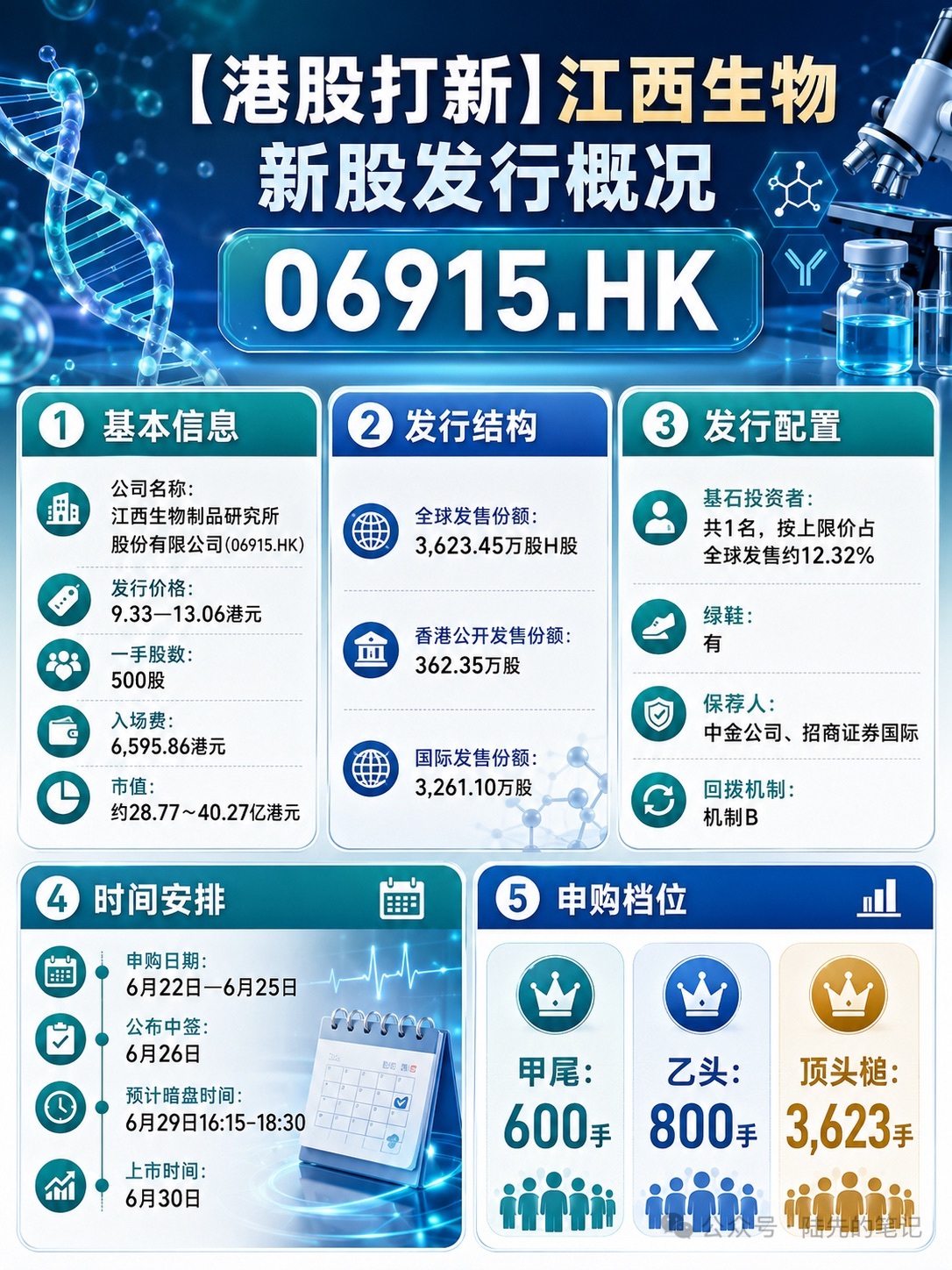
Company Name: Jiangxi Biological Products Research Institute Co., Ltd. (06915.HK)
Global Offering: 36,234,500 H Shares
Hong Kong Public Offering: 3,623,500 Shares
International Offering: 32,611,000 Shares
Issue Price: HK$9.33—HK$13.06
Board Lot: 500 Shares
Minimum Subscription Fee: HK$6,595.86
Cornerstone Investor(s): 1 in total, representing approximately 12.32% of the Global Offering at the upper price limit
Greenshoe: Yes
Sponsors: CICC, CMB International
Clawback Mechanism: Mechanism B
Subscription Period: June 22—June 25
Allotment Results Announcement: June 26
Expected Grey Market Trading Time: June 29, 16:15-18:30
Listing Date: June 30
Market Capitalization: Approximately HK$2.877 billion to HK$4.027 billion
Group A Tail: 600 Board Lots
Group B Head: 800 Board Lots
Top Hammer: 3,623 Board Lots
2. Fundamental Analysis of the Company
The core product of Jiangxi Biological is human tetanus antitoxin (TAT). It is not a vaccine but provides antibodies for short-term protection and treatment when there is a risk of tetanus infection in a wound.
Based on 2025 sales volume, the company is the largest supplier of human TAT in China and globally, with market shares of 65.8% and 45.8%, respectively. Based on revenue, the shares are 66.9% and 33.2%, respectively. In that year, the company sold approximately 29.87 million doses, including 13.5 million domestically and 16.37 million for export, covering over 30 countries and regions in Asia and Africa.
Financial performance is not bad. Revenue from 2023 to 2025 was RMB 198 million, RMB 221 million, and RMB 235 million, respectively. Net profit was RMB 55.48 million, RMB 75.14 million, and RMB 94.79 million, respectively. Adjusted net profit was RMB 55.48 million, RMB 78.80 million, and RMB 113 million, respectively. Gross profit margin increased from 67.8% to 76.8%, and operating activities have consistently generated positive cash flow.
However, the company's problems are also concentrated. In 2025, human TAT contributed 96.4% of revenue, making it almost a single-product company. Domestic sales are highly dependent on volume-based procurement (VBP). Although the company obtained 100% and 72% shares in two VBP projects, policy changes can directly affect prices and profits.
More importantly, starting in 2026, the applicable value-added tax (VAT) rate for human TAT will increase from 3% to 13%. The company has already anticipated that the average selling price of domestic products will decline, while R&D, sales, and listing expenses will increase, leading to a significant drop in net profit for 2026 compared to 2025.
Exports have also shown volatility. Export sales in the first four months of 2025 were 3.7 million doses, but only 1.4 million doses remained in the same period of 2026. The company explained this was related to overseas demand, logistics, and production line upgrades, but it also indicates this part of the business is not stable.
Future growth mainly relies on antivenom serum, equine rabies immunoglobulin, as well as veterinary tetanus antitoxin and PMSG. Some products will advance to clinical or commercialization stages in 2026, but whether they can replace TAT as a second growth curve in the short term remains to be seen.
In terms of valuation, based on the issue price, the company's market capitalization is approximately HK$2.877 billion to HK$4.027 billion. Roughly calculated based on 2025 net profit, the P/E ratio is about 26x to 37x. Looking at historical profits alone, it's not particularly expensive, but considering the company has explicitly warned of a significant profit decline in 2026, the actual forward valuation will be higher.
3. IPO Subscription Analysis and My Action
Specific capital arrangements are shared on the Planet. The advantages of this IPO are its high industry position, existing profitability, high gross margin, and relatively small market cap. The initial Hong Kong Public Offering is only about 7,247 board lots, with a minimum subscription fee of about HK$6,600. The float is small, making it easy to attract small capital participation.
The disadvantages are also obvious. Over 90% of the company's revenue depends on a single product. In 2026, it simultaneously faces VAT increases, declining export sales, and rising R&D expenses, with profit pressure already highlighted before listing.
The offering structure is only average. There is only one cornerstone investor, accounting for only about 12.32% of the Global Offering at the upper price limit, indicating weak share locking. The estimated one-lot winning rate is 2%, with all Group A subscriptions going through a ballot.
Overall, Jiangxi Biological is not a bad company, and its historical financials are relatively solid. However, limited growth space and the expected profit decline in 2026 are the main contradictions. The small market cap and limited public offering shares may bring some short-term volatility, but the fundamentals are insufficient to support heavy leveraged financing.
My action: I will not subscribe.
$JIANGXI BIO(06915.HK)
The copyright of this article belongs to the original author/organization.
The views expressed herein are solely those of the author and do not reflect the stance of the platform. The content is intended for investment reference purposes only and shall not be considered as investment advice. Please contact us if you have any questions or suggestions regarding the content services provided by the platform.
