


Copper Bull Stays! CPO: real opportunity or mirage?
In the previous piece, we outlined the CPO concept and its value chain. The next questions are: where is the tech today, who is building what, and where are the investable spots? This article breaks down each in turn.
I. What are tech giants building?
1) High-speed interconnects for AI data centers fall into three broad camps:
(1) Led by NVDA and AVGO, which both bet on the CPO path, albeit with different approaches. NVDA is pursuing vertical integration to build a full-stack moat, embedding its CPO switches deeply across the compute ecosystem. The aim is to reinforce the competitiveness and longevity of its chips and systems as CSPs like GOOGL push in-house designs.
By contrast, AVGO focuses on standardized CPO chips and reference designs, emphasizing common standards and interoperability to foster the ecosystem. That helps drive CPO toward mass production and expands its addressable market, while extending AVGO’s scope to capture more value across the chain, and strengthening its supplier positioning.
(2) CSPs led by GOOGL, aiming to cut cost, are using OCS to replace portions of traditional opto-electronic switching. OCS is ahead of CPO in deployment and already in volume production, but it applies only to certain use cases. It can erode NVDA’s share in pockets, yet it cannot supplant CPO across broader workloads.
(3) Some China majors (Alibaba, Huawei, etc.), facing manufacturing and ecosystem barriers, are prioritizing NPO as an interim path. NPO is not the endgame, but it could remain a key solution for China data centers for an extended period, partially weighing on NVDA and other U.S. vendors’ share.
Bottom line, CPO is not an isolated product but part of an end-to-end data center solution, increasingly embedded in system architecture. For CPO to industrialize, leadership from giants is necessary, and a full-stack system or ecosystem must be in place.
2) Where is the industry on execution?

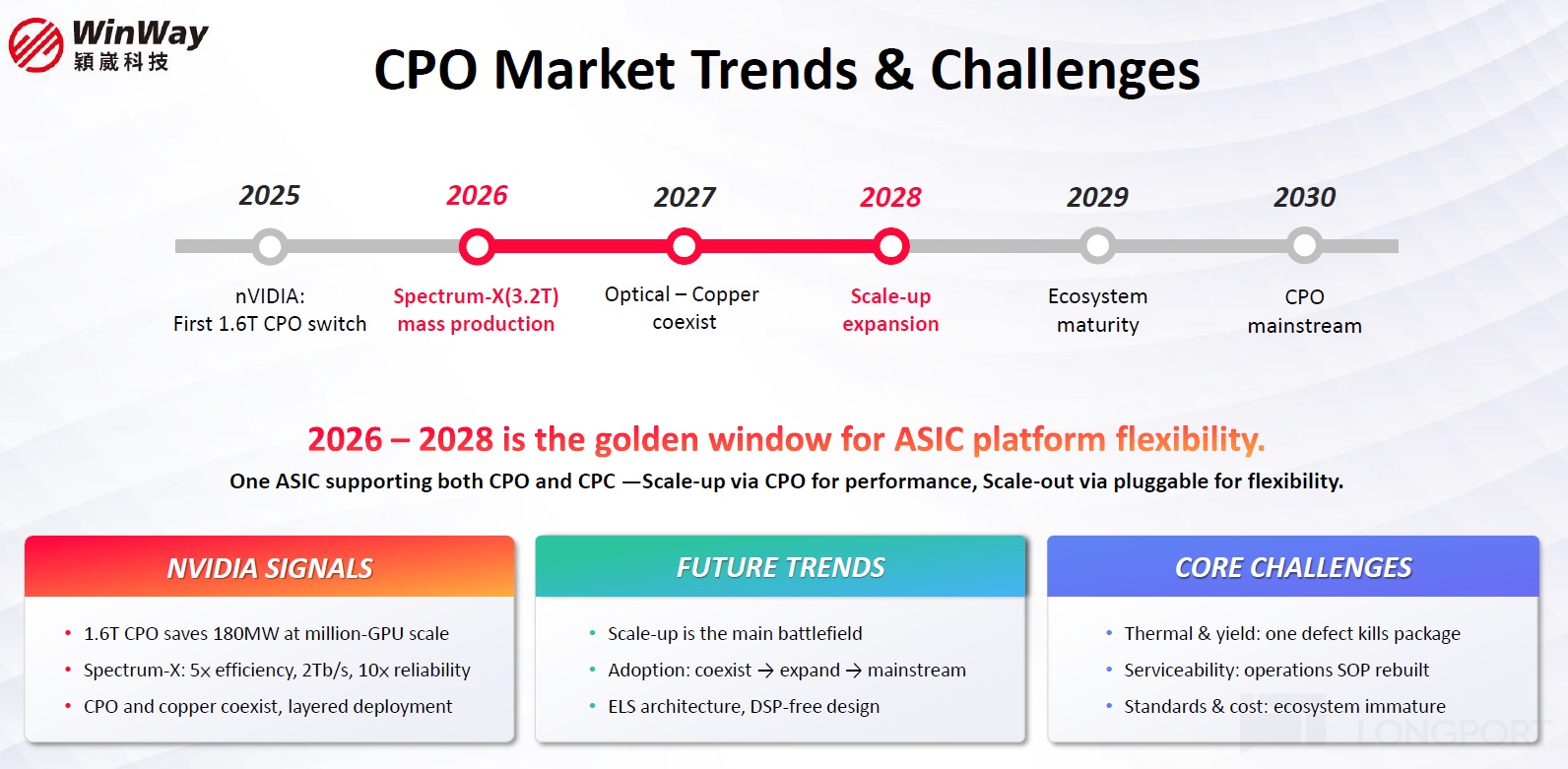
(1) The most aggressive CPO drivers today are NVDA and AVGO, starting with NVDA’s roadmap. NVDA has launched multiple Quantum and Spectrum CPO switches, and at GTC 2026 said Spectrum-X CPO switches will enter full mass production and be folded into the Rubin platform. It also confirmed the next-gen Feynman platform will support both copper and CPO expansion.
Chart: NVDA data center architecture and timeline
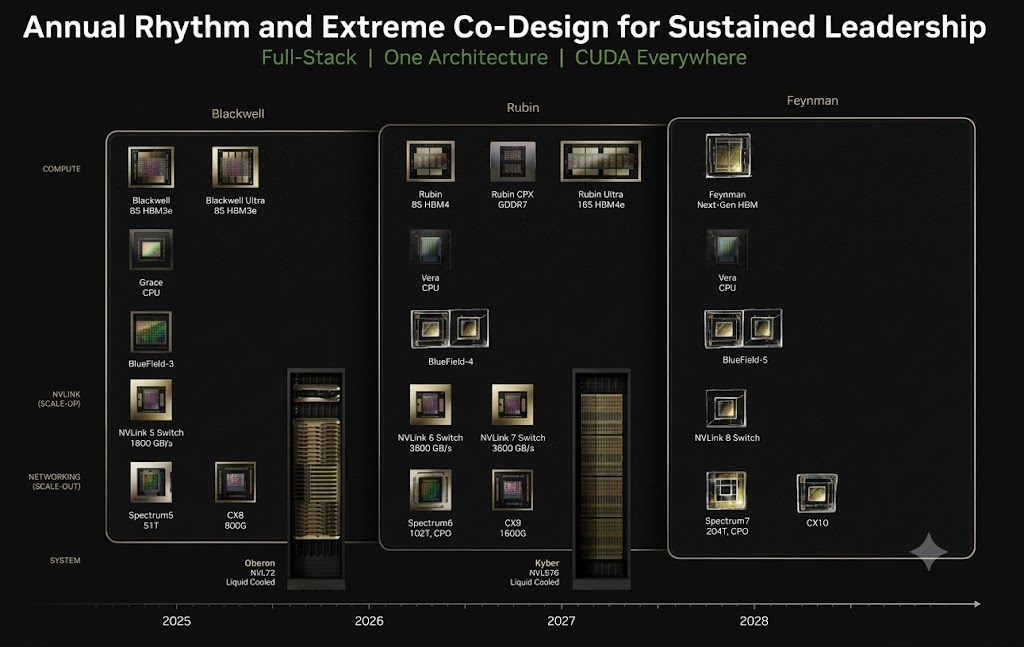
Source: NVIDIA, Dolphin Research
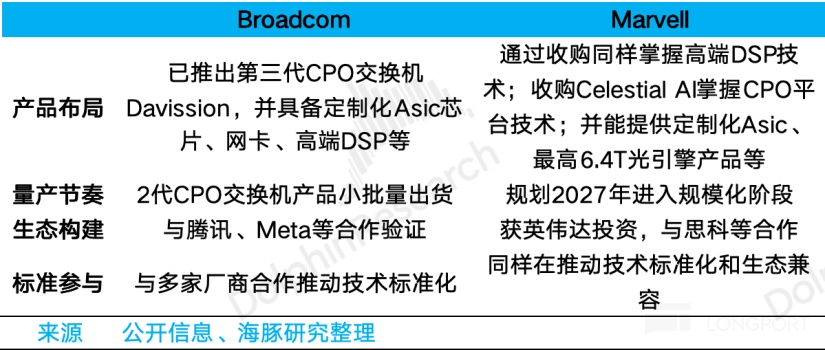
(2) AVGO is equally bold, having introduced its 3rd-gen CPO switch ‘Davisson’ with 102.4T total bandwidth and 16x 6.4T optical engines (NVDA’s max deployed engine is 3.2T). AVGO previously shipped small batches of its 2nd-gen CPO to Tencent for validation.
In short, AVGO and NVDA are now direct competitors in CPO. CPO is at the eve of mass production, and with NVDA’s CPO switches ramping, 2026 should mark the shift from concept to industrialization.
That said, end-demand is ultimately driven by data center bandwidth needs, not by vendor push alone. Downstream, the pace of CPO adoption will still track data center capex cycles.
II. How to size the market?
First, prior forecasts: (1) LightCounting expects CPO port shipments to rise from 50k in 2023 to 9 mn in 2027, equating to ~70k switches, with 1.6T CPO ports exceeding 24 mn units by 2029.
(2) Yole projects the global Datacom CPO market to grow from $67 mn in 2024 to $8 bn by 2030 (CAGR 121%), with scale-up as the main driver. These reflect earlier optimism and, if anything, look conservative now on total TAM; however, the mass-production cadence has lagged those timelines. Barriers exist, as we noted previously, yet they are not insurmountable, and NVDA has put CPO onto a mass-production track.
We also build a bottom-up TAM using forecasted NVDA rack shipments. We map optical engine and related component content per rack and apply CPO penetration assumptions.
Given yield constraints in packaging and assembly, we remain conservative for 2027 and see scale only after 2028. 2026–27 should be a copper-plus-optics coexist phase; as networks scale to 576 GPUs, cross-rack scale-up interconnects become necessary. Within-rack scale-up may remain mixed, with CPO only partially replacing copper.
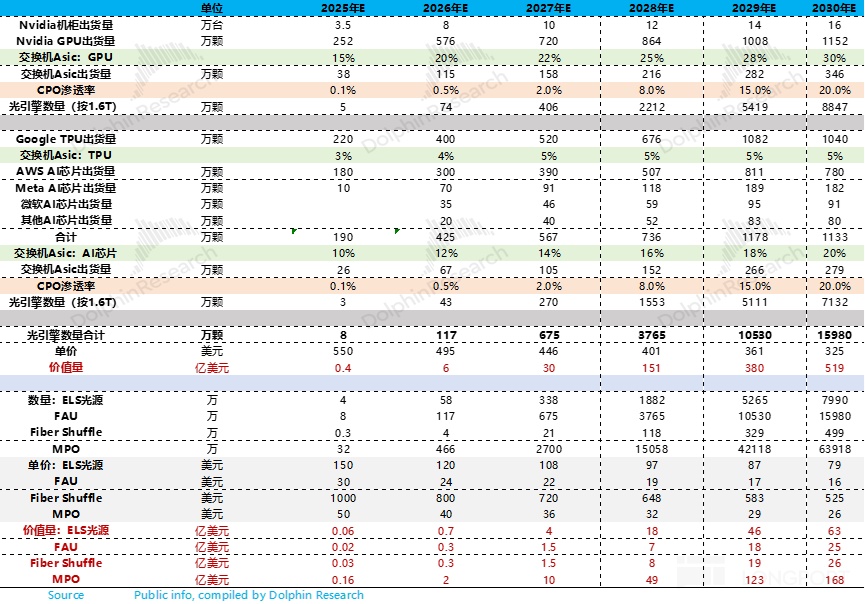
Key takeaways from the sizing: 1) Optical interconnect capex differs from the recent surges in compute and storage. Its benefits—lower latency, power, cost, and footprint—are the result of integration.
The real catalyst is that when compute and storage scale high enough, data movement must not bottleneck. As electrical links push to higher frequencies, loss grows exponentially, whereas CPO’s core advantage is transmitting ultra-high-frequency signals with minimal loss; the ‘four savings’ are consequences of that.
2) The path benefits from lower cost/power and a mature supply chain. During the capacity upgrade cycle, legacy solutions can bridge the gap before new tech fully matures, implying a long coexistence and a more gradual S-curve than compute/storage. Because CPO is a route substitution, value will be reallocated across incumbents and entrants, and the pace of rollout will keep that debate alive.
3) CPO is the likely end-state, but the iteration will be incremental. Jensen Huang said MRVL could be a trillion-dollar company, but the gradual storage-path evolution makes the timing of that call—2026, 2027, or 2030—dependent on how fast the route iterates.
With that, we turn to the investable names involved —
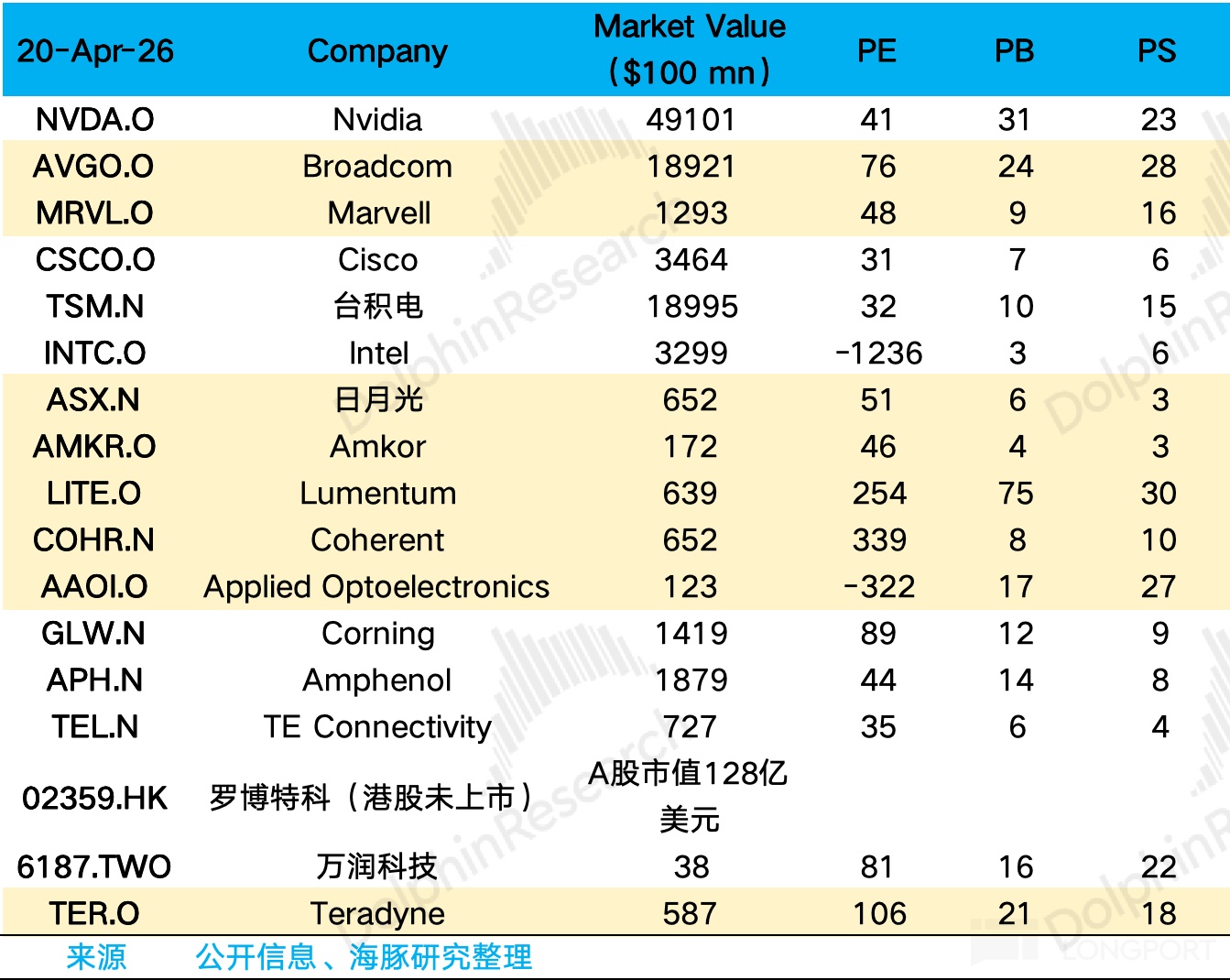
III. Value chain and stock mapping
1) Definers and drivers of CPO:
(1) NVDA
As noted, NVDA is rolling out its own CPO switches and building a system-level ecosystem. It is also investing directly in critical supply: $2 bn each in LITE and COHR to secure upstream laser and other key capacity; it has invested in Ayar Labs (CPO interconnect solutions such as the SuperNova external light source and TeraPHY optical I/O chiplets) and MRVL as well.
(2) AVGO
As discussed, AVGO is launching CPO switches based on its Tomahawk 6 and is pushing standardization via bodies such as the OCI Alliance. The goal is to accelerate CPO industrialization.
(3) MRVL
AVGO’s key rival MRVL is deeply engaged and received a $2 bn investment from NVDA. MRVL views CPO as a core future differentiator, offering its own CPO architecture, switch platform, and a self-developed 3D SiPho engine, positioning itself as an ecosystem builder. It also acquired Celestial AI, which focuses on optical interconnect.
(4) CSCO
CSCO remains cautious on CPO but has silicon photonics capability and is co-developing 1.6T/3.2T CPO optical engines with suppliers. Its programs are in tech validation.
Across these names, CPO is not a standalone P&L silo. It can be a potential bottleneck to overall data center capex if it fails to scale, yet it can also bolster core competitiveness and help capture a larger share of the value chain.
We would track three things: (1) CPO product milestones as key upside/downside drivers for the core business; (2) the incremental P&L elasticity from CPO is greater for AVGO/MRVL than NVDA, given CPO’s smaller wallet share at NVDA; (3) upstream opportunities based on each OEM’s CPO progress, supplier roadmaps, and partnerships.
2) Enablers for CPO production:
(1) TSM
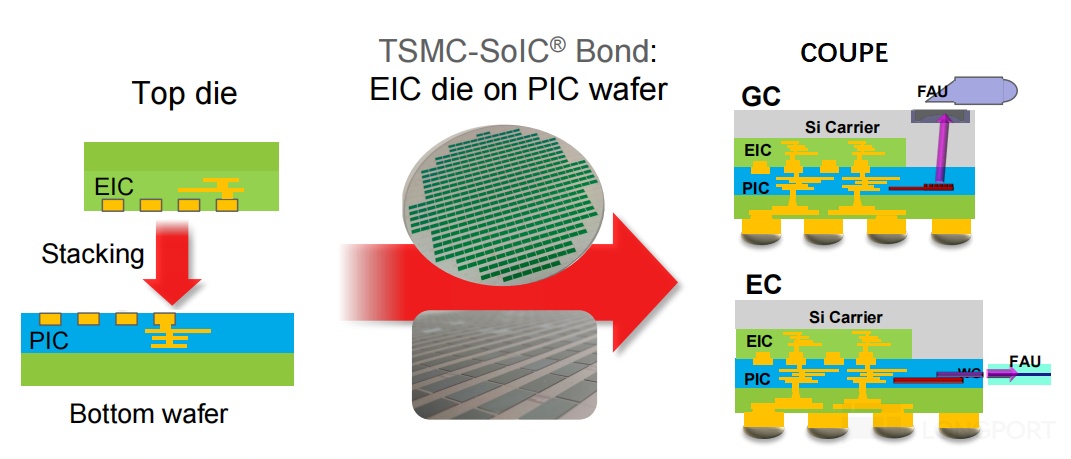
CPO depends on TSM’s leading wafer fabs and advanced packaging, which are both foundational and bottleneck. Beyond CoWoS, TSM has built strong silicon photonics know-how and launched its COUPE platform (compact universal photonic engine) that uses SoIC and other 3D packaging to stack PIC and EIC at high density, a key to CPO mass production. NVDA, AVGO, and others are adopting it.
Chart: TSM Coupe process
Source: TSMC, Dolphin Research
(2) INTC
INTC was an early mover in silicon photonics. Progress has been slower than hoped, and given NVDA’s tight alignment with TSM—particularly as CPO requires tight integration of front-end wafer and back-end advanced packaging—INTC faces a high bar. Its competitiveness in switch ASICs is also limited, so the market’s CPO expectations for INTC remain muted.
That said, INTC has solid silicon photonics IP and full-stack capability, having shown a CPO prototype years ago. It could still secure a place in the ecosystem.
(3) ASE Technology
ASE is the largest OSAT globally and has strong advanced packaging. Its VIPack platform (integrating FOCoS/FOCoS-Bridge and other 2.5D/3D techniques) could serve as TSM overflow capacity. TSM already outsources much of the ‘oS’ in CoWoS to ASE, which positions it to support CPO packaging. ASE targets CPO mass production in 2026.
(4) Amkor Technology
AMKR also has depth in advanced packaging, with mature Hetero/SiP and high-density fan-out (2.5D) capabilities. It has taken some overflow from NVDA and, while later to CPO, has made it a strategic focus.
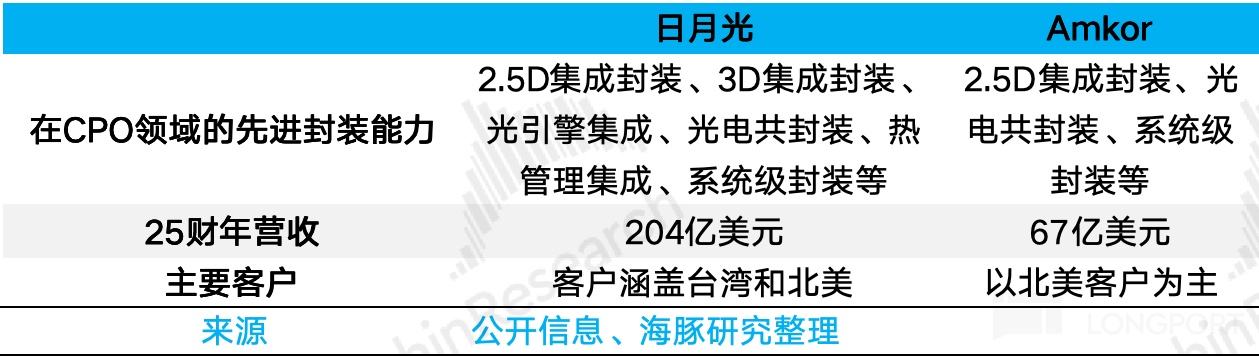
The initial plan was CPO mass production in 2026, but TSM’s current opto-electronic 3D co-packaging yield is only 50–60%. Downstream assembly at OSATs such as ASE involves mounting the integrated module to the final substrate, fiber coupling, thermal, etc., with alignment between fiber and optical engine at micron or even nanometer precision; yields here are only 20–50%.
TSM plans to lift PIC capacity to 10k wpm by Q1 2027. Even so, 2027 should only ...
Net-net, for TSM, like NVDA, CPO is hard to treat as a standalone business, so direct P&L elasticity looks limited, though it deepens TSM’s moat from fabs to advanced packaging. For ASE and AMKR, taking on parts of the back-end CPO flow could add meaningful upside.
3) Components further upstream:
CPO integrates optical engines as well as lasers and fiber components. If CPO demand inflects, these parts should see a surge as well.
a. Optical devices (lasers):
(1) Lumentum
LITE is a leader in optical communications, and CPO is a battleground for optical devices. It owns the world’s largest InP wafer capacity for lasers and supplies ELS external light sources.
LITE also supplies into OCS, works closely with GOOGL, and has booked orders. Beyond lasers, it can provide FAU and related products.
(2) Coherent
COHR, another optical leader, is equally invested in CPO. It offers external ELS lasers (with the first global 6-inch InP mass-production line) and more advanced heterogeneous integration by embedding InP devices on silicon.
Beyond lasers, COHR can contribute to CPO solution design and supply PMF/FAU, and it also addresses OCS, albeit with a different route vs. LITE. Its broader portfolio spans beyond optical comms into semis and industrial, its traditional base.
(3) Applied Optoelectronics
AAOI also supplies lasers (CW), with in-house design, fab, and test, and has secured top-tier orders. It remains an industry newcomer with revenue yet to fully ramp.
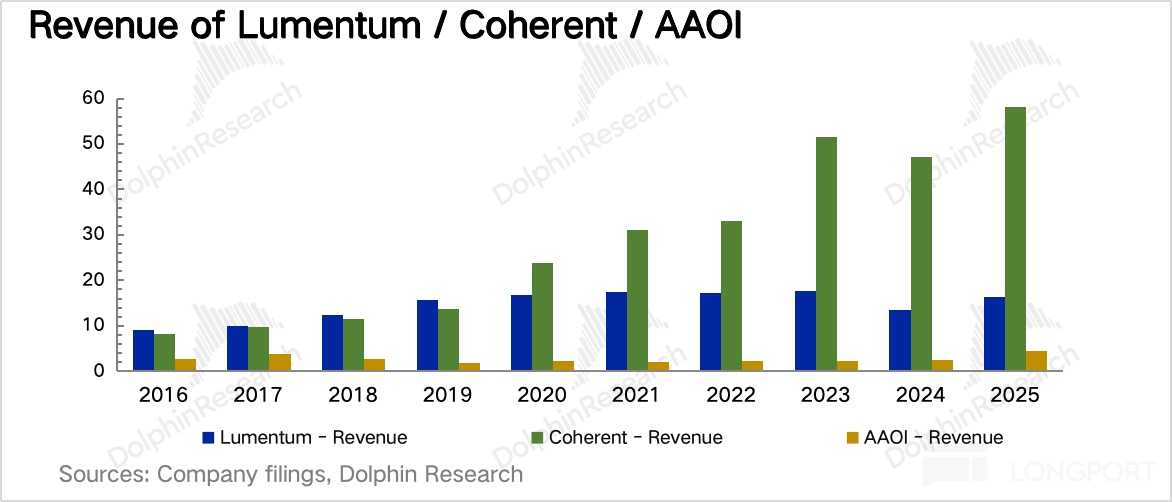
Comparing LITE, COHR, and AAOI:
(1) LITE and COHR share many traits: deep EML/InP laser chip know-how and capacity, the ability to supply CW lasers, and strategic investments from NVDA that establish tight linkage.
(2) LITE is more focused on optical comms and thus has higher operating leverage, with 50% capacity expansion planned for 2026. Beyond CPO, it leads globally in OCS switches and is a core GOOGL supplier; if you are bullish on GOOGL’s OCS path, LITE is a key proxy.
(3) COHR is more integrated end-to-end, from materials and devices to systems, and covers broader fields than optical comms. With VCSEL and SiPho depth, it can influence CPO solution design, while maintaining exposure to semis and industrial, its legacy strongholds.
(4) AAOI’s legacy core was cable broadband, but it quickly entered optical comms via anchor customers like Microsoft. As a latecomer, it is at a relative disadvantage in competitiveness and customer mix, but offers higher upside optionality.
(5) That said, given NVDA’s investments and the constructive outlook, much of the upside for LITE/COHR may already be reflected, leaving valuations relatively rich. Selectivity and entry timing matter.
4) Fiber components:
(4) Corning
GLW, a materials leader, supplies end-to-end optical solutions from fiber/cable to connection hardware, and in CPO can provide FAU, MPO, and more. Its strength skews toward the transmission layer.
(5) Amphenol
APH is a top interconnect vendor and in CPO supplies MPO, fiber shuffles, etc. Versus GLW, APH is more focused on connectors.
(6) TE Connectivity
TEL is another connector leader with MPO and fiber shuffles in CPO as well. One risk: NVDA still uses copper for scale-up today, a sweet spot for APH and TEL; if scale-up interconnects shift to CPO later, it would be a headwind for their core TAM.
Overall, in fiber components, incumbents still dominate. Growth torque likely trails the laser/device segment.
4) Equipment: focus on incremental and bottleneck steps
Process-wise, CPO spans front-end and back-end flows: (1) Front-end (Fab): EIC wafer, PIC wafer (SiPho), laser manufacturing, and wafer-level test.
(2) Back-end: dicing and die attach, bonding, fiber-array coupling, and system-level test. Versus traditional electrical chips, coupling and test are the main pain points.
(1) Coupling equipment for engines/lasers/fibers:
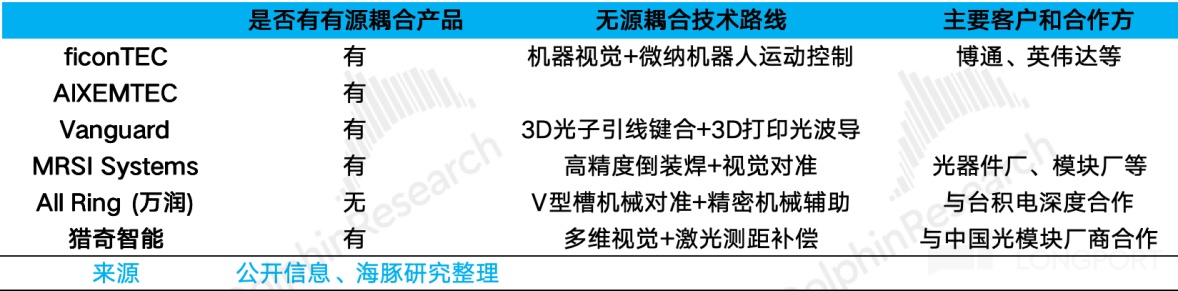
Globally, ficonTEC (acquired by China’s Robortek, which plans a HK listing) supplies active/passive coupling. It is among the few with passive solutions, which offer higher throughput and lower cost and could become the preferred CPO path, though active dominates volume today.
Other players include: AIXEMTEC (active coupling); Vanguard (active, plus pushing 3D-printed waveguide passive coupling); MRSI Systems (pursuing passive coupling with semiconductor vision alignment); All Ring (Taiwan-listed, Wanrun Tech; semiconductor vision passive); and Lieqi Intelligent, which mass-produces passive coupling mainly for China.
Keep an eye on Robortek’s HK IPO timing. Execution there could be a useful sentiment catalyst.
(2) Test equipment: Because CPO integrates EIC and PIC, both wafer-level and module/system-level electrical and optical tests must be automated at higher spec. TER (NYSE) and Advantest supply ATE platforms. As test is not a net-new step, its growth torque may lag coupling tools.
<End>
The copyright of this article belongs to the original author/organization.
The views expressed herein are solely those of the author and do not reflect the stance of the platform. The content is intended for investment reference purposes only and shall not be considered as investment advice. Please contact us if you have any questions or suggestions regarding the content services provided by the platform.
