


BABA: E-comm Steps Back, AI Takes Lead; Cash Burn Not a Concern
$Alibaba(BABA.US) posted its Mar-end quarter (FY26 Q4) before the U.S. market opened tonight. At first glance, issues abound — cloud growth was softer than hoped, on-demand retail narrowed losses but only in line with expectations, and heavier AI-to-C spending drove a deep loss in Innovation.
Is it really that scary? Let's look at the details.
1) CMR looks weak, but has likely bottomed and stabilized: in core far-field e-commerce, CMR rose 1.2% YoY, which looks soft. However, the company moved certain merchant subsidies from marketing expense into contra-revenue, depressing reported growth. Ex this change, comparable CMR growth was ~8%, a clear improvement vs. last quarter.
This aligns with JD's print and NBS data, suggesting the trough in e-commerce growth is behind us.
2) On-demand retail keeps cutting losses, pace in line: Taobao Flash Sales revenue was just under RMB 20bn, slightly down from RMB 20.8bn QoQ. A rough estimate suggests Flash loss was ~RMB 17bn this quarter vs. ~RMB 23–24bn last quarter. In other words, order mix is improving, lifting revenue per order while loss per order is narrowing.
From a expectations perspective, China E-com Group adj. EBITA was RMB 24bn, down RMB 15.7bn YoY and near the low end of the sell-side range. Assuming Taotian ex on-demand retail has bottomed with flat to low-single-digit profit growth YoY, Flash losses were not strong enough.
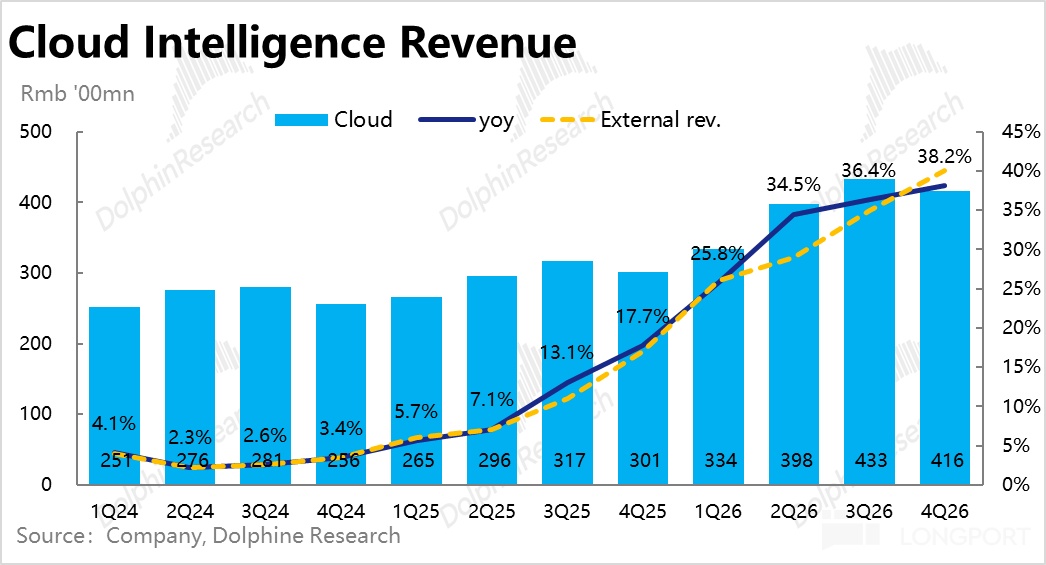
3) Alibaba Cloud re-acceleration fell short, but the thesis stands: cloud revenue grew 38% YoY, a mild step-up. Yet the market was looking for ~40%, so it was a slight miss.
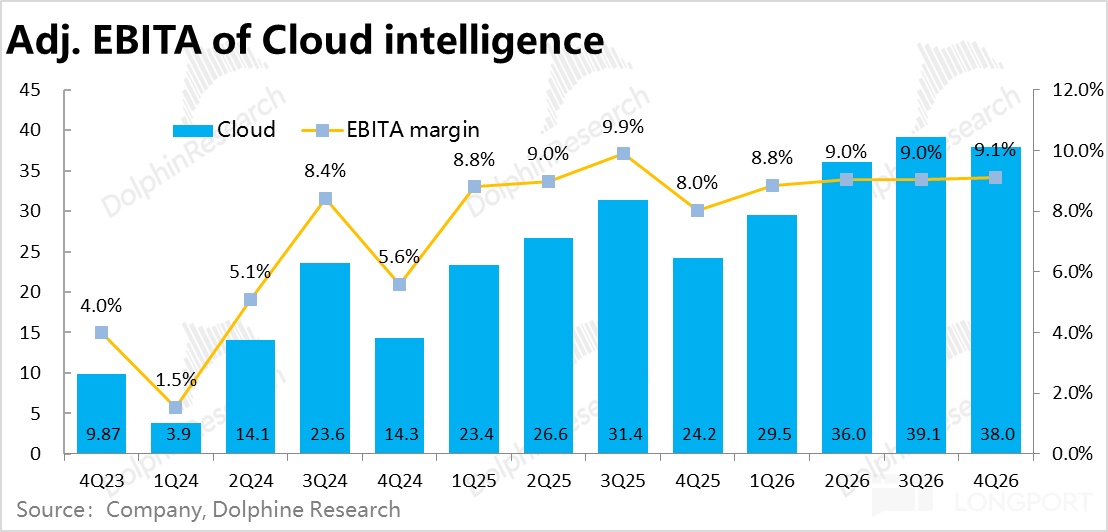
External cloud revenue rose 40% YoY vs. 35% last quarter, while internal revenue slowed further to ~33%. A small positive: cloud adj. EBITA margin reached 9.1%, holding up even as AI mix rises, with a modest uptick.
Taken together, the likely reason growth was not more exciting is capacity constraints holding back revenue recognition, implying more AI capex is needed to unlock demand. Redirecting spend from retail into AI would likely be welcomed by the market.
Management also indicated AI-related revenue was ~RMB 9bn this quarter (annualized RMB 36bn), about one-fifth of cloud, still growing triple digits. This suggests cloud can keep accelerating as compute supply eases.
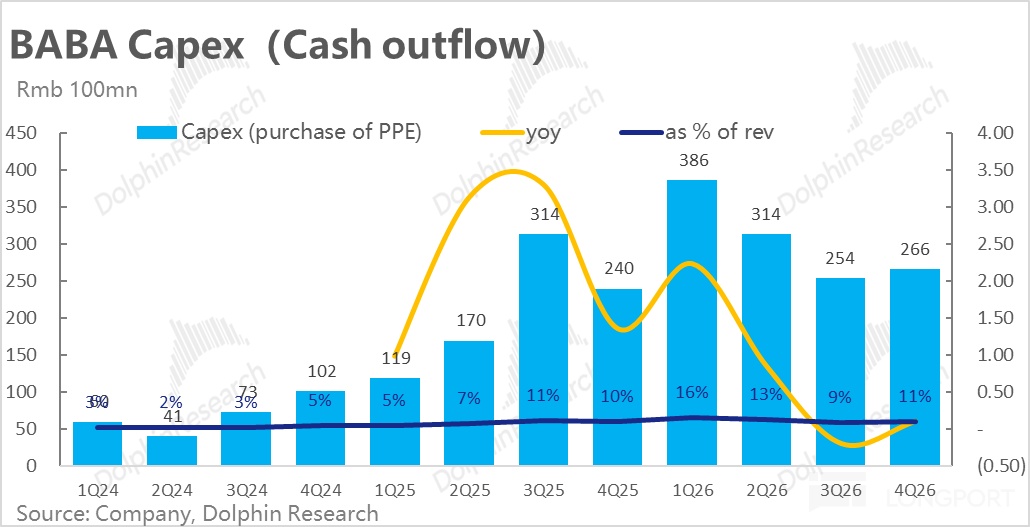
4) Capex budget raised: cash capex was RMB 26.6bn this quarter, back on an uptrend but not by much. Management guided that future capex will exceed the prior three-year plan of ~RMB 380bn, and part of compute build-out will shift to leasing/Opex, not fully showing in capex.
5) Intl e-com back to breakeven territory: revenue grew 5.5% YoY this quarter, improving from ~4% last quarter. Meanwhile, adj. EBITA loss narrowed sharply to RMB 0.14bn vs. RMB 2bn loss last quarter.
The loss cut was decent, validating ongoing efficiency gains and that last quarter’s big loss was seasonal. The segment remains on a path of refined operations.
6) New biz posted a massive RMB 20bn loss: the biggest drag on group earnings came from the 'non-core' Others segment.
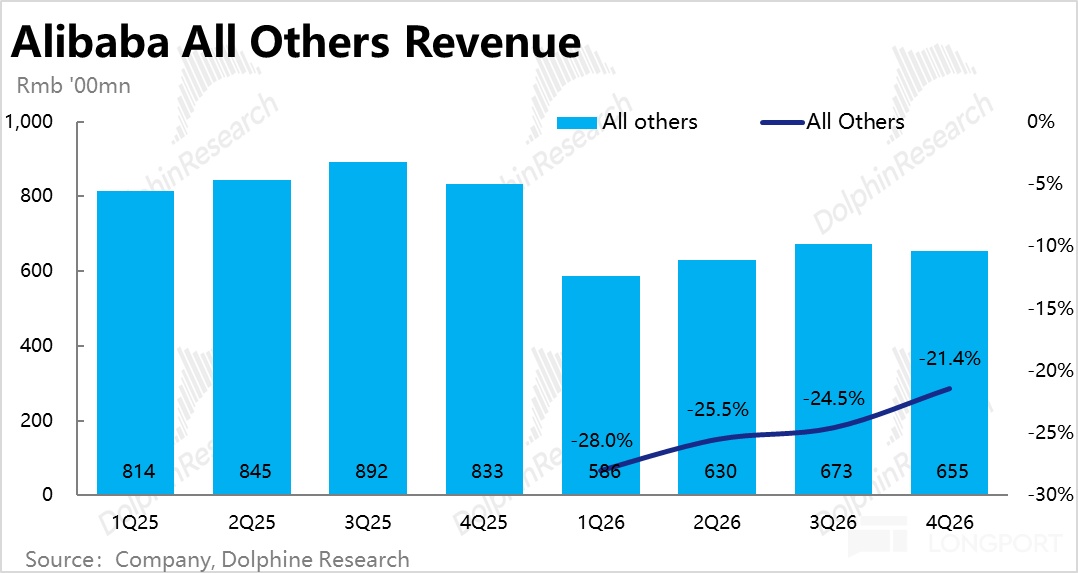
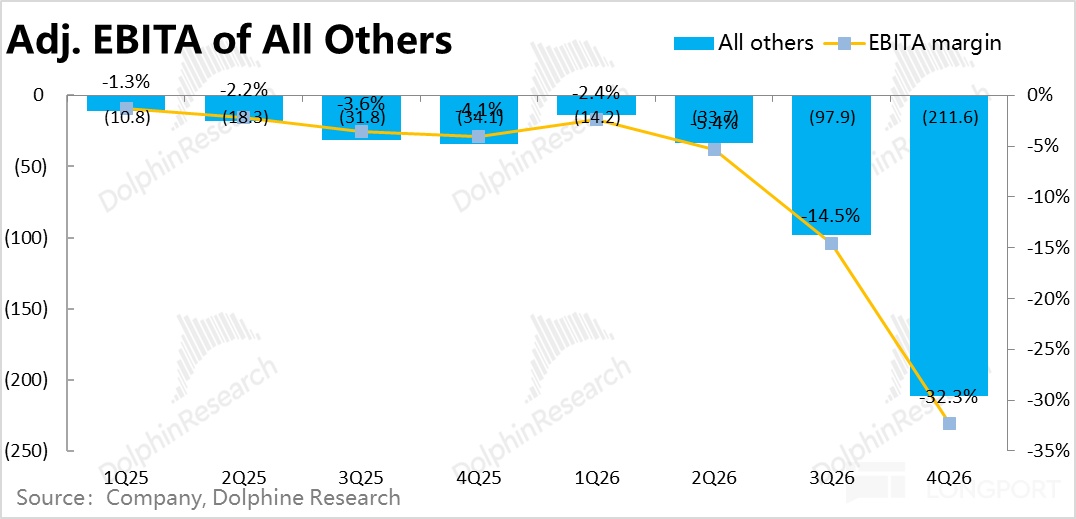
Revenue was ~RMB 65.5bn, down 21% YoY, still mainly due to deconsolidating Intime and Sun Art. But loss widened to RMB 21.1bn, exceeding the already raised sell-side estimate of ~RMB 20bn.
Others loss rose by over RMB 11bn QoQ while on-demand narrowed losses by only ~RMB 7bn, pushing group profit to multi-year lows.
Key drivers included Qwen App red-envelope campaigns during CNY, Flash-linked free-delivery vouchers, and spending on multiple AI models and apps for R&D and user acquisition.
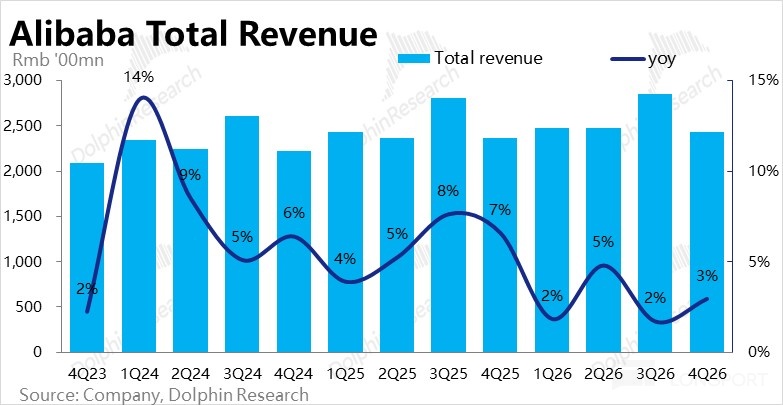
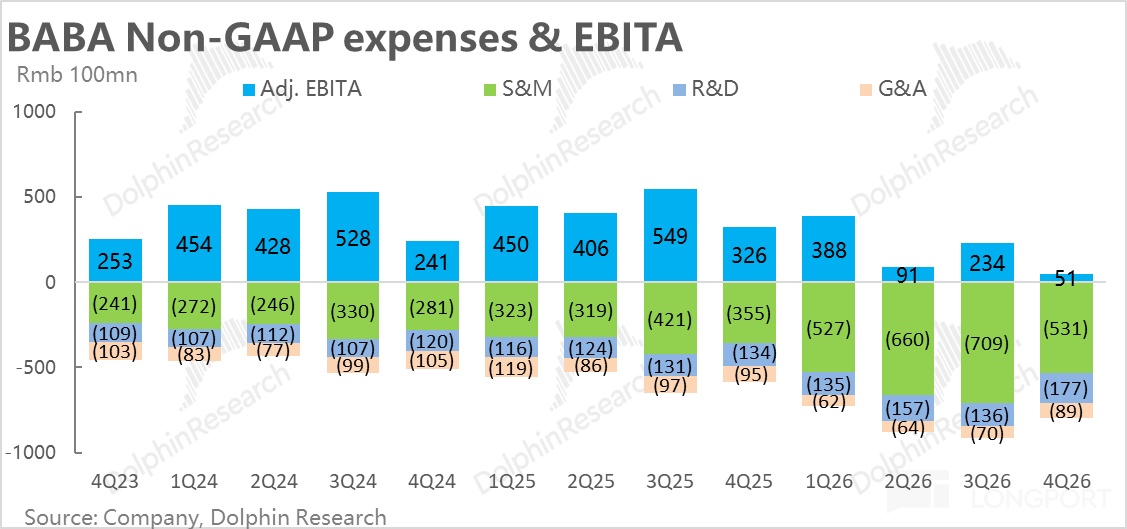
7) Group topline up, profits down sharply: total revenue was ~RMB 243.4bn (+2.9% YoY), and ex Intime/Sun Art the comparable growth was ~11%, up from 9% last quarter. Adj. EBITA was ~RMB 5.1bn (-~84% YoY), a multi-year low.
On costs and opex, note that non-GAAP GPM was 34.7%, down ~400bps YoY, driving GP to ~RMB 84bn (-7.5% YoY), nearly RMB 10bn below Bloomberg consensus. Marketing spend rose by only ~RMB 17.5bn YoY vs. ~RMB 29bn last quarter.
Given the large GPM miss, CMR reclassification alone cannot explain it. Dolphin Research thinks other retail subsidies were also moved from marketing to contra-revenue.
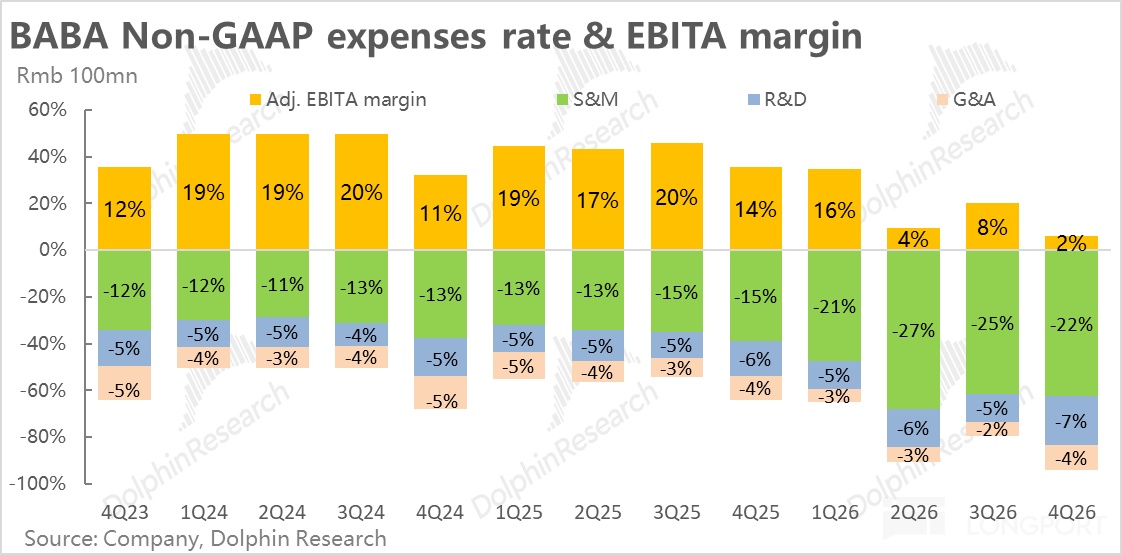
Also noteworthy, non-GAAP R&D reached ~RMB 17.7bn (+32% YoY), the fastest since FY21, underscoring heavier investment in AI apps and models.
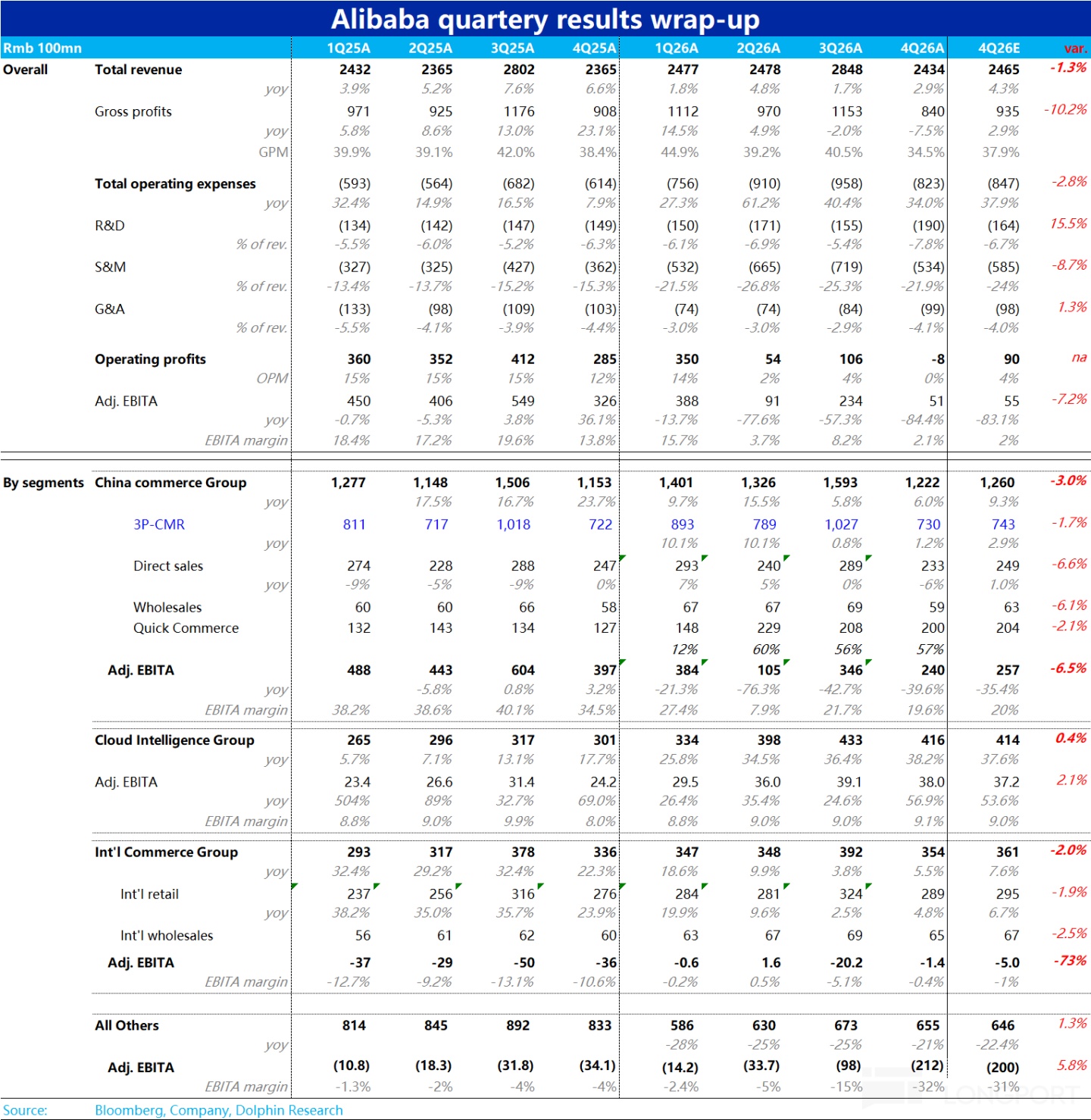
Dolphin Research view:
1) Soft quarter
In short, growth trends improved, but profits suffered due to heavy investment. Absent expectations talk, a light-asset company with ~RMB 250bn in quarterly revenue delivering only ~RMB 5bn in adj. profit — and a GAAP loss — is indisputably weak.
By segment:
a. Far-field e-com (ex CMR reclassification) has bottomed on both growth and profit and is turning the corner; the worst is likely over.
b. Flash is seeing order-mix optimization as expected and lower loss per order, but nothing materially above expectations.
c. Cloud growth lagged expectations, though margins slightly improved. Capacity constraints aside, acceleration still fell short of the market’s bar.
d. While the above three were neutral-to-positive, the heavy losses in AI-app-heavy Others tilt the quarter broadly negative.
2) Outlook: bottom set, recovery follows — a net positive
Past is past; the focus is the outlook.
1) Far-field e-com: our high-level view is little changed from last quarter. With state subsidies fading in 2026 and AI compute gradually displacing labor, we remain cautious on 2026 industry growth, with GMV likely in low single digits for the year.
This quarter supports the view that Q4 CY25 was the trough for e-com growth. However, the Q1 rebound was partly CNY-driven, and online retail weakened again after Mar, tempering the recovery.
We therefore expect Taotian (ex Flash) to deliver low-single-digit positive growth in both revenue and profit in FY27, consistent with guidance on the call.
2) On-demand retail: two clear trends — Alibaba and Meituan will likely keep battling on order volume and share for a while, with no big divergence. Unit economics should keep improving via lower subsidies, better mix, and higher efficiency.
Per prior guidance, the goal is to halve Flash losses each year in FY27–FY28. With FY26 losses near RMB 90bn, that implies ~RMB 40+bn loss in FY27, ~RMB 20+bn in FY28, and breakeven in FY29. Post-quarter, management essentially maintained this guide.
Joint loss-cutting across platforms is positive for all. But this assumes share stays broadly stable, and Alibaba remains determined to defend scale and keep up with Meituan. If any player pushes for outsized share gains, subsidies and losses could reflate.
3) Chips + models + cloud + apps: despite being one of the strongest integrated AI players in China — arguably closest to the Google narrative — recent share performance has been underwhelming.
a) Models need to push harder: since early 2026, Qwen has not clearly led the field, and with talent departures, investors are cautious on pricing AI optionality.
Globally, companies achieving SOTA — OpenAI, Anthropic and Google — have seen robust revenue and valuation momentum. Domestically it is still a melee; Qwen is in the lead pack but not clearly ahead of GLM, Kimi, DeepSeek, etc., and may be slightly behind.
Thus, while Alibaba Cloud enjoys scale advantages, it lacks a unique, must-have edge vs. other clouds and model vendors. Acceleration may not match Anthropic or Google.
Hence, a key watch for the Alibaba thesis is whether it can launch a domestically sustainable SOTA foundation model.
b) Chips: watch Pingtouge’s in-house chip progress, external sales, and any standalone listing plan. In the nearer term, tight supply has lifted average compute rental prices, and management expects cloud margins to move from 9% to above 10%, while keeping the long-term 20% margin target.
c) 2C vs. 2B is not either-or: with agents like OpenClaw and Claude Code gaining traction, the frontier is shifting from consumer traffic hubs to enterprise productivity tools.
The difference: 2C follows a mobile-internet playbook where AI is a traffic gateway monetized indirectly via ads/commerce, while 2B is software-like, monetizing value created by the tool itself.
The displacement narrative has also shifted from search/ads/commerce platforms to software/SaaS in the industrial internet. Near term, 2B direct monetization is easier than 2C, but both should coexist and work over the long run.
OpenAI’s 2C monetization struggles reflect both a harder path and a lack of operational domains like e-commerce or travel. For Alibaba, with sizable C-end assets, it needs to explore both 2C and 2B paths, with shifting focus over the medium term.
We therefore expect continued investment in consumer-facing Qwen and enterprise products like Wukong and Qwen Code. 2C apps are more defensive, shoring up the retail moat — despite heavy CNY red-envelope losses this quarter, Qwen’s MAUs rose sharply to 160mn+, second only to Doubao, though chatbot retention remains weak.
Enterprise monetization is more offensive, delivering immediate revenue/profit for AI and cloud. The trade-off is sustained high AI investment, albeit not as extreme as the one-off ~RMB 20bn hit from CNY promos this quarter, but FY27 losses in Others will likely stay elevated.
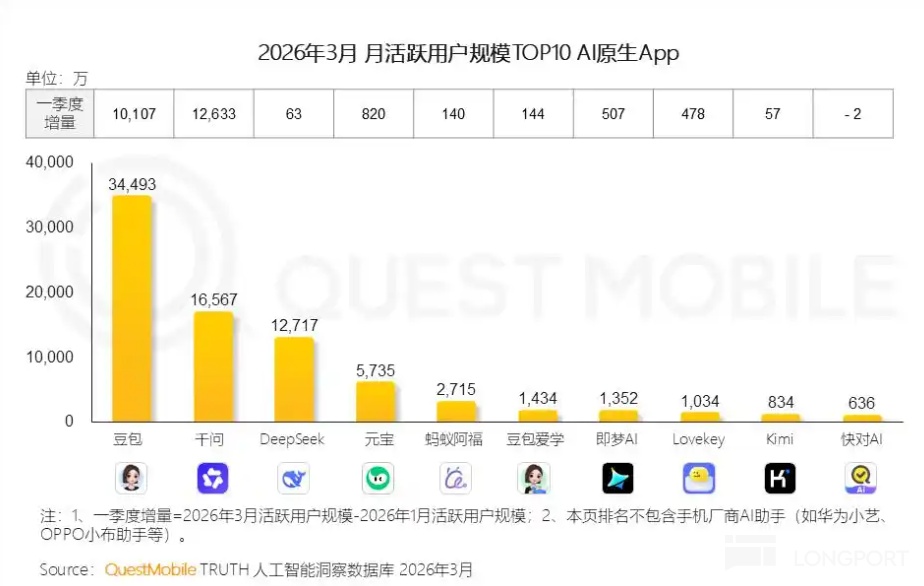
d) Funding pressure and mix optimization: heavy Other-segment spend shrank operating cash inflow to RMB 9.4bn, and with sizable capex, FCF turned negative at -RMB 17.3bn.
Looking ahead, Taotian (ex on-demand) can generate ~RMB 200bn in cash profits annually. As on-demand losses halve from ~RMB 90bn, more capital can shift to AI — a positive.
Without tapping cash reserves, ~RMB 150bn per year could go into AI, which should cover capex and spending on Qwen and other AI apps.
3) Bottom line: retail is rebounding; supply constraints delay cloud revenue release — bias tilts positive
Dolphin Research applies SOTP. For China E-com Group, given a less upbeat 2026 outlook for legacy e-commerce,
we expect Taotian (ex Flash and Fliggy) adj. EBITA to grow only low single digits in FY27, and assume RMB 43bn on-demand drag for the year, aggregating to ~RMB 120bn profit after tax.
Given ample room for loss cuts in on-demand and potential moat benefits from Flash and AI, we assign 12x PE, implying ~$74/share. On a Taotian ex on-demand basis, the implied PE is ~7.7x, near the upper end of the sector’s 6–8x range.
For Alibaba Cloud, leveraging end-to-end chips+cloud+software capabilities, we model ~RMB 220bn FY27 revenue (+40% YoY), value at 5x PS, and with a long-term 20% margin, that implies ~25x PE for profits, or ~$67/share.
Intl e-com growth remains slow but loss-cutting beats; we trim FY27 revenue to ~RMB 150bn and keep 1x PS, or ~$7/share.
Sum-of-parts yields ~$151/share, which we view as neutral. In a conservative case — 7x for Taotian+on-demand combined, 4x PS for cloud — we get ~$115/share.
As long as far-field e-com holds and the on-demand war does not re-intensify, Alibaba looks near a clearing point for negatives.
Any positive on cloud, models, or chips could quickly drive the stock higher, and the odds are decent.
Detailed results analysis follows:
I. New reporting structure
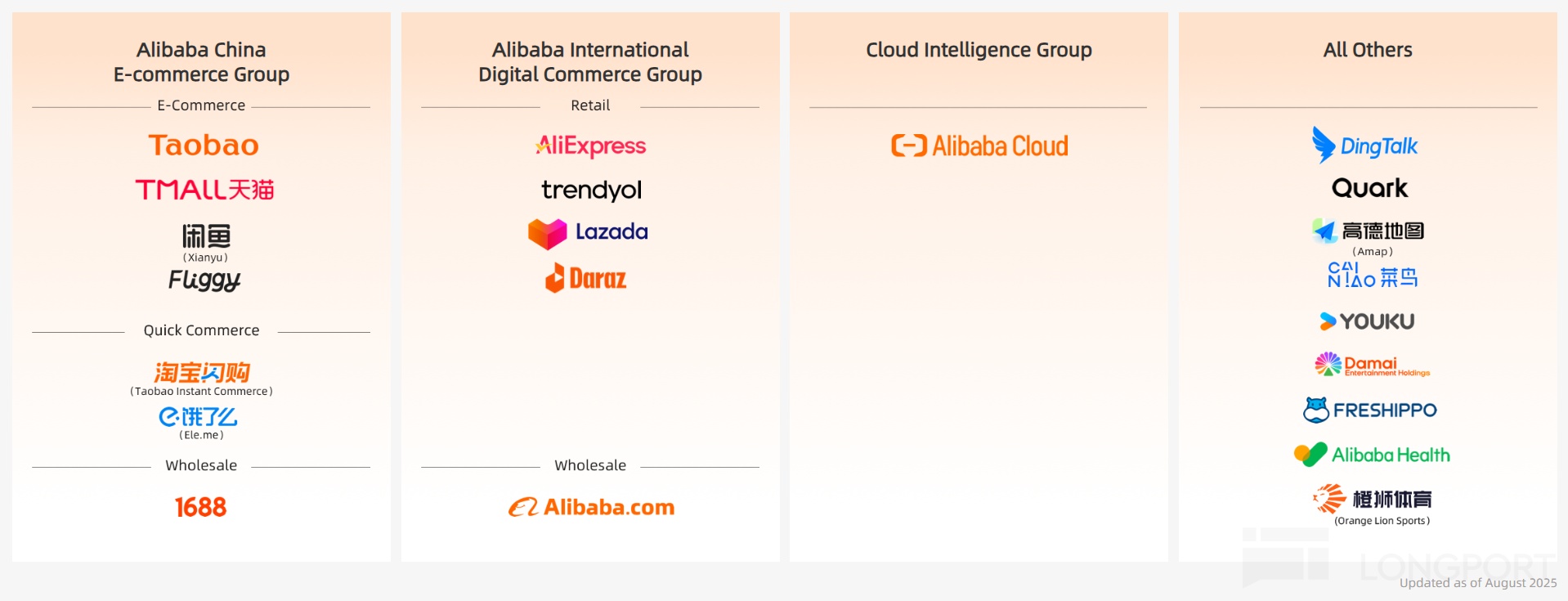
Starting FY26, Ele.me on-demand retail and Fliggy travel were folded into Taotian to form the China E-commerce Group, prompting another update to org and disclosure. As shown below, Alibaba now has four major segments:
1) China E-commerce Group: legacy Taotian + Fliggy + Flash/Ele.me; 2) Intl e-commerce remains unchanged;
3) Alibaba Cloud remains unchanged; 4) everything else — including Cainiao, Damai Ent, AutoNavi, etc. — moves to Others.
II. Ex reclassification, e-com growth has bottomed
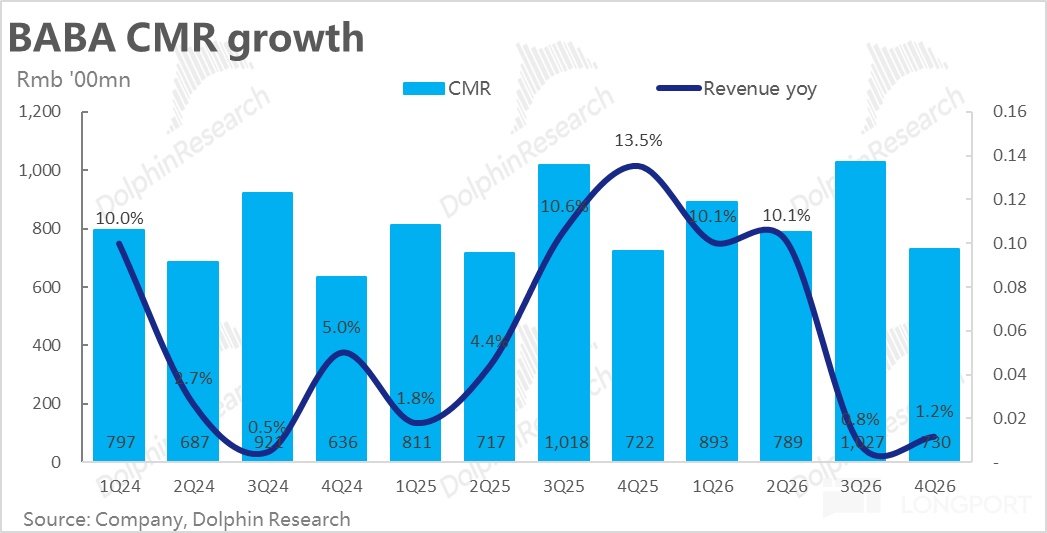
1) In far-field e-com, CMR was ~RMB 73bn, up 1.2% YoY, a weak print. A key factor this quarter was the shift of certain merchant subsidies from marketing into contra-revenue, depressing revenue; ex this, comparable CMR growth was ~8%.
Consistent with last quarter’s takeaway, Q4 CY25 likely marked the trough for domestic e-com growth, evidenced by both JD and Alibaba.
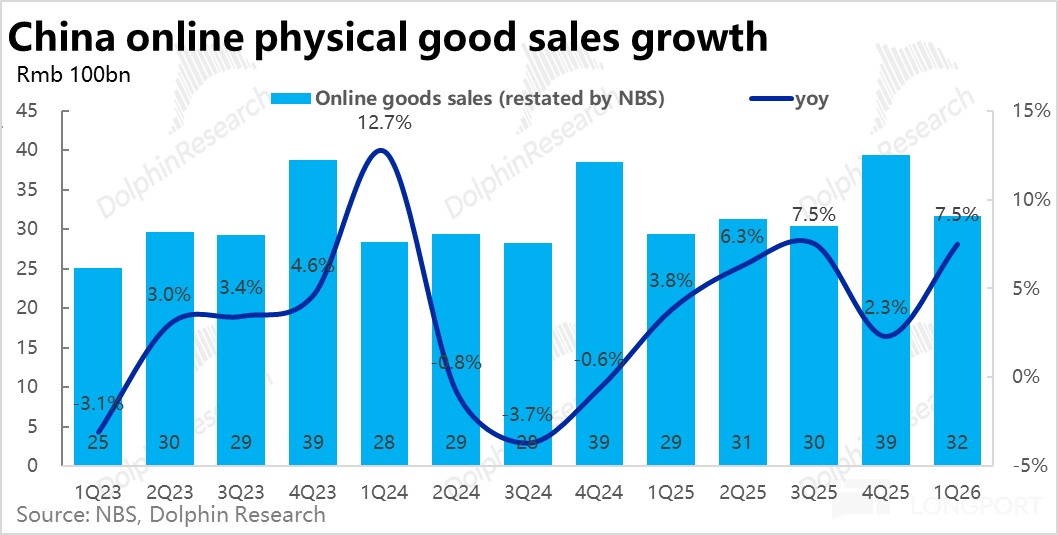
NBS data show online physical goods growth rebounded from 2.3% in 4Q last year to 7.5% this quarter. That said, the rebound and last quarter’s softness share the same driver — late CNY shifted demand into this quarter.
With CNY tailwinds fading, Mar online physical goods growth slipped back to 2.5%, implying full-year growth pressure remains.
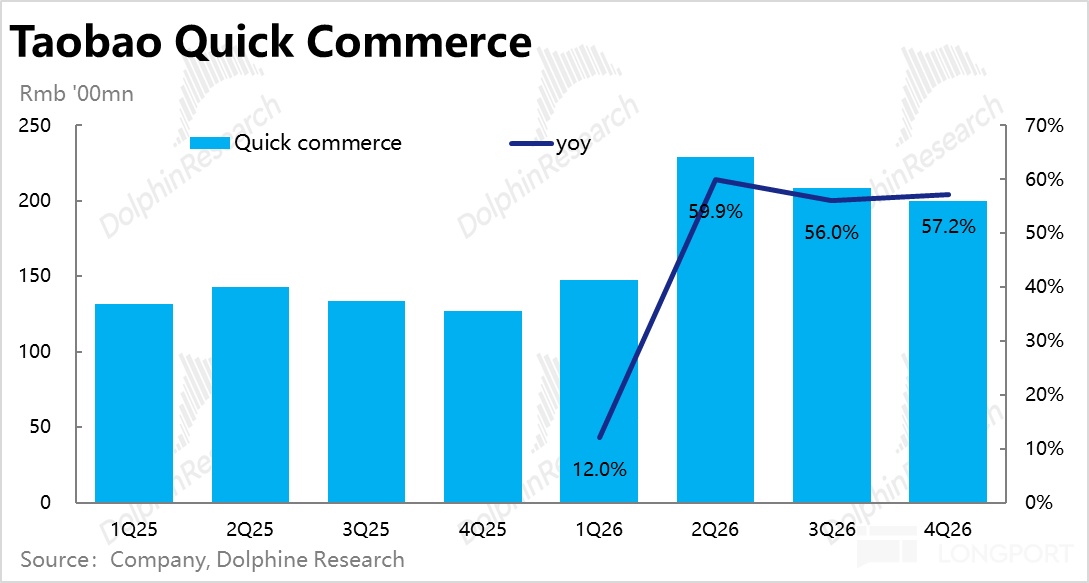
2) Taobao’s on-demand retail revenue was just under RMB 20bn, slightly down from RMB 20.8bn QoQ, while we estimate Flash loss narrowed from ~RMB 23bn last quarter to ~RMB 17bn.
Given lower orders vs. 4Q, it is clear revenue per order rose and loss per order fell at Flash. This is in line with expectations and directionally positive.
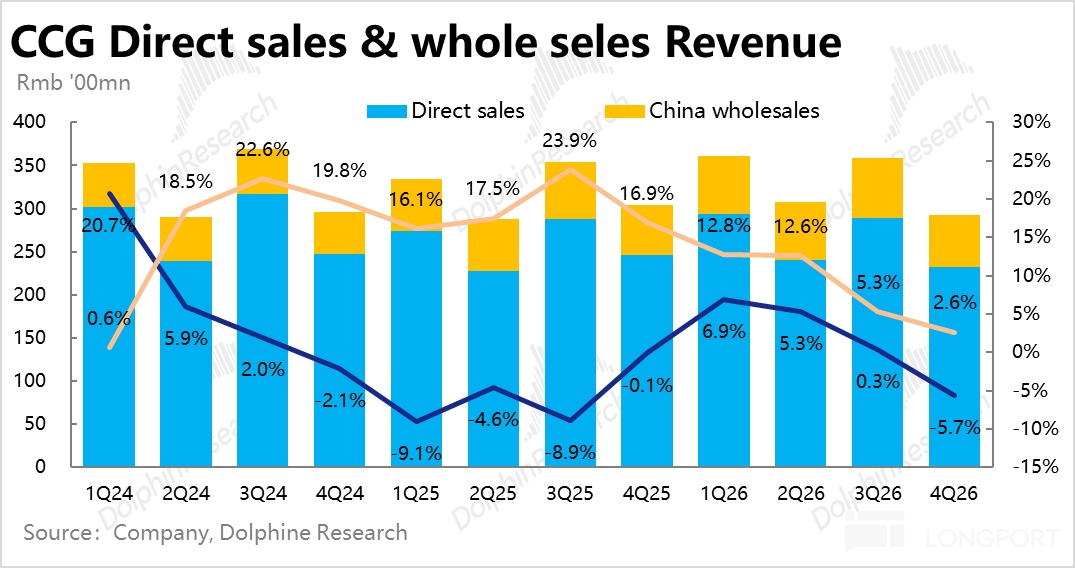
3) Self-operated retail (incl. related fulfillment) declined ~6% YoY this quarter vs. slight growth last quarter. With overall e-com improving and no scope changes here, Alibaba is likely pruning low-quality self-operated SKUs.
At 1688.com wholesale, growth slowed to 2.6%, entering a plateau after 2+ years at 10–20%. The prior boost from higher value-added membership fees may be fading.
Overall, despite the CMR reclassification drag and weak growth outside Flash, the China E-com Group grew ~6%, slightly better QoQ.
III. Far-field e-com profits bottoming; on-demand loss cuts as expected
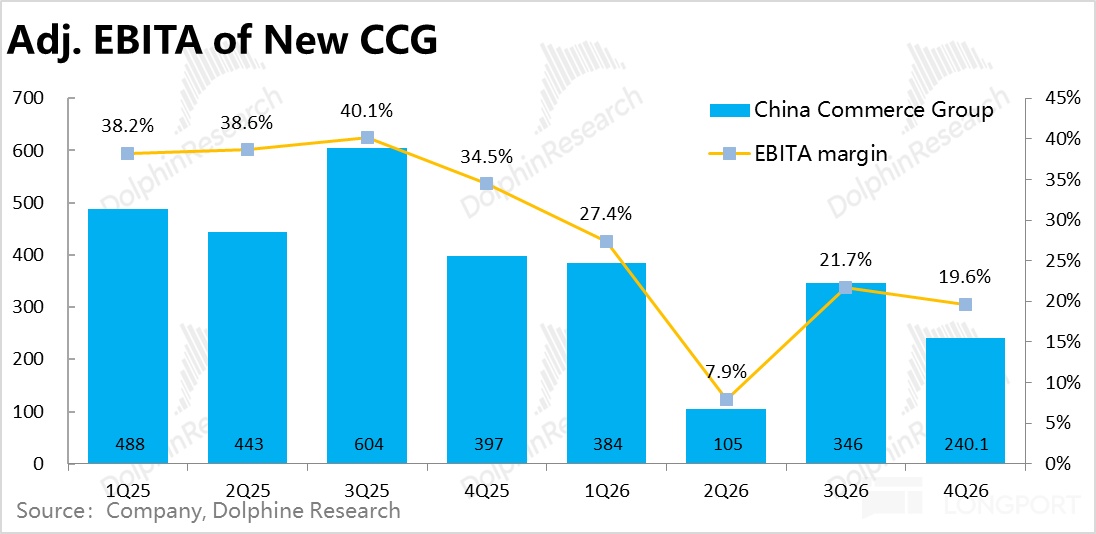
China E-com Group adj. EBITA was ~RMB 24bn, near the low end of the sell-side range and down ~RMB 15.7bn YoY.
Since CMR reclassification does not affect profit and growth improved, Taotian ex Flash likely moved from a YoY decline last quarter to flat or low-single-digit growth this quarter. Back-solving implies Flash net loss at ~RMB 16–17bn, near the high end of sell-side expectations.
That narrows ~RMB 7bn from the ~RMB 23–24bn last quarter. Based on channel checks, Flash loss per order fell from just above RMB 3.5 to under RMB 3, beating some UE estimates.
IV. Cloud acceleration continues but misses; capex to exceed prior guide
AI/cloud momentum remains positive but shy of expectations. Alibaba Cloud grew 38% YoY vs. 36.4% last quarter, but top brokers expected ~40%, so it was a slight miss.
External revenue rose 40% YoY vs. 35% last quarter, while internal slowed to ~33%, showing a prioritization of external monetization over internal use and R&D.
Profit-wise, adj. EBITA margin reached 9.1%, up 10bps QoQ, not deteriorating as some feared — a small positive.
While capex into AI is rising, acute supply-demand tightness has flipped rentals from deflation to price hikes. With higher-margin MaaS mix vs. bare-metal, cloud margins may keep trending up for a while rather than down.
Cash capex was RMB 26.6bn this quarter, resuming an uptrend, albeit modestly.
On the call, management said capex will exceed the prior ~RMB 380bn three-year plan (~RMB 130bn per year). Some compute build will be done via leasing/Opex, not all showing in capex.
V. Intl e-com retests breakeven
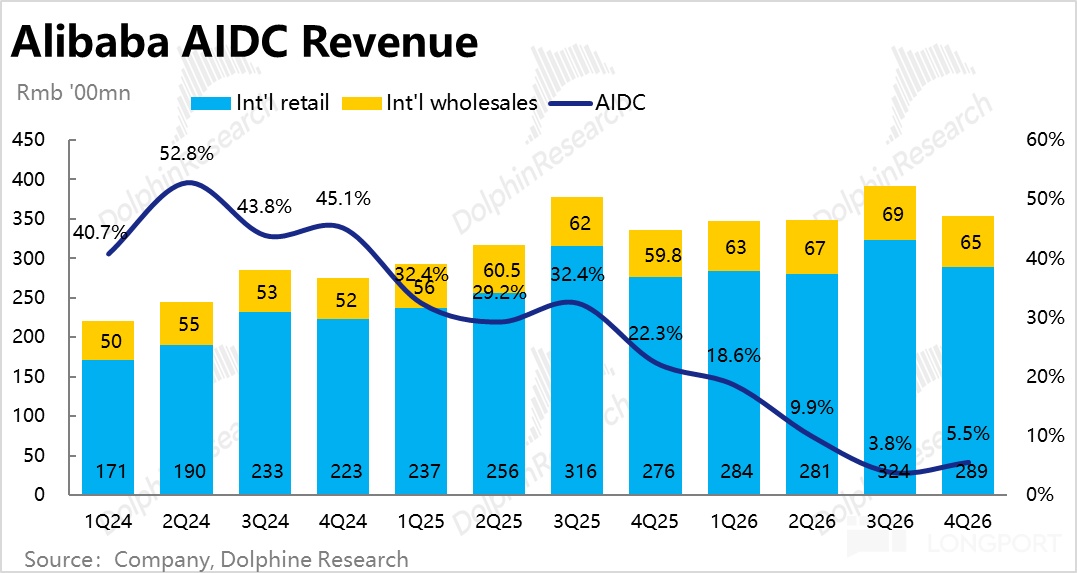
Intl e-com improved this quarter: revenue grew 5.5% YoY, better than ~4% last quarter, driven by AliExpress, while Lazada remained down YoY.
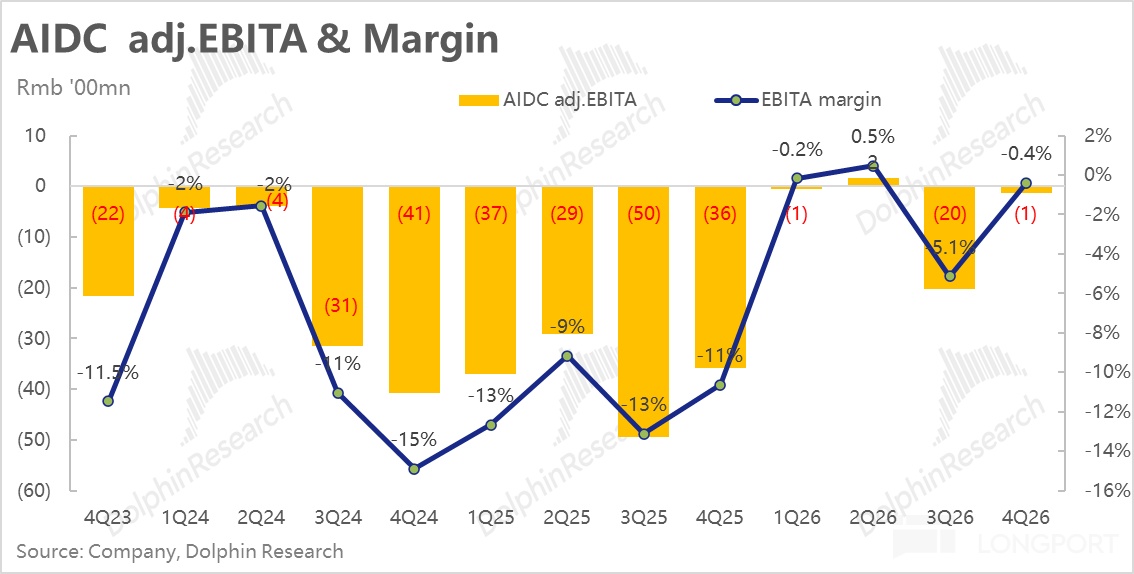
Adj. EBITA loss narrowed to RMB 0.14bn vs. RMB 2bn last quarter, beating expectations. The company’s claim that the prior big loss was seasonal and that it would stick to refined ops is holding up.
VI. Massive RMB 20bn loss in Others drags group profit to new low
Beyond the three core segments, including Cainiao, Damai Ent, AutoNavi, Qwen and other legacy Others, revenue was ~RMB 65.5bn (-21% YoY), still mainly due to Intime/Sun Art disposal.
The main hit was the Others loss widening to RMB 21.1bn, above the raised ~RMB 20bn sell-side estimate. Given Others loss rose by >RMB 11bn QoQ while on-demand narrowed by only ~RMB 7bn, and Q1 is a seasonal profit trough, group profit hit multi-year lows.
Markets anticipated this: Qwen’s CNY red envelopes and Flash-linked free-delivery cards alone likely topped RMB 5bn per foreign broker estimates. Multiple model builds and B-end AI app customer acquisition added to the surge in Others losses.
VII. Growth warms, profits worsen
Total revenue was ~RMB 243.4bn (+2.9% YoY), or ~11% comparable growth ex Intime/Sun Art, up from 9% last quarter.
Adj. EBITA was ~RMB 5.1bn (-~84% YoY), a multi-year low and below the level during the peak on-demand spend in 3Q last year, mainly due to Qwen and other AI app investments.
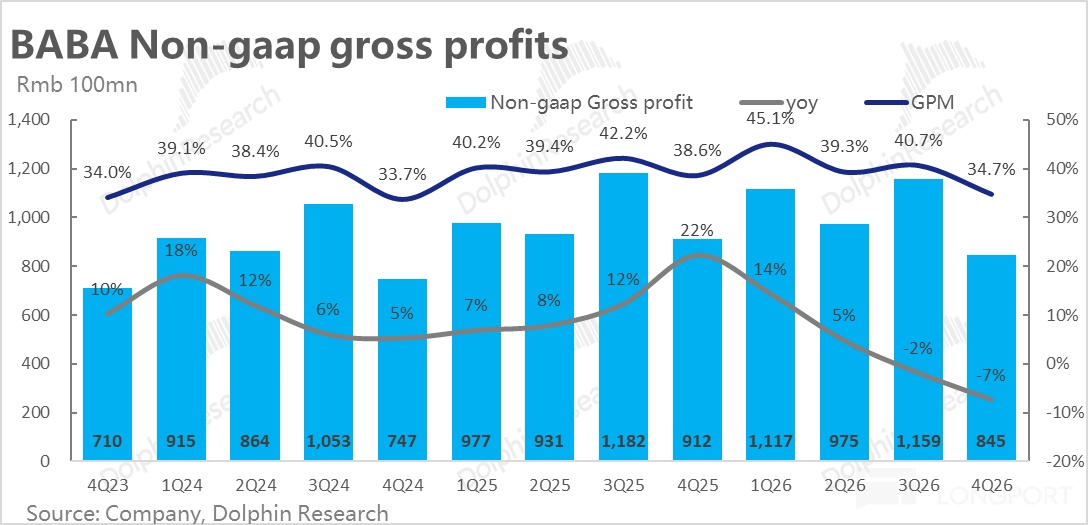
Costs and expenses: non-GAAP GPM was 34.7%, down ~400bps YoY. With modest marketing growth, beyond the CMR reclassification, we think significant spend in Others (e.g., Qwen) was booked in COGS or contra-revenue rather than marketing.
As a result, GP was ~RMB 84bn (-7.5% YoY), nearly RMB 10bn below Bloomberg consensus. Non-GAAP marketing was ~RMB 53bn, up ~RMB 17.5bn YoY, vs. ~RMB 29bn YoY increase last quarter, supporting the view that some spend shifted from opex to COGS.
Non-GAAP R&D was ~RMB 17.7bn (+32% YoY), the fastest since FY21, clearly signaling rising AI investment in apps and models.
<End>
Dolphin Research prior work on [Alibaba]:
Earnings season:
Nov 26, 2025 Trans: Alibaba (Trans): No AI bubble in 3 years; Flash UE loss halved from peak
Nov 26, 2025 First Take: AI as soul, consumption as root — is Alibaba finally back?
Aug 30, 2025 First Take: Wolf mode returns! The 'lost' Alibaba starts over
Aug 30, 2025 Trans: Alibaba (Trans): Limit-up move! What did the call reveal?
May 16, 2025 First Take: Bleeding before AI lifeline — can the 'unwilling' Alibaba make another push?
May 16, 2025 Trans: Alibaba (Trans): AI is a decade-long opportunity; on-demand subsidies can replace marketing
Feb 20, 2025 First Take: AI to the rescue — Alibaba reborn?
Feb 20, 2025 Trans: Alibaba (Trans): China AI standard-bearer
Nov 16, 2024 First Take: Taotian squats too long — can Alibaba spring back?
Nov 16, 2024 Trans: Alibaba: When will Taotian turn (2Q25 call)
Aug 16, 2024 First Take: Big brother Taotian stumbles, younger units hold up half of Alibaba
Aug 16, 2024 Trans: Alibaba: When can Taotian improve, when can the smaller units profit
Deep dive:
Dec 28, 2023 Who killed Alibaba, Meituan, JD and Tencent?
Oct 10, 2023 Against the wind — can Alibaba, JD, Meituan flip the script?
Jan 19, 2023 Ant back on track, Daniel Zhang moves to cloud — how far to Alibaba’s re-rating?
Jan 18, 2023 Endgame in e-commerce — can Taobao beat Douyin?
Hot topics:
Jun 5, 2024 Alibaba-style capped-price buybacks: cheap capital and anti-dilution?
Jan 10, 2024 Years of toil for nothing — what did Alibaba invest in?
Risk disclosure and disclaimer: Dolphin Research Disclaimer and General Disclosure
The copyright of this article belongs to the original author/organization.
The views expressed herein are solely those of the author and do not reflect the stance of the platform. The content is intended for investment reference purposes only and shall not be considered as investment advice. Please contact us if you have any questions or suggestions regarding the content services provided by the platform.
