


 Likes Received
 Rate Of Return
💢💢💢
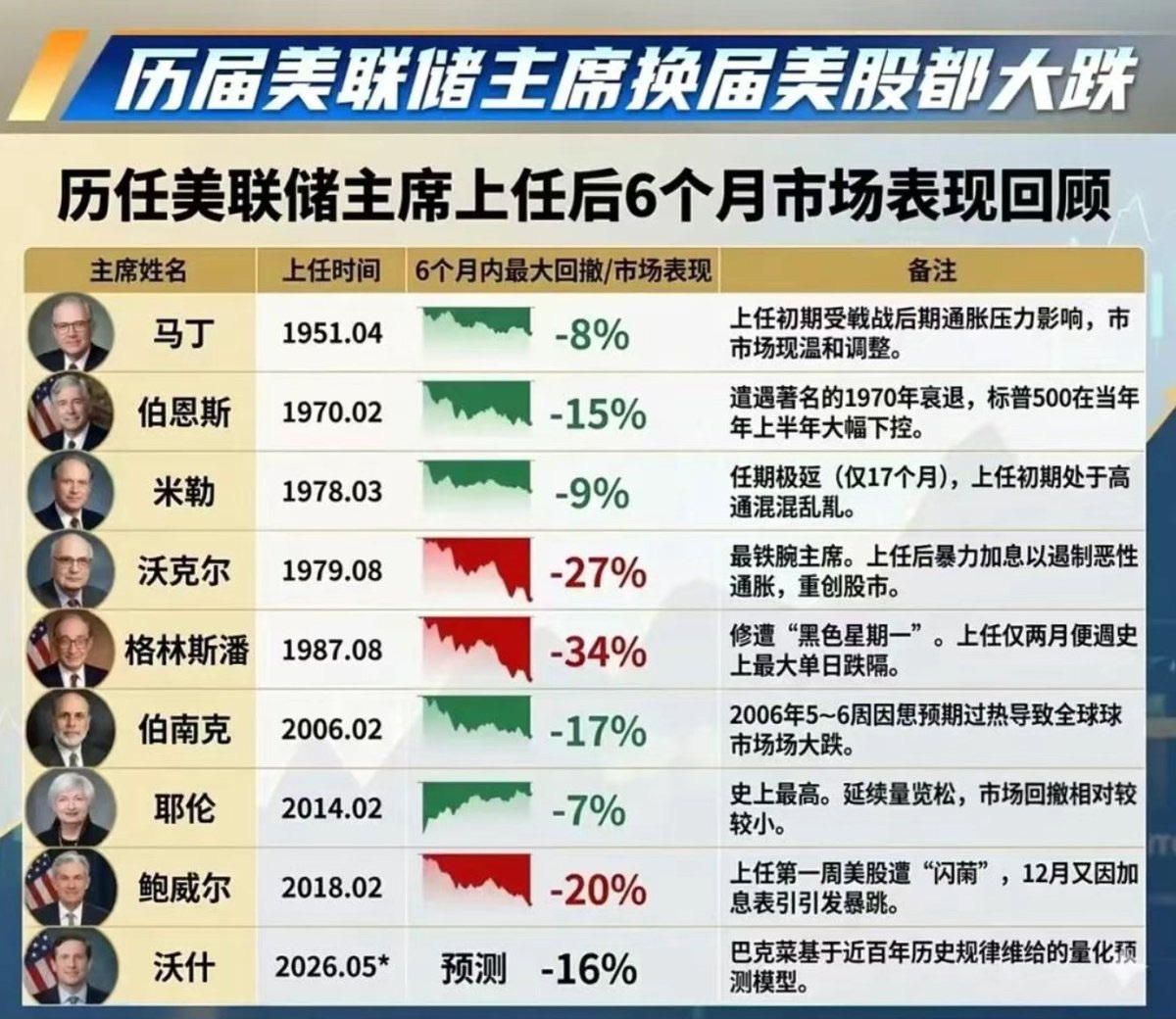
🇺🇸Fed Chair Transition = US Stock Market Crash?
Cherish next week's time?
And find that golden pit before the midterm elections, go all in?
Recently, this chart and the above statements have been spreading like wildfire on Twitter and in various US stock groups.
But upon closer inspection, it's clear that this chart and the bottom-fishing rhetoric are problematic, not just a simple data error.
1. I don't know what the so-called 6-month maximum drawdown here uses:
A) The lowest point within 6 months of taking office minus the S&P 500 at the time of taking office, or
B) The lowest point within 6 months minus the highest point within 6 months.
2. Take Powell as an example. He was sworn in on February 5, 2018. The flash crash in early 2018 happened on January 26. Using algorithm A, Powell's maximum drawdown within 6 months of taking office was 2.56%. Using algorithm B, the maximum drawdown was 9.45%. Both are far lower than shown in the chart.
3. Furthermore, regardless of which drawdown calculation method is used, there is no significant difference between the maximum drawdown within 6 months of a Fed Chair taking office and the maximum drawdown of the S&P 500 in any 6-month period in history.
4. According to drawdown definition A, the maximum drawdown within 6 months of taking office for the last 7 Chairs is as follows:
Burns (1970-02-01), 19.20%
Miller (1978-03-08), 0.00%
Volcker (1979-08-06), 4.25%
Greenspan (1987-08-11), 32.82%
Bernanke (2006-02-01), 4.58%
Yellen (2014-02-03), 0.00%
Powell (2018-02-05), 2.56%
Median is 4.25%
5. The distribution of the S&P 500's maximum drawdown in any 6-month period is:
10th percentile, 0.09%
25th percentile, 1.44%
75th percentile, 8.98%
90th percentile, 16.24%
Median, 4.12%
Their medians are almost identical. T-test p=0.2870, Wilcoxon test p=0.3438. No significant difference.
6. According to drawdown definition B, the maximum drawdown within 6 months of taking office for the last 7 Chairs is as follows:
Burns (1970-02-01), 23.21%
Miller (1978-03-08), 17.12%
Volcker (1979-08-06), 13.31%
Greenspan (1987-08-11), 33.51%
Bernanke (2006-02-01), 7.70%
Yellen (2014-02-03), 12.38%
Powell (2018-02-05), 9.45%
Median is 13.31%
7. The historical distribution of the S&P 500's maximum drawdown in any 6-month period is:
10th percentile, 7.80%
25th percentile, 9.97%
75th percentile, 17.74%
90th percentile, 22.12%
Median, 12.99%
Their medians are again almost identical. p=0.5516, p=0.8854. Similarly, no significant difference.
8. In summary, according to historical patterns, it is almost certain that the US stock market will experience significant drawdowns within any 6-month period. This is the historical norm, and the next 6 months will be no exception. It can even be speculated that, given the historically extreme valuation levels of US stocks, the magnitude of future drawdowns may be higher than the historical median.
9. For example, the current CAPE of the S&P 500 is as high as 39.58 times, in the 95%+ percentile historically. Based on backtesting over the past 100 years, when CAPE is in the high range of the 80-100th percentile, the median return of the S&P 500 over the next 60 months (annualized +4.32%) is significantly lower, and the maximum drawdown (-19.40%) is significantly higher. However, the difference in the short to medium term (3-24 months) is not significant.
10. In other words, Kevin Warsh's appointment—if unexpectedly hawkish—could become the trigger for a US stock market adjustment, but it does not mean that the chair transition itself inherently carries any asset implications.
This chart—both its data and logic—is AI-generated garbage.
Not to mock that chart, nor to prove statistical expertise.
It's just that, in an era where AI can mass-produce "charts that look very professional," we all need a certain ability more than ever: when seeing a chart, first ask, is this data correct?
When hearing a conclusion, think one step further, does this logic hold?
This ability isn't sexy, can't make you rich overnight, and might even make you miss some seemingly reasonable opportunities.
But it can help you avoid many seemingly reasonable pitfalls.
After all, in an age of information explosion, not losing money is more important than making money.
The copyright of this article belongs to the original author/organization.
The views expressed herein are solely those of the author and do not reflect the stance of the platform. The content is intended for investment reference purposes only and shall not be considered as investment advice. Please contact us if you have any questions or suggestions regarding the content services provided by the platform.
