


SQ (Trans): From app co. to AI co.
Below is Dolphin Research's$Block(XYZ.US) FY26 Q1 earnings call transcript; for the earnings take, see 'US 'Alipay' Block: Growth via credit, profit via layoffs?'.
I. Earnings Highlights
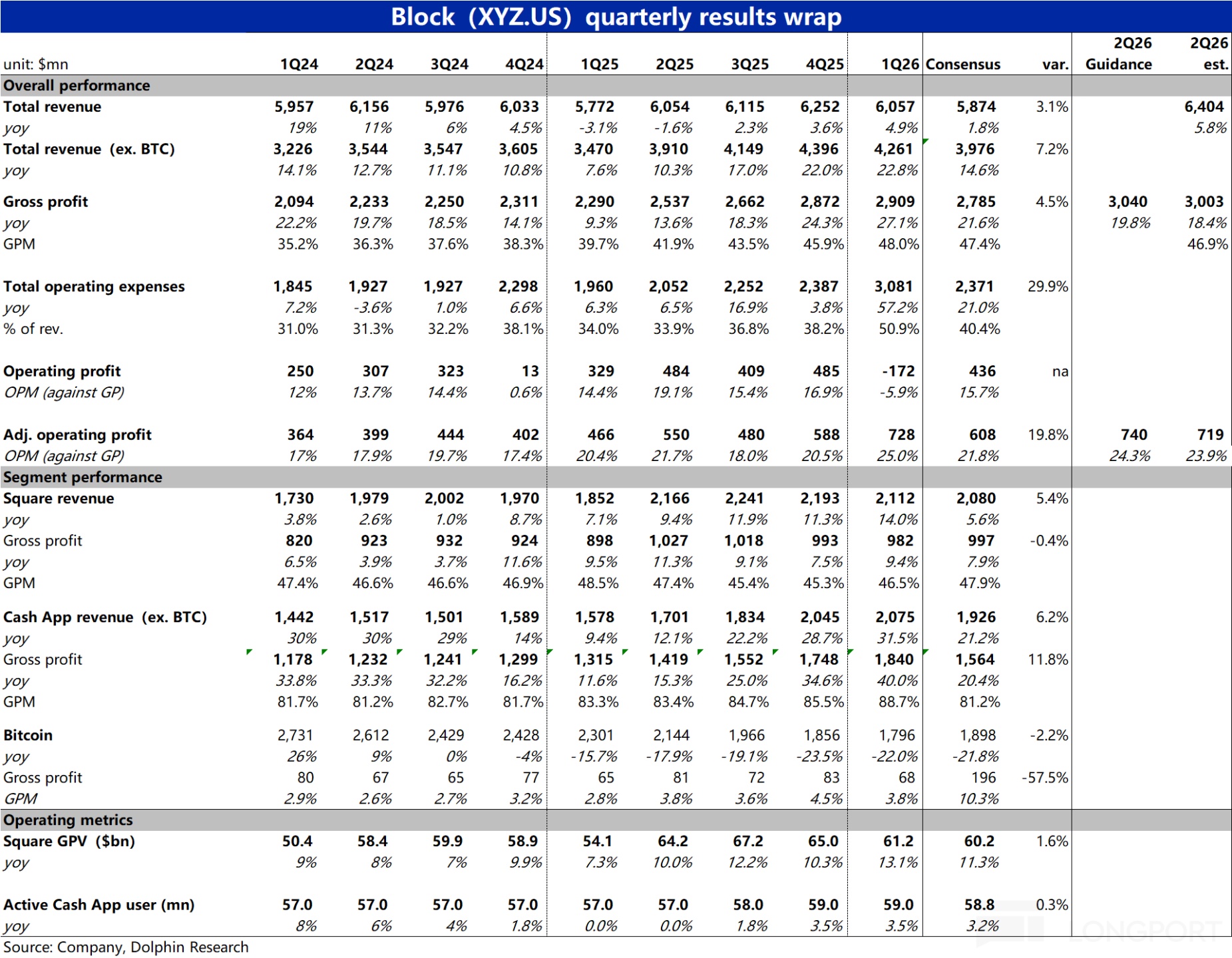
1. Guidance (raised): FY2026 GP lifted to $12.33bn (+19% YoY, +100bps vs. prior). Adj. OP to $3.34bn with a 27% margin (+100bps vs. prior). Adj. diluted EPS $3.85 (+62% YoY).
Exit GP growth by end-2026 is expected to be mid-teens, consistent with Nov. investor day. Q2 GP is guided to $3.04bn (+20% YoY). Q2 Adj. OP $740mn (+35% YoY) with margin expansion of 200bps YoY. Q2 Adj. diluted EPS $0.86 (+39% YoY). Q2 interest expense is $55–60mn; full-year interest expense approx. $200–210mn. Non-GAAP effective tax rate stays in the mid-20% range for Q2 and full year.
2. Key financials: Q1 GP was $2.91bn, up 27% YoY and a record high. Adj. OP was $728mn, up 56% YoY with a 25% margin, also a record. Adj. diluted EPS was $0.85, up 52% YoY and a record. Adj. profitability grew at ~2x the pace of GP, reflecting disciplined investment while scaling.
3. Apr. operating update: Square GPV at cc rose 12% YoY, with US +9% and Intl at cc +25%. Cash App inflows per active and monetization trends remained healthy. Underwriting outcomes were in line with expectations.
4. Other forward points: Cash App MAUs are expected to grow at a low single-digit rate for the year. Q2 primary banking actives are expected to see a small seasonal QoQ dip. GPV growth in 2026 is expected to accelerate vs. 2025. In H2, Square GP growth should broadly track GPV growth. The Q2 gap between Square GP and GPV growth should narrow vs. Q1 due to last year's network remediation tail and a one-off positive impact from Square hardware tariff refunds this quarter.
II. Call Details
2.1 Management Highlights
1. Cash App
a. GP grew 38% YoY. Growth was driven by both commerce enablement and financial solutions.
b. MAU transactors rose 4% YoY. Inflows per active increased 10% YoY. Primary banking actives grew 18% YoY to 9.7mn.
c. Consumer loan originations climbed 82% YoY. Commerce enablement volumes rose 18% YoY.
d. Launched Afterpay Pre-Purchase for Cash App Card. BNPL features expanded to P2P and Cash App Pay.
e. Moneybot went GA. Over 1mn active users engaged in the past week without any in-app or out-of-app marketing.
f. Cash App Score began rolling out. Core underwriting capabilities are becoming more visible and actionable to customers.
g. Introduced Cash App custodial accounts for kids aged 6–12, with parental controls. This extends reach to younger users.
2. Square
a. GP grew 9% YoY with acceleration. Ex-hardware costs, GP rose 11%. GPV increased 13% YoY (+11.5% at cc), also accelerating.
b. Restaurant GPV grew 21% YoY, and mid-market GPV rose 22% YoY. Both were the strongest since Q1 2023.
c. Intl GPV was up 35% YoY, or +26% at cc. International momentum continued to build.
d. New volume added (NVA) remained strong in both US and Intl. Mar. and Apr. set records for first-month GPV for newly onboarded merchants.
e. Rolled out the next-gen Square Register flagship countertop POS. Hardware upgrades target higher-traffic merchants.
f. Managerbot now covers 1mn+ merchants. The plan is to reach all Square merchants by Jun.
g. Square Bitcoin payments expanded to retail and services. Crypto payments broadened acceptance.
3. Neighborhoods (merchant-consumer connection platform)
a. Covered merchants' annualized GPV reached $320mn, up 190% vs. Dec. New merchants added in Apr. alone exceeded the product's entire prior history.
b. Followers, after several quarters post sign-up, spend ~10% of a merchant's total GPV. Engagement deepens over time.
c. Merchants on Avg. gain ~1,000 Cash App followers in year one. Roughly half of followers were not active on Cash App in the prior month.
d. Merchant messaging converts at ~6x email marketing. Messaging efficacy is materially higher.
e. Neighborhoods is expected to meaningfully drive Cash App active user growth starting in H2. It should become a non-trivial contributor.
4. ISO channel and go-to-market
a. Signed 140+ ISO partners, with new merchants via ISO up 200% QoQ. The channel is scaling from a low base.
b. Mar. ISO-originated volume equaled the output of ~70 field sales reps. Productivity was strong.
c. The field sales team expanded further in Q1 across the US, UK, Australia, and Canada. Coverage broadened.
d. Self-serve onboarding conversion rose 15% YoY. Payback remains 4–6 quarters, with healthy unit economics.
e. New brand wins include GOLFTEC, Steak Escape, Birch Coffee, and Acai Republic. Cinnaholic returned to Square with 85 stores.
5. AI and org efficiency
a. Prod code changes per engineer rose over 2.5x from Jan. to Apr. Developer velocity improved materially.
b. For non-engineers, prod code changes in Apr. were ~60% higher vs. Jan. Contribution broadened.
c. Internal Builderbot enables any employee to build or fix features via Slack. Tools democratize development.
d. Example: Cash App Pay BNPL was initially scoped for 3 months with 5–6 engineers. Two ML engineers actually completed it in 3–4 weeks including quality tests.
e. The org is flatter with smaller teams, faster decisions, and greater autonomy. Execution speed is rising.
2.2 Q&A
Q: Which strong areas in Q1 drove the full-year outlook raise? What are the specific expectations by segment?
A: We came out strong in Q1. The key is broad underlying strength across both ecosystems. For Cash App, within the inflows framework, actives rose 4%, inflows per active grew 10%, and monetization kept compounding. This reflects deep multi-product engagement, with Borrow originations up 82%, commerce enablement volume up 18%, and primary banking actives up 18%.
On Square, both GPV and GPV at cc accelerated. The three focus areas, restaurants, mid-market, and Intl, each grew over 20%. NVA growth was strong, and net volume retention improved both QoQ and YoY.
We raised the full-year outlook by 100bps to 19% GP growth and a 27% OP margin. For Q2, Apr. data show healthy trends and momentum, but Borrow growth is expected to normalize due to high base effects. For H2, we maintain mid-teens exit GP growth. We expect margins to expand in both Q3 and Q4, even as we step up high-ROI go-to-market investments.
On Square, we expect H2 GP growth to accelerate and are excited about pricing and packaging moves. For Cash App, we continue to expect low single-digit active growth. Cash App Green keeps driving deeper engagement, and consumer lending infrastructure is being embedded across the product stack.
Q: Post-reorg retrospective – what exceeded expectations? What were the challenges or regrets? What proof points should we watch?
A: Our expectations were very high, which is why we could take that milestone action. I believe we met all of them. We had clear principles: ensure reliability, meet all regulatory and trust commitments, and keep growing the business. We accomplished these.
On challenges, as AI agents helped us write lots of code, PR volumes surged and needed merging to the main codebase. The review burden increased notably. We found solutions, focusing on the most important pieces to speed progress.
Looking ahead, we are pushing a flatter org to get more people closer to customers and decisions. The strongest outcome of the reorg is faster decision-making and the ability to execute decisions through tools. AI tools handle more routine tasks so we can be more creative and innovative. Continuing to increase product velocity is core, as customers care only whether we stay ahead of their needs. Moneybot and Managerbot are just the first steps.
Q: When Borrow growth normalizes in 2027–2028, what are Cash App's mid-term growth drivers?
A: Cash App is a multivariate platform, with core growth drivers in network effects, customer interconnectivity, and cross-product engagement. We are now seeing lending capabilities embedded across other Cash App products, making those products more valuable to customers.
Specific drivers: Borrow has significant room to grow even after normalization. We will raise limits for mature customers responsibly and keep innovating around core products. Afterpay Post-Purchase is growing even faster than Borrow over the same period, driven by net new BNPL customers, expanding the overall Afterpay base. Pre-Purchase was only launched a few months ago and remains very early.
Core Afterpay also saw acceleration in Q1. Cash App Score is another net-new opportunity, helping customers build more rational financial behavior and offering potential monetization. Each lending product is growing faster than the previous cohort at the same stage, reflecting compounding in our underwriting know-how.
Q: What is Block's AI strategy panorama? Is the end-state Block evolving into an AI company?
A: Yes, I think we will evolve into an 'intelligent company'. The future service form is not today's traditional navigational app bundle. Instead, we deeply understand merchants and Cash App customers and deliver exactly what they need at the right moment. We can predict in real time with high accuracy what they might need.
AI agent commerce is still a bit far. However, one near-term use case is merchant supplier purchasing. Agents can be set to auto-order from suppliers on a routine basis or triggered by inventory, demand, or trends.
Internally, we have Builderbot, which lets anyone build or fix any service feature via Slack. Extending this, merchants could directly use it. If we lack a feature but can support it, they could build custom functionality for themselves and integrate it into the interface. That is the ultimate goal, letting customers create any value within our UI so our product roadmap stops being a constraint. I think we are not far from that.
Q: Product release velocity has clearly increased. What are the drivers?
A: It does feel like we are firing on all cylinders. The evidence is in recent launches: Moneybot GA, Managerbot covering 1mn+ merchants, Afterpay Pre-Purchase in Q1, Cash App Score rolling out, custodial accounts for children, and many improvements in Square for restaurants.
The drivers are twofold: AI tool efficiency and org changes. Smaller, flatter teams bring greater autonomy and flexibility with fewer administrative barriers. On AI, the pace of change is now measured in weeks. Cash App Pay BNPL, initially scoped for 3 months with 5–6 engineers, was completed by two ML engineers in 3–4 weeks including all quality testing. We expect this pace to keep compounding.
Q: Early impact from the scaled rollout of Managerbot – any initial signals on retention, cross-sell, or GPV?
A: The overall framework is that Managerbot, Moneybot, and Builderbot share the same base, Goose, our first model-agnostic agent framework started in 2024. Improvements in one area flow to others. Our focus is proactive intelligence rather than passive chat, with agents able to take actions on behalf of customers.
Managerbot now has 100+ local agents working for merchants. It can access sales data, catalogs, CRM tools, and reporting tools. Typical use includes team performance analysis, bestseller insights, new vs. existing customer revenue, weekly/monthly revenue forecasts, sales tracking, and appointment reminders.
An encouraging early signal is that Managerbot user retention is above expectations. Merchants who used it tend to come back at high rates in subsequent weeks or months.
On Moneybot, a recent experiment used push notifications to alert specific customers of potential future cash flow gaps. Response and engagement were excellent. This is fundamentally different from passive chat. In cross-sell, over one-third of customers who moved funds via Moneybot did so as their first use of a new product. Moneybot just went GA with no marketing, yet over 1mn active users used it in the past week.
Q: How are Square's go-to-market channels performing (self-serve, field sales, ISO)?
A: NVA growth had another healthy quarter. Over the past 18–24 months, we showed we can steadily lift the NVA growth curve and build diversified channels. Field sales, self-serve, and ISO channels all performed strongly, with healthy paybacks and unit economics. Mar. and Apr. both set records for first-month GPV for new merchants.
Self-serve: marketing continues to drive most NVA, with 4–6 quarter paybacks. Conversion improved 15% YoY. Field sales: in Q1 we expanded further in the US and Intl, covering the US, UK, Australia, and Canada. Our product is increasingly attractive to merchants in larger upmarket segments.
ISO: the newest focus, and while early, it exceeded expectations. We have 140+ ISO partners, and new merchants via ISO rose 200% QoQ. Mar. ISO-originated volume matched roughly 70 field reps. The most exciting aspect is the diversification and health of the NVA growth curve.
Q: What does Neighborhoods mean for Cash App and Square?
A: We have a unique ability to connect both sides of the counter, Square on the merchant side and Cash App on the consumer side. Key data points: followers after several quarters account for ~10% of a merchant's total GPV. Merchants on Avg. gain ~1,000 Cash App followers in year one. About half of followers were not active on Cash App in the prior month, meaning Neighborhoods reactivates dormant users.
2025 is the year to validate product-market fit, and we now have strong confidence. We are moving into scale and distribution. Auto-enrollment changes are starting to work, with hundreds of merchants added weekly and a clear path to thousands per week. Offline redemption is working, expanding Neighborhoods' TAM.
New merchants added in Apr. alone exceeded the product's entire prior history. We expect Neighborhoods to begin meaningfully driving Cash App active growth in H2, beyond rounding error. Next, we will expand to more hardware types and invest in merchant messaging.
Q: How should we think about Borrow penetration and the sustainability of its growth trajectory?
A: Borrow is compelling because it helps manage income volatility and maintain flexibility between inflow cycles. It covers a very broad set of use cases. We still see sustained and meaningful room to grow Borrow at scale.
Growth paths include the full transition to SFS (internal banking) for loan issuance, which improves unit economics. That expands eligibility in new states and in Cash App Green, both with more room to grow. We will responsibly raise limits for mature customers based on underwriting models and keep innovating around the core product. Ultimately we are guided by variable margin after risk losses and processing costs.
Mature cohort effects are encouraging: the newest customer risk loss rate is 3.16%, 7–12 month customers are at 3.01%, and 13+ month customers at 2.67%. As the product matures and the share of mature cohorts rises, there is opportunity to keep improving variable profitability.
Q: How do you balance user growth at the top of the funnel vs. deepening relationships with existing users (primary banking actives)?
A: We are pleased with the pace of active expansion. Apr. MAUs of ~59mn look flat for two consecutive quarters, but that is rounding. It is actually the fastest active growth in about 18 months.
Near-term network growth levers include continued optimization of core P2P flows, such as new pay links. Custodial accounts are expected to be a meaningful tailwind. Cash App Score drives engagement and helps shift annual/quarterly actives into daily/weekly/monthly actives. We will keep stepping up go-to-market across paid, lifecycle, and brand partnerships.
Longer term, Neighborhoods may be the largest lever, with potential to fundamentally change our network's scale and growth trajectory. It is still early. Moneybot is also early and can attract new customers from non-core segments. We will keep investing in Cash App Green and Cash App Card to make them more useful and top-of-wallet.
Our Bitcoin platform continues to be optimized. We have significantly cut prices to maintain the simplest, cheapest, and most accessible positioning. Ultimately, network growth tracks product velocity, and the faster we deliver useful things, the more people will choose Cash App.
<End of text>
Risk disclosure and statement:Dolphin Research disclaimer and general disclosure
The copyright of this article belongs to the original author/organization.
The views expressed herein are solely those of the author and do not reflect the stance of the platform. The content is intended for investment reference purposes only and shall not be considered as investment advice. Please contact us if you have any questions or suggestions regarding the content services provided by the platform.
