


COIN (Trans): Confident a bill will be enacted by late summer
Below is Dolphin Research's $Coinbase(COIN.US) FY26 Q1 earnings call Trans. For our earnings take, see 'Coinbase: After a long drought, waiting for policy rains'.
I. Key takeaways
1. Shareholder returns: Repurchased ~6 mn shares in Q1 for $1.1 bn. Cumulative buybacks have offset ~90% of stock-based comp dilution since Q4 2024. The $1.3 bn 2026 convertible notes mature on Jun 1; absent hitting the conversion price, the company plans to repay in cash.
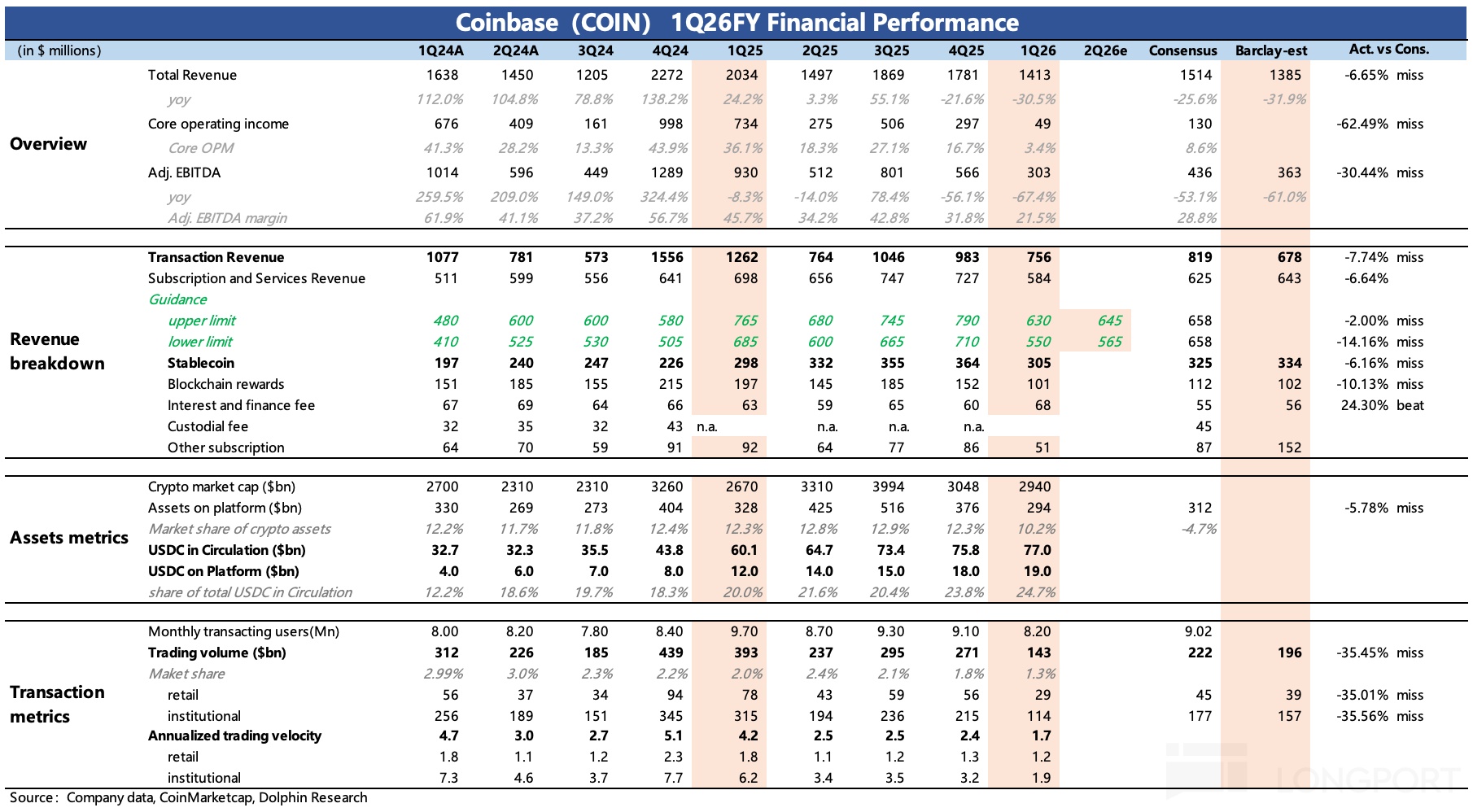
2. Outlook: Q2 Subscription & Services revenue guided to $565–645 mn, implying QoQ growth. Q2 R&D + G&A opex guided to $820–870 mn, down 4–9% QoQ. Q2 to incur an additional $50–60 mn in restructuring costs (layoffs). FY26 Adj. opex guided to $4.3–4.6 bn, ~$500 mn below the midpoint of the Q4 2025 annualized exit rate.
3. Key financials: Q1 revenue $1.4 bn, down 21% QoQ. Trading revenue $756 mn (consumer $567 mn, institutional $136 mn). Subscription & Services revenue $584 mn, down 16% QoQ (stablecoin revenue $305 mn; blockchain rewards $101 mn; interest and financing fees $68 mn, +13% QoQ). Net loss $394 mn; Adj. EBITDA +$303 mn (positive for the 13th straight quarter).
4. Balance sheet: Cash and equivalents >$10 bn at quarter-end; total available resources $12 bn. Reporting change: reclassified $18 mn of enterprise stablecoin revenue to other revenue; USDC and cash viewed as fully fungible assets.
5. Costs and restructuring: Total opex $1.4 bn, down 5% QoQ. R&D $526 mn (modestly higher on Q4 acquisition one-offs); G&A down 17% QoQ. Layoffs expected to reduce total costs by ~$500 mn vs. the Q4 2025 run-rate; ex-USDC rewards growth, FY26 expenses are roughly flat vs. FY25.
II. Earnings call details
2.1 Exec highlights
1. Everything Exchange a. Evolving from a spot-heavy crypto venue to an all-asset platform, adding stocks, 24/7 perpetuals on equities, and prediction markets. b. Derivatives run-rate revenue topped $200 mn; prediction markets reached a $100 mn annualized pace in Mar, less than two months post-launch. c. Non-crypto contracts (silver, gold, crude) volumes rose 4x QoQ. d. Both the US and Intl derivatives exchanges hit record revenue contribution in Q1.
2. Stablecoins and payments a. USDC held on-platform hit a record, Avg. $19 bn; Coinbase holds over 25% of total USDC supply and captures ~50% of USDC economics. b. Stablecoin trading volume doubled QoQ, with USDC and partner stables accounting for over 80% of total trading. c. Base handled 62% of all stablecoin transactions; 90%+ of AI Agent trades ran on Base and 99% settled in USDC. d. The USDC agreement auto-renews every three years in perpetuity and is non-terminable.
3. Share and custody a. Crypto trading market share hit an all-time high in Q1, up ~5x since Q1 2023. b. Achieved net native unit inflows for the 12th straight quarter, as clients consolidate to trusted platforms in down markets. c. Coinbase custodies the largest pool of crypto assets globally.
4. Agentic Commerce a. The x402 protocol was donated to the Linux Foundation; Cloudflare, AWS, Stripe, Shopify, and Google joined governance. b. It is currently the most adopted open standard for AI agent commerce. c. Launched Agentic.Market to list services accessible by AI agents.
5. Deribit integration and options a. Integration is on track, targeting full unification in 2026 across spot, perps, futures, and options on one platform. b. No public timetable yet for US crypto options trading, but progress is active.
6. AI-native transformation a. PRs per engineer up 78% YoY; integration test coverage tripled in six months. b. Non-technical staff (PMs, designers, etc.) can draft code with AI agents, while human engineers still review all production code. c. Announced layoffs this week, moving toward an AI-native org.
7. Product portfolio a. 12 products now at >$100 mn annualized revenue; Coinbase One paid subs surpassed 1 mn. b. Retail derivatives poised to be the next $250 mn+ line; prediction markets could become the 13th $100 mn+ product. c. DeFi volumes doubled QoQ; lending balances grew over the past year to >$1 bn.
2.2 Q&A
Q: Where is the Clarity Act in the legislative process, and what would it mean for the biz?
A: We are confident it will enter markup this month, get a full-chamber vote in early summer, and be signed into law by late summer. Last week, Senators Tillis and Alsobrooks reached a compromise on stablecoin rewards. While we are not declaring victory, we appreciate their efforts. From the published text, the direction is clear — activity-based rewards will be protected, while pure bank-like passive deposit yields will be prohibited, a framework we view as workable.
The language suggests rewards will be protected, allowing us to retain key elements of our current program. Many details will still need rulemaking after passage, so it is too early to be definitive. That said, we are building a model anchored on engagement and utility, and that positioning should serve us and our customers well under any final framework.
More importantly, do not miss the forest for the trees. The Clarity Act would be a major unlock for the industry, customers, and Coinbase, especially the ability to build new products and services under clear rules — unprecedented in crypto.
Q: Post-Clarity, who enters crypto over the next year and what do they do?
A: Clarity is far broader than stablecoins and rewards. It will catalyze tokenization, define commodities vs. securities, clarify the roles of exchanges and custodians, and give DeFi and self-custody wallets important standing. Expect dynamics similar to post–Genius Act, when hundreds of large US companies announced stablecoin integrations in the following months.
Once Clarity passes, many companies will begin integrating crypto, whether to raise capital on-chain or to offer crypto services to their customers. It will unlock substantial institutional capital inflows. Our opportunity is to serve these entrants and provide technical integration via Coinbase Developer Platform. We want every company to plug into the crypto financial system like they do the internet or AI, and Coinbase can provide that stack.
Q: Will changes to stablecoin reward policy alter the revenue-share with Circle?
A: Our contract with Circle is set and auto-renewing, and we expect to continue under the same terms. The details of the legislation matter, and I cannot pre-judge all impacts before it is signed. But we are confident the outcome will be appropriate, and the relationship remains intact.
To add, the rev-share is tied to overall USDC supply and adoption, not to any specific rewards language.
Q: If non-technical staff ship code via AI, how do you ensure quality and brand trust while accelerating dev?
A: I should have been clearer in the announcement. We encourage PMs, designers, and other non-technical roles to use AI agents to draft code, which is getting easier. But human engineers still review all code that goes to production, with multiple layers of human review on our most sensitive systems.
AI agents are not just about speed or enabling more people to code; they are lifting quality and security. Anthropic's recent Mythos model showed it can find 99%+ of vulns that human engineers miss. It is like self-driving — becoming safer than human drivers. In time, non-technical staff could write code and AI agents could handle security and quality, even ship to prod in specific cases, but we are not there today.
At Coinbase, we are pushing the frontier and rigorously testing these capabilities. If AI consistently exceeds human standards in certain areas, failing to automate further would be irresponsible. Meanwhile, our investments in quality and integration testing are scaling faster than the growth in new PRs.
Q: Coinbase kept gaining share in a down market — what is the competitive backdrop and drivers?
A: We hit an all-time high in crypto volume share in Q1, gaining in both spot and derivatives, while total crypto volumes fell 20%+ QoQ. Since Q1 2023, our share is up ~5x. When markets are tough, people migrate to platforms they trust, driving 12 straight quarters of net native unit inflows.
Share gains are driven by product innovation and expanding our derivatives platform, including launching derivatives in the flagship Coinbase app and adding non-crypto contracts. The Everything Exchange thesis is playing out — retail derivatives at a $200 mn+ run-rate and prediction markets at a $100 mn annualized pace in Mar. These are incremental cross-sells on our existing user base, which is very positive.
We believe share captured in a downturn will prove sticky when markets improve.
Q: How ambitious is Coinbase in stablecoin payment rails — content with being a CPN participant or expanding into settlement and beyond?
A: We have built a faster, cheaper global settlement layer and intend to leverage it fully. We own the full stack — as a primary distributor of USDC; Base as the settlement layer; payments APIs as the enterprise integration layer; and x402 as the open standard for next-gen AI agent commerce. No one else has this end-to-end stack. We are not merely a network participant; we are the platform powering stablecoins.
The market opportunity is enormous, and we believe we are still early in the cycle.
Q: What is the concrete opportunity for x402, and what does it mean for incremental USDC inflows and Base fees?
A: x402 is an open AI agent commerce protocol incubated at Coinbase, allowing agents to attach payments to any request — from e-comm checkout to agent-to-agent workflows. We then donated it to the Linux Foundation; Cloudflare, AWS, Stripe, Shopify, and Google contribute and govern. It is the most popular open standard for AI agent commerce today.
How does x402 help Coinbase? First, 99% of x402 transactions in Q1 settled in USDC, which we monetize via our relationship with Circle. Second, 90% of AI agent stablecoin volume settled on Base, the leading chain. Because x402 was incubated in-house, our Developer Platform offers strong APIs to integrate x402 and enable agent payments.
This product, grown from Coinbase into an open standard, creates powerful synergies across our lines — exemplifying the full-stack solution Emilie mentioned, from x402 to Developer Platform, Base, and USDC. We are the only company with this complete stack.
Q: What is the monetization timeline and revenue outlook for Everything Exchange across equities, prediction markets, and commodities?
A: Everything Exchange is already contributing. Retail derivatives run-rate revenue surpassed $200 mn, and prediction markets reached a $100 mn annualized pace in Mar, under two months post-launch. Non-crypto assets are gaining traction too — silver, gold, and crude volumes rose 4x QoQ.
These are tangible signals that customers are embracing broader tradable assets. We will not provide product-level guidance. Our goal is to keep growing total market share, expand into new asset classes, and drive broader customer participation, as we did this quarter.
Q: Status and hurdles for launching US crypto options?
A: We closed the Deribit acquisition last year. Deribit is the clear leader with institutions and pro market makers in options. We are focused on integration, progressing well, and targeting 2026 for full unification — spot, perps, futures, and options on one platform with deep liquidity and cross-asset efficiencies. For the US, we cannot provide a timeline today, but work is active and we are optimistic.
Globally, both US and Intl derivatives exchanges hit record revenue contribution in Q1. Institutional derivatives growth more than offset the decline in Deribit options activity.
Q: Spot crypto volumes remain soft while the narrative is increasingly bullish on stablecoins and on-chain apps. Are we in a transition where speculative volumes fall before utility demand inflects, and what underpins long-term volume growth at Coinbase?
A: That is why we invested in Everything Exchange — to diversify tradable asset classes. Spot crypto has softened in recent quarters, while derivatives, prediction markets, and commodities futures have risen. Markets always have winners and laggards — that is trading.
Diversifying via Everything Exchange matters, and on the non-trading side we are diversifying with Subscription & Services, now 44% of net revenue. On utility, I do not think it is waiting to arrive. Stablecoins are growing fast, prediction markets have strong momentum, tokenization signals are clear, and AI agent commerce and DeFi lending are scaling quickly.
Utility is here. We are in a transition: spot crypto down, other categories up. As diversification progresses, these forces should balance and, over time, drive an upward trajectory.
Q: How much of the layoffs reflect the market vs. AI leverage, and how much cost will be saved?
A: The restructuring reflects both forces; it is not purely one or the other and is hard to fully disaggregate. We face market headwinds and are shifting to AI-native operations. PRs per engineer are up 78% YoY, and we expect more work to be handled by AI.
In dollar terms, layoffs reduce total costs by ~$500 mn vs. the Q4 2025 run-rate. We provided Q2 and FY guidance — FY26 Adj. opex of $4.3–4.6 bn. Ex-USDC rewards growth, Adj. opex from FY25 to FY26 is roughly flat.
Q: Any plans to cut pricing? Traditional brokers like Morgan Stanley offer lower fees.
A: Our stance is consistent — customers do not choose us because we are the cheapest. They choose us because we are the most trusted, easiest to use, custody the most crypto, and operate under 80 licenses and a strong regulatory foundation. Customers can choose among our core platform, Advanced, and Coinbase One to fit their needs, not just fees.
Over the long run, as the biz. commoditizes, fees may compress, which is why revenue diversification is critical. We now have 12 products at $100 mn+ run-rate and a strong pipeline. We acknowledge fee compression risk, but have not seen it in the near-term business trends.
For fee-sensitive users, we already offer strong options. Coinbase One subs get zero-fee trading, which many use. Coinbase Advanced offers very competitive pricing for high-volume traders, with top tiers at only a few bps.
Q: Institutional trading revenue fell more than retail QoQ — how do you view recent institutional interest in crypto? Was the relative weakness surprising?
A: The ebb and flow between institutional and retail is normal. Institutional trading revenue was $136 mn, down 27% QoQ, consistent with broader institutional trends. Lower volatility dampened hedging needs, and Deribit options activity moderated after record highs in Q4, disproportionately weighing on institutional revenue.
Deribit OI share remained stable, so the franchise durability is intact. Below the revenue line, institutional engagement was actually strong by quarter-end, with most of the downturn in Jan. Active lending clients grew double-digit QoQ, and Avg. daily loan balances hit a record $1.4 bn.
In Q1, 45 major FIs moved tokenization from concept to production. Institutions understand crypto's long-term utility and are positioning ahead of regulatory clarity. We also have a strong institutional pipeline — including ETFs (with staking features) — and Prime Custody activations are opening new TAM.
Q: Brian, what excites you most over the next 1–3 years?
A: A lot. First, all asset classes are moving on-chain — equities, prediction markets, commodities, FX, and real-world asset tokenization. RWAs are ~$30 bn today and could reach $16 tn by 2030. Trading will become more efficient and increasingly on-chain.
Second, stablecoins — we are in a golden era. Payments can now reach anywhere in a second for under a cent, like sending a WhatsApp message — near-free and instant. That has never existed in payments, and more of global GDP will flow over stablecoin rails.
Third, AI agent commerce — people will rely more on agents to get work done, and agents need payments. We launched Agentic.Market to aggregate services AI agents can connect to, with fees paid via the x402 protocol as agents complete tasks. Building a more efficient financial stack for the world and for AI agents makes this a very exciting time.
<End>
Risk disclosure and disclaimer:Dolphin Research Disclaimer and General Disclosures
