


 Applovin Commentator
 Rocket Lab Gain Hunter
Moving averages from the perspective of stochastic processes and signal processing: An N-day moving average is essentially taking the average of a discrete random sequence of N points. From a signal processing standpoint, it can be viewed as a moving average filter with N taps and filter coefficients all equal to 1. The larger the N, the more taps, and the better the filtering effect. This filter is the simplest low-pass filter, primarily used to filter out high-frequency noise.
Stock signals are actually obtained by superimposing low-frequency signals and high-frequency noise. The low-frequency signal reflects the trend, i.e., intrinsic value, while the high-frequency noise reflects volatility. The new sequence obtained by calculating the moving average of a stock signal is equivalent to the sequence containing only low-frequency signals after passing the stock signal through a low-pass filter, reflecting only the stock's value. The stock price and the moving average price are essentially the sequences of the pre-filtered price and the post-filtered value, respectively. The idea of "adding to a position when the price falls below the N-day moving average" means that at that moment, the stock price is lower than its intrinsic value, providing a margin of safety for adding to the position. It's still the concept of "price fluctuating around value."
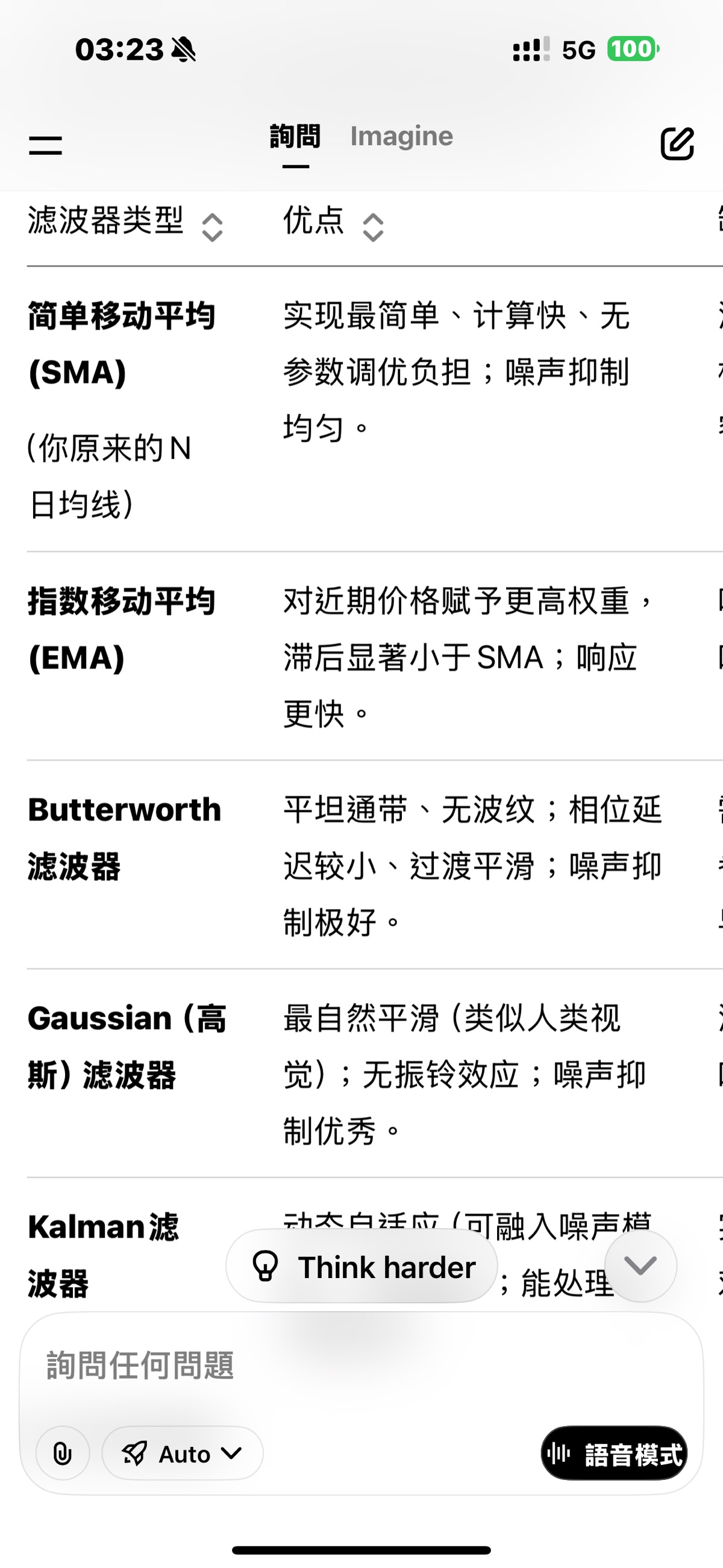
I'm wondering, what would happen if we replaced the moving average filter with other types of filters? 🤔
The copyright of this article belongs to the original author/organization.
The views expressed herein are solely those of the author and do not reflect the stance of the platform. The content is intended for investment reference purposes only and shall not be considered as investment advice. Please contact us if you have any questions or suggestions regarding the content services provided by the platform.
