


POP MART (Trans): 2026 'pit stop to refuel and change tires'
Below is Dolphin Research's$POP MART(09992.HK) FY25 earnings call Trans
I. Key takeaways
1. Shareholder returns: The co. plans to pay out 25% of attributable NP as dividends, implying total dividends of RMB 3.194bn and RMB 2.38 per share.
2. Guidance: Targeting revenue growth of no less than 20% in 2026, prioritizing healthy and sustainable growth over aggressive expansion. The co. will avoid revenue growth without profit growth.Quarterly biz. updates will be added in May and Nov. to increase disclosure frequency.
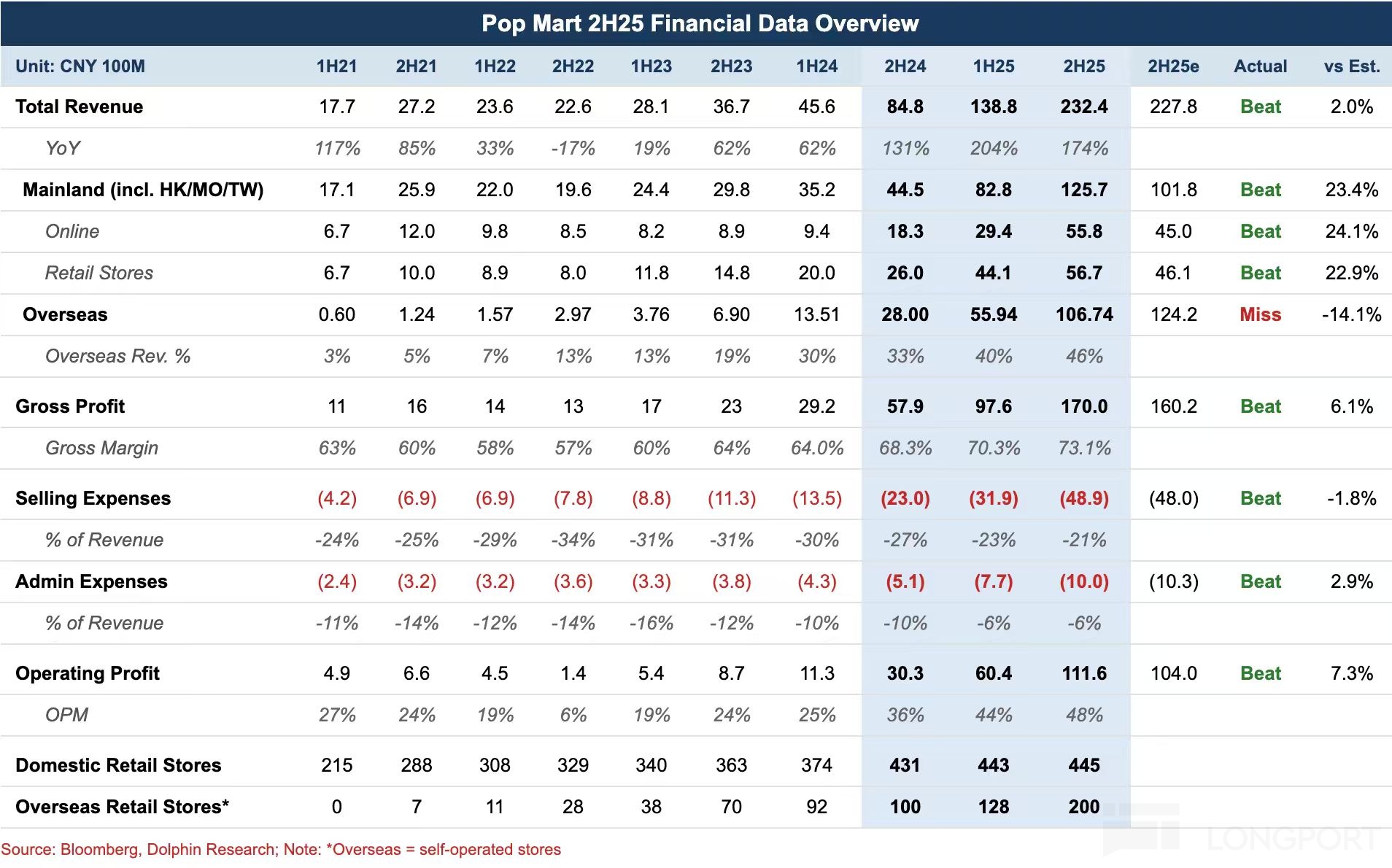
3. Key financials: FY25 revenue of RMB 37.12bn (+184.7% YoY), GP of RMB 26.76bn (+207.4%), GPM 72.1% (+5.3pp), NP of RMB 13.012bn (+293.3%), NPM 35.1% (+9.7pp), and Adj. NP of RMB 13.084bn (+284.5%).Marketing ratio fell from 35.3% to 26.5%.
4. Margin outlook: GPM in Jan–Feb 2026 was down approx. 1ppt YoY, with NPM down by less than 1ppt.Given uncertainties in intl logistics and raw material costs, detailed margin guidance will be provided with the Q1 biz. update in May.
II. Detail from the call
2.1 Mgmt remarks
1. IP ops
a. 2025 self-developed product revenue was RMB 36.788bn (+189.2%), contributing 99.1% of total. Six IPs exceeded RMB 2bn each, and 17 IPs topped RMB 1bn.
b. LABUBU delivered RMB 14.1bn (+365%), becoming a world-class super IP. The film co-produced with Sony Pictures has entered the scripting stage, and the brand will join global events this year such as the FIFA World Cup collaboration and the Macy's Thanksgiving Day Parade centennial.THE MONSTERS 10th-anniv. world tour has covered Shanghai, Hong Kong, Taipei, and Paris, with the U.S., Tokyo and Beijing next.
c. SKULLPANDA reached RMB 3.54bn (+170%), maintaining its distinct style. Crybaby continued explosive growth, testing crossovers with fashion.DIMOO kept growing, with plush products becoming blockbusters. Molly marks its 20th anniv., showing strong extensibility through multiple forms and themes, with Angry Molly adding fresh momentum.
d. Xingxingren (launched in 2024) is among the fastest-rising new IPs, up over 1,600% YoY. It has become a phenomenon in China and across Asia.
2. Product categories
a. Plush revenue reached RMB 18.708bn (+560.6%), becoming the top-contributing category for the first time, at 50.4% of total.
b. Figurines grew 73% off a high base, and derivatives rose 182%.c. New categories are being explored, including apparel (seven POP MART apparel stores in China), desserts (offline stores to open in 1H), and small home appliances (to launch next month in partnership with JD).
3. GPM drivers
a. Higher ASPs overseas vs. domestic, with rising overseas mix contributing +3.5pp.
b. Flexible supply-chain strategy, concentrating orders with core suppliers to cut costs, adding +0.9pp.c. Lower mix of licensing and mold fees, contributing +0.9pp.
4. China biz.
a. China revenue was RMB 20.85bn, with triple-digit growth in both Mainland and Hong Kong & Macau.
b. Offline retail revenue topped RMB 10bn for the first time, posting triple-digit growth. Flagship-store pilots received strong consumer feedback.c. Robot stores delivered RMB 1.35bn for the year, up nearly 80%, beating expectations.
d. Online channels beat across the board: Douyin +164%, Tmall +184% (remains No.1 in the sector). The online draw-box model led growth and extended IP lifecycles.Xiaohongshu GMV grew from a RMB 10mn base to over RMB 100mn in 10–11 months, ranking No.1 by annual GMV on the platform.
e. Registered members exceeded 70mn cumulatively, with 26.5mn new in 2025. Member purchase intent across categories and channels hit a three-year high, and cross-channel purchasing members surpassed 1mn (triple-digit YoY growth).
5. Intl biz.
a. Overseas revenue reached RMB 16.27bn (+291.9%), or nearly 44% of total. Revenue mix: China 56.2%, APAC 21.6%, Americas 18.3%, Europe & others 3.9%.
b. By year-end, there were 630 stores globally (China 445, APAC 85, Americas 64, Europe 36). Overseas stores totaled 185 (net +95), with 241 robot stores (net +108).c. In 2025, five new countries were added: Denmark, Germany, Qatar, the Philippines, and Canada, entering 30+ major cities.
d. E-com overseas rose to 48.6% of intl sales. Country websites went live sequentially, and the official app topped the U.S. App Store shopping chart in North America.Intl logistics is shifting to local-fulfillment models.
e. The U.S. and Europe grew by approx. 7x and 5x, respectively. Offices are now in 21 countries/regions globally with over 11,000 employees, including nearly 4,000 non-Chinese staff.
6. Parks & entertainment
a. Phase-1.5 construction of the park is progressing smoothly and will complete this summer. Despite nearly half the area being closed, traffic and revenue far exceeded expectations.The share of non-family and out-of-town visitors was well above expectations.
b. Phase-2 design is being advanced, with construction expected to start in 2027. It will be built around the worlds of SKULLPANDA and Xingxingren.
c. The park incubated dessert and mascot businesses. The mascot team attended ~40 events last year at home and abroad.
7. 2026 strategy
a. Core strategy: globalization + IP-centered group structure (top priority for the next five years).
b. Overseas expansion will focus on the Middle East, South Asia, Europe and South America, radiating from four regional hubs to neighboring countries. Expansion will gradually reach lower-tier and tourist cities.c. 2026 is positioned as a 'pit stop' year to refuel and change tires, prioritizing org. management, cross-border coordination, and middle–front office alignment.
2.2 Q&A
Q: 2025 was a breakout year. What did the co. learn, and what needs improvement?
A: 2025 was indeed the fastest growth year since inception, with record highs in revenue, profit, headcount, store count, IP and brand influence. Internally, we liken it to a rookie driver being thrust onto the F1 circuit, where both the driver and the car face extreme pressure at high speed.We are pleased that our early strategic layout for global online and offline ops absorbed the traffic surge and amplified brand influence. POP MART is becoming a lifestyle for more people, easing concerns that LABUBU or the category is just a fad.
What we reflect on more are the gaps. Hypergrowth exposed issues in org. management, information flow across regions, and middle–front office coordination.We have always respected time and disciplined ops, aiming for linear, healthy growth. Hence we want 2026 to be a 'pit stop' year, identifying issues faster than peers, clarifying fixes, and laying the groundwork for long-term development.
Q: What is the roadmap for LABUBU ops and new launches?
A: On product, there are many exciting launches this year. We just announced an official FIFA World Cup collaboration.There will be two heavyweight series in 2H, and the first will be our internal, true '4.0' series — last year's Alphabet series and the recent Kitty collaboration are not considered 4.0 internally. Year-end will also bring a major artist collaboration.
On marketing, the LABUBU mascot will continue to travel globally. In Jun, it will appear at matches in the U.S., Mexico and Canada for the World Cup, and we will again join the Macy's Thanksgiving Day Parade on its 100th anniv.THE MONSTERS 10th-anniv. global tour has visited Shanghai, Hong Kong, Taipei and Paris, and will go to the U.S., Tokyo and Beijing.
Medium to long term, the focus is content and the park experience. We will republish the first three picture books by Teacher Luo, and the fourth is in final preparation.The film with Sony Pictures has entered scripting, and Park Phase-1.5 will deliver a more immersive LABUBU world. With more content and offline experiences, we hope LABUBU accompanies its fans through the next decade.
POP MART is far more than LABUBU. Even excluding LABUBU, the co. still delivered very rapid growth.DIMOO grew fast last year, and Xingxingren exceeded expectations. We see LABUBU as a gold mine whose value extraction has only begun, and with continuous newness and holistic ops, we are confident in its lifecycle and heat. As a platform, we are getting more mature and confident in running core IPs and incubating new ones.
Q: What is the 2026 growth guidance from mgmt?
A: We are not a tech co.; we are a consumer and pop-culture entertainment co. that sells products and runs channels. Despite last year's hypergrowth, we prefer linear, healthy growth.We far exceeded prior guidance last year, and the larger base adds pressure.
Broadly, hypergrowth revealed many areas to optimize in org. management — cross-border management, staffing, and middle/back/front-office coordination. These are core goals this year.As a 15-year-old co. entering year 16, there are many lessons to make up.
This year we aim for revenue growth of no less than 20%, without chasing overly aggressive expansion. We will not accept revenue up with profits flat, and the core is to drive more durable, steady and healthy growth.
Q: How will overseas expansion unfold by region in 2026?
A: Our four regions are China, APAC, the Americas and Europe. We used to expand from China HQ; now each region serves as a hub to radiate into nearby markets.For example, Europe can develop Africa, APAC can develop the Middle East and South Asia, and the Americas can deepen Central America.
We will move from capital-centered expansion to penetration into second- and third-tier cities. We will also focus on tourist cities and flagship projects.For new businesses, the idea is to validate in China first, then replicate overseas, while also considering incubating some new businesses overseas for global rollout.
Q: Any new thinking on long-term strategy by biz. and by region?
A: At IPO we stated two core strategies: globalization and an IP-centered group structure. Intl expansion has driven major progress in recent years and delivered excellent results.But we still believe IP-centered group development is the most important direction.
We tried many new businesses with better-than-expected results — including F&B, desserts and film — and will launch small home appliances with JD next month. IP-centered group development will be a key growth engine over the next five years.We also adjusted the org., with Jessie, after helping overseas reach nearly 50% mix, returning to drive group development.
Q: What drove China’s surge in 2025, and how to sustain it?
A: China has grown for three straight years, with a bigger step-up last year. There was no grand blueprint; we doubled down on meticulous ops.
Operationally, we moved from a unified merchandise pool to fully aligning merchandise rhythms with terminal-channel marketing rhythms in 2025. This extended the lifecycles of hot and near-new products.For example, Macaron LABUBU launched in Oct 2023 and remains a hot-seller in China today. SKULLPANDA 'Temperature' launched in Nov 2022 and still sells steadily.
We stick to multi-IP and multi-category. In China, plush and blind boxes grew similarly in percentage and absolute terms.LABUBU accounts for roughly one-third of sales across plush, blind boxes and peripherals; about 70% comes from multi-IP and multi-category, which underpins sustainability.
On stores, we upgraded in 2025 with area up 30%–50%, and post-upgrade sales per sqm were nearly 2x the national avg. We will accelerate upgrades in 2026, well above 2025 levels, and pursue flagship projects.
Online, 3P channels focus on new-customer acquisition, while 1P channels focus on repurchase, with omni-channel promoting circulation. Cross-channel purchasing members exceeded 1mn in 2025, up triple digits YoY.On Xiaohongshu, GMV grew from RMB 10mn to over RMB 100mn in 10–11 months. On Douyin Live, the 'box-unpacking' experience posted triple-digit growth.
Q: How is the U.S. market performing, and what are the near- and long-term outlooks?
A: When the U.S. budgeted for 2025 in 2H24, it was ~RMB 2bn; actual revenue reached RMB 6.9bn. Although we missed the year-end stretch goal above RMB 7bn, delivering RMB 6.9bn on a RMB 2bn budget strained talent, systems, warehousing and logistics.The result remains a pleasant surprise internally.
The first U.S. store opened in 2H22, the team was reorganized in 2023, and 2024 was the first true acceleration year with over RMB 800mn. The second year jumped to nearly RMB 7bn, underscoring the market’s potential.Last year, with only 50–60 offline stores, capacity was insufficient, pushing too much volume online. That mix is not our long-term target.
We aim, over time, to shift to an offline share slightly above online via continued store openings and merchandise allocation changes. This is a long-term goal, not a 2026 task.We have opened 72 stores and will surpass 100 this year. Two flagship stores at Times Square and Fifth Avenue in New York are slated to open in Q4 if all goes well.
Online, the U.S. member base is already large. We were TikTok U.S. No.1 across all categories last year and will deepen collaboration this year.Amazon began to see strong momentum in 2H last year. The U.S. team is nearly 2,000 people, and we upgraded the U.S. HQ office.
Going forward, the U.S. office will not only run North America ops but also pursue artist scouting and film/TV content production.The biggest challenge this year is slower post-hypergrowth traffic. We need to offset it via ops and offline expansion. Q1 is seasonally softer in the West, giving us time to reset strategy and conduct team building. Medium to long term, North America still has substantial potential.
Q: How is the park performing and what’s next?
A: Phase-1.5 construction is on track and will complete in summer. Even with nearly half the area closed, performance far exceeded expectations, with strong growth in traffic and revenue.The share of non-family and out-of-town visitors was much higher than expected.
The park has incubated dessert and mascot businesses. Mascots now include LABUBU, Xingxingren, Molly and others, and the team joined ~40 events last year, including major parades and New Year shows.For expansion, Phase-2 design is advancing, with construction to start in 2027. It will be themed around SKULLPANDA and Xingxingren to deliver stronger playability and IP immersion.
Q: How are top IPs trending across regions, and how do you adapt to local tastes?
A: Top IPs are generally well received globally, especially LABUBU, SKULLPANDA, HIRONO and Crybaby. We have not seen clear trend shifts driven by aesthetic differences.Molly and DIMOO may perform better in China and Asia, but via collaborations with locally popular IPs, we unlocked Western markets. Space Molly and Angry Molly delivered solid results in new countries and regions.
Xingxingren is already a phenomenon in China and Asia, but may need more investment in the West.Our discussions with Western teams suggest different interpretations of Xingxingren, so we will adapt marketing and storytelling. Through org and workflow changes, we are pushing for more localized teams and IP ops to find better region-specific strategies.
Q: Will store adjustments in China continue to go lower-tier? What is the pace and room for optimization?
A: We have long emphasized disciplined store openings in China, focusing on retail fundamentals. Given 2025 results, we will modestly step up openings in 2026.But it is not about chasing any market tier; the core is to improve the customer experience.
We plan to open some flagship stores, though not many. Their value lies beyond sales growth, serving as testbeds for space, merchandising and product-supply models, which differ materially from standard stores.
We did some upgrades in 2025, and 2026 upgrades will far exceed 2025. Based on 2025 experience, upgraded stores generally increased area by 30%–50%, while sales per sqm rose to nearly 2x the national avg, implying ample room.
Q: How do you view 2025 margins and what about 2026?
A: First, an update: beyond interim and annual reports, we will publish biz. updates in May and Nov., with investor communications alongside.For 2025, NPM reached 35.1%, up 9.7pp YoY, the best in our history, driven by operating leverage. 2026 may be a year to consolidate the base of hypergrowth, tightening control over discretionary expenses and avoiding revenue up with profits flat.
From Jan–Feb 2026, GPM slipped by approx. 1ppt and NPM by less than 1ppt. Given high uncertainties in intl logistics and raw material costs, we will need more time to assess margins, and plan to offer more precise guidance with the May Q1 update.
Q: What are the improvements in intl logistics and replenishment responsiveness?
A: Global simultaneous launches hinge on three links: design, production and logistics. We need to ensure all three stay on schedule.
On design, past licensing reviews did cause major delays, as seen in the Kitty collaboration having limited volumes in the West and the Halloween series being pushed back due to design changes. We have refined internal design processes and early-warning mechanisms.On supply chain, we will invest more in digitalization this year, leveraging better systems and AI to optimize scheduling, production efficiency and data allocation.
On logistics, we are reorganizing to integrate first/last-mile logistics and warehouse mgmt across regions under unified standards. We will build systems and negotiate at group level with ocean and air carriers to secure better discounts and capacity.Additionally, we flex strategies by channel and country. For example, on Amazon in the West we no longer insist on full simultaneity, staggering some non-seasonal launches. But for flagship releases, the goal remains fully synchronized global launches across channels.
Q: How do pricing strategies differ by region, and what drove U.S. price moves?
A: The U.S. saw significant tariff volatility last year. During higher-tariff periods, we adjusted prices to offset extra costs.Tariffs then fell more than expected, and we have restored pricing of all new products to normal.
Two core factors drive intl pricing: underlying costs (including logistics and COGS) and target GPM, and local consumption power. This year, we do not seek further price increases and aim to hold prices steady.
Challenges include higher raw material and logistics costs due to geopolitics. We continue to offset via supply-chain and product-design optimization, aiming to deliver better products without raising prices.
Q: Will you accelerate new businesses in 2026 and beyond, and how will you pace them?
A: Many top consumer brands deliver 'fashion for all'. Our mission is 'fun', and we aspire to 'fun for all' or 'happy for all'.We see large market potential grounded in joy and beauty — whole families visit our stores and each member has a great experience, which differs from many consumer categories.
We still see this as a very young industry and are confident in future category expansion and demand. After saying 'fix the roof while the sun is shining' last year, we cautioned teams against complacency and urged deeper thinking.Over the past year, we have built strong capabilities — an IP matrix, management team, brand influence and global mgmt experience.
Each new business may be overshadowed by the group's hypergrowth, but each is quietly accruing experience and iterating, with encouraging results. We will not be overly aggressive in pacing, but the outlook is highly promising.
<End>
Risk disclosure and disclaimer:Dolphin Research Disclaimer and General Disclosure
