


Nongfu Spring: From defense to offense, the 'Water Maotai' powers higher! ---
On the evening of Mar 24 Beijing time, Nongfu Spring (9633.HK) released its 2H25 results. Overall, under an aggressive 'ten-thousand-store display' push at the channel level, packaged water and tea drove a strong top-line beat, delivering an above-consensus print.
Key takeaways are as follows: $NONGFU SPRING(09633.HK)
1) Packaged water: profitability at a new high: 2H25 packaged water revenue reached RMB 9.27bn (+25% YoY), accelerating further after returning to positive growth in 1H.
On one hand, during peak season Nongfu rolled out large-scale 'ten-thousand-case' displays across supermarkets, c-stores and neighborhood shops, using end-cap stacks and exclusive shelf space to tighten terminal control.
In addition, leveraging shelf and stack positions previously won by the green-bottle SKU, the company increased the mix of red-bottle water. Based on channel checks, red-bottle contribution in packaged water has recovered to about 82% (vs. a trough of 75%), lifting the segment OPM to 39.4%, a record high.
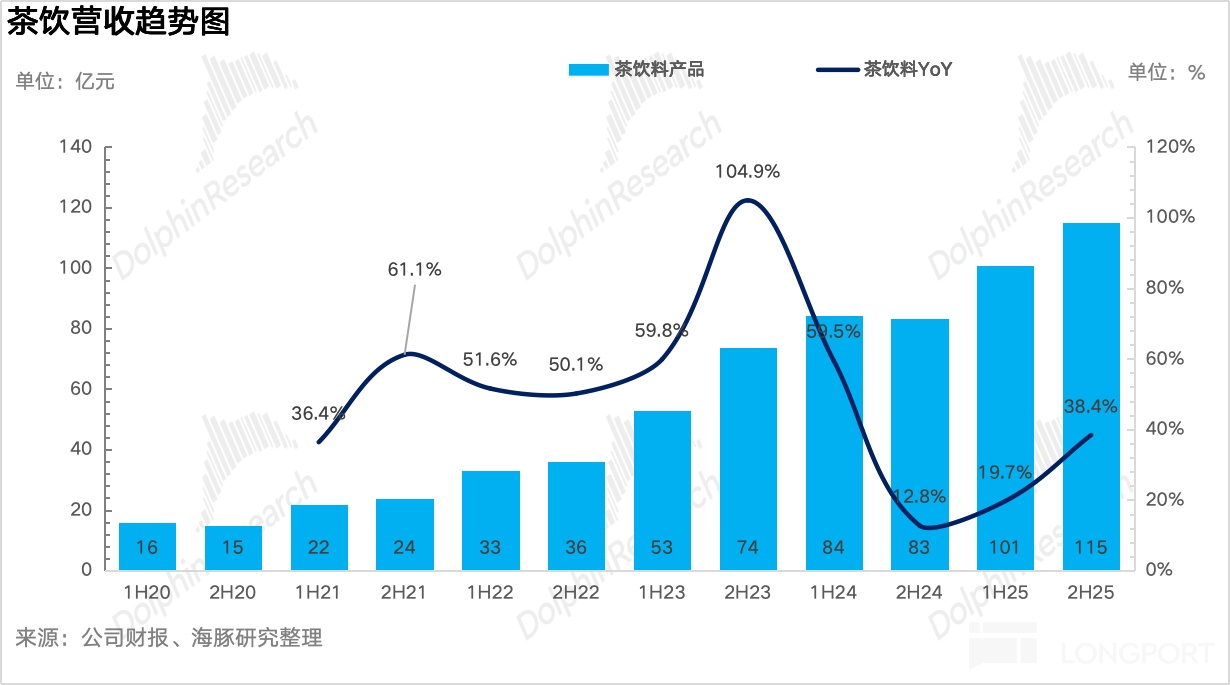
2) Tea as the primary growth engine: Tea revenue in 2H25 reached RMB 11.5bn (+38.4% YoY). It overtook packaged water in scale, becoming the company’s largest growth driver.
In winter, Nongfu deployed hot-drink cabinets nationwide, repositioning Oriental Leaf from a traditional cold drink to a winter hot option, greatly expanding consumption scenarios.
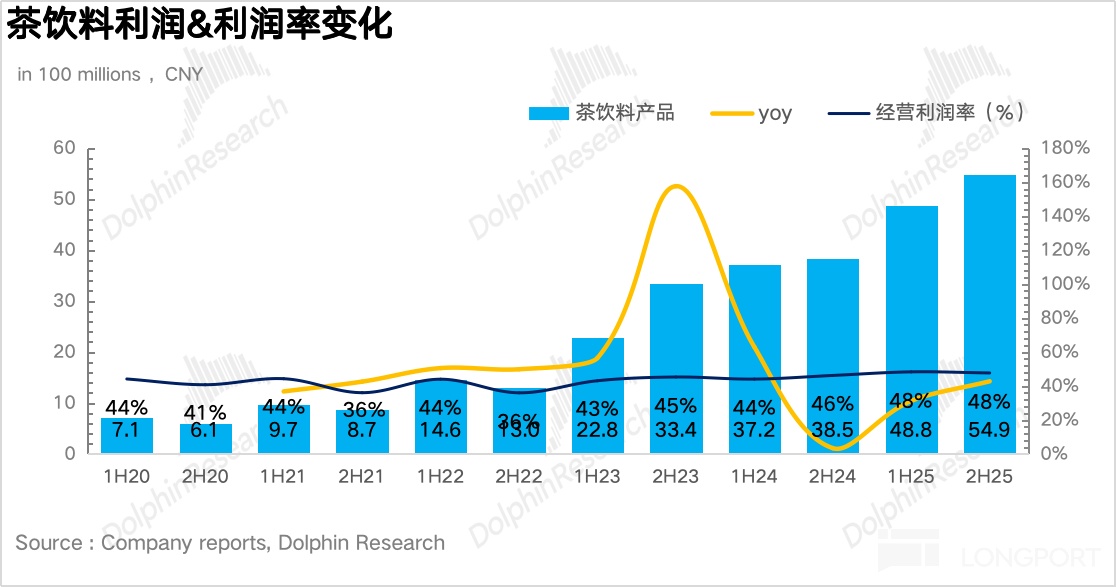
Meanwhile, despite a minor price concession via the 'RMB1 Enjoy' campaign, which took the segment OPM down slightly HoH to 47.7%, tea remains the most profitable business for Nongfu.
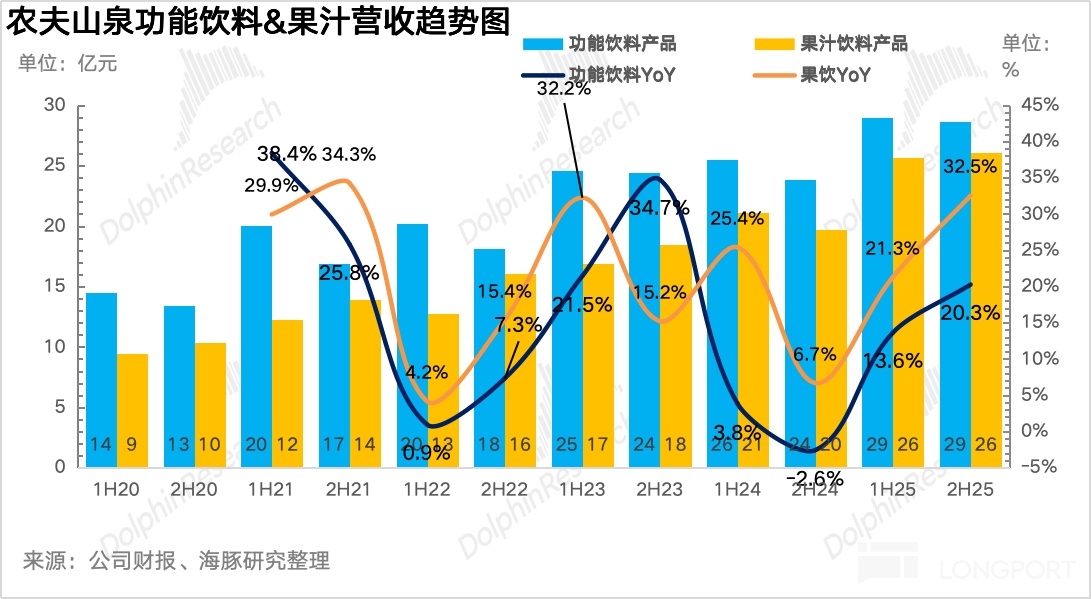
3) Functional drinks & juice: faster product iteration: Benefiting from accelerated distribution of electrolyte water in 2H and a full upgrade of the Scream portfolio, functional beverages grew 20% YoY in 2H, slightly ahead of expectations.
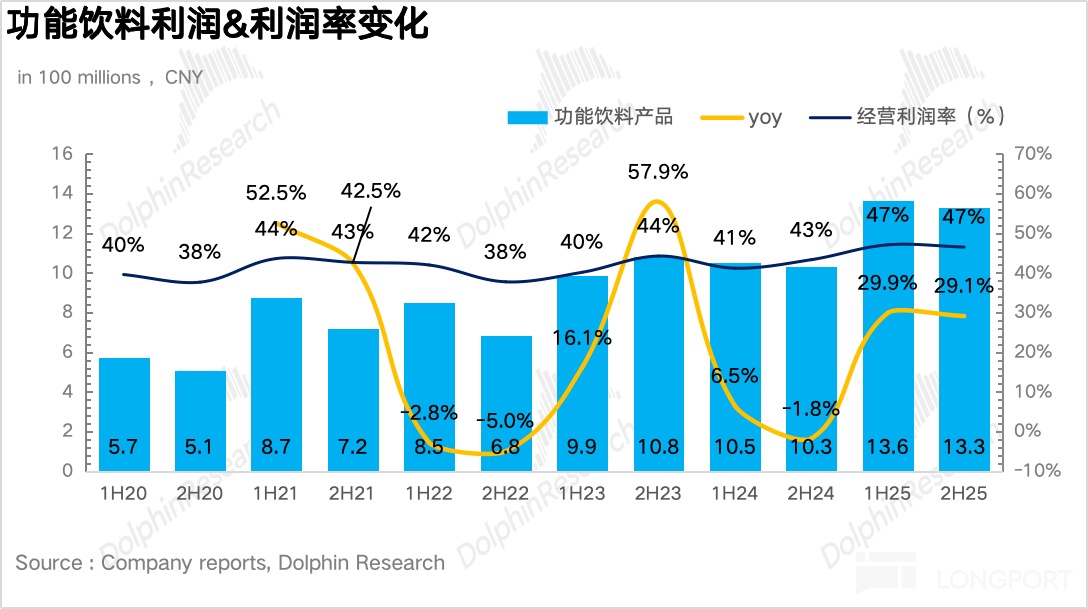
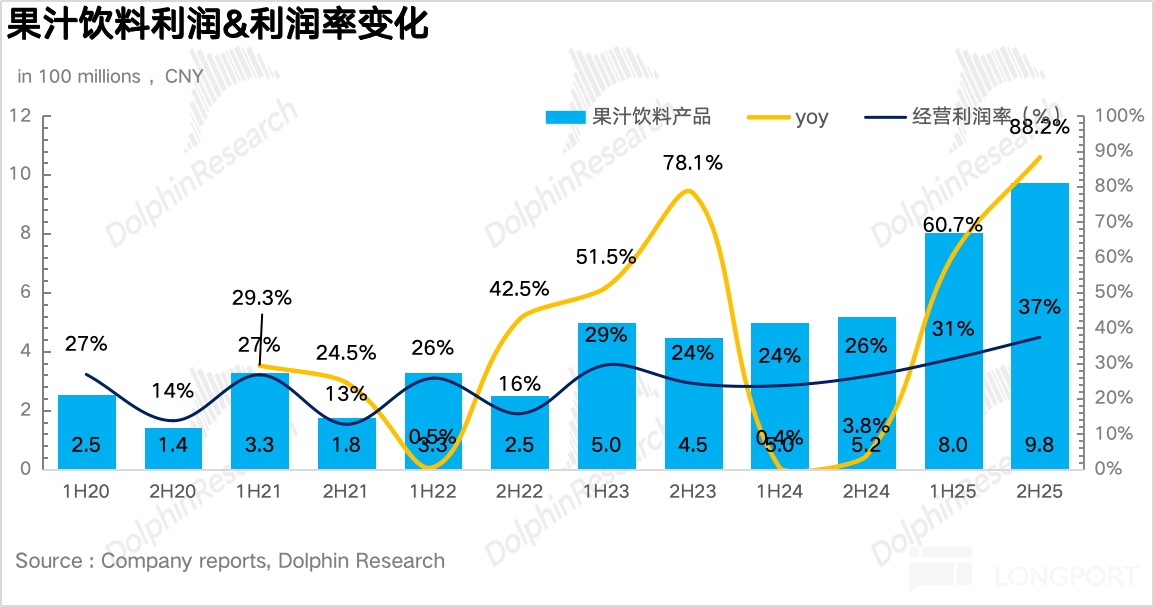
For juice, with the ongoing premiumization strategy, the 17.5° NFC line launched 1L family packs in 2H, targeting breakfast and gathering occasions at home. Segment OPM reached 37.3%, a new high.
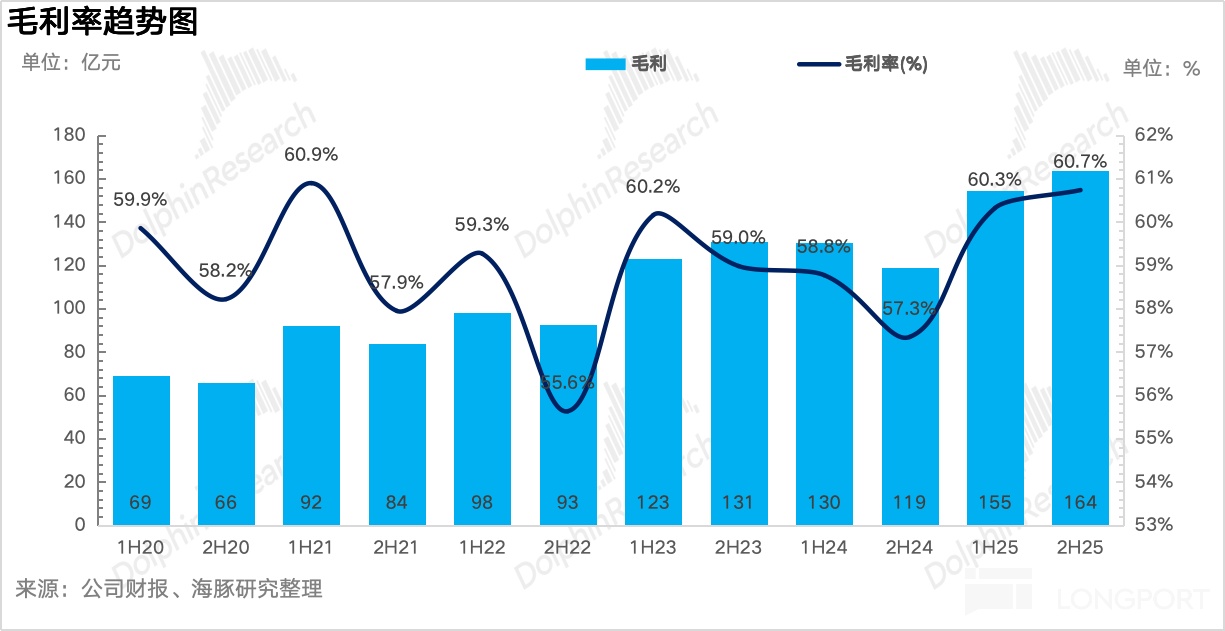
4) GPM continued to improve. On gross margin, key raw materials and packaging (PET and corrugated) stayed at low levels in 2H. Coupled with volume from higher-margin SKUs (red-bottle water, electrolyte water, NFC juice and Scream), GPM expanded by 3.4pct to 60.7% in 2H.
5) Operating leverage unlocked; profit beat.
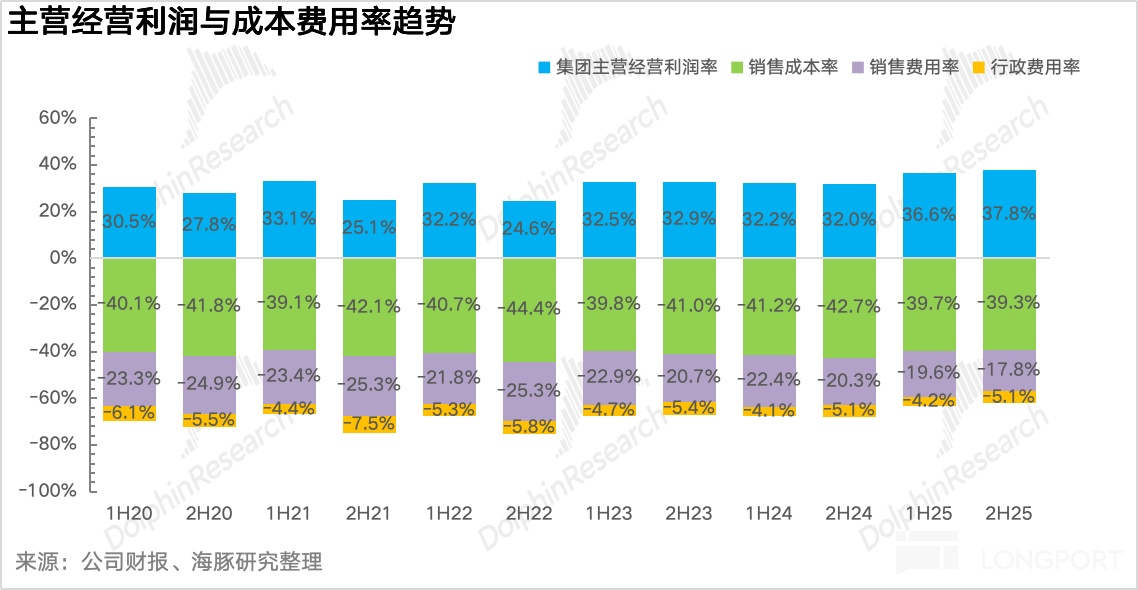
On opex, Nongfu phased out low-efficiency TV ads, pivoting to short videos and live-streaming, and reduced ineffective promotions by strengthening cooler placements. The selling expense ratio fell 2.5pct to a record-low 17.8%.
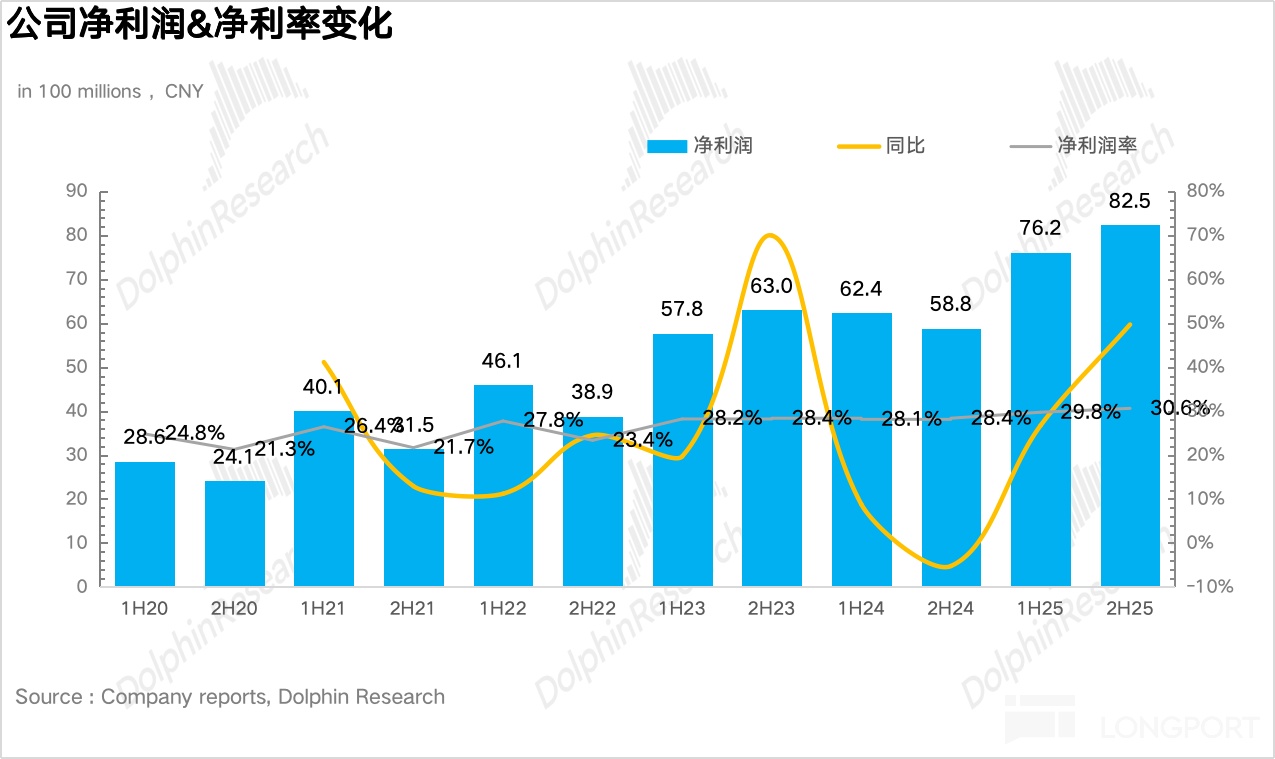
Admin expenses rose temporarily on stock-based comp and digitalization investments, and NPM reached 30.6%, a record high that topped market expectations.
6) Financial snapshot:
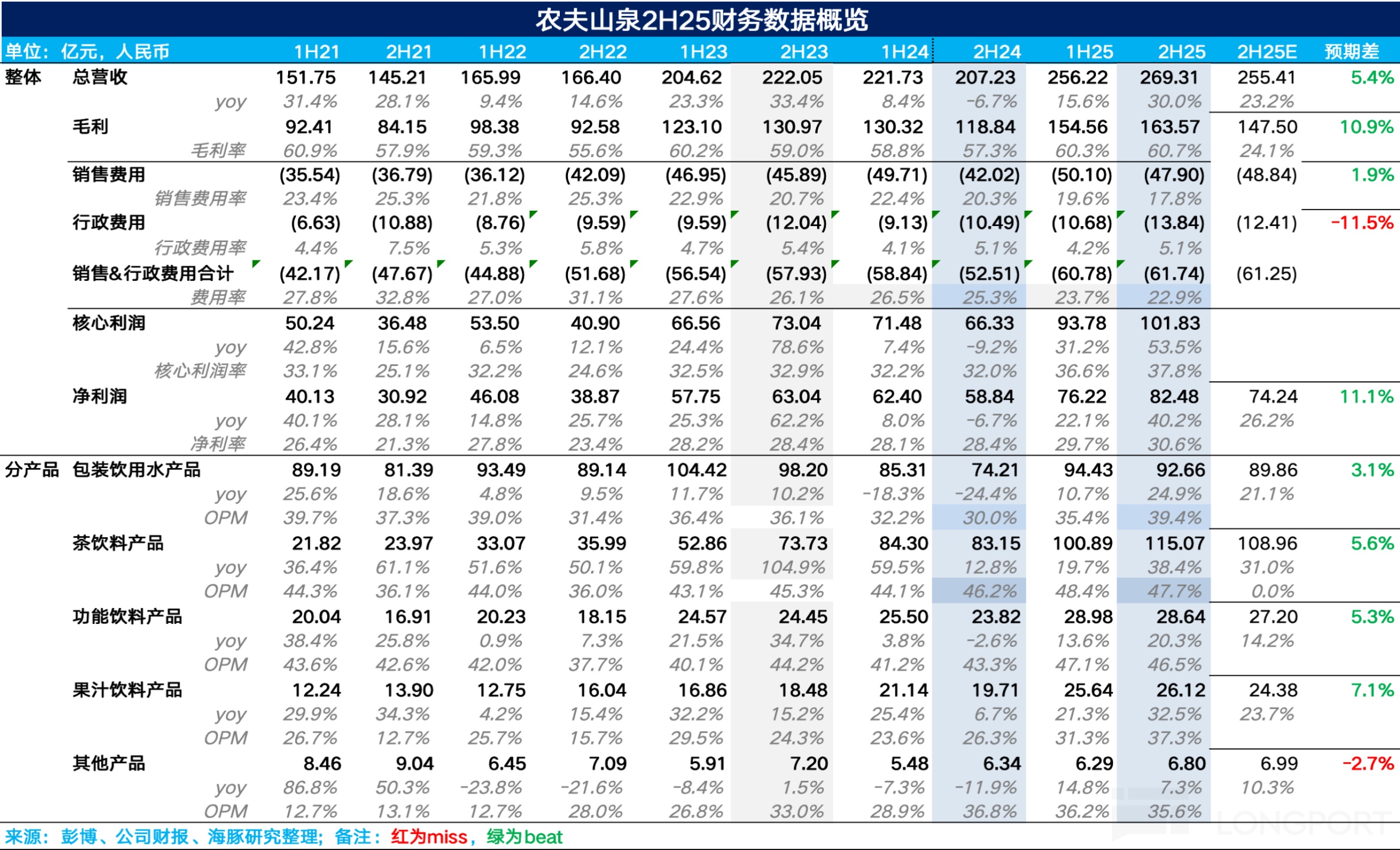
Dolphin Research view:
In our view, Nongfu once again delivered a broad-based upside surprise in 2H.
Starting with packaged water, competitors like C'estbon and Wahaha maintained ongoing promotions, with price cuts across community groceries, c-stores and e-commerce in multiple cities. The price war spilled from lower-tier markets into core Tier-1/2 cities, trading price for volume and pressuring the industry price system.
Sell-side trackers at foreign banks also saw the packaged-water price index drift lower through 2H, raising concerns that Nongfu would be forced to cut prices and suffer GPM pressure.
On the other hand, the market worried that Nongfu’s aggressive 'ten-thousand-case display' push would require hefty rebates and large end-cap/shelving fees to distributors, potentially weighing on packaged water margins.
However, in practice, Nongfu stuck to a no-price-war stance, substituting low-price promos with precision channel spending. The green-bottle low-price strategy was confined to lower-tier markets, largely preserving red-bottle pricing, with traffic effectively funneled back to red-bottle after green-bottle completed its 'entry and placement' role.
In ground execution, Nongfu abandoned uniform, heavy end-cap fees in favor of more granular, tiered investment: priority spend at core doors and lighter displays at regular doors. This reflects enhanced digital control, similar to the playbook of Eastroc Beverage.
As a result, packaged water not only grew fast but also achieved a new high in profitability, which we see as the standout.
Turning to tea, a similar worry existed: as Suntory, Guozishule and major dairy players (Yili, Mengniu) rushed into sugar-free tea, the track became crowded. The market feared Oriental Leaf would cut prices to defend share, hurting profit delivery.
Instead, Oriental Leaf did not cut prices and even pushed 1.5L large packs harder in 2H, effectively lifting ticket size.
Channel checks show that many of the newcomers suffered from uneven taste and unstable supply chains. Consumers experienced fatigue after trials and returned to Oriental Leaf, underscoring its product strength.
That said, expectations for Nongfu’s sugar-free tea were already high, so the upside vs. expectations was less striking than in packaged water.
Finally, on valuation, both water and tea are near RMB 20bn in annual revenue scale each. Assuming natural growth deceleration and 15% profit growth in 2026, implied at ~25x P/E, valuation looks fair.
If in 2026 Nongfu further lifts share in water and tea through refined channel operations, multiple expansion to ~30x is possible, implying ~20% upside. Investors can calibrate exposure per their risk appetite.
Detailed earnings breakdown follows:
Nongfu reports by four categories: packaged water, tea, functional beverages and juice. We analyze in that order below.
I. Overall: further sequential acceleration
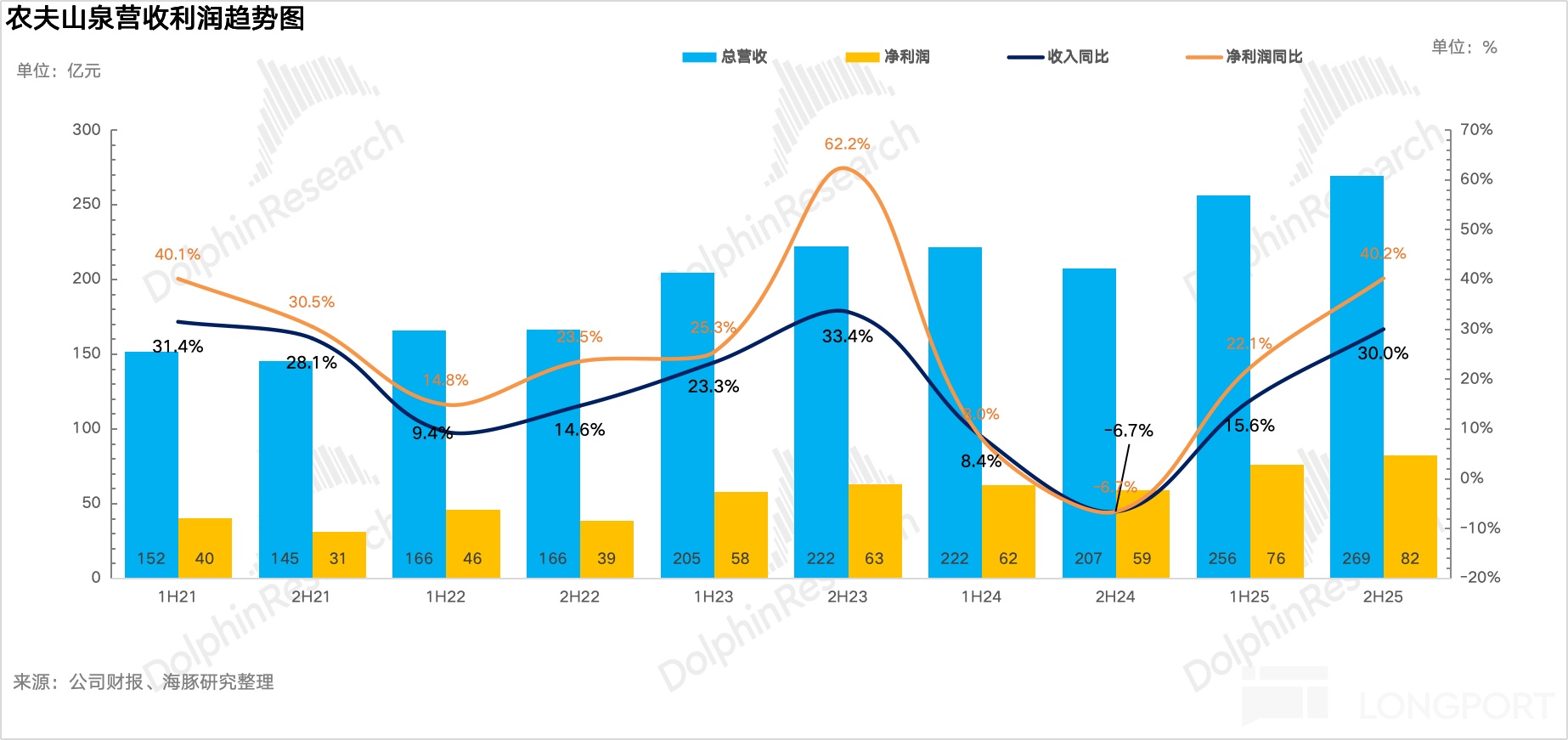
2H25 revenue reached RMB 26.93bn (+30% YoY) and net profit RMB 8.25bn (+40% YoY). With the high-intensity 'ten-thousand-store display' push, packaged water and tea drove robust growth, while better operations unlocked operating leverage, accelerating profit delivery and driving an all-round beat.
II. Packaged water: profitability at a new high
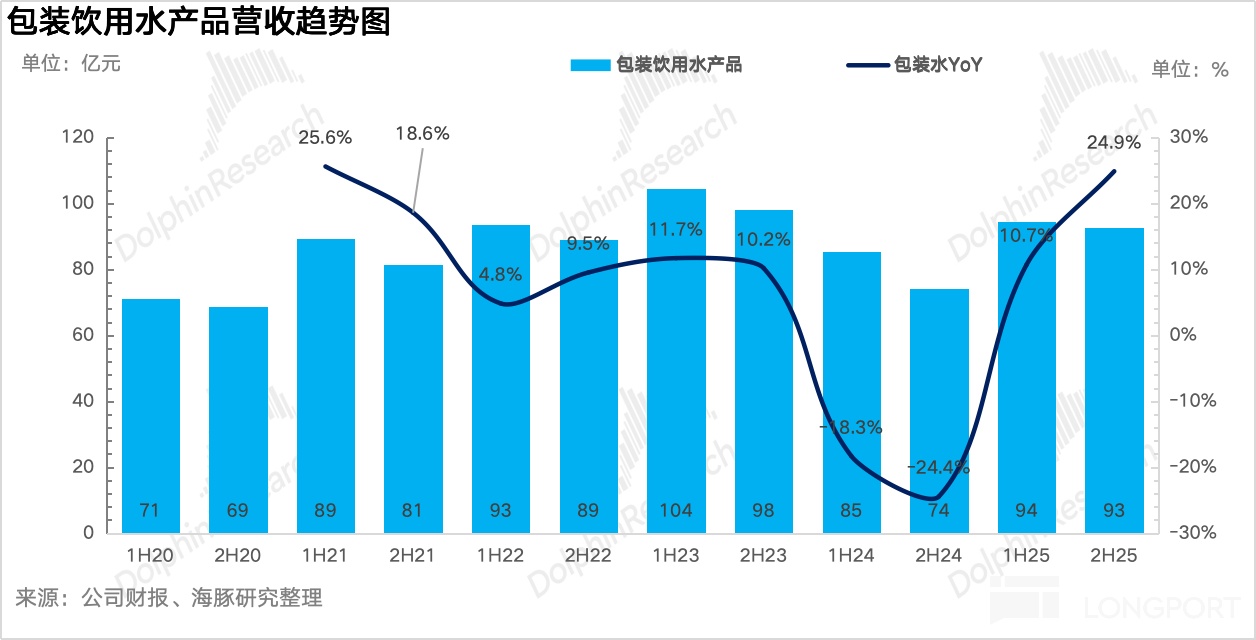
2H25 packaged water revenue was RMB 9.27bn (+25% YoY), with sequential acceleration after returning to positive growth in 1H.
By mix, leveraging share gains from earlier green-bottle placements, the company intensified red-bottle promotion in 2H and upgraded the structure by substituting green with red. Based on checks, red-bottle contribution in packaged water rose from 78% in 1H to about 82% by year-end.
On execution, Nongfu set stricter shelf ratio requirements for distributors in 2H. The mandated display ratio for red vs. green bottles was no less than 7:3.
Distributors who pushed only green bottles without meeting red-bottle display standards would forfeit substantial quarter-end rebates.
In parallel, the company tweaked tiered rebates: despite higher volumes for green bottles, per-case rebates were compressed, while per-case incentives for red bottles were increased, nudging store owners to place red bottles in prime locations such as the checkout counter.
Moreover, starting in 2025, Nongfu ramped up promotion of large-pack red-bottle water (1.5L, 2L, 4L, etc.). As large packs mainly serve households and F&B, replacing tap water for cooking and tea, consumers focus more on source quality, aligning well with the red-bottle positioning.
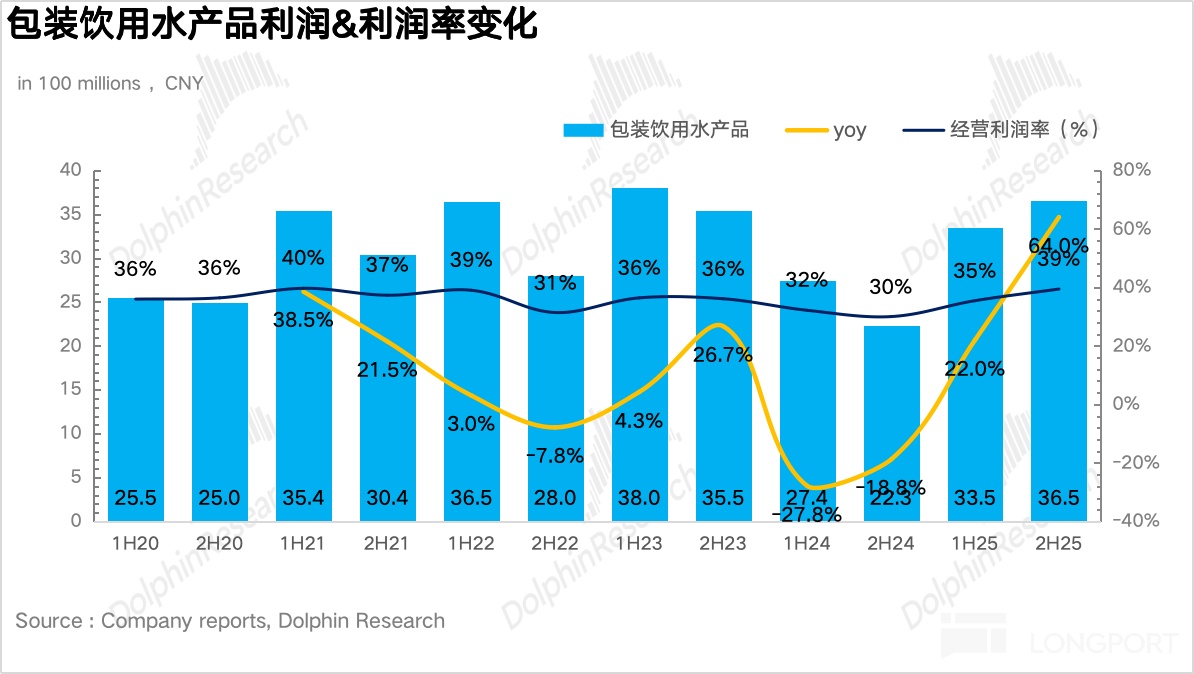
With the higher red-bottle mix, packaged water OPM improved further to 39.4%, a record high.
III. Tea: further sequential acceleration
2H25 tea revenue reached RMB 11.5bn (+38.4% YoY). It officially surpassed packaged water in scale, becoming the top growth engine.
In winter, Nongfu rolled out hot-drink cabinets nationwide, shifting Oriental Leaf from a traditional cold drink to a winter hot option, significantly broadening use cases.
Separately, the company stepped up the push for 1.5L large packs in 2H. While the price per bottle is higher, cost per ml is lower, spurring stock-up by heavy users, and a long summer helped drive incremental revenue from large sizes.
Nongfu also leveraged Oriental Leaf’s strong position to demand equal display treatment to packaged water. From a share perspective, although 2025 saw a flood of new entrants into sugar-free tea, their scale remains far from Oriental Leaf’s.
Channel checks indicate Nongfu’s sugar-free tea share exceeded 80% at times in 2H, effectively an oligopoly with one dominant player.
On profitability, despite small concessions under the 'RMB1 Enjoy' campaign that took OPM down slightly HoH to 47.7%, tea remains Nongfu’s most profitable segment.
IV. Functional beverages & juice: accelerated iteration
Although these two categories lack the first-mover advantages of water and tea and receive relatively less resource allocation, both delivered strong performance in 2H.
Functional beverages (including Scream and electrolyte water) delivered RMB 2.86bn in 2H (+20% YoY), with some sequential acceleration, driven mainly by faster rollout of electrolyte water in 2H and a comprehensive Scream portfolio upgrade.
Juice delivered RMB 2.61bn (+33% YoY). A standout was the 17.5° NFC orange juice, which benefited from the health trend and entry into Sam’s Club late last year, becoming a hot seller and effectively expanding at-home consumption.
The bigger surprise was profitability: with juice premiumization, segment OPM jumped 10pct in 2H to 37.3%.
V. GPM expanded sharply
On gross margin, key raw materials and packaging (PET, corrugated) stayed low in 2H. Together with volume from red-bottle water and other high-GPM SKUs (electrolyte water, NFC juice, Scream), company GPM rose by 3.4pct to 60.7% in 2H.
VI. Operating leverage further boosted profitability
On selling expenses, Nongfu gradually cut low-efficiency TV ads, shifting to short videos, live-streaming and other new media, and reduced ineffective promotions by strengthening cooler placements. The selling expense ratio fell 2.5pct to 17.8%, a record low. Admin expenses rose on SBC and digital investments, and NPM reached 30.6%, above market expectations.
<end>
Longbridge Dolphin Research historical notes on 'Nongfu Spring':
Earnings season
Aug 26, 2025 earnings take: 'Nongfu Spring: Green bottle steps back, red bottle takes over; the water champion returns'
Mar 25, 2025 earnings take: 'Nongfu Spring: Has the 'porter of nature' lost its edge?'
Aug 27, 2024 earnings take: ''Plunge' at Nongfu Spring: Don’t panic — is it time for the richest man to pass the baton?'
Aug 27, 2024 call notes: 'Nongfu Spring minutes: Big holders selling in turns — what did the water champion say?'
Aug 25, 2022 earnings take: 'Nongfu Spring: Tea surges against the tide — the water champion’s strength can hardly be contained in 2H'
Aug 25, 2022 call notes: 'Tea beverages become the new growth engine'
Mar 30, 2022 call notes: 'Nongfu Spring 2021 earnings call minutes: Sales targets basically met'
Mar 28, 2022 earnings take: 'Nongfu Spring: The return of the water champion'
Aug 25, 2021 earnings take: 'Nongfu Spring: The water champion returns, but valuation risks remain'
Mar 29, 2021 call notes: 'Nongfu Spring 2020 earnings call minutes'
Mar 26, 2021 earnings take: 'Nongfu Spring: Are the 'water champion' results overstated?'
Deep dive
Jul 20, 2021: 'Nongfu Spring (Part II): How much room is left for a 'rational' rerating?'
Jul 14, 2021: 'Nongfu Spring (Part I): A story of water sources'
Risk disclosure and statements: Dolphin Research Disclaimer and General Disclosure
The copyright of this article belongs to the original author/organization.
The views expressed herein are solely those of the author and do not reflect the stance of the platform. The content is intended for investment reference purposes only and shall not be considered as investment advice. Please contact us if you have any questions or suggestions regarding the content services provided by the platform.
