


Mixue Group (Trans): GPM and NPM expected to decline in 2026---
Below is Dolphin Research's transcript from Mixue Group's 2H25 earnings call. For our earnings take, please see 'Mixue Group: Lucky Coffee's comeback, has Snow King bottomed?'.
I. Key takeaways from the results
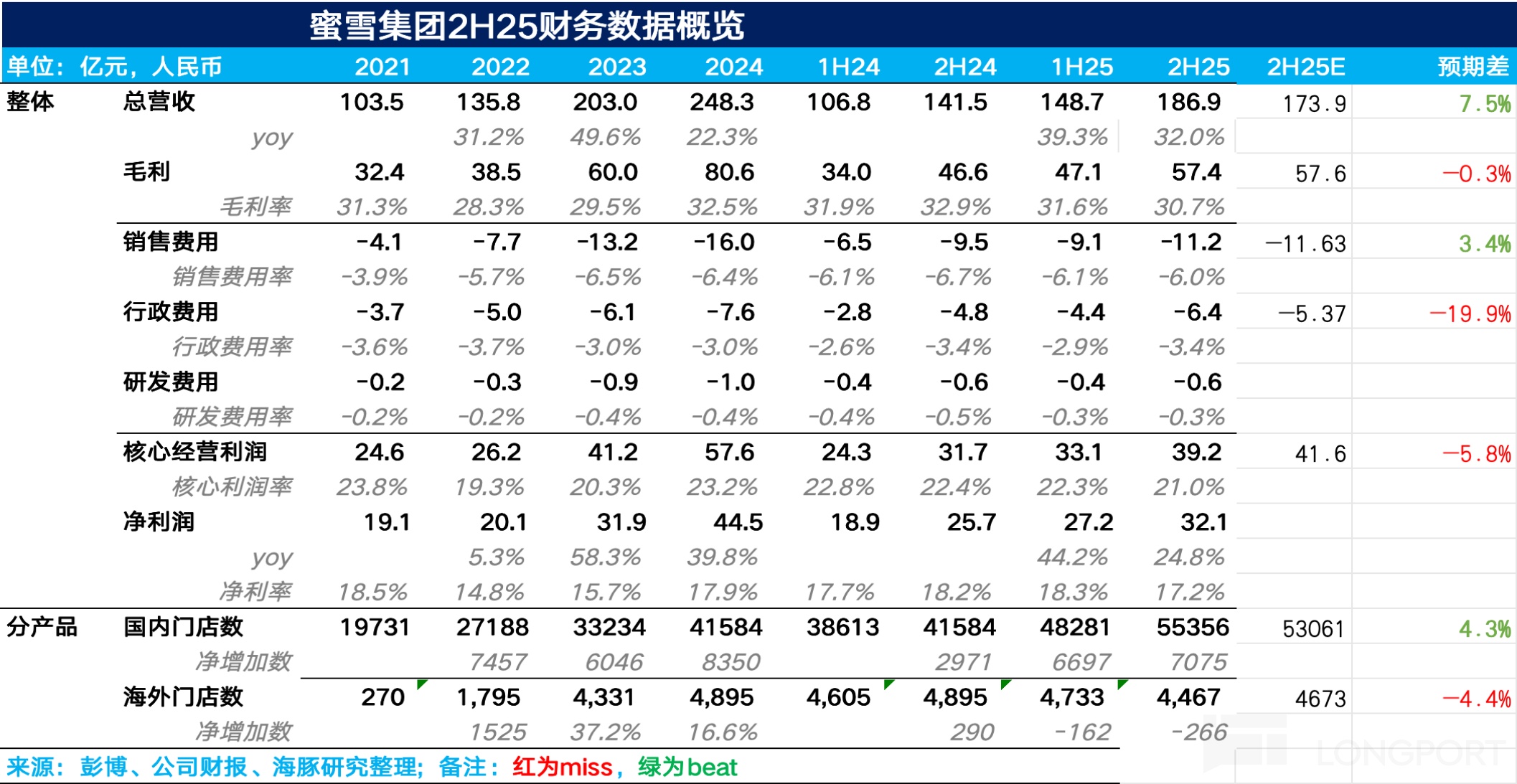
1. Outlook: GPM in 2026 is guided down vs. 2025 (long-term target unchanged at ~30%). Net margin is also expected to decline. On opex, the company will step up brand marketing, digital build-out and cold-chain upgrades, aiming to keep ratios at healthy, sustainable levels. $MIXUE GROUP(02097.HK)
2. Capex: 2026 group capex is ~RMB 1.8–2.0bn. Domestic capacity expansion is ~RMB 1.4bn, the overseas Vietnam base ~RMB 200mn, and Snow King Park under RMB 100mn, with additional spend in Fresh Beer FuluJia breweries, cold-chain warehousing/logistics and digitalization. There are no concrete M&A plans for now, while the company continues to monitor opportunities.
II. Details from the earnings call
2.1 Management remarks
1. Leadership changes
a. Zhang Hongfu was appointed Co-Chairman, and Zhang Yuan became CEO. This is essentially a further split and upgrade of management responsibilities.
b. Zhang Hongfu will focus on the group’s long-term agenda, including incubating the Snow King IP and culture, applying AI and frontier tech, green agriculture, and social philanthropy. These areas anchor future direction and require long-horizon effort.
c. Zhang Yuan will take on more day-to-day execution with brand/country heads. Those leaders are granted broader, more flexible resource allocation and decision rights to enhance agility.
2. Store operations
a. As of end-2025, the company operated nearly 60,000 stores across China and 13 overseas markets. Scale continued to expand.
b. The domestic market is growing steadily with a focus on quality. The company will deepen its footprint in lower-tier and white-space markets.
c. Intelligent ice makers now cover 13,000 MiXue Ice City stores. Hardware upgrades are ongoing to improve consistency.
d. Lucky Coffee accelerated store rollout and completed the acquisition of Fresh Beer FuluJia. Expansion and integration progressed in parallel.
e. Overseas, Mixue entered Kazakhstan and the U.S., while Lucky Coffee opened its first stores in Malaysia and Thailand. Indonesia and Vietnam networks were proactively optimized.
3. Supply chain and products
a. The company built a full-chain operating system across procurement, production, logistics, R&D and QC. Direct sourcing and scale production reinforce its cost edge.
b. MiXue Ice City launched the 'Encounter' ice cream series and new blueberry/green grape/apple SKUs. Lucky Coffee rolled out 10+ fruit-coffee and nearly 10 milk-coffee products.
c. In Q1 2026, core SKUs began switching ingredients from ambient to cold chain, such as upgrading 'Bengda Fresh Orange' from ambient jam to frozen blended orange juice. The transition is being phased in across lines.
4. IP and digitalization
a. The company continues to market the Snow King IP on- and offline, launching animations and derivatives. Flagship stores blend product experiences with IP-themed scenes.
b. Digital remains a weaker link, and Mixue will invest heavily. The aim is to reach consumers via brand mini-programs and a member operations system.
5. Industry challenges and outlook
a. Competition on third-party delivery platforms has intensified. Orders are migrating online faster, and store cash collection rates are declining.
b. Challenges are likely to persist into 2026. The company will concentrate on improving store efficiency and be prudent on store count expansion.
2.2 Q&A
Q: What is the background to the leadership reshuffle and how will Zhang Hongfu’s role evolve?
A: Brand and country heads now have broader and more flexible authority over resources and decision-making within their remit. This should energize the team, raise execution efficiency, and strengthen governance and talent pipelines.
Zhang Hongfu, while overseeing operations, will focus more on long-term initiatives. These include Snow King IP incubation, applying AI and tech such as Jushun Intelligence across the value chain, building a green agriculture ecosystem, and philanthropy. These differ materially from the mature core biz and call for first-principles thinking and sustained investment.
Q: After delivery subsidies faded, what has been the impact on store revenue and profitability? How will you respond in 2026?
A: We did see delivery subsidies roll off from Q4 last year. On the top line, store sales growth slowed versus mid-year/Q3, and delivery mix fell from the subsidy peak, though it remains high YoY.
As orders moved online, store cash take rates fell, pressuring bottom-line profitability. Our core strength has been an offline, in-store model, which took a hit.
It will take time for consumers to return offline and for us to strengthen online operations. Hence, both store sales and profitability will be under some pressure in 2026. We also felt winter product fatigue and insufficient online marketing in Q1.
We will focus on store quality, invest in infrastructure and operating systems for the long term, and expand prudently. Several key initiatives have been defined and are being rolled out:
First, product upgrades. We will upgrade fruit and dairy inputs by switching ambient fruit ingredients to cold-chain to preserve freshness and mouthfeel, and replace ambient milk/coconut milk with chilled fresh milk and chilled coconut milk. Production lines and warehousing/logistics, especially cold chain, will be upgraded accordingly.
For 'Bengda Fresh Orange', we upgraded ambient orange/grapefruit jam to frozen blended orange juice in Q1. Supporting changes were made to the Daka factory lines and cold-chain storage/distribution.
Second, digital operations. On the consumer side, we will gradually channel third-party delivery users to our mini-programs, leveraging the 10k-store network to promote pickup. Membership operations will be refined, with upgrades to benefits and engagement.
We will expand marketing on WeChat, Douyin and Xiaohongshu to strengthen traffic ops. Offline, store images will be upgraded to create a warmer, more comfortable dine-in experience to draw customers back.
We will also adopt AI and other advanced tools to empower franchisees and internal ops, such as ingredient shelf-life management and smart inspections. The goal is to lift efficiency at scale.
Third, increased brand investment. MiXue Ice City will keep leveraging the Snow King IP and accelerate global promotion. Internally, we have also set up dedicated incentive pools for product upgrades, IP/brand promotion and digitalization.
Over the long run, the fade of delivery subsidies is not a bad thing, as it exposes digital shortcomings earlier and more fully. It is healthy to stay vigilant.
Q: What is the 2026 domestic store-opening cadence for MiXue Ice City, and what are the initiatives to lift franchisee profitability?
A: First, digital upgrades in online ops. As of end-2025, we had 430mn cumulative members, with over 290mn annual actives. We will deepen private-domain channels and the membership system, integrate internal/external platforms, and enhance precision ops.
We will offer exclusive discounts on owned channels to drive return visits, and use community groups for exclusive bundles to improve retention. These efforts target better LTV and efficiency.
Second, rollout of digital in-store devices. Intelligent ice makers are expected to cover 23,000+ stores by end-2026, and smart tablets will reach all domestic stores. Devices embed make-to-order standards, SOPs and ingredient alerts to raise efficiency and standardization while reducing food-safety risk.
Third, comprehensive product upgrades. We will broaden freshly ground coffee offerings and add fresh milk SKUs, with 28 new series planned for 2026. On inputs, chilled fresh milk will be introduced to improve dairy-based products, and packaging materials and visual design will be upgraded.
Fourth, store image upgrades. We will improve materials and functional design to deliver a more comfortable, premium and distinctive experience. In 2026, we will focus on 12 cities including Shenzhen, Beijing and Nanjing with limited and themed products.
Q: How are Lucky Coffee and MiXue Ice City differentiated in coffee positioning? How will the two brands collaborate?
A: Many tea brands are pushing into coffee, blurring category lines. This underscores the sizable growth potential and visibility of coffee in China.
Multiple data sources show per-capita cups rising from 9 in 2016 to 22 in 2025 and still growing. More entrants are not zero-sum; they help expand the market.
On equipment, Lucky Coffee primarily uses semi-automatic machines with pro grinders, and baristas execute each manual step. This raises operational demands but maximizes coffee attributes.
Flagship stores are fitted with top-end La Marzocco machines, and we plan to invest RMB 100–200mn this year to upgrade store equipment. We intend to fully adopt world-class coffee equipment over time.
On craft, baristas are trained across grinding, extraction, latte art and hand-brew. Digital management and smart-store systems ensure quality and efficiency at 10k-store scale.
The core of brand collaboration is shared supply chain resources. Centralized procurement lowers core input costs, production lines are shared and complementary, and Lucky Coffee leverages Mixue’s logistics network.
R&D shares fresh-fruit sourcing and blending know-how. This dual-brand model keeps Lucky Coffee’s quality high while controlling costs, delivering specialty at value prices and creating 1+1>2 synergy.
Q: What are Lucky Coffee’s 2026 plans for biz. development and footprint? Will the 2025 opening pace continue?
A: The 2026 strategy is about 'quality and efficiency'. In 2025, we executed on lifting per-store sales while scaling, driving double-digit YoY growth in daily sales per store and reaching a 10k-store milestone.
In 2026, we will continue this approach, prioritizing per-store sales growth with scale as a complement. Channel-wise, we will slow net adds to refine the unit model, target double-digit sales growth, and expand into higher-tier cities and Hong Kong/Macau.
On product, we will stick to the 'three fresh, one on-site' principle, introducing low-temp fresh milk, HPP cold-pressed fruit and customized short-shelf-life beans to lift quality. Pilot cities have seen a 13% increase in daily cups.
On brand, we will invest RMB 300mn in celebrity endorsements and spatial design upgrades. The goal is to reposition from 'extreme low price' to 'high-quality, professional, value coffee' through a systematic refresh in visuals and experience.
Q: How is the Southeast Asia optimization progressing? Is SEA still the overseas focus in 2026? How about Central Asia and the Americas? Can net store adds resume overseas in 2026?
A: The decline in overseas store count in H2 2025 was mainly due to proactive structural adjustments in Indonesia and Vietnam. We aimed to optimize legacy locations and raise new-store standards, with new-store sales at 1.7x old stores.
By deploying smart inspection tools, strengthening delivery ops and franchisee training, same-store sales for legacy SEA stores rose 17.6% YoY. The optimization is showing clear results.
In 2026, SEA remains the core growth engine, underpinned by population dividends, a mature supply chain and a high-quality, value positioning. Central Asia and the Americas have completed initial exploration, with stores launched in the U.S. and Mexico.
The group will stick to 'quality first', improving digital site selection and brand image. We are confident of achieving steady net growth in overseas store count in 2026.
Q: What is the long-term potential for fresh beer? What are Fresh Beer FuluJia’s 2026 plans for biz. and market expansion?
A: We are structurally bullish on fresh beer, seeing it shift from a 'niche novelty' to 'everyday mass'. Our conviction rests on three points.
First, explosive potential: fresh beer aligns with premiumization in beer and has vast room to grow. Second, precise positioning: by reusing the group’s supply chain, cold chain and franchise network, we fill a gap at RMB 5.9–12.9 for extreme value on-tap fresh beer.
Third, the model is validated, covering 28 provinces and 300+ cities nationwide, with initial per-store investment under RMB 1mn. The payback framework is controlled.
In 2026, the focus balances 'higher per-store sales' and 'more stores'. We will leverage events like the World Cup, create million-revenue flagship stores in Tier-1 cities, and precisely empower tail stores to lift profitability.
On product, we will launch new SKUs monthly to smooth seasonality. Store expansion will be steadier, with differentiated city strategies, deeper base markets and a focus on high-potential trade areas to ensure success rates and profitability.
Q: What is 2026 capex? Plans for domestic/overseas capacity and M&A? GPM and net margin outlook?
A: 2026 group capex is ~RMB 1.8–2.0bn. We provide the breakdown below.
Domestic (~RMB 1.4bn): to support 'fresher and richer' product upgrades, we plan new processing lines for fresh oranges, strawberries and passion fruit. We will procure fresh fruit and handle washing, juicing and IQF in-house to ensure freshness and lower long-run costs.
We will add ~330 mu at the Anhui industrial park to produce syrups, dairy, coffee beans and frozen fruit, shortening delivery lead times for key inputs to East China stores. To address capacity constraints, we will build a passion-fruit plant in Yunnan (processing at origin) and add strawberry capacity in Anhui.
Fresh Beer FuluJia will build an automated high-bay warehouse to boost logistics efficiency. These projects target upstream control and speed.
Overseas (~RMB 200mn): we plan a self-built Vietnam base producing fruit (e.g., passion fruit, coconut) and coffee products. This enhances local supply and resilience.
Fresh Beer FuluJia: Phase II of the Henan brewery and a new brewery in Chengdu to serve the Southwest are in planning. The long-term goal is a central brewery in every province to supply nearby stores.
Snow King Park: sited at Zhengzhou HQ, it will be a small indoor park synergized with the HQ flagship store and showroom. This is still exploratory and pilot in nature, with investment under RMB 100mn.
Cold-chain and logistics upgrades: aligned with fresher products and a higher share of chilled/frozen inputs, we will expand cold storage space in existing warehouses. We will also enhance end-to-end temperature control with better digitalization and visibility.
IT and digitalization: to support brand marketing and membership upgrades, we will push store smartification and integrate data from POS to factory inventory. Global digital infrastructure will be accelerated to support overseas growth.
On GPM, we remain committed to ~30% long term, but expect some decline in 2026 vs. 2025. There are three reasons: input upgrades raise costs (e.g., more cold-chain fruit, switching ambient jam to frozen juice), coffee mix is rising but priced to leave more margin to franchisees (lower GPM), and we will lift benefits for supply-chain staff, especially frontline manufacturing.
We will also drive cost-down/efficiency-up to offset. For inputs, we will extend the supply chain (e.g., Yunnan plant for origin passion-fruit processing), implement solar PV at plants to cut energy costs, and automate lines by scrutinizing each base, line and node to raise throughput.
Net margin will also decline. On opex, we will invest more in brand, digitalization and cold chain to solidify store operating quality. At the same time, we will improve overall efficiency to offset, keeping cost ratios at healthy, sustainable levels.
