


SPOT (Trans): AI unlocks content at scale, boosts personalization and user engagement ---
Below is Dolphin Research's transcript of $Spotify(SPOT.US) FY25 Q4 earnings call. For our earnings take, see: 『Narratives Cracking? Spotify Still Small but Mighty』.
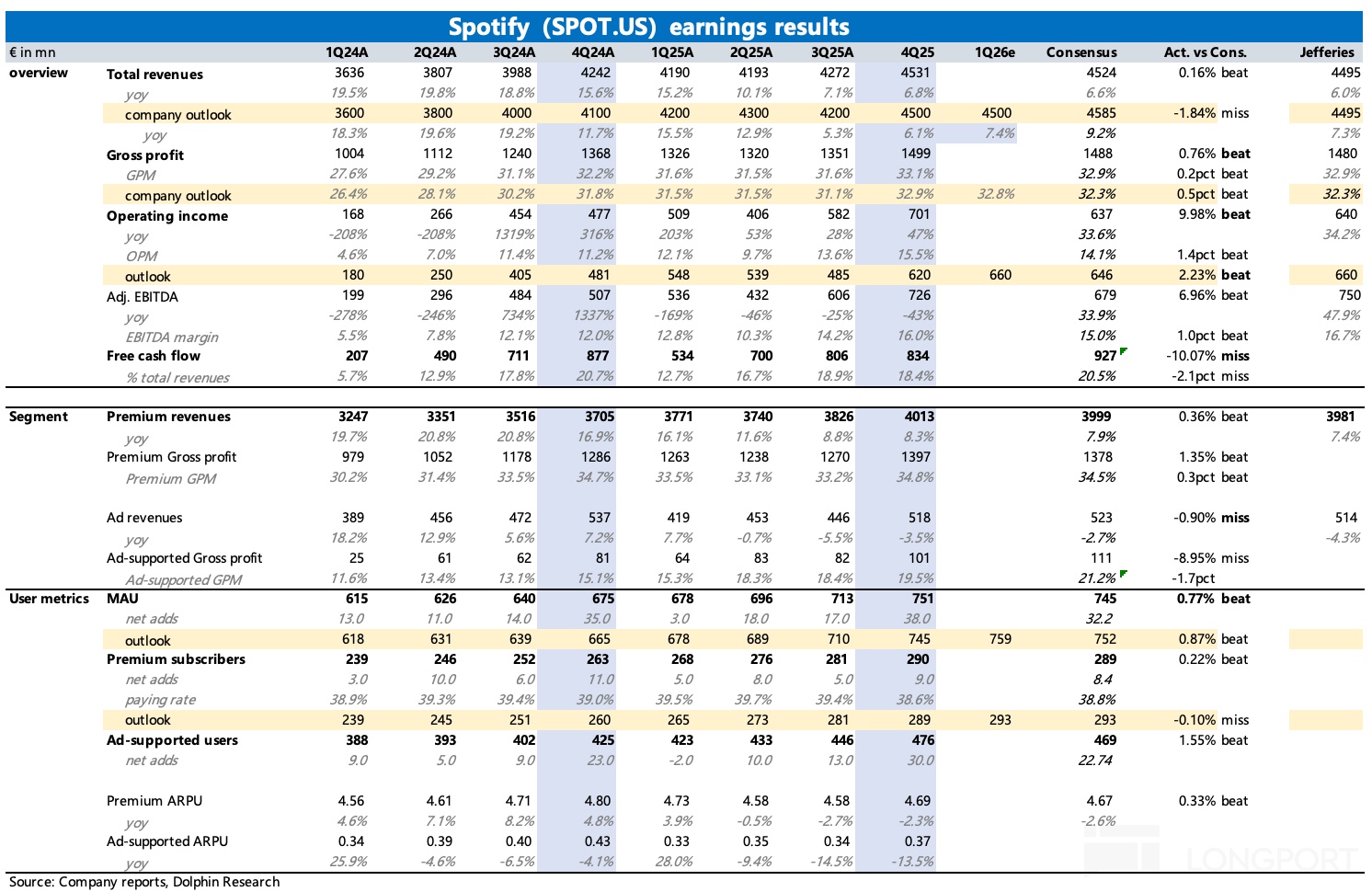
I. Key Financials Recap
1) User metrics (Q4 and latest guide):
Q4 MAU net adds hit a quarterly record high, taking total MAUs past 750 mn.
Q1 MAUs are guided to 759 mn, with Premium subs at 293 mn.
2) Q1 (2026) outlook:
- Total revenue: ~EUR 4.5 bn (+~15% YoY).
- ARPU growth: 5%-6%.
- GPM: 32.8%.
- OP: ~EUR 660 mn.
3) Outlook:
2026 is the year of ambition, with ambition as the engine of success and the guiding principle for a new chapter.
Growth confidence: Management is confident across users, revenue, GPM, OP, and FCF. Global penetration remains low (subs ~3.5% of world population), leaving substantial runway, with a long-term target of 10% or even 15%.
2026 expectations:
- MAUs and subs to grow healthily with stable low churn.
- Further progress on revenue growth and margin expansion.
- Both GPM and OPM to improve in 2026, with pricing driving revenue growth ahead of net content cost increases.
- FCF to materially exceed 2025.
- More details to come at the Investor Day in May.
4) Other key datapoints:
- Over $11 bn paid to music rights holders in 2025, a global record, taking cumulative payouts since inception close to $70 bn.
- AI DJ has attracted ~90 mn Premium users, contributing 4+ bn hours of listening.
- Video podcast consumption rose over 90% since SPP launch, with 530k+ video podcast shows live.
II. Call Details
2.1 Executive remarks
1) Strategy:
(1) Focus on the intersection: The core strategy stays centered at the convergence of consumers and creators, addressing pain points on both sides and building a virtuous ecosystem of artists, listeners, creators, authors, and advertisers.
(2) Tech-first identity: Spotify is a tech company first and the R&D engine of the music industry, with ongoing investment in AI and next-gen interfaces.
(3) Long-termism: Success is measured by long-term value creation, not quarterly prints. To scale, we historically chose growth over profit, with key bets (AI M&A, 'play everywhere' ubiquity) made for the long run and with an open, not closed, ecosystem.
2) Operations and progress:
Users and growth: MAU growth is the flywheel starter for the entire biz, boosted by packaged offerings and annual campaigns (300 mn+ participants, +20% YoY), which helped set a single-day record for new subs.
3) Content ecosystem:
- Music: Continues to drive commercial growth for the creative industry, with record payouts to rights holders.
- Podcasts: Rapid video podcast growth, with cultural impact underscored by winning a Golden Globe Best Podcast award with a show.
- Audiobooks: Expanding paid titles to more markets with strong support from top global publishers, bringing in new listeners and growth.
4) Product and tech innovation:
(1) AI: Spotify is seen as a key AI beneficiary. As early as 2022 we acquired an AI voice platform to build intelligent interactions, with AI DJ as a showcase and new prompt-based 'Smart Playlists' enabling deeper personalization.
(2) Direction of travel: Building the world's most intelligent, agentic media platform, shifting from passive experiences to interactive ones. For example, the new remixing tool has reached the 50 mn remix playlist milestone.
(3) Engineering velocity: With advanced internal systems like Honk, engineers use AI assistants to fix bugs or deploy features quickly, sustaining a high-velocity shipping and innovation cadence.
3) Views on AI and the music industry:
(1) Two AI use cases: AI-native music and AI covers/remixes of existing music. The former will flood the world with new content, helping Spotify attract users and deepen engagement, while the latter remains constrained by incomplete copyright frameworks.
(2) Platform role and opportunity: Regardless of how music is created, Spotify remains the end-point for cultural distribution and the largest monetization platform. The company is willing to partner across the industry to unlock monetization of existing works via AI, leveraging current tech and platform advantages for mutual benefit.
2.2 Q&A
Q: The market is focused on AI and its impact on biz models. How will Spotify apply AI tools and apps to new and evolving products and services, and could that spawn new service tiers?
A: Macro shifts create the biggest opportunities. Spotify was born in the era of cheap broadband and then rode waves such as smartphones, personalization, and smart homes to accelerate growth.
The key is to ride the change. In AI, we have structural advantages.
First, our monetization model (subscriptions plus ads) already matches leading AI companies and will remain the model in consumer.
Second, we have invested for years and are leading in natural language interfaces for media, aiming for a truly intelligent, conversational, agentic media service via AI DJ and prompt-based playlists.
We are building a unique dataset mapping language to music, podcasts, and books. Taste is not fact but opinion, so there is no single right answer.
Understanding concepts like 'work music' requires hundreds of millions of global listeners to continuously tell us what it means for each person. That is the distinctive dataset we are building at unprecedented scale, which keeps improving with retraining.
Q: What drives GPM expansion in 2026, and how has that changed vs. recent years?
A: We are confident in reaching our long-term GPM target in a steady and sustainable way. Margin management balances several levers.
Disciplined monetization, reinvestment of COGS with rigor, and innovation that enhances platform differentiation are all key, and our track record is solid. In 2026, revenue uplift from price increases already implemented will outpace net content cost growth.
At the same time, ads are improving and should accelerate in H2 2026, and Marketplace contributed to GP and GPM in 2025 and remains an effective tool.
Lastly, expanding new verticals in existing countries and entering new markets will also support margin progression.
Q: You have been rebuilding the ad-tech stack for two years. Progress update, biggest gains, and remaining work? Should we expect a step-up in ad growth later this year?
A: Roughly 18 months ago, we chose to rebuild Spotify's ad-tech stack in-house and move away from rented tech, primarily to better serve clients and meet the benchmark for high-performance self-serve and auction platforms. It was a tough call then and implied near-term pain.
Today, we are pleased to see a record number of advertisers on the platform. Higher density improves yield and revenue growth. We are positive on ads; there is more to do, but progress and early signals are very encouraging.
Q: With a very strong balance sheet, any update on capital returns?
A: Yes. With robust cash flow and a strong balance sheet, it is relevant to ask. Our first priority is reinvestment in the biz to lift growth and compound the flywheel; that is our daily focus. Where there is room to return capital, we will do so.
In 2025, we repurchased EUR 510 mn of stock, and buybacks remain an option, especially to offset dilution. We also have EUR 1.5 bn+ of converts maturing in Mar this year, which we will settle in cash.
Q: Thoughts on the AI opportunity: 1) its role in product and platform evolution; 2) how it transforms internal processes; 3) implications for broader audio creation and distribution.
A: On product and platform: last year we spent significant time refactoring Spotify for the intelligent era.
Questions that once required a senior Spotify developer to answer, like what a first-time user is likely to listen to, can now be asked in plain English by any user.
We began this work ~two years ago and are now shipping products on top of it, with the goal of being the world's first truly intelligent media platform. More details at Investor Day.
On internal process: we briefly mentioned an internal tool called Honk. On your commute, you can use Claude to add features or fix bugs in the iOS codebase, get a QR build pushed back to try the app instantly, and even merge to prod before you get out of the car if satisfied. That meaningfully accelerates development.
This is the beginning, not the end, of AI's impact. We are retooling the company for this era, and while it brings change, as noted, change is the opportunity.
Q: What share of Spotify content is AI-generated today, and how much is uploaded daily? What is your policy on AI music uploads?
A: We do not disclose the percentage of AI-generated music. From a creation standpoint, Spotify should not dictate what tools creators can use, whether an electric guitar or AI, but we believe users want to know how music was made. Hence we are working with the industry to allow creators and labels to tag creation methods in metadata on upload, so users can see it.
AI can amplify spam uploads, but spam is not new; it is a scale issue, and we are investing more than most peers to curb it.
Overall, more creation and uploads are positive for Spotify, because the larger the catalog, the more critical personalization becomes. We have adapted from tens of millions of tracks to hundreds of millions today.
Q: Will Spotify compete head-on in AI? Some worry Udio, Suno AI, and Stability AI could both enable creation and become DSPs, taking share, while Spotify appears more cautious. Thoughts?
A: The industry is broadly optimistic about the future, and AI is a pivotal moment for all of us. Spotify offers a scaled platform with a viable biz model for rights holders and artists to distribute and monetize their work. Whatever tech or tool is used to create, this is where new tracks are launched.
We engage widely across the industry, and we see no opposition from rights holders to our vision. As noted, we will proceed in a controlled, artist- and community-respectful way and will not sign deals that are bad for artists or Spotify.
Q: Please elaborate on Spotify's role in AI music. Do you need to invest in creation tools, and how will you help human creators build audiences and income?
A: A larger catalog and more interactivity benefit users and the industry. AI materially increases the value of our platform.
AI enables better personalization, which drives higher engagement, which lowers churn, which lifts LTV, ultimately enhancing enterprise value. As a tech company, we already have the needed tech and capabilities and are partnering with the industry to realize these opportunities.
Q: After the latest U.S. price hike, how do you view price-value vs. peers and expected churn relative to prior hikes?
A: We are pleased with the Jan price increase in the U.S. It was fully in line with expectations, with very low churn.
The $1 step-up mirrors the U.S. increase in Jun 2024. Pricing is one of our growth levers, and we act from a position of strength.
We assess pricing market by market to optimize long-term platform value, not a one-size-fits-all. Our goal is to always deliver more value than price, maintaining a favorable value-to-price ratio.
Q: What has changed at Spotify in the early days after Daniel stepped down as CEO?
A: In some ways, not much has changed, as we continue to gain share and lead. Structurally, there are changes: Alex and I now co-lead.
We chose not to split teams and instead operate as a single direct report group, with a weekly 3-hour e-team meeting.
We are more synchronized than under Daniel, with VP-level leaders making decisions and driving work together weekly. Our operating model has shifted toward tighter synchronization and planning.
In the AI era, planning matters even more because when productivity is at your fingertips, you need excellent plans to harness these agents efficiently.
The shift started over two years ago and has been carefully planned.
We now synchronize across the company with teams and their leaders, set goals, and land key deliverables. We manage outcomes for the company, P&L, and balance sheet with great discipline.
Over the last three years, revenue CAGR was 17% (FX-adj.), GP CAGR 20%, OPM improved 18 pts, FCF neared EUR 3 bn in 2025, and cash margin reached 17%. The team is proud of the journey, and we are well-positioned to invest and build Spotify's future.
Q: Why enter physical book sales?
A: First, we do not hold inventory in this biz. While it may look separate from a tech or financial lens, we focus on the consumer.
For consumers, a physical book, a Kindle e-book, and an audiobook are the same book. Feedback shows they want options, such as reading at night or in the morning, and may not want to listen in bed and risk missing content if they fall asleep.
That consumer need drives this service. We want it to be simple: if you find a book on Spotify but do not want only the audiobook, you can tap to buy the physical copy, get it delivered, and keep progress synced with the audiobook.
We are very bullish on audiobooks, with a long runway. We recently launched Premium audiobooks in Sweden, Denmark, Finland, Iceland, and Monaco; it is early but publishers are very positive about our entry and the audiences we attract and engage.
Our catalog has more than doubled in two years to 500k+ titles across 14 global markets, with more to come. We are solving a consumer problem others have not truly tackled.
We want Spotify to be your media companion, and if that means syncing progress across physical and Kindle e-books, we will solve it.
Q: Shares fell about one-third over the last three months, and the market seems to imply AI will hurt Spotify. What benefits from AI do you think the market underappreciates, and what are your top priorities to avoid falling behind?
A: AI is hard to grasp for many. We do not comment on short-term stock moves, but AI is compelling and will be impactful.
We have explained why this is a great opportunity for us and how we started years ago, not just now. Without early preparation, the future would be harder.
As noted, big shifts are opportunities, and we intend to seize them. We will invest, but with discipline and only when we see clear opportunities and returns.
Q: After announcing the new Free tier, when do you expect conversion headwinds to ease and for focus to shift back to driving conversion and subs? How does that affect 2026 MAU and Premium trajectories?
A: We just finished a very strong quarter for both MAUs and subs, so we feel encouraged about growth in 2026 on both metrics.
We are seeing broad-based engagement gains across the new enhanced retail front and the overall Spotify experience. That was a key driver behind adding 38 mn users in Q4.
It is like a leaky bucket: once you plug the leaks, the water level rises faster, and engagement is the most important leading indicator of growth, as it has been for the past 15-16 years. When engagement rises, user growth accelerates and ultimately lifts all of Spotify, including subs and other monetization.
Q: How is intelligent coding changing product velocity, and what does gen-AI mean for engineering productivity and R&D spend needs?
A: Over the Christmas period last year, AI productivity broke through, and our most senior engineers stopped hand-coding from Dec onward. They now generate and supervise code, which is a real and fast change. We prepared for at least 18 months and built systems like Honk, so we are well positioned, but this is only the beginning.
Engineering, product, and design practices will all change, and we are in the middle of it, so we must stay agile.
What we build today may soon be obsolete, but as the cost of generating correct code collapses, we should still push ahead. Software companies will produce vast amounts of software.
As with the early internet, when friction falls, things tend to aggregate rather than fragment. That is the opportunity ahead: companies like ours will ship huge volumes of software until consumer capacity for change becomes the constraint.
Q: With paid ARPU set to accelerate through much of 2026, how should we think about Premium and overall margin expansion? Your Q1 GPM guide suggests better-than-usual seasonal improvement. Should we expect stronger GPM expansion in 2026 vs. 2025?
A: We do not guide full-year GPM. You are right that we enter Q1 with 5%-6% ARPU growth, faster than Q4, and it includes recently announced price hikes in markets like the U.S., which will flow through part of this quarter and provide some uplift.
That said, when we see opportunities to create long-term value, we will invest, so quarterly GPM progression may fluctuate with core performance and the timing of disciplined monetization investments. We continue to expect both GPM and OPM to improve in 2026.
Q: You announced in Oct a collaboration with major labels to build artist-first AI products. Amid all the talk of competition and disruption, how will you differentiate, and is there urgency to launch?
A: We avoid blue-sky talk. We split AI music into two buckets: net-new and derivative works. For net-new, many companies let you create with AI, but Spotify is where music breaks and monetizes, the cultural center, and a growing catalog is always a tailwind for us.
For derivative works, we see an untapped opportunity for artists to monetize existing IP. We have the tech and capabilities and are excited to pursue it.
We are ready to partner with those eager to seize it. First movers will benefit most. We are hungry and excited but not under pressure; we are prepared for partners who want to make money.
Risk disclosure and statement:Dolphin Research Disclaimer and General Disclosure
