



Will Pop Mart become China's Lego?

Imagine a scenario: a friend you haven't seen for a long time invites you to their home for a get-together tonight. Time is a bit tight, and you want to bring a small gift for your friend's child. What would you bring? How many people are like me? Before Pop Mart appeared, I might have used Lego as a fallback option. If I couldn't decide what to buy, I'd just buy Lego.
People who talk about the 'Pop Mart bubble theory' often say a plastic doll is sold for so much money, and the bubble will burst sooner or later. Pop Mart's gross margin is indeed very high, but what about Lego? It's also not low (maintained around 70% in the past few years).
It must be said that Lego's business model is truly powerful. Toy attribute + social attribute + emotional attribute + collection attribute + educational attribute. Once a culture is formed, even though it's just a plastic piece, it has a strong moat.
But I don't know when it started, the small gift for visiting a friend's house quietly changed from Lego to Pop Mart. Moreover, it's a gift 'suitable for all ages,' liked not only by children but also adults (of course, many adults also like Lego, but giving adults Lego is still a bit niche). Furthermore, a two or three hundred yuan Lego set feels a bit too cheap to give, but a one or two hundred yuan Pop Mart item can be placed on the table with confidence. Comparing the above attributes of Lego, except for the educational attribute where Pop Mart currently falls short of Lego, the other four attributes are already fully possessed by Pop Mart. Moreover, the emotional value brought by opening blind boxes is truly a joyful thing, reminiscent of the happiness of collecting Water Margin cards in childhood.
Some might say blind boxes are everywhere now. Indeed, I remember once passing through Hong Kong Airport, and in any toy store, the first thing that caught the eye was rows of blind boxes, with all kinds of varieties. I think this is good for Pop Mart. With the popularity of blind box culture, the one at the top benefits the most. An imperfect analogy is similar to how Deepseek lowered computing power costs, stimulating demand which would make NVIDIA sell even better.
Of course, whether it can ultimately form a long-term culture is Pop Mart's core challenge. Actually, from the perspective of national will or ethnic expectations, we also hope to have products representing Chinese culture go global. Otherwise, the 15 billion box office of Nezha 2 cannot be explained. Even if the entire 15 billion box office is domestic, the international attention it generates would not be low.
Believe that Pop Mart has the strength to represent China on the global stage. Bullish on Pop Mart definitely becoming China's Lego.
Below is some collation by Qianwen regarding the comparison between Pop Mart and Lego, for reference.
Although both Pop Mart and Lego are globally renowned toy brands, they represent two different business models and development paths: Pop Mart is an IP-driven trendy toy blind box platform, while Lego is a global toy empire centered on brick building. They differ fundamentally in IP operation, product form, and channel strategy, but both have demonstrated strong brand value and growth potential.
I. Core Similarities
Outstanding IP Operation Capability
Both build strong brand barriers through IPs. Pop Mart incubates IPs through internal design and external licensing (e.g., Molly, The Monsters series), while Lego drives with a dual engine of 'licensed IP + owned IP' (e.g., Star Wars, Harry Potter, and Lego Ninjago). Both have loyal fan bases and strong community effects, forming unique brand cultures.
Global Strategic Layout
Pop Mart has already expanded its business to over 30 countries, with overseas revenue accounting for 38.9% in 2024. Lego's overseas sales exceed 60%. Both focus on opening flagship stores at cultural landmarks (e.g., Pop Mart at the Louvre in Paris, Lego at 12 theme parks worldwide) to build a global brand image.
High Gross Margin Feature
Pop Mart's gross margin was 57.5% in 2022, while Lego's was 68.8% in the same period, far higher than retail brands like Miniso. This reflects their pricing power and brand value in their respective segments. Pop Mart is essentially 'in the business of IP,' while Lego has turned the bricks themselves into an IP carrier.
II. Key Differences
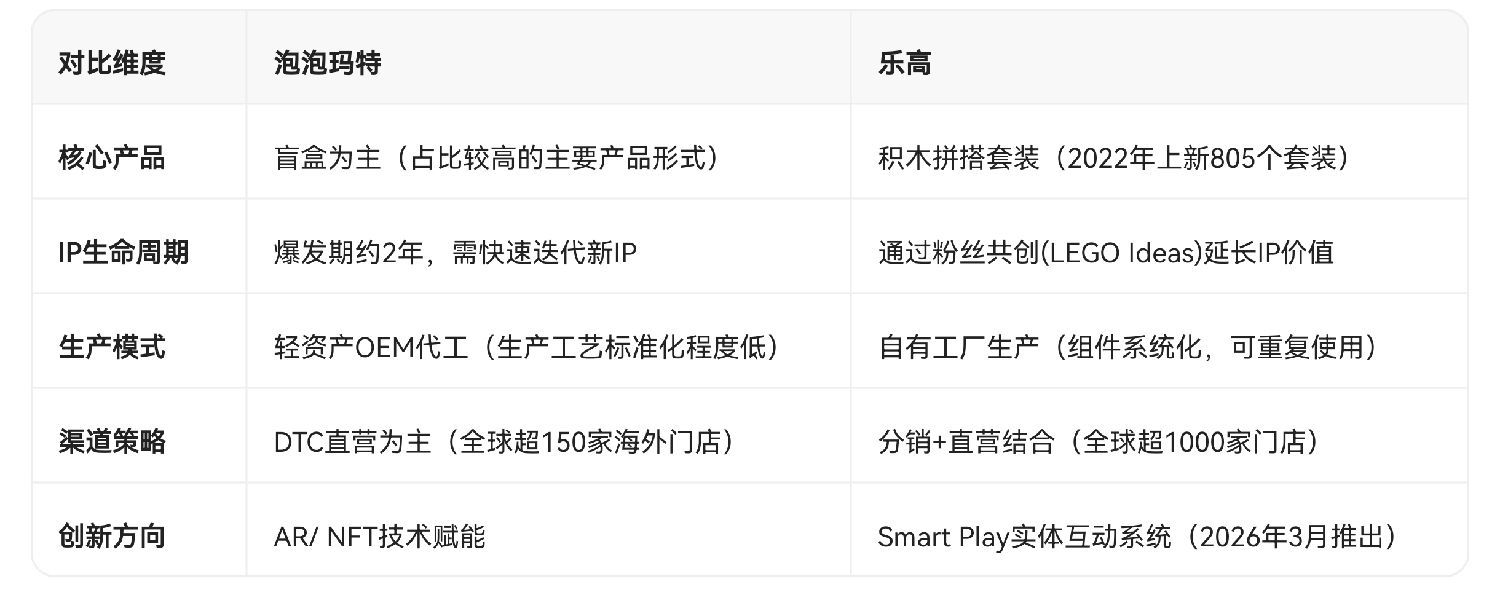
III. Investment Perspective Analysis
Pop Mart: High Growth and IP Matrix Potential
Pop Mart's 2024 revenue is estimated at 12.45 billion yuan (+97.6%), with net profit of 2.88 billion yuan (+263%). HSBC forecasts a revenue CAGR of 30% for 2024-2026. Investment value is mainly reflected in:
- IP Matrix Diversification: After the Labubu series exploded, new IPs like Xingxingren and Crybaby are rising rapidly, reducing single IP dependency risk.
- Globalization Acceleration: Overseas revenue in Q1 2025 grew 475%-480% YoY, with the US market growing 895%-900%.
- Valuation Flexibility: Current PE (TTM) is relatively high, but compared to global IP companies like Sanrio and Bandai Namco, its PEG (2025-2027) is 1.04x, considered to still have room for improvement.
Investment Risks: Limited IP lifecycle, requiring continuous validation of new IP incubation capabilities; overseas expansion faces cultural differences and competitive pressure.
Lego: Steady Growth and Sustainable Innovation
Lego's H1 2025 revenue was 34.6 billion Danish kroner (+12%), with net profit of 6.5 billion Danish kroner (+10%). Its investment value lies in:
- Mature IP Ecosystem: Possesses 22 licensed IPs and 19 owned theme series, forming a complementary structure.
- Production and Supply Chain Advantages: Owns multiple factories globally, with new factories under construction to ensure supply chain stability and sustainability.
- Innovative Product Portfolio: Launched 314 new products in H1 2025, a record high.
Investment Risks: Traditional toys face impact from digital entertainment; raw material cost fluctuations affect profit margins.
IV. Investor Tips
Track Key Metrics: For Pop Mart, focus on overseas revenue share, new IP sales share (e.g., new IP share in the Indonesian market already exceeds 50%); for Lego, focus on the number of new product sets and the proportion of sustainable materials used (target: 60% of sourced materials from sustainable sources by 2025).
Understand Valuation Logic Differences: Pop Mart suits a high-growth valuation model (PEG), while Lego is more suitable for a stable cash flow discount model. Avoid simple PE comparisons.
Focus on IP Lifecycle Management: Pop Mart needs to prove it can continuously incubate new IPs, while Lego needs to demonstrate the ability to refresh classic IPs. This is the core of their long-term value.
Beware of Market Expectation Gaps: Pop Mart's 'single IP hot cycle' is a common industry phenomenon. The market is shifting from focusing on single hits to evaluating the overall vitality and commercialization potential of its IP matrix.
In summary, Pop Mart represents a high-growth, high-volatility IP operation model, while Lego embodies a steady, sustainable global toy empire path. Investors should choose their allocation based on risk appetite and investment horizon.
$POP MART(09992.HK)
The copyright of this article belongs to the original author/organization.
The views expressed herein are solely those of the author and do not reflect the stance of the platform. The content is intended for investment reference purposes only and shall not be considered as investment advice. Please contact us if you have any questions or suggestions regarding the content services provided by the platform.
