


 Amazon
 Feed Explorer
The 48 Founders of Modern Civilization Systems: The Five-Hundred-Year Formation of the State, Rule of Law, and Market

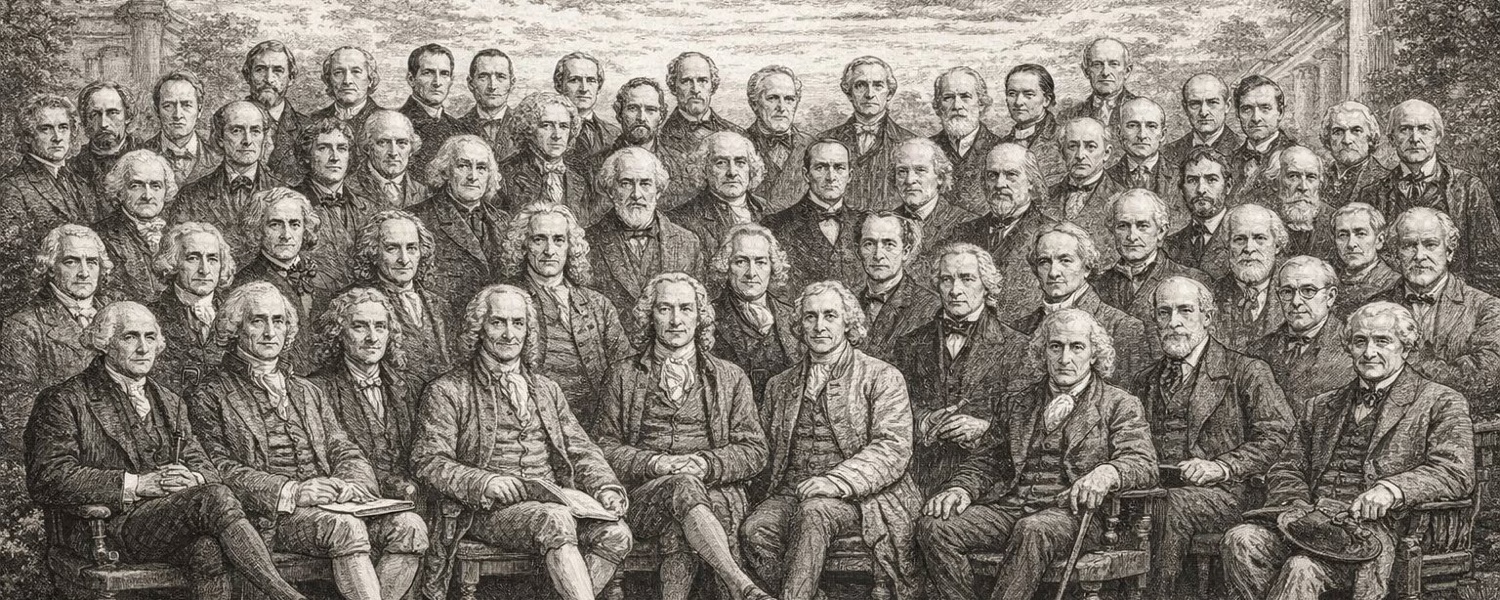
Modern civilization is not the product of any single ideology or nation, but rather an institutional structure gradually formed over the past five hundred years. This structure includes sovereign states, constitutional democracy, the rule of law, market economy, public education systems, and normative theories of justice and rights. The stability and sustainable development of modern society do not rely on a single idea, but on the long-established balance between different institutions.
The formation of these institutions is a process in which a series of thinkers continuously responded to the same question: How should society be organized after humanity no longer relies on theocracy and traditional hierarchical orders?
I. The Birth of the State: Politics from Theology to Institutions
The starting point of modern politics is commonly considered to be **Niccolò Machiavelli (1469–1527)**. He was the first to understand politics as a practical field independent of religious morality, making the state an object that could be analyzed and designed. **Jean Bodin (1530–1596)** subsequently introduced the concept of sovereignty, establishing the theoretical foundation for the state as the highest political authority.
**Thomas Hobbes (1588–1679)** further explained the necessity of the state. In his view, the state originates from a contract formed by humans to escape a state of disorder. **John Locke (1632–1704)** revised this theory, proposing the principles of natural rights and limited government, making political power subject to popular authorization.
**Montesquieu (1689–1755) addressed the abuse of power through the theory of separation of powers, while Voltaire (1694–1778)** shaped the spirit of tolerance and freedom of speech in modern political culture. **Jean-Jacques Rousseau (1712–1778)** proposed popular sovereignty, basing political legitimacy on the collective will.
These ideas were put into practice by Thomas Jefferson (1743–1826), **James Madison (1751–1836), and Thomas Paine (1737–1809)**. The American constitutional experiment transformed natural rights, federalism, and checks and balances into institutional forms. Subsequently, **Alexis de Tocqueville (1805–1859)** observed democratic societies and pointed out that democracy is not only a political system but also a social structure. **John Stuart Mill (1806–1873)** further combined individual liberty with democratic institutions, making liberalism one of the core traditions of modern politics.
II. The Rule-of-Law State: Power Subject to Law
The fundamental distinction between a modern state and a traditional state lies in whether the law is above the ruler.
**Edward Coke (1552–1634)** proposed within the English common law tradition that the king is also bound by the law, laying the foundation for the principle of the rule of law. Locke's theory of limited government made law a prerequisite for political power.
**Immanuel Kant (1724–1804)** elevated the rule of law to a principle of moral and political philosophy, proposing the possibility of a republican system and an international legal order. **Jeremy Bentham (1748–1832)** promoted the rationalization and utilitarian evaluation of law, moving it away from tradition. **A. V. Dicey (1835–1922)** ultimately systematized the principle of the rule of law, making it a core standard for modern constitutional states.
At the same time, **Alexander Hamilton (1755–1804)** established the administrative and financial foundation of the modern state through the design of fiscal and credit systems, enabling constitutional states to operate sustainably.
III. The Formation of Market Society: The Evolution of Economic Institutions
Another pillar of modern civilization is the market economy.
**Adam Smith (1723–1790)** explained how individual exchange forms social order through market mechanisms, while **David Ricardo (1772–1823)** explained the principle of comparative advantage in international trade. **John Stuart Mill (1806–1873)** combined economic freedom with individual liberty, bringing economic thought to a mature stage.
After the 20th-century economic crisis, John Maynard Keynes (1883–1946) proposed the theory of state macroeconomic regulation, providing a theoretical basis for the welfare state. In dialogue with him was Friedrich Hayek (1899–1992), who emphasized the importance of the market as a mechanism for coordinating knowledge. **Joseph Schumpeter (1883–1950)** pointed out that innovation and entrepreneurship are the driving forces behind the continuous development of capitalism.
Subsequently, **Milton Friedman (1912–2006)** promoted monetarist policies, **Ronald Coase (1910–2013)** proposed the transaction cost theory, **Douglass North (1920–2015) incorporated institutions into economic analysis, and Elinor Ostrom (1933–2012)** demonstrated that common-pool resources can be effectively governed through self-governing institutions. **Karl Polanyi (1886–1964)**, from a reflective perspective, pointed out that market society itself requires the constraints of social institutions.
IV. Understanding Modern Society: Sociology and Institutional Reflection
With the formation of industrialized society, humans began to systematically understand society itself.
**Auguste Comte (1798–1857)** founded sociology and advocated for positivist research methods. **Émile Durkheim (1858–1917)** introduced the concept of social facts, emphasizing the shaping effect of social structure on individual behavior. **Max Weber (1864–1920)** analyzed rationalization and bureaucracy, revealing the tension between efficiency and freedom in modern society. **Herbert Spencer (1820–1903)**'s theory of social evolution, though controversial, profoundly influenced early social theory.
Institutional reflection in the 20th century unfolded in different directions. **Hannah Arendt (1906–1975)** analyzed how totalitarianism destroys the public sphere, while **Michel Foucault (1926–1984)** revealed how power permeates social life through knowledge and institutions. **Karl Popper (1902–1994)** proposed the "open society," emphasizing that institutions must allow for self-correction.
V. Educational Institutions: The Formation of the Modern Citizen
Modern institutions cannot be separated from universal education.
**John Amos Comenius (1592–1670)** proposed universal education and the classroom teaching system, **Horace Mann (1796–1859) promoted public education as a state responsibility, and John Dewey (1859–1952)** combined education with democratic life, making schools one of the foundational institutions of modern society.
VI. Justice and Rights: The Normative Foundation of Modern Institutions
As political and economic institutions gradually stabilized, modern thought began to focus on whether institutions were fair.
**Mary Wollstonecraft (1759–1797)** brought women's rights into modern political discourse. **John Rawls (1921–2002)** proposed the theory of justice as fairness, making institutional design consider the interests of the least advantaged. **Robert Nozick (1938–2002)** emphasized that individual rights cannot be violated for collective goals. **Amartya Sen (1933–) redefined development and freedom using the capability approach, while Michael Walzer (1935–)** proposed the theory of complex equality.
**Jürgen Habermas (1929–)** viewed public discourse as the source of legitimacy, **Robert Dahl (1915–2014)** analyzed the mechanisms of real-world democracies. **Francis Fukuyama (1952–) summarized the developmental stages of liberal democracy from a historical perspective. Earlier, David Hume (1711–1776)**, starting from custom and experience, explained that institutions often form through evolution rather than design.
The copyright of this article belongs to the original author/organization.
The views expressed herein are solely those of the author and do not reflect the stance of the platform. The content is intended for investment reference purposes only and shall not be considered as investment advice. Please contact us if you have any questions or suggestions regarding the content services provided by the platform.
