


Tianrun Cloud (02167.HK) Insight: What Does McKinsey's 25,000 AI Agents Reveal?

$TI CLOUD(02167.HK)
The way enterprises work is undergoing a structural shift: from relying on human labor to complete tasks, to AI taking on the primary production capacity.
Recently, McKinsey gave a clear signal: among its approximately 60,000 "employees," over 25,000 are already AI Agents, and it explicitly stated that in the future, every human employee will be equipped with an AI Agent to collaborate with.
This is not an upgrade of efficiency tools, but rather enterprises beginning to acknowledge: AI is becoming the new main labor force. In the field of customer contact, this trend has actually landed earlier and more thoroughly.
Customer contact itself is a standardized work form characterized by high frequency, repetition, and clear rules. As labor costs, turnover rates, and management complexity continue to rise, enterprises will inevitably delegate basic and routine tasks to AI—letting AI handle the basics and routine work, while humans focus on goals, judgment, and fallback.
Next, we will start from the customer contact scenario to dissect why this shift is irreversible and how it will reshape enterprise service organizations.
I. Why "AI Employees" Are an Inevitable Choice for Enterprises
When enterprises evaluate the value of AI, the criteria are actually very simple: whether it can stably undertake work and continuously produce results. Once the answer is yes, AI cannot remain merely a "tool."
Simply put, whoever does the work is considered an employee.
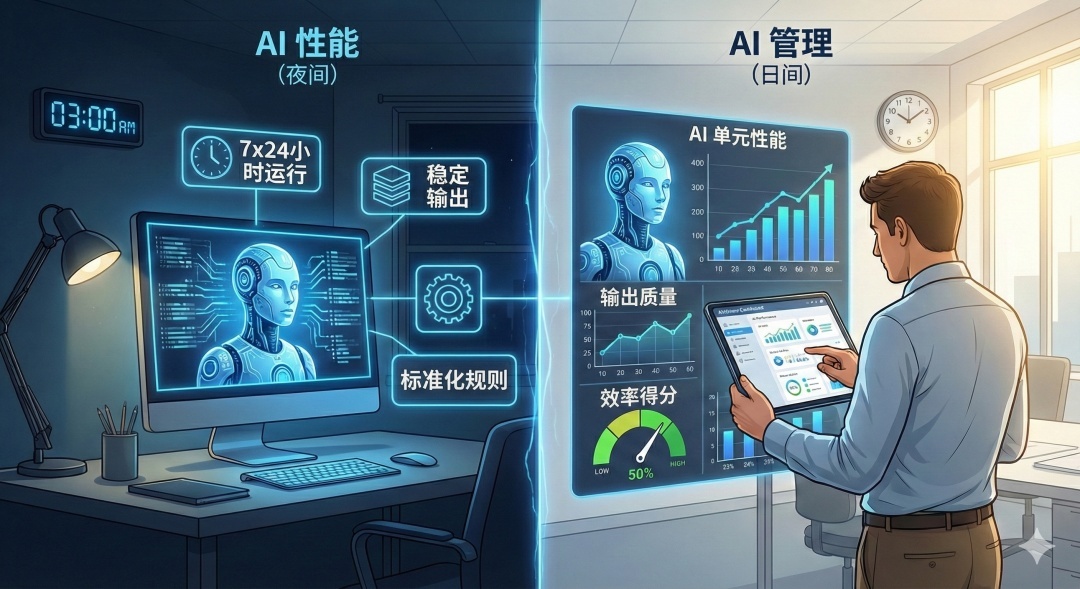
In reality, more and more AI already possess such capabilities: they can operate 24/7, reuse the same set of knowledge and rules, be uniformly quality-checked, traced back, and continuously optimized, and can directly interface with business systems to form a complete results loop.
From a management perspective, this means it has already become a manageable and assessable production unit.
And once production units no longer rely entirely on humans, the division of labor structure within enterprises will naturally change. This is not enterprises being "radical," but a rational choice made under pressure from scale and costs.
Therefore, McKinsey is not redefining "employees," but acknowledging a fact: as long as AI can work stably, it will inevitably be managed as an employee.
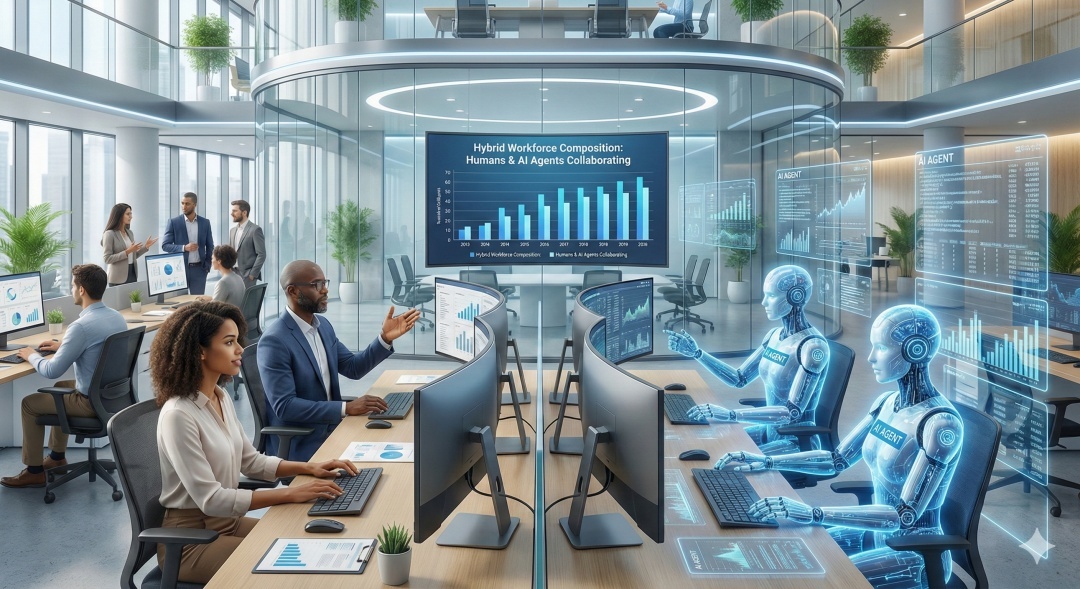
II. Why Customer Contact is the First Stop for AI's Large-Scale Implementation
The reason customer contact is the earliest to move towards "AI employees" is: it is itself a standardized, labor-intensive work system.
In the past, customer contact involved a large amount of work that was high-frequency, repetitive, and rule-based, requiring extremely high stability, yet long relied on scaling up human labor to support it. Once business grows, labor costs, management difficulty, and instability amplify simultaneously. This makes customer contact the most typical and also the most suitable labor form for AI to take over.
At the same time, the traditional human-based customer service model is nearing its efficiency limit.
High personnel turnover makes it difficult to accumulate experience, while training and management costs continue to rise; during traffic peaks, there aren't enough hands, and during troughs, there's significant idle capacity, leaving the organization with almost no elasticity. These problems are not due to "inadequate management," but rather because the organizational method that uses humans as the primary production capacity is itself no longer suited to the current business scale.
It is precisely against this backdrop that AI can now, in customer contact scenarios, stand directly on the front line, undertaking the main reception and processing work.
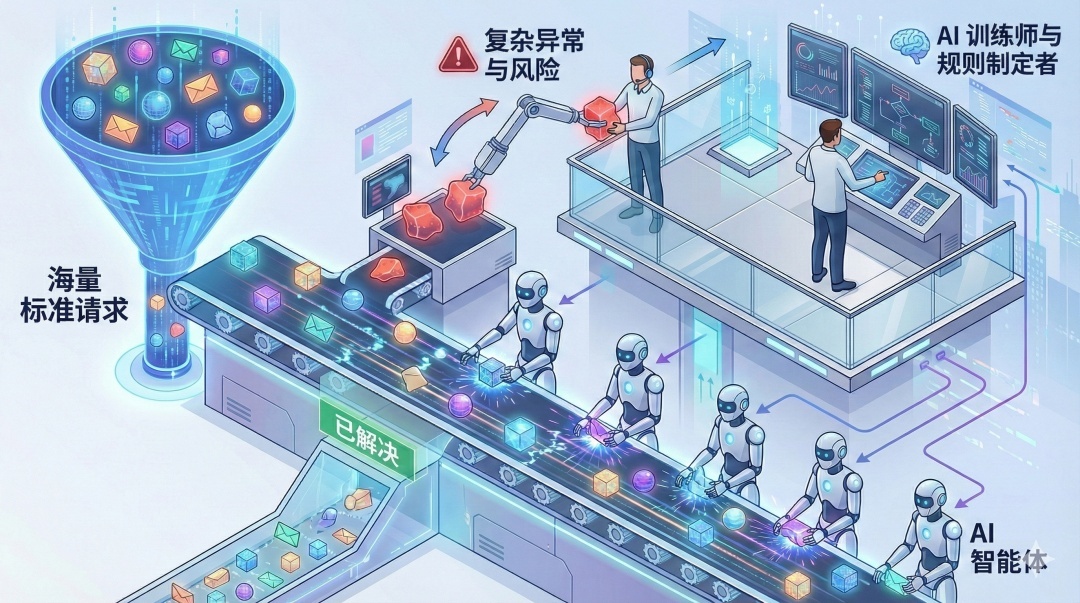
That's why AI becomes the primary producer in customer contact scenarios, while humans shift to setting goals, handling exceptions, and managing risks. And precisely because of this, customer contact is not a "testing ground" for trying out AI employees, but the inevitable scenario that has reached this stage the earliest.
III. Organizational Reshaping: From "Managing People" to "Managing AI"
When it comes to AI employees, many people are willing to understand them as "smarter robot customer service," but this is a misunderstanding.
A true AI employee is not simply about automated replies, but a digital workforce capable of handling real users, achieving business goals, and completing work within clear rules and boundaries. It can be uniformly managed, continuously trained, and constantly optimized, essentially being a scalable and replicable digital production line.
And precisely because of this, the focus of change is not on AI, but on the shift in the role of humans within the organization.
Under the AI employee system, AI is responsible for frontline reception, response, and execution; humans no longer repeatedly handle conversations, but instead shift to defining goals, breaking down scenarios, setting rules, handling exceptions, and deciding when human intervention is needed. The customer service role thus transforms from a "receptionist" into an AI trainer and AI operator.
When this division of labor is established, three changes occur simultaneously in the customer contact organization:
· Production capacity no longer relies on constantly adding people, but on scaling AI;
· The management focus shifts from "managing people" to "managing AI's effectiveness and boundaries";
· Value measurement also shifts from handling volume and online duration to business results, stability, and continuous optimization capability.
Therefore, AI employees are not an upgrade to the customer service system, but a key step in customer contact's transition from human-driven to AI-driven.
Overall, what McKinsey demonstrates is the direction of future enterprise organizational forms. AI employees are also not a conceptual slogan, but a rational choice made by enterprises under pressure from scale, efficiency, and stability.
For customer contact, the real watershed moment lies not in whether AI is introduced, but in whether the organizational switch from human-driven to AI-driven is completed.
$TI CLOUD(02167.HK)
The copyright of this article belongs to the original author/organization.
The views expressed herein are solely those of the author and do not reflect the stance of the platform. The content is intended for investment reference purposes only and shall not be considered as investment advice. Please contact us if you have any questions or suggestions regarding the content services provided by the platform.
