


Nomura: DRAM/NAND Wafer Capacity
Samsung Electronics> DRAM Capacity Growth: SEC’s DRAM capacity is projected to expand significantly from 655k wafers/month at the end of 2024 to 1,264k wafers/month by the end of 2030, driven by heavy capacity additions in phases like P4, P5, and P6. Year-over-year (y-y) growth peaks notably in 2030 at 22%.> NAND Capacity Trends: NAND capacity fluctuates in the near term (with dips in 2025 and 2027), but ramps up significantly toward the end of the decade, reaching 533k wafers/month by the end of 2030 with a 29% y-y growth.SK Hynix> DRAM Expansion: SK Hynix ramps up total DRAM capacity from 474k in 2024 to 1,183k wafers/month by end-2030. Major growth spurts are expected in 2028 (25% y-y growth) and 2030 (26% y-y growth), largely supported by new expansions in the Y1, Y2, and Y3 phases.> NAND Trajectory: After experiencing capacity contractions between 2025 and 2027, SK Hynix's NAND production surges sharply starting in 2028 (up 58% y-y) to hit 580k wafers/month by end-2030.Micron> DRAM Growth & Regional Split: Micron’s DRAM capacity grows steadily from 310k in 2024 to 690k wafers/month by end-2030. Expansion is anchored by both its Taiwan facilities (scaling from 195k to 430k) and its US/Japan operations.> NAND Stability: Micron’s NAND capacity remains stable at 130k wafers/month through 2026 before expanding via new fab lines (such as Fab 10 B and Fab 11) to reach 280k wafers/month by 2029–2030.$Micron Tech(MU.US) $DRAM $EWY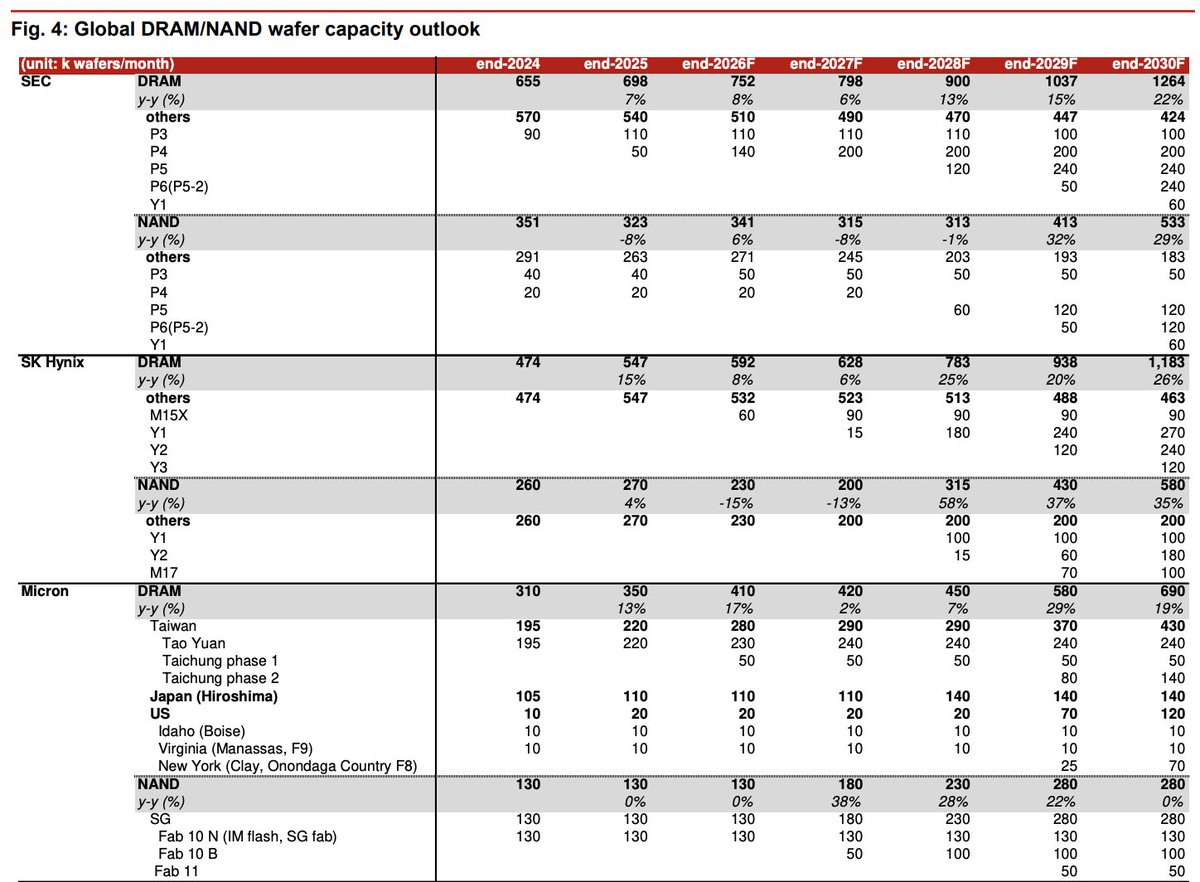
The copyright of this article belongs to the original author/organization.
The views expressed herein are solely those of the author and do not reflect the stance of the platform. The content is intended for investment reference purposes only and shall not be considered as investment advice. Please contact us if you have any questions or suggestions regarding the content services provided by the platform.
Post your comment

No Comments