


UBS: Fiber
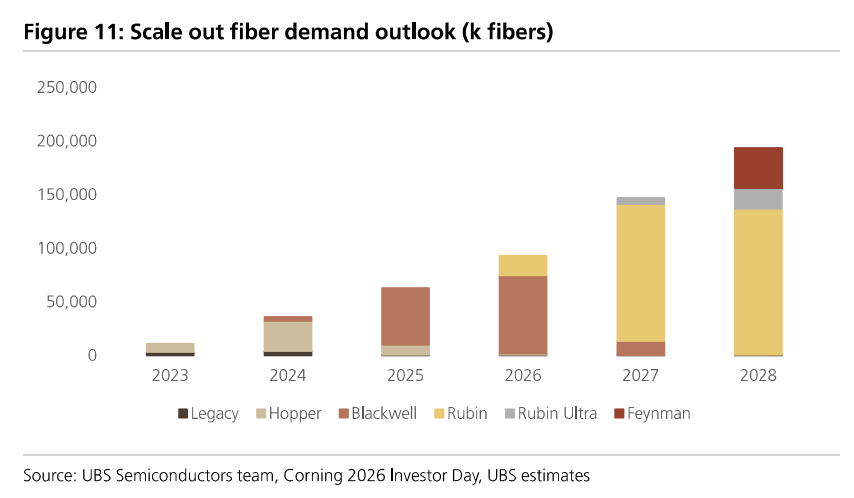
Fiber Connections by GPU Generation> Hopper & Blackwell: Both utilize a 100 Gb/s SerDes Bandwidth and require 2 fibers per lane. However, Blackwell doubles the GPU bandwidth (0.8 Tb/s) and lane count (8 lanes), resulting in 16 fibers per GPU compared to Hopper's 8 fibers.> Rubin & Feynman (2028): Both advance to a 200 Gb/s SerDes Bandwidth. Rubin maintains 8 lanes (16 fibers/GPU), while Feynman scales up to 16 lanes and 32 fibers per GPU with a 3.2 Tb/s GPU bandwidth.Scale-Out Fiber Demand Outlook> Growth Trajectory: Total scale-out fiber demand is projected to grow at a ~41% CAGR through 2028.> Driver Breakdown:Near-term growth (up to Rubin) is primarily driven by increased overall GPU production volumes while fiber content per GPU remains stable.A major step change occurs in 2028 with the rollout of Feynman, driving a significant surge in fiber-per-chip demand and scale-out growth as its production mix scales up.Scale-Up vs. Scale-Out Networks> Current Deployment Limits: In current AI architectures, fiber is restricted to scale-out networks (connecting racks across a cluster).> Copper Transition: Connections within a rack (GPU-to-GPU) currently rely on copper. However, as nodes expand beyond single racks, growing bandwidth and distance requirements will eventually drive the conversion of these copper links over to optical fiber.$Corning(GLW.US)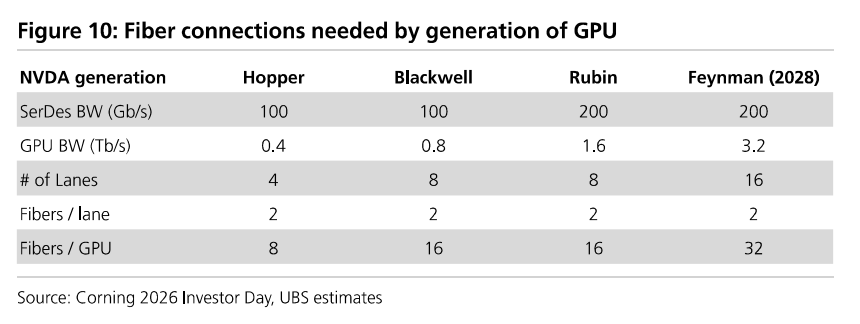
The copyright of this article belongs to the original author/organization.
The views expressed herein are solely those of the author and do not reflect the stance of the platform. The content is intended for investment reference purposes only and shall not be considered as investment advice. Please contact us if you have any questions or suggestions regarding the content services provided by the platform.
Post your comment

No Comments