


 NVIDIA Return Rate
 Go Beyond!
Puzzled by How Markets are Classified?
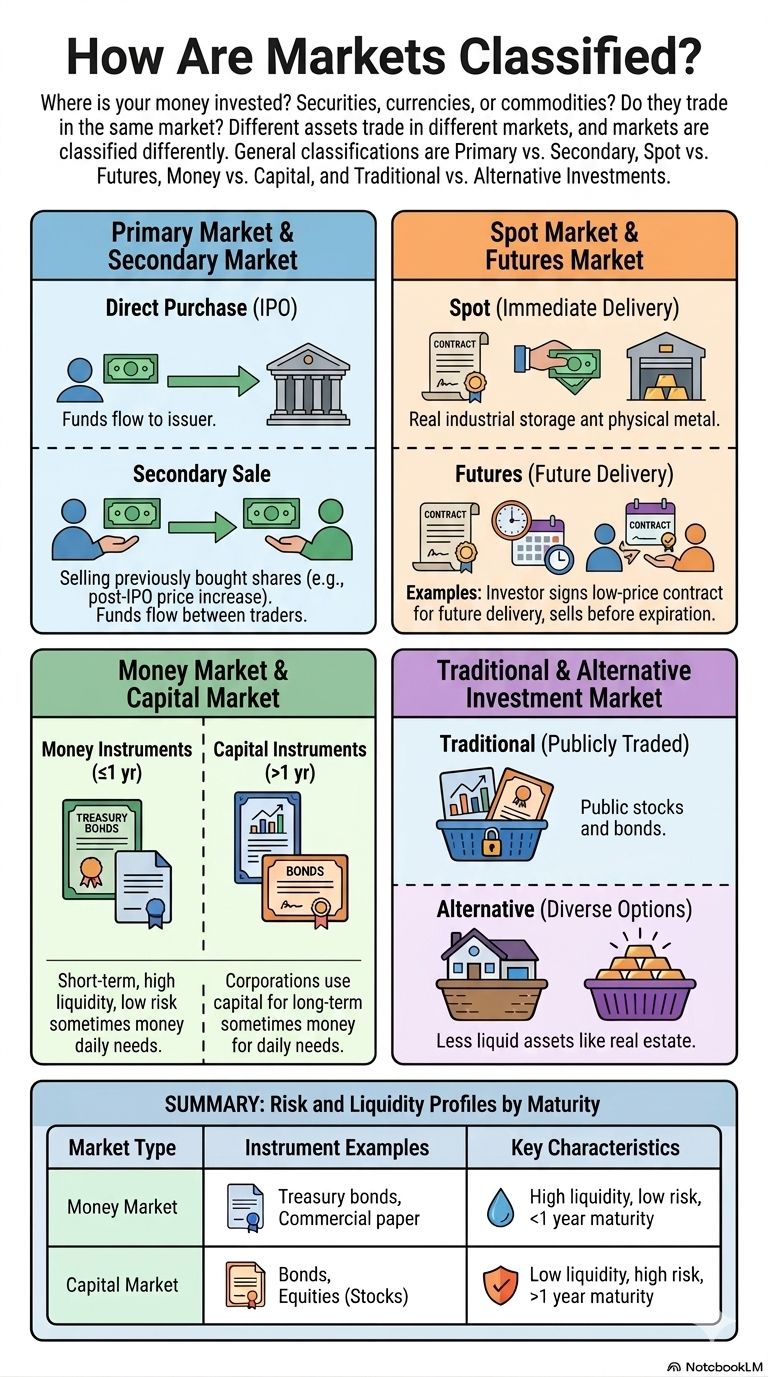
Global financial markets are categorized by:
1. Primary vs. Secondary Markets - Classification by fund flow.
* Primary: Companies sell new securities directly to investors to raise capital (e.g., via an IPO like $SpaceX(SPCX.US)). Funds flow from the buyer directly to the issuer.
* Secondary: Facilitates subsequent trading between investors. Funds flow exclusively between traders, providing essential liquidity.
2. Spot vs. Futures Markets - classified by the timing of delivery.
* Spot: Designed for immediate delivery. This suits participants needing immediate physical possession of an asset, like a processor buying industrial metals for production.
* Futures: Involve contracts for delivery on a specific future date. These are used by investors wanting to profit from price fluctuations w/o handling or storing physical goods.
3. Money vs. Capital Markets - Maturity, liquidity, and risk profiles determine which an asset belongs to.
* Money: Trade instruments maturing in less than one year, such as short-term treasury bonds, certificates of deposit, commercial paper & repurchase agreements. Trades feature high liquidity & low risk, serving short-term capital needs or temporary placement for idle funds.
* Capital: Involve medium-to-long-term assets (maturities over one year) like bonds & equities. They feature lower liquidity & higher risk, but offer favorable returns & finance long-term corporate development plans.
4. Traditional vs. Alternative Markets - divided by the conventionality of the asset class.
* Traditional: Cover standard, publicly traded assets including stocks, bonds, currencies, & futures.
* Alternative: Consists assets outside traditional categories, such as private equity (including venture capital), hedge funds, real estate, commodities, infrastructure & collectibles. They are typically less liquid, less market-correlated & frequently trade at a discount or premium.
The copyright of this article belongs to the original author/organization.
The views expressed herein are solely those of the author and do not reflect the stance of the platform. The content is intended for investment reference purposes only and shall not be considered as investment advice. Please contact us if you have any questions or suggestions regarding the content services provided by the platform.
