


How to Hedge Against Downside Risk in a Surging Market?
"If the probability of something happening is very small, the consequences when it does happen are inevitably catastrophic."
While this quote may seem out of place given the recent market rally, the point worth making is that cautionary words are most needed when euphoria is at its peak. Over the past two years, U.S. stocks have seen dramatic surges and plunges. While the exact turning point is hard to predict, the magnitude of the decline after each turning point has been remarkably consistent. As the market continues to climb, accumulated trading risk grows ever larger. It's difficult to predict when a downturn will come during an uptrend — but when it does, how can we hedge against the risk in advance?
Rather than losing sleep at all-time highs, it's better to take the initiative. Today, we'll introduce several options strategies for hedging downside risk.
Protective Put
This strategy involves buying a put option while holding the underlying stock. If the stock price drops, the loss on the stock position is offset by gains from the put, thereby hedging the downside.
Take the recent hot semiconductor sector as an example. Suppose an investor holds 100 shares of SOXL at $180. To hedge against a decline, they could buy a put with a strike price of $180. No matter how far the stock falls, the profit from the put would perfectly offset the loss on those 100 shares. However, buying this put comes at a cost — if we purchase a put expiring on May 15th, the latest market price is $835. That means we need to spend $835 to buy this put.
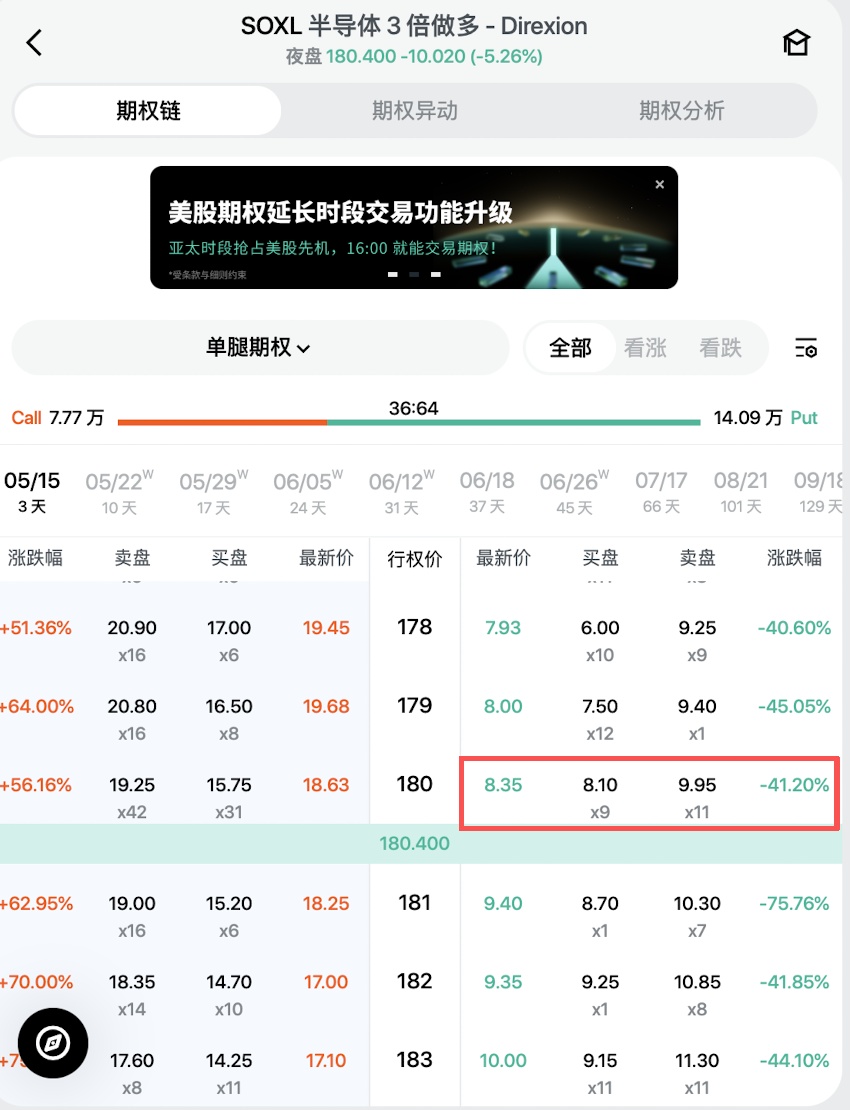
So the P&L curve for this combined position looks like this: when the stock price is below $180, the put provides downside protection — no matter how far it falls, our maximum loss is always capped at $835. But when the stock price rises, the gains from the stock increasingly offset the premium paid, so the profit curve slopes upward above $180.
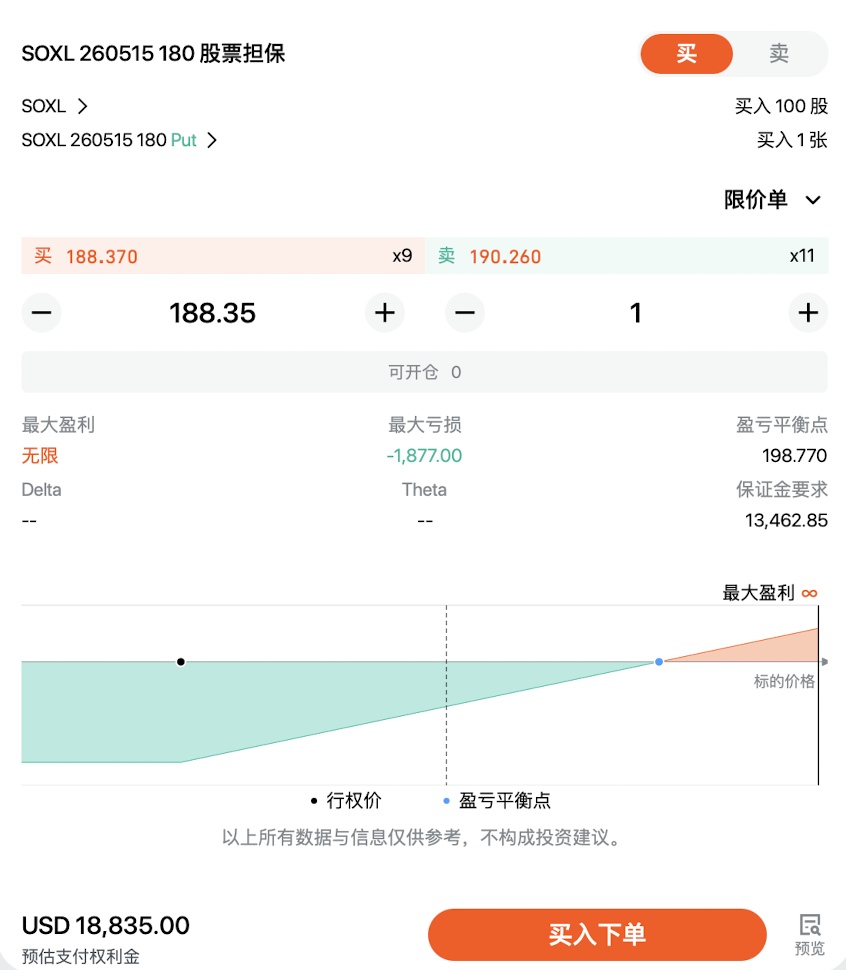
The biggest advantage of this strategy is that it's essentially buying insurance for your stock. The premium paid for the put is the insurance cost, and the maximum loss for the entire position is limited to the $835 premium.
However, many investors find this form of downside protection too expensive. If the current stock price is $180, the $835 premium means the stock needs to rise from $180 to $188.35 just to break even. In other words, buying one put against 100 shares of stock already creates a 6% sunk cost. Intuitively, that does feel expensive. So is there a way to reduce the hedging cost?
There is — we can use another ultra-low-cost hedging strategy: the Vertical Put Spread.
Vertical Put Spread
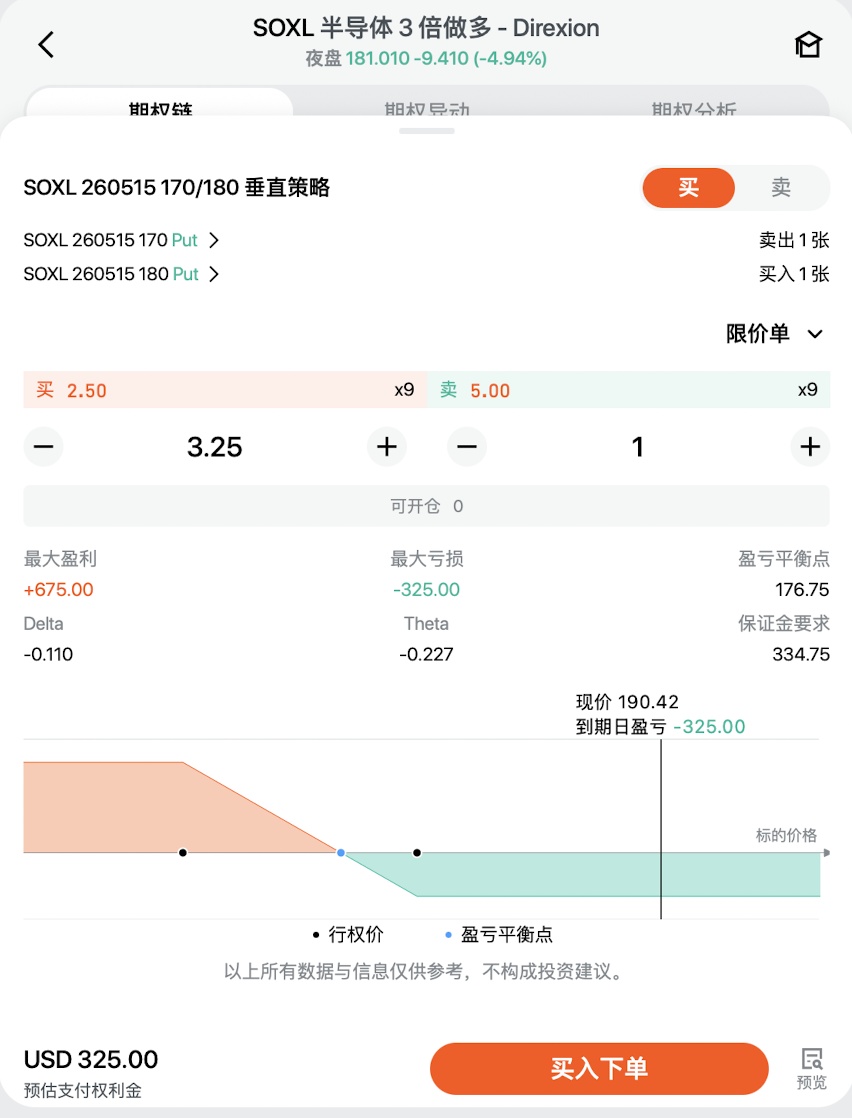
Using SOXL as the example again: while holding 100 shares, we buy a put with a $180 strike and simultaneously sell a put with a $170 strike. This reduces the net premium outlay to just $325. If the stock drops, as long as it doesn't fall below $170, this combination can still fully offset the downside loss. If the stock rises, we only need it to reach $183.25 to break even — far less than the cost of building a straight protective put at the $180 level.
Of course, compared to the first strategy, this one has limited hedging range. Once the stock falls below $170, the vertical spread can no longer provide further downside protection.
Going Long the VIX Fear Index
Long-term experience has shown that the correlation coefficient between the VIX index and U.S. stock market performance ranges from approximately −0.7 to −0.9. This negative correlation is especially strong when stock indices are crashing. The biggest advantage of using the VIX to hedge lies in the following:
This negative correlation is not constant. On roughly 20% of trading days, the VIX and stock indices actually move in the same direction. The negative correlation is typically strongest during the early stages of a market crash (panic pushes VIX higher), while it weakens during slow, steady bull markets. Furthermore, this correlation is asymmetric — the magnitude of VIX increases when stocks fall is far greater than the magnitude of VIX decreases when stocks rise.
So when constructing a hedging strategy, this strong negative correlation can be exploited. Moreover, because the relationship between the VIX and stock indices is not perfectly symmetrical across extreme and calm market conditions, this can largely prevent the VIX position from creating significant profit erosion on the overall portfolio if the stock market continues to rise.
In practice, the main products linked to the VIX index are VIX ETFs, such as UVIX (a 2x leveraged long VIX futures ETF).
Let's calculate how to use UVIX to hedge 100 shares of QQQ:
Using the same logic but with 2x leverage: QQQ drops 1% → VIX short-term futures rise approximately 3% → UVIX rises approximately 6% (2x leverage). 100 shares of QQQ ≈ $71,100 in holdings; a 1% drop means a $711 loss. UVIX rises 6% — at $5.45, that's roughly $0.33 per share. To offset the $711 loss, you'd need 711 ÷ 0.33 ≈ 2,150 shares of UVIX, approximately $11,700, or about 16.5% of the QQQ position value.
However, if using UVIX to hedge, we need to be aware that UVIX is fundamentally a futures-based ETF with 2x leverage, which means hedging with UVIX subjects you to both contango decay and volatility drag simultaneously.
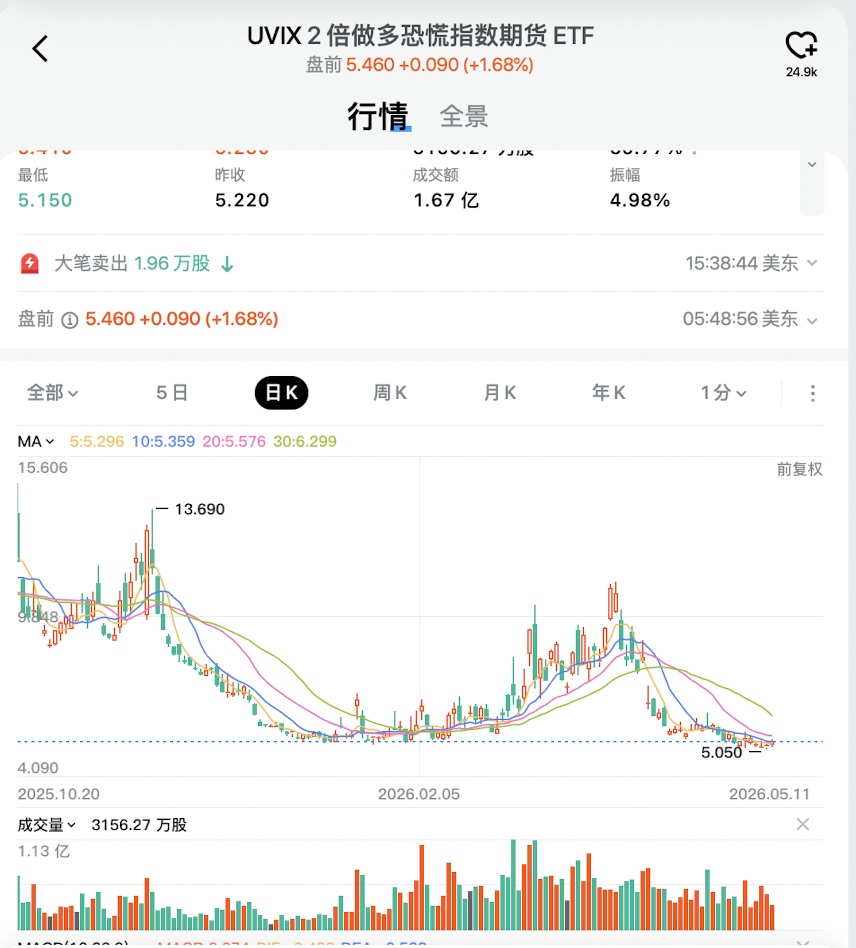
This becomes very intuitive when looking at the price chart — from last October to now, UVIX has ground down from nearly $13 to around $5, losing roughly half its value in just over six months. During that same period, the VIX index actually trended upward. This is purely structural decay eroding the principal.
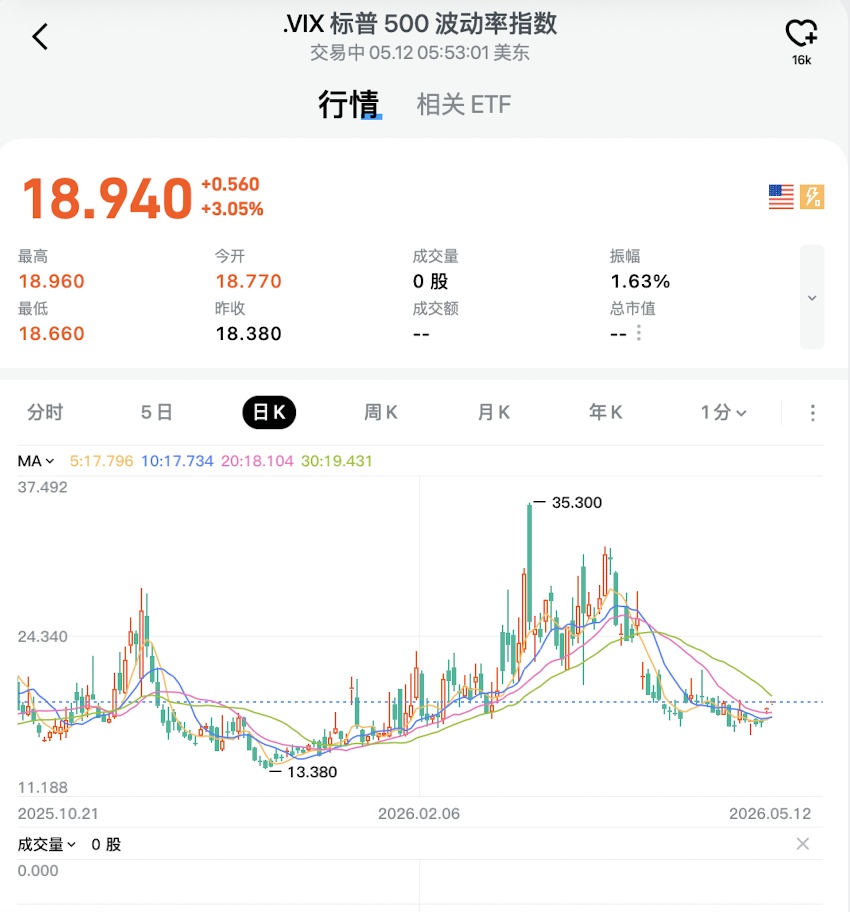
So the conclusion is: UVIX is suitable for short-term directional bets lasting a few days (for example, if you sense a sharp drop is imminent), but it is not suitable as a long-term hedging tool. Its long-term decay rate means that while you're waiting for a black swan event, you'll suffer significant erosion.
That's all for today's sharing! Feel free to ask questions or discuss in the comments. For those interested in options investing or wanting to learn more details, check out the latest《Introduction to option course》on Longbridge Academy.
The copyright of this article belongs to the original author/organization.
The views expressed herein are solely those of the author and do not reflect the stance of the platform. The content is intended for investment reference purposes only and shall not be considered as investment advice. Please contact us if you have any questions or suggestions regarding the content services provided by the platform.
