


High interest rates and a strong dollar double strangulation: Wells Fargo has downgraded its gold price forecast for the third time, forcing the gold frenzy to be postponed until 2027
Affected by high interest rates and a strong dollar, Wells Fargo Investment Institute has lowered its gold price forecast for the third time. The target price for 2026 has been reduced from USD 5,300-5,500 per ounce to USD 4,900-5,100 per ounce, and the target price for 2027 has also been adjusted downward accordingly. Previous forecasts that were raised due to expectations of interest rate cuts have been forced to be revised due to the Federal Reserve's hawkish turn, the strengthening of the dollar, and persistently high U.S. Treasury yields, which hinder the logic for rising gold prices
The Zhitong Finance APP noted that earlier this year, Wells Fargo made a bold commodity price forecast, which is the most aggressive prediction made by this large institution in years.
This forecast was eye-catching. It implied returns typically seen only in speculative assets. For several months, this trading strategy indeed worked.
But then the market changed. The forecast was downgraded. Then it was downgraded again. This is the third revision for 2026, and the gap between Wells Fargo's initial forecast at the beginning of the year and the current forecast has become large enough for anyone paying attention to it to not ignore.
Wells Fargo Investment Institute has lowered its 2026 gold price target from the previous range of $5,300 to $5,500 per ounce to $4,900 to $5,100 per ounce. Its 2027 target price has also been lowered from $5,800 to $6,000 to $5,400 to $5,600. Both ends of the two forecast ranges have been reduced by $400.
Wells Fargo lowers 2026 gold price target
In February of this year, Wells Fargo had raised its 2026 gold price target to $6,100 to $6,300. At that time, gold was trading around $4,961. The bank then expected a price increase of 23% to 27% by the end of this year.
The logic at that time was straightforward: interest rates were about to be lowered, central banks were buying, and gold had structural support.
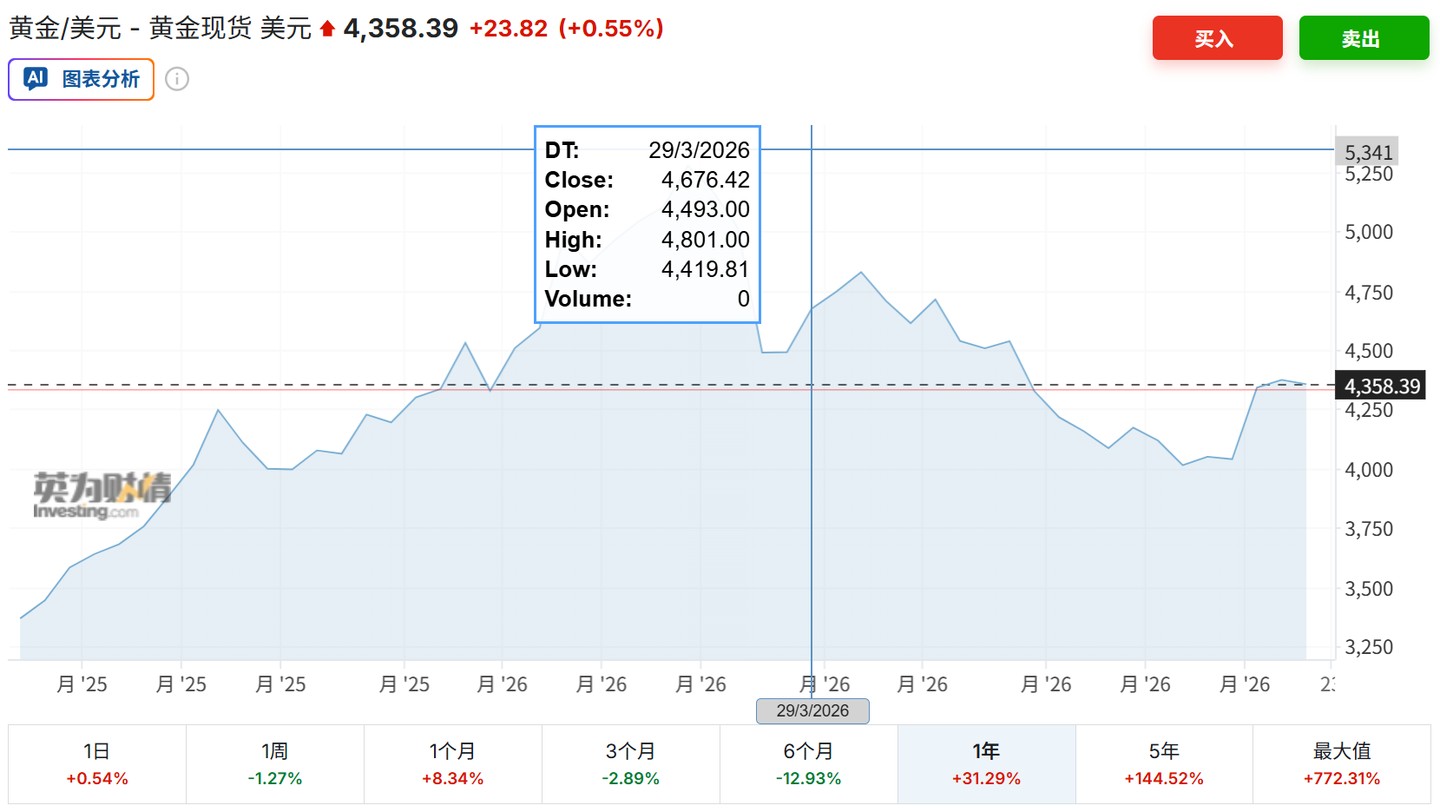
However, this logic hit a wall. Gold reached a historic high of nearly $5,594 in January, then sharply corrected. The Federal Reserve turned hawkish, the dollar strengthened, and U.S. Treasury yields remained high. By June, Wells Fargo had lowered its 2026 target price to $5,300 to $5,500.
July passed without another downgrade. But August saw the second downgrade.
From the peak in February, the median target price for 2026 has dropped from $6,200 to $5,000. In six months, it has decreased by $1,200 per ounce.
The February target price was based on two assumptions: that the Federal Reserve would cut interest rates and that central banks would continue to buy.
However, the Federal Reserve did not cut rates, and the pace of central bank purchases has slowed. Since then, Wells Fargo has been revising its target price.
Gold price correction in August
On August 18, the spot gold trading price was around $4,397 per ounce. Rising U.S. Treasury yields and increasing oil prices are the culprits. Higher yields are particularly unfavorable for gold, as this metal does not pay any interest or dividends When bond yields are higher, investors face a real opportunity cost of holding gold instead of bonds. This cost has been rising throughout the year.
Wells Fargo stated in July that gold prices have fallen more than 20% from their January peak. The reasons are intertwined with various factors: profit-taking after a significant rise, outflows from ETFs, expectations of tighter Federal Reserve policies, a stronger dollar, and temporary sell-offs by some central banks.
During the peak of fund outflows, U.S.-listed gold funds saw monthly redemptions reach approximately $5.3 billion. None of these dynamic factors have been completely reversed. Therefore, the projected upper limit has been lowered again.
The correlation with crude oil, while not as intuitive, still exists. Rising oil prices push up inflation expectations, which in turn drive bond yields higher, making gold less competitive. This mechanism has been adversely affecting gold for most of the summer.
Those who positioned themselves earlier this year based on a different set of assumptions have felt this deeply.
However, the bank still expects gold prices to rise. The new forecast range for 2026 is $4,900 to $5,100, which is still above the current trading price. Based on $4,397, this range implies an upside of 11% to 16%. The target price of $5,400 to $5,600 for 2027 suggests an upside of 23% to 27%.
The overall direction has not changed; what has changed is the timeline and the projected upper limit.
The Golden Feast Delayed
There is a substantial difference between lowering the target price and a bearish reversal. Wells Fargo is not suggesting selling gold; rather, it indicates that the speed and magnitude of gold price increases will not be as fast or as high as previously expected in February.
This is crucial for investors who have been using Wall Street target prices to build return expectations.
In February, Wells Fargo stated that gold had a potential upside of over 23% by the end of 2026. Now, it has turned into an opportunity of 11% to 16%, with larger gains postponed until 2027.
Central bank demand, diversification of foreign exchange reserves, and geopolitical uncertainty are still included in the bank's research report. Wells Fargo has not abandoned these reasons for holding gold. Persistently high interest rates and a strong dollar have merely delayed the timeline for realization. This is an objective and realistic interpretation of the changing situation.
Investors betting on gold prices quickly rising to $5,400 or higher before December are the most affected. If investors had been anticipating the old target price, the new target price is undoubtedly a significant downgrade.
If investors are merely holding gold as a long-term store of value, this downgrade is not as dramatic. Wells Fargo still believes that gold prices will reach new highs, just shifting the timeline to 2027.
Currently, gold's sensitivity to U.S. interest rate trends and the dollar exceeds that of almost any other variable. Investors are awaiting the minutes from the Federal Reserve's July meeting, which will be released on August 20 This set of minutes may indicate whether there will be an interest rate hike or a hold in September. This signal will reveal more about the next movement of gold than any target price given by banks
