


HSAI: ASP Keeps Plunging — How Long Will the Pain Last?
Overall,$HESAI-W.HK delivered results broadly in line, but the print underscored the core issue: lidar ASPs are still falling too fast. Specifically:
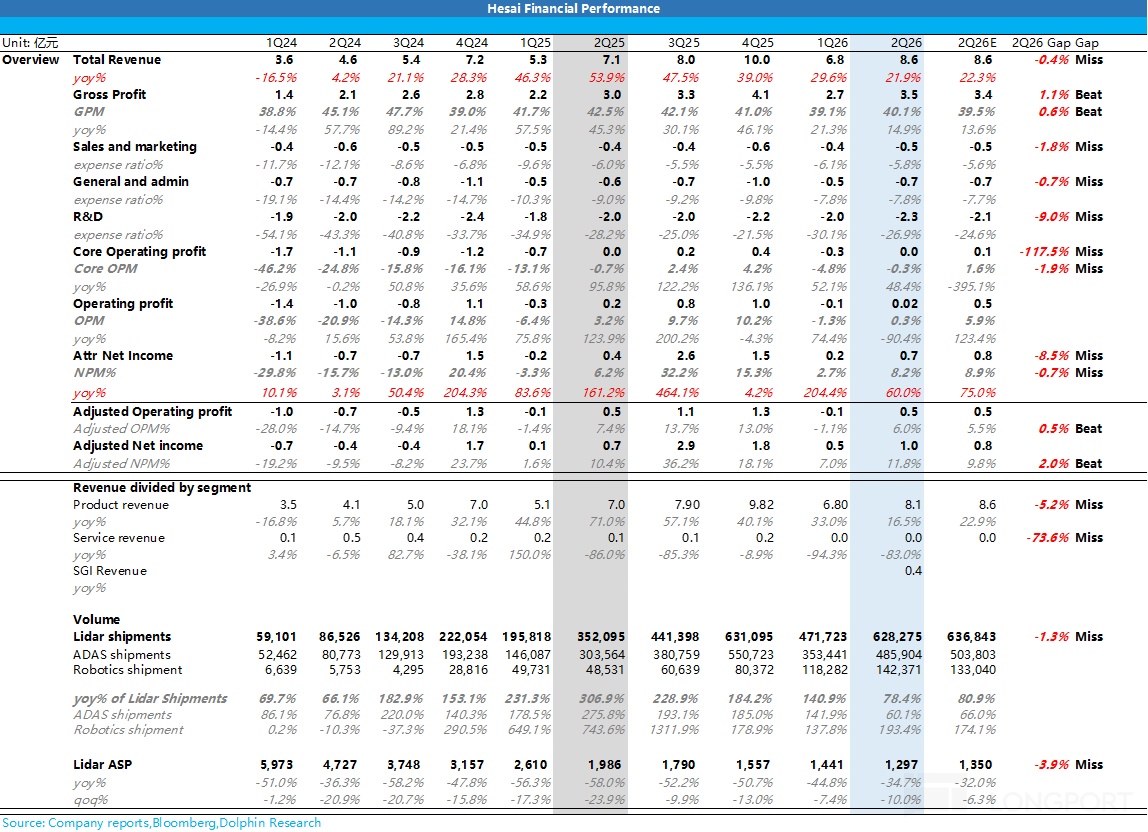
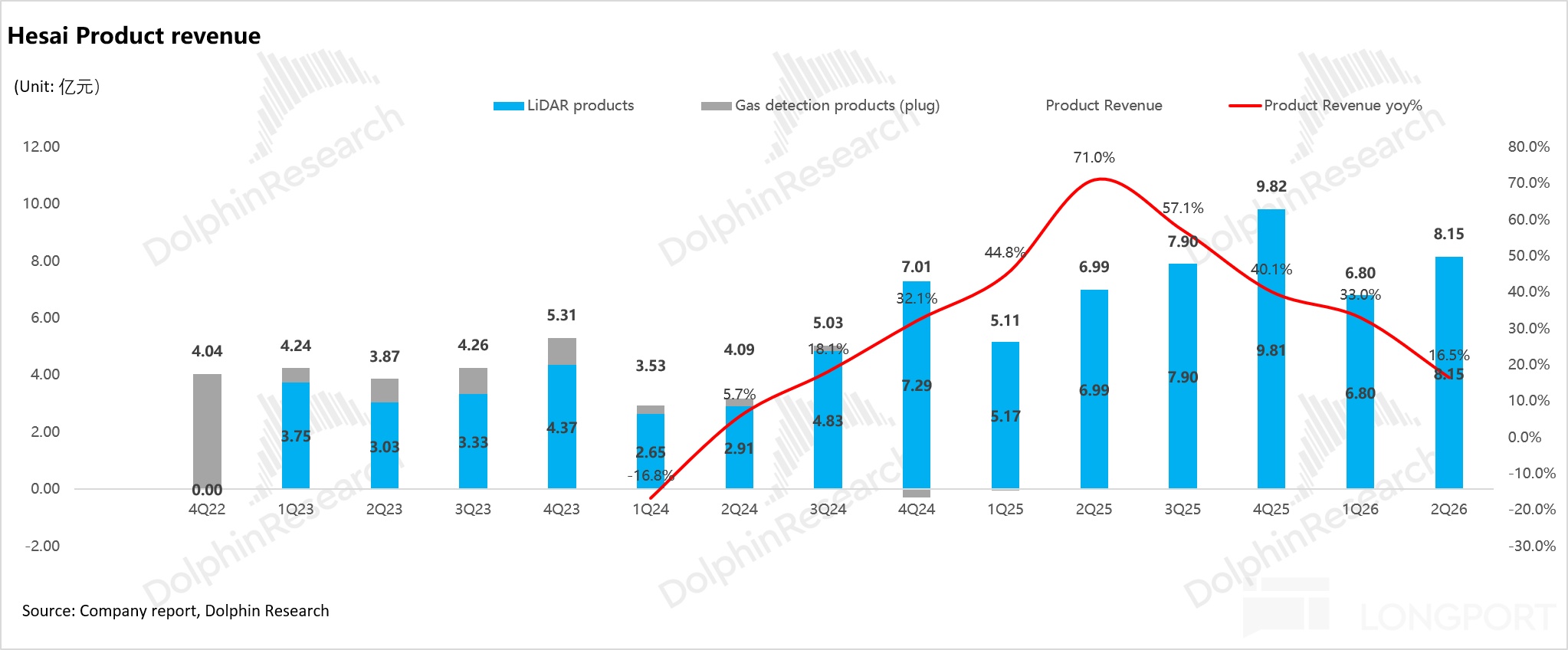
① Revenue broadly met guidance, but core lidar sales missed: Q2 revenue was RMB 860 mn (+22% YoY), landing near the low end of Hesai’s 2Q26 guidance of RMB 850–900 mn. SGI (currently mainly Kosmo and actuator modules) contributed RMB 40 mn this quarter. Excluding SGI, core lidar revenue was ~RMB 810 mn, with YoY growth slowing to ~16.5%, below the Street.
② Lidar volume and price both missed:
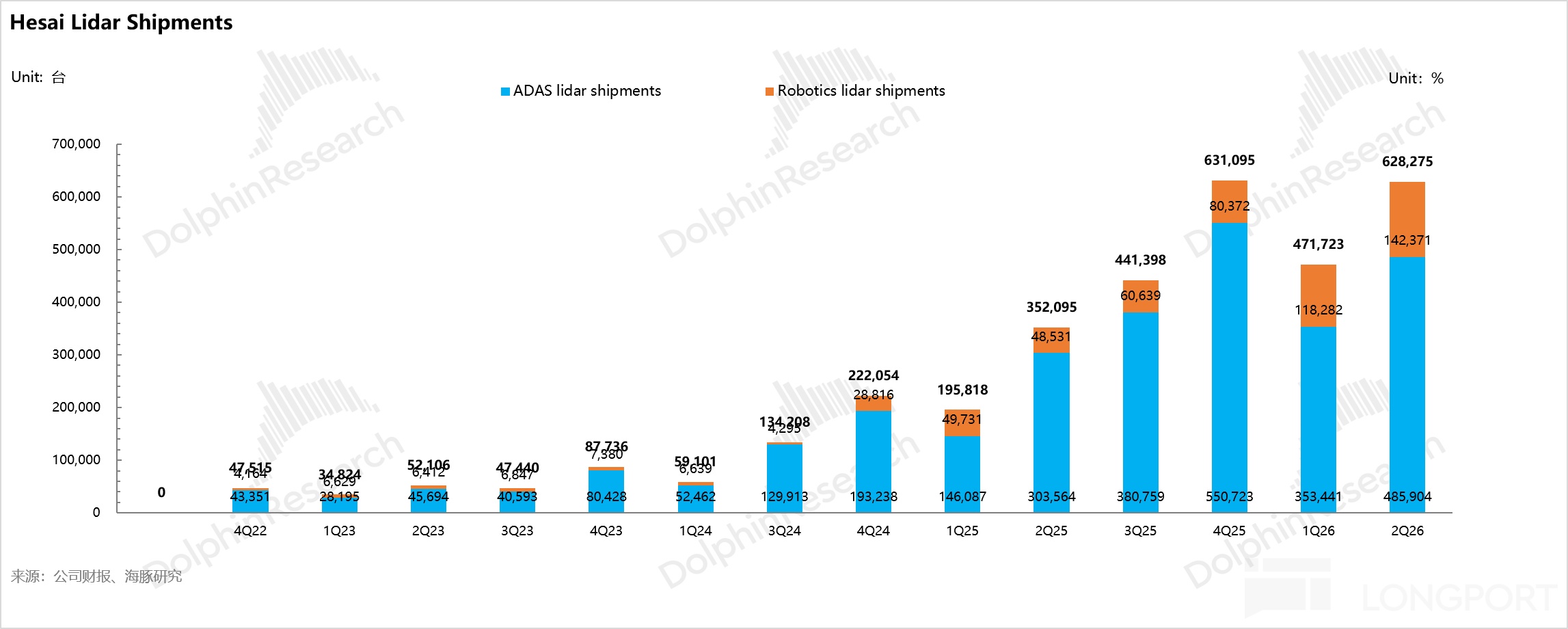
Shipments: 2Q26 units were 628k, below company guidance of 650k and the Street’s 637k. The shortfall was driven by weaker-than-expected ADAS passenger-car lidar: ADAS shipments were 486k vs. 504k est., likely tied to slower NEV sales growth amid state subsidy roll-off, and softer sales growth at key customers Xiaomi and Li Auto vs. expectations.
Robot lidar shipments were 142k, above the 133k est., helped by JT128 for humanoid and quadruped robots (now in cooperation with 50+ embodied AI companies) and better-than-expected JT16 lawnmower lidar demand.
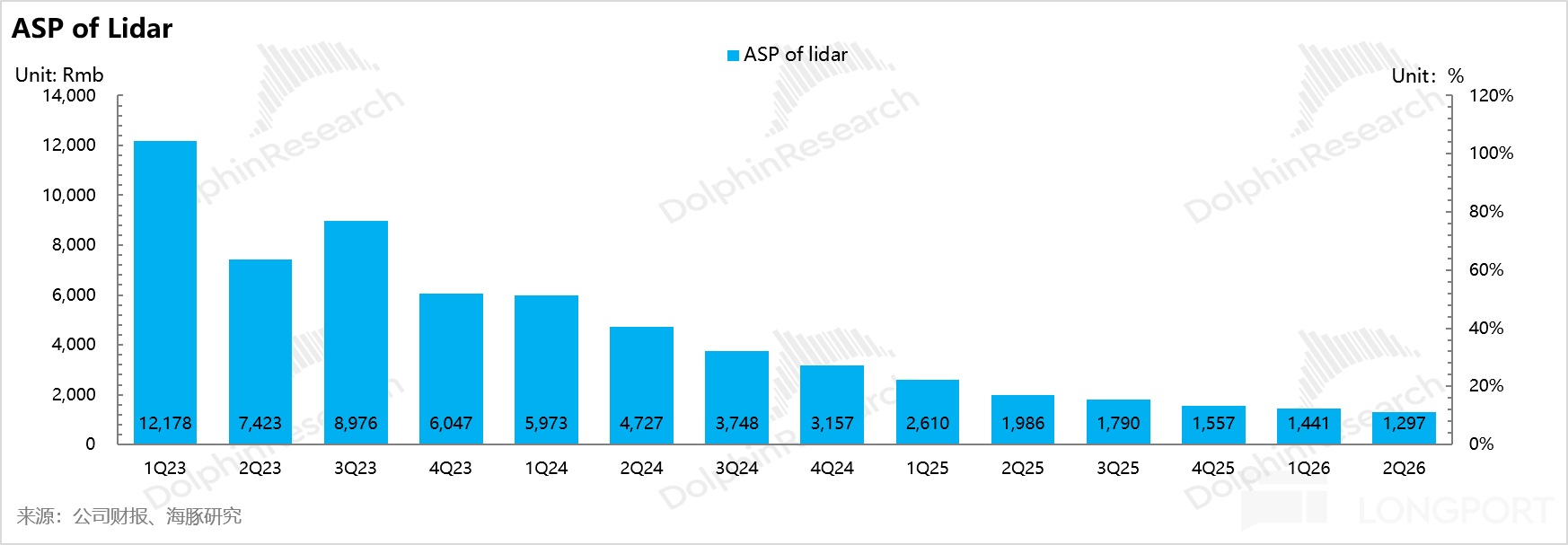
ASP: 2Q26 blended lidar ASP was just RMB 1,297, down 35% YoY and below the Street’s RMB 1,350, likely due to:
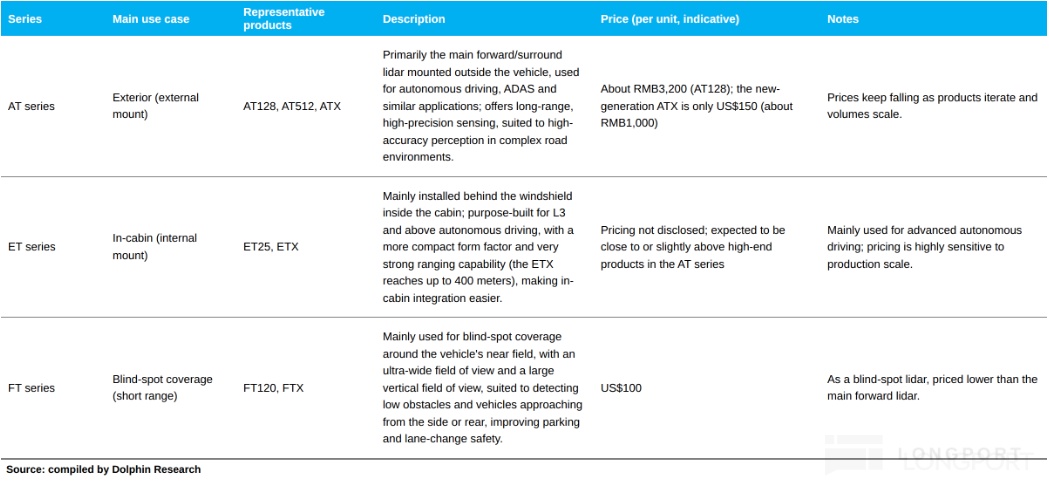
a. Intensifying competition: as rivals (e.g., RoboSense EMX series) narrow the performance gap, Hesai, as the leader, ceded its prior 10–20% pricing premium to drive volume and defend share.b. ATX dedicated versions for volume customers like BYD and Geely are priced ~RMB 800, and rising mix further drags ATX line ASP.c. FTX blind-spot radar ASP is guided at ~$100, and as its shipment mix rises, it structurally depresses blended ASP.
③ GPM held the 40% line: 2Q26 GPM was 40.1%, slightly above the Street at 39.5%, up 100 bps QoQ. Despite rapid unit price declines, GPM stayed above the key 40% threshold.
Drivers included scale benefits from QoQ shipment growth, localization and high integration of the main control chip, and cost-down from in-house SPAD integration.
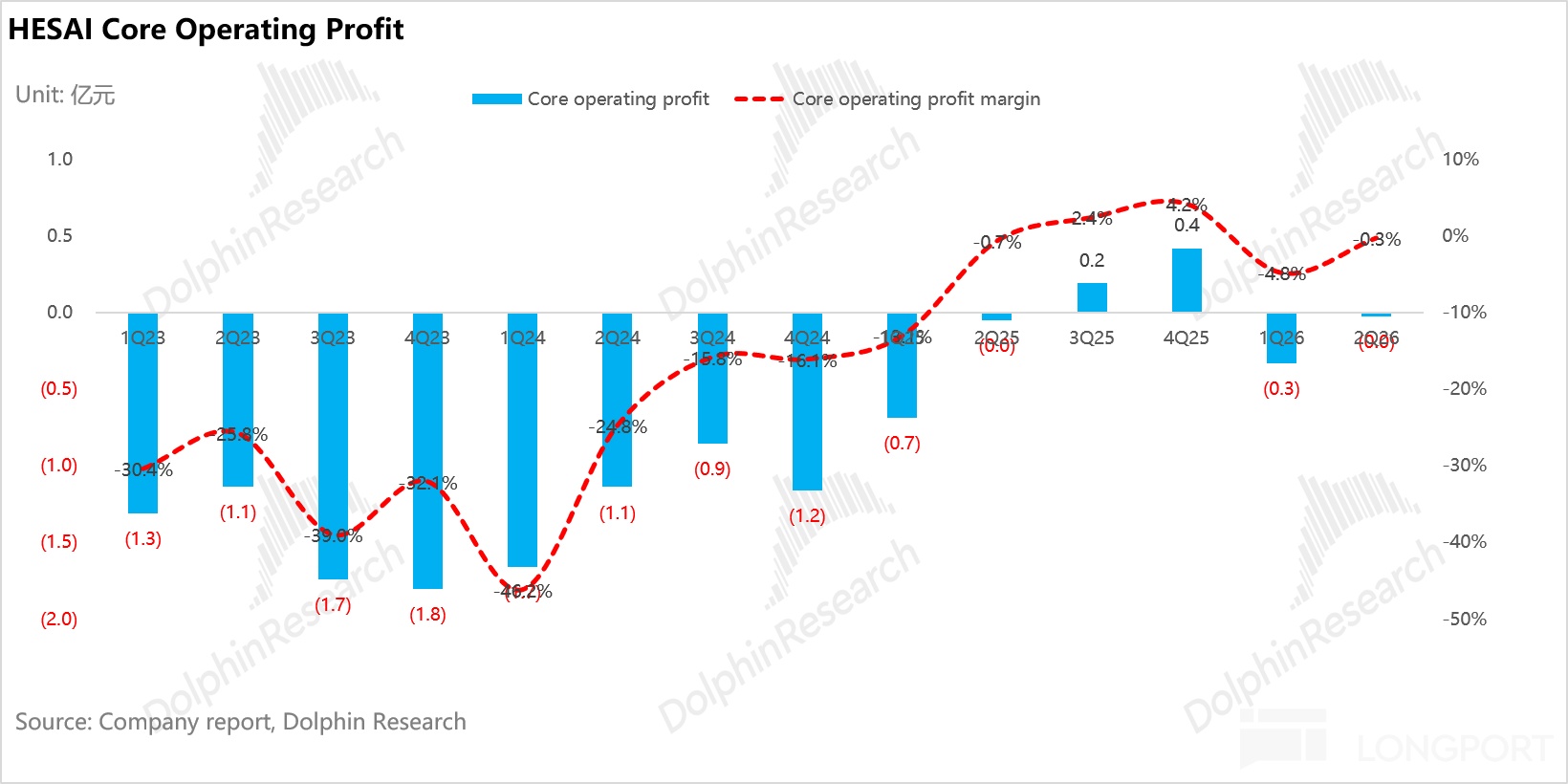
④ OP missed on higher opex: 2Q26 OP was just RMB 2 mn vs. the Street’s ~RMB 50 mn, mainly on higher R&D. R&D was RMB 230 mn (+16% YoY), driven by increased investment in SGI initiatives (management previously guided ~RMB 200 mn forward-looking spend in 2026).
Dolphin Research core take:
Overall, Hesai’s quarter was broadly in line: revenue slightly beat on SGI contribution to Spatial General Intelligence; GPM held the key 40% threshold on scale and tech cost-down; OP missed due to stepped-up SGI R&D spend.
However, the report again highlights the central tension: ASPs are falling too fast. Lidar unit price fell below RMB 1,300, down 35% YoY, driven not only by tech cost-down but more by intensified competition, with Hesai choosing to trade price for volume, defend share, and scale, as rivals like RoboSense’s EMX accelerate shipments since Q4 last year.
2026 is set to be a year of deep price-for-volume games. High-end ETX (L3 core lidar) won’t ramp until year-end, keeping competition focused on low-price L2 car lidars (ATX/FTX). Downstream NEV makers face slower sales growth as purchase tax subsidies fade and margin pressure from rising upstream commodities (aluminum, steel, batteries, storage), increasing sensitivity to component pricing.
For 2026 in particular, this is the painful but necessary phase to ride out the price war and position for the next-gen general sensor ecosystem:
① Full-year shipments to remain high growth, but ASP to shrink more than expected under competitive pressure:
a. Shipments to stay strong: Hesai raised 2026 shipment guidance from 2–3 mn units to 3–3.5 mn, implying 85–116% YoY growth, and kept that target this quarter. To match demand, annual capacity is planned to double from 2 mn units in 2025 to 4+ mn in 2026. ADAS is near doubling, robots more than doubling.
ADAS: 2.5–3.0 mn units (200–300k FTX blind-spot, remainder ATX around RMB 1,000), up 81–117% YoY. Key drivers:
① ATX penetration into L2+ mass market: lidar now reaches RMB 80–100k price bands as optional on certain models.② L3 will drive per-vehicle lidar counts up, but volume ramp likely by late 2026 or 2027. Post L3 regulation in 2027, setups should move from single ATX to ‘1 main ATX/ETX + multiple FTX blind-spot’, lifting per-car value from ~$200 to $500–1,000, with greater price tolerance. ETX has been nominated by Great Wall Motor, SOP around end-2026, with detection range over 2x ATX.③ FTX blind-spot ramp: Li Auto L8/L9 each mount four Hesai lidars in mass production, and the new Li Auto L6 (~RMB 250k) offers four-lidar option, bringing premium configs into mainstream price bands.
By ADAS customer split for 2026, Dolphin Research expects core volume from Xiaomi (46–50k vehicles in 2026, introduced RoboSense as a second source), Leapmotor (mostly sole-sourced ~600k units), Li Auto (sole-sourced ~400k), BYD (~300–350k, roughly half the market), Geely (~500k), and Great Wall (~200k), among other large orders.
Robots: Hesai guides 500k+ units (+109% YoY). Mix remains JT series at ~RMB 1,000 ASP (~450k units), mainly supplying lawn robots for Dreame, Mova, etc. Hesai works with 50+ embodied AI firms; recent orders include Unitree, Robbyant, Galbot, Galaxea, Dexmal. JT128 for humanoids should drive upside, with some high-performance warehouse/logistics setups mounting up to 15 JT128 per device, and JT128 ASP above JT16 for lawnmowers.
Dolphin Research expects 2026 lidar shipments at ~3.3 mn:
ADAS lidar at 2.62 mn (+90% YoY), near the low end of guidance, due to slower downstream NEV growth and Xiaomi adding RoboSense as second source. Robot lidar at 677k (+183% YoY), well above the 500k guide, on potential JT128 upside.
b. But ASPs keep shrinking: As competitors (e.g., RoboSense EMX) close the gap and ramp since Q4 2025 (RoboSense shifted from early MEMS to rotating mirror, erasing the tech gap), price competition has intensified. As the leader, Hesai is sacrificing its prior 10–20% premium to trade price for volume and defend share.
Specifically:
a. While ATX standard versions in 2026 may hold around $150, dedicated versions for volume customers like BYD and Geely are ~RMB 800, and rising mix will further lower ATX line ASP.b. FTX blind-spot radar ASP is guided at ~$100.c. High-value ETX will only mass-produce by end-2026.
Thus, blended 2026 lidar ASP will keep deflating. Based on prior guidance (RMB 4.2–4.6 bn revenue; 3.0–3.5 mn units), blended ASP implies ~RMB 1,300–1,380, but Q2 ASP has already fallen to RMB 1,297, a faster decline than Dolphin Research expected.
Dolphin Research now expects 2026 blended ASP to drop 31% YoY to RMB 1,268, especially as Q2 ASP under-shot.
c. SGI to accelerate revenue contribution:
SGI comprises two main lines:
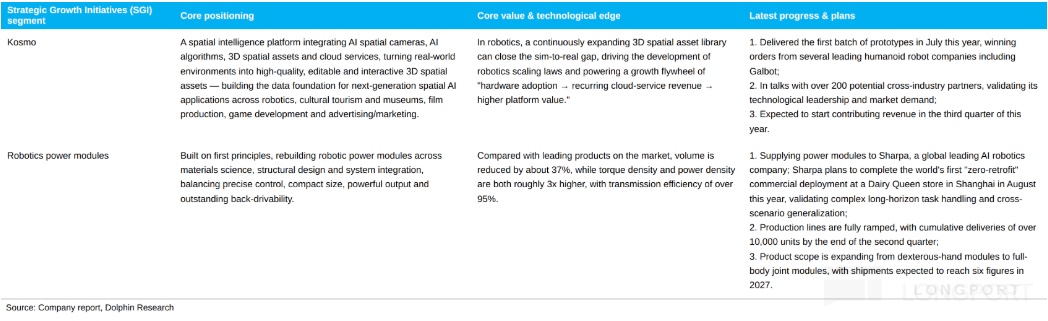
① Kosmo (Spatial Intelligence Platform): an integrated system of AI spatial cameras, AI algorithms, 3D spatial assets, and cloud services to capture, reconstruct, and understand the physical world. Commercially, after prototypes were sent in Jul, orders came within 7 days from leading humanoid robot firms including Galbot. Since the Apr preview, over 200 potential partners have engaged, expanding into culture/tourism, film/TV, gaming, and advertising.
② Actuator modules: starting with dexterous hands, the hardest humanoid module, to validate the architecture in the most challenging scenarios before scaling to other body parts. Full-body modules SOP is expected in H2 2026, expanding to shoulder and wrist joints.
Shipments: Cumulative module shipments exceeded 10k units by end-Q2, with a near-term ramp to ~10k per month, and six-figure shipments expected by 2027.
Customers: supplying AI robot firm Sharpa (co-founded with Hesai founders, independent off-balance-sheet), and Sharpa has been adopted by NVIDIA’s GROOT platform.
With faster SGI rollout, Hesai raised SGI revenue guidance: 2026 from RMB 100 mn to RMB 200–300 mn (3Q26 quarterly contribution near RMB 100 mn), and 2027 remains at RMB 700 mn (~$100 mn).
Dolphin Research expects 2026 total revenue at RMB 4.48 bn (+48% YoY): lidar RMB 4.18 bn (+40% YoY), dragged by ASP deflation; SGI RMB 250 mn; other RMB ~50 mn. The total sits around the mid of company’s RMB 4.2–4.6 bn guide.
c. Despite ASP pressure, Hesai still guided resilient FY26 GPM at ~40%, supported by tech cost-down and scale:
a. Localization and high integration of the main control chip (in-house FMC500 SoC on RISC-V integrating MCU, FPGA, and ADC), a single-chip solution compressing ~40% of BOM core chip cost.b. In-house SPAD integration (to mass-produce in 2026).c. Scale effects at 3.0–3.5 mn units and highly automated manufacturing.
While ASP deflation remains steep, management maintained full-year 2026 GPM guidance at 40%, down 180 bps YoY.
d. On opex:
Overall opex is expected to rise ~15% YoY, mainly from ~RMB 200 mn forward investment into robot initiatives (‘the physical AI eye’ sensors and ‘the physical AI muscle’ micro-motors). This is independent of off-balance-sheet Sharpa, and is Hesai’s bet on its second growth curve, which near term compresses 2026 profit delivery by ~RMB 200 mn.
Excluding new-business spend, core opex is expected flat to down low-single digits, indicating steady cost control.
On valuation, Dolphin Research models 2026 revenue of RMB 4.48 bn (+48% YoY) and net profit of RMB 520 mn (near the low end of company’s RMB 500–700 mn guide), +19.4% YoY.
On this, current market cap implies ~35x 2026 P/E, and with ~19% profit growth, PEG is ~1.8x, relatively rich and needing sustained high growth in 2027 to digest. Consider: ① 2026 competition remains around L2+ low-price lidars with rival tech routes largely caught up, keeping share under pressure; ② high-price ETX and higher-margin overseas orders won’t contribute until late-2026 or 2027; ③ robot remains a long-dated option not fully priced. Near term (2026), upside elasticity looks limited.
Looking mid-to-long term, while Hesai faces near-term competition and margin pressure, lidar exhibits strong ‘Moore’s Law’ traits (exponential point-cloud density rise, exponential cost decline) and high barriers (ecosystem lock-in, scale).
As the leader under the dual theses of rising ADAS penetration and the second-curve robot expansion, Hesai remains a high-conviction long-term beneficiary.
① Near-term share may be pressured, but with comprehensive tech bets, share should stabilize mid-to-long term
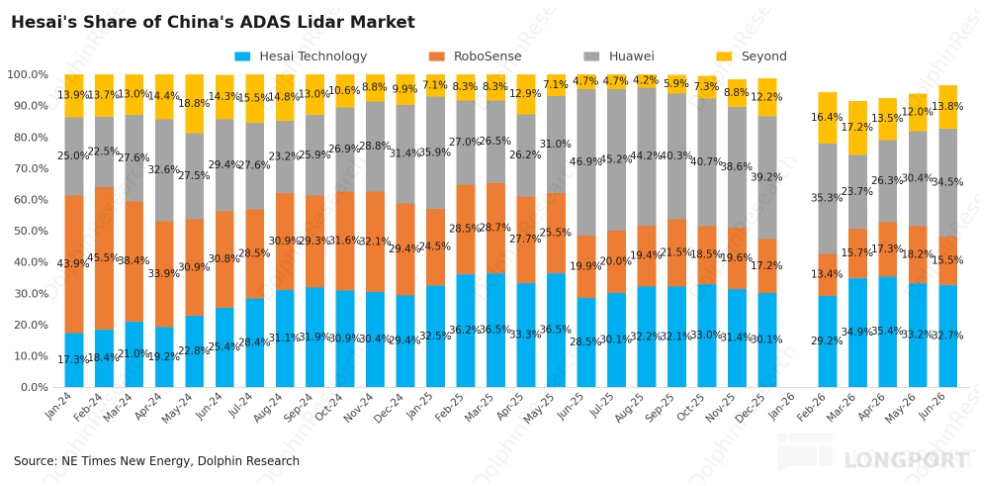
Share-wise, Hesai saw some volatility since H2 last year due to Huawei blind-spot lidar ramp. But Huawei’s lidar is mostly bundled soft/hard integration at higher prices, focused on the Aito/HI ecosystems, so independent Tier-1 competition still centers on Hesai, RoboSense, and Tudatong.
Hesai retains the No.1 position thanks to strong low-price ATX shipments. Yet as RoboSense EMX has accelerated mass shipments since Q4, share may still be eroded in 2026 near term.
Hesai’s bets on next-gen lidar routes (e.g., FMCW, vision-lidar fusion ‘Limera’) are larger and more comprehensive. FMCW is viewed as key for complex autonomous scenarios (high dynamics, reflective interference), and management expects car-grade mass production within 2–3 years, opening a new GPM premium cycle. Hence, mid-to-long term share should remain relatively stable.
② L3 to multiply per-vehicle lidar counts
As noted, L3 demand shifts from single ATX to ‘1 main radar (ATX/ETX) + multiple blind-spot (FTX)’, lifting per-car value from ~$200 to $500–1,000. Hesai’s ETX will start mass production around end-2026 into 2027, directly benefiting from this upgrade.
③ Overseas inflection, NVIDIA ecosystem tailwinds
Hesai completed C-sample development for long-range radar with a leading European OEM, with overseas mass production expected by end-2026. Meanwhile, Hesai was selected for NVIDIA Drive Hyperion, giving it preferred recommendation when OEMs adopt NVIDIA’s stack, improving integration and scalability to accelerate overseas OEM wins.
Overseas buyers are less price-sensitive and prefer high-end products, making export a key offset to domestic ASP declines.
Thus, with L3 upgrades and high-priced overseas lidars contributing, earnings elasticity should start to release by end-2026 or 2027.
④ Robots as the second growth curve
Hesai pursues an ‘internal + external’ dual-track in robots:
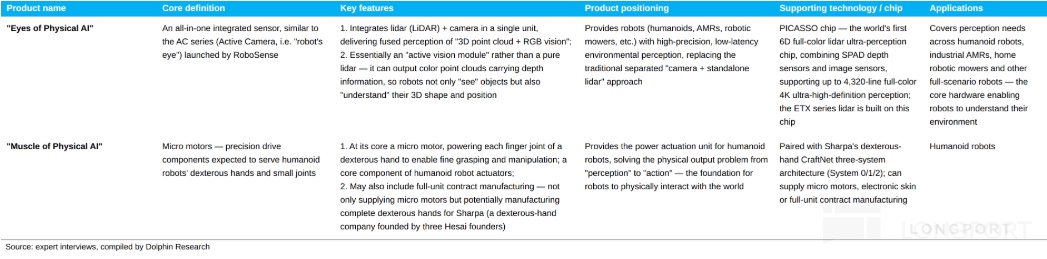
Internal: general sensor logic with ‘the physical AI eye’ (fully integrated sensors) and ‘the physical AI muscle’ (micro-motors), targeting a 5-year revenue split of 50/50 with lidar.External (Sharpa): via founder-backed dexterous-hand firm Sharpa, building humanoid core actuators, with Hesai potentially supplying micro-motors or contract-manufacturing full hands at higher per-unit value.
Hesai expects SGI revenue of RMB 700 mn in 2027, +180% vs. RMB 250 mn in 2026, continuing strong growth.
⑤ 2027 is the key inflection from ‘rapid ASP deflation’ to ‘steady annual declines’:
Dolphin Research expects blended lidar ASP decline to narrow to ~10% in 2027 (vs. ~31% in 2026), then 5–10% annually thereafter. The core reason: over 50% ASP declines in the past two years were largely driven by in-house chip-based tech cost-down, and that wave is mostly spent.
At the same time, product mix will tilt higher from 2026 with more high-end contributions, offsetting L2 ADAS ASP pressure. As the industry moves from L2 to L3/L4, per-car lidar value multiplies: L2 ~ $200 (typically 1 ATX), entry L3 ~ $350 (1 ATX + 2 FTX), and high L3 $500–1,000 (ETX plus multiple FTX).
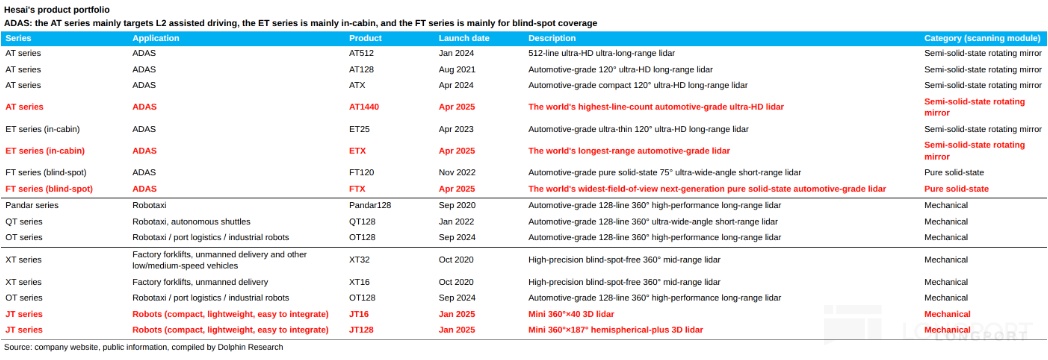
ETX (with Picasso 6D full-color SPAD-SoC, up to 4,320 channels, 600m range) is expected to enter SOP in H2 2026, with global scale-up in 2027–2028 as a flagship on high-end models.
Robot lidars provide higher ASP support: GPMs are typically 5–10 pts higher than car ADAS, with ASPs well above ADAS, and Hesai is already the global revenue leader in robot lidars. As robot mix rises, it structurally supports blended ASP.
More fundamentally, lidar is shifting from ‘emerging tech’ to standardized auto components, with pricing moving from rapid cuts for penetration to traditional annual reductions (usually 5–10% per year).
Into 2027, Dolphin Research expects net profit at RMB 860–900 mn, driven by narrower ASP declines (~10% vs. ~27% in 2026) and SGI revenue of RMB 700 mn. This implies ~20x 2027 P/E, roughly in line with ordinary auto parts suppliers, not expensive.
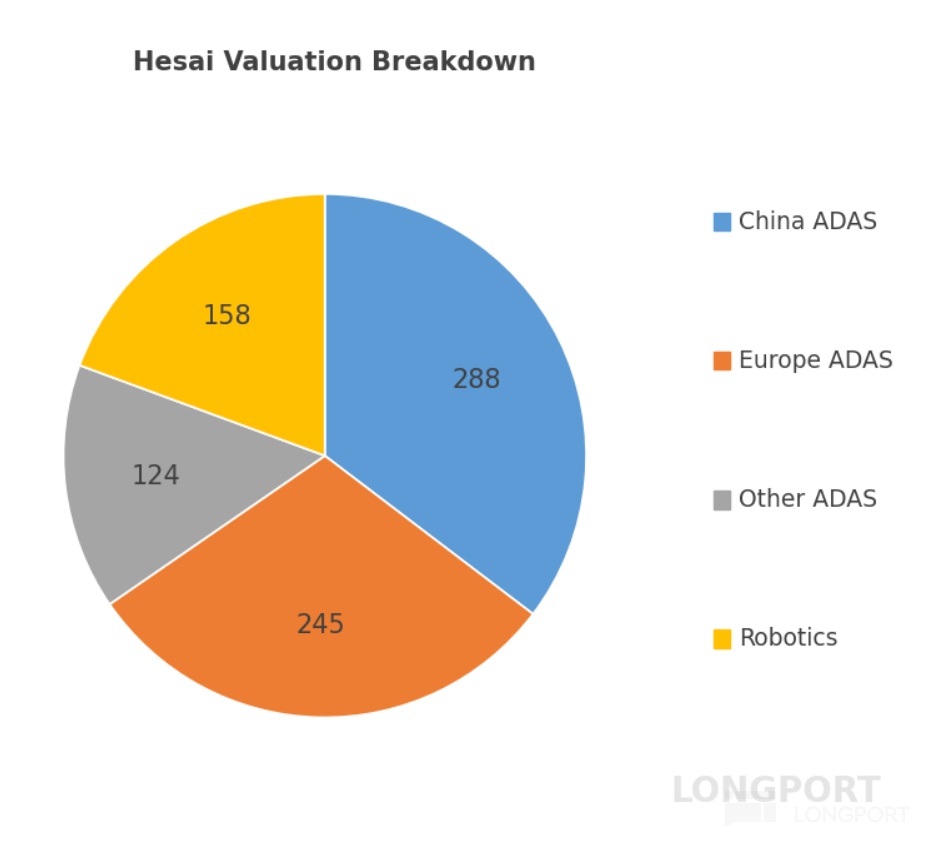
From a long-term TAM lens, the current ~RMB 18 bn market cap does not yet reflect the baseline value of domestic passenger-car ADAS (conservatively RMB 40 bn by 2030). The market is still worried about intensified 2026 competition and faster ASP declines.
Hesai’s clear overseas trajectory, best-in-class next-gen lidar route reserves, and the broad upside optionality in robots support solid mid-to-long-term upside elasticity.
See valuation in ‘Hesai: Tesla’s ‘castoff’? Lidar’s comeback is unstoppable’.
Past pieces:
Hesai deep dives:
‘‘4x’ Hesai: why the lidar shunned by Tesla shines again?’
‘Hesai: Tesla’s ‘castoff’? Lidar’s glorious comeback’
Hesai earnings
‘Hesai: surging ‘eye of ADAS’ shipments — can it take off again?’
‘Hesai: chased by RoboSense, cutting prices to defend the No.1 seat?’
