


Policy Adjustments Amid July Economic Data
July economic data showed signs of stabilization, but uncertainty regarding a rebound in the third quarter has increased. Industry demonstrated resilience supported by external demand, with significant contributions from high-tech sectors; fixed asset investment growth slowed, and fiscal stimulus effects are lagging, with stabilization expected by September. Real estate policies are shifting toward core regions to stabilize expectations. Consumption exhibited a pattern of "stable services, weak goods," with policy orientation turning toward reshaping mid-to-long-term mechanisms
July data reflects increased uncertainty about economic stabilization in the third quarter, but also reveals some preliminary signs of stabilization at the margin. After excluding the adverse impacts of extreme weather such as high temperatures and heavy rainfall, industrial investment remained resilient under the support of exports. Consumption, after removing the drag from automobiles, also showed certain supportive strength, particularly with the service sector performing relatively steadily. Meanwhile, the State Council recently approved nuclear power construction projects worth over RMB 170 billion, which, combined with the accelerated advancement of the "Six Networks" construction, indicates that while fiscal efforts to stabilize investment face time lags, a turnaround is expected by the end of the quarter.
Industry exhibits characteristics of "external demand providing a floor and structural divergence," with its underlying resilience providing a buffer period for policy implementation. Although the growth rate of industrial value-added slowed in July due to seasonal factors and extreme weather, the export delivery value of industrial enterprises maintained double-digit high growth. The prosperity of external demand has allowed short-term macroeconomic policies some room for observation. Structurally, the high-tech industry performed brilliantly, contributing approximately 50% to the growth of industrial value-added from January to July. In recent years, the growth rates of industrial value-added and infrastructure investment have often moved in opposite directions. The underlying resilience currently shown by industry objectively delays the urgency of stabilizing infrastructure through strong stimulus in the short term.
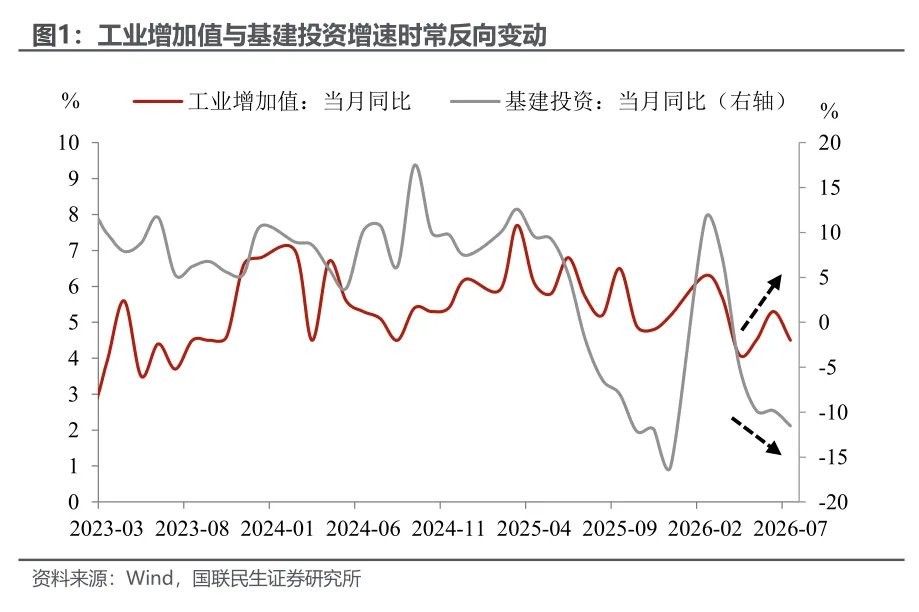
Pressure on investment momentum reflects the objective time lag in fiscal stimulus. In July, the growth rate of fixed asset investment slowed to -12.8% (previous value: -10.0%). High levels of fiscal deposits indicate that funds are "accumulated but not yet deployed," with no clear signs of intensified efforts yet. Considering the time lag in policy transmission and the disturbance from extreme weather in August, investment stabilization is expected to occur no earlier than September. The fiscal approach to stabilizing investment emphasizes precision, with structural efforts being the main axis. Areas such as the "Six Networks" construction will be key focal points going forward.
The impact of real estate on investment continues to deepen, with the main front for stabilizing expectations shifting to core regions. Facing increased uncertainty about halting the decline, first-tier cities represented by Beijing have recently marginally relaxed restrictions on the demand side. This move is expected to drive stabilization in sales in local core areas. The upcoming "Golden September and Silver October" will be the core observation window to test the effectiveness of this round of policies.
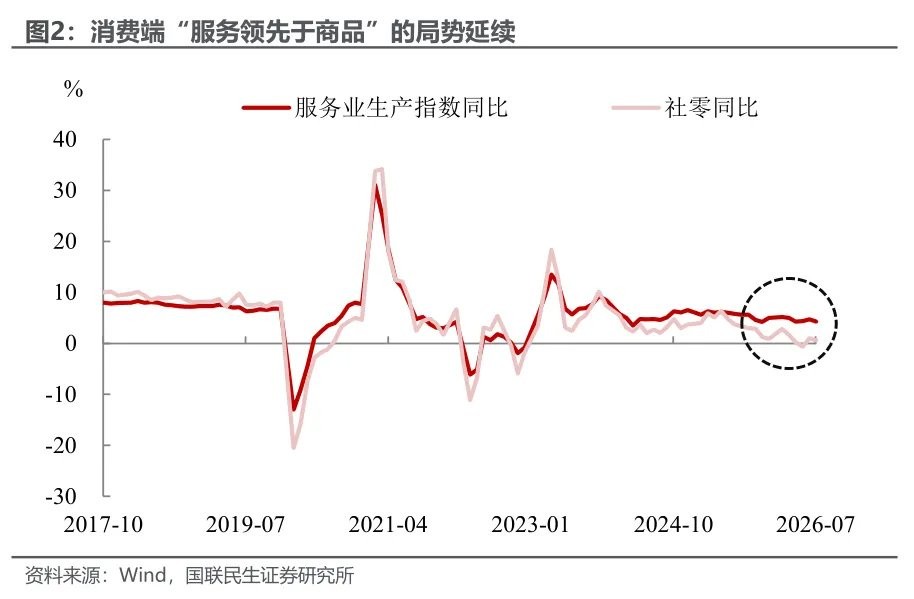
Consumption recovery exhibits a structural characteristic of "stable services, weak goods," with policy orientation clearly tilting toward mid-to-long-term mechanism reshaping. Total retail sales of consumer goods increased slightly by 0.6% in July. The pull from the "trade-in" program is slowing, and automobiles (year-on-year -17%) remain the main drag, while service consumption retains resilience. From the deployment in the "15th Five-Year Plan" for expanding consumption to the Politburo meeting's tone of "tapping into the potential of service consumption," it is evident that the policy focus is on mid-to-long-term mechanism building, meaning short-term incremental intensity may be relatively limited.
Risk Warning and Disclaimer
The market carries risks; investment requires caution. This article does not constitute personal investment advice, nor does it take into account the specific investment objectives, financial status, or needs of individual users. Users should consider whether any opinions, views, or conclusions in this article align with their specific circumstances. Investors bear full responsibility for their own decisions.
