


JPMorgan: GLM-5.3 Upgrade + DeepSeek Price Hike Reshape China's AI Landscape; Raises Price Targets for Z.AI and MiniMax
JPMorgan's core logic is that GLM-5.3 achieves an endogenous leap in capabilities through enhanced post-training, solidifying its moat; the DeepSeek API price hike provides breathing room for MiniMax, but its core competitiveness still awaits validation via M3.1. The firm favors capability-driven models, believing that models with pricing power over "frontier intelligence" hold greater investment value than those relying solely on low prices
JPMorgan recently stated that in the competition within China's AI model layer, endogenous capability drivers offer greater investment value than passive improvements from the external environment. Z.AI occupies a more favorable competitive starting point due to the endogenous capability leap of GLM-5.3, while the valuation re-rating of MiniMax depends on whether M3.1 and H3 can deliver convincing results in their respective dimensions.
According to Zhuifeng Trading Desk, JPMorgan pointed out in its research report on August 16 that two major catalysts—the release of Z.AI's GLM-5.3 and DeepSeek's API price increase effective August 17—are reshaping the industry's competitive landscape. Its core conclusion is clear: In the rapidly evolving AI market, models with pricing power over "frontier intelligence" hold greater investment value than those relying solely on low prices.
JPMorgan believes it currently favors the capability side, as the frontier of intelligence is still evolving rapidly. Z.AI's enhanced competitiveness stems from endogenous drivers, resulting in a more solid moat; MiniMax needs to prove through its upcoming M3.1 that it can establish a competitive advantage on some dimension of the Pareto frontier. Hailuo H3 provides multimodal option value, but doubts remain regarding the value capture ability of independent vendors against integrated platforms like ByteDance and Kuaishou.
Based on this logic, JPMorgan made the following key investment rating and target price adjustments:
- Z.AI: Maintains an "Overweight" rating, with the December 2026 target price significantly raised from HK$1,600 to HK$1,800. Z.AI achieved a capability leap in GLM-5.3 through endogenous technology drivers (enhanced post-training), strengthening its moat.
- MiniMax: Maintains a "Neutral" rating, with the December 2026 target price raised from HK$160 to HK$260. The positive factors mainly stem from the breathing room provided by competitor DeepSeek's price hike, as well as the multimodal option value brought by Hailuo H3, but its core large model capabilities still need to be validated by the upcoming M3.1.
Meanwhile, JPMorgan also raised its earnings forecasts for Z.AI and MiniMax respectively: Z.AI's revenue forecast for 2026-27 was raised by 6-9%, with an overall increase of 6-10% for 2026-30; MiniMax's 2026 revenue forecast remained unchanged, while the 2027-30 revenue forecast was raised by 11-21%.
Competitive Framework: Pareto Frontier Defines the Dual Track of Capability and Cost
JPMorgan introduces the "Pareto Frontier" as the core framework for assessing the competitive landscape of China's AI models. It is defined as: A model is on the Pareto Frontier when no competitor offers stronger capabilities at the same or lower price, or equivalent capabilities at a lower price.
Models on the frontier can build two types of attractive business models:
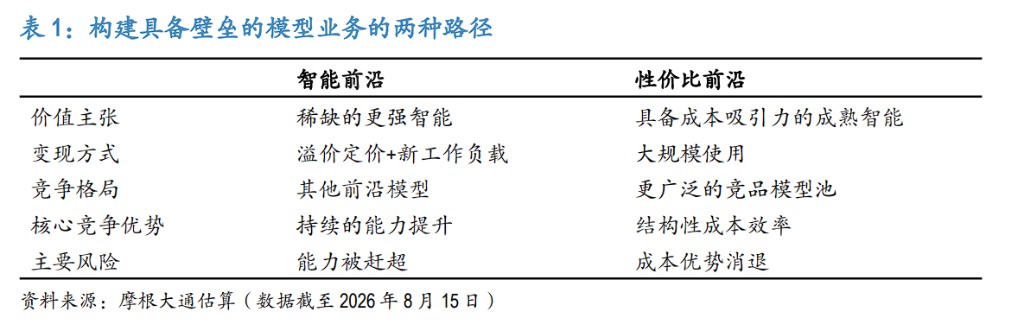
JPMorgan currently favors the capability side for three reasons:
First, model intelligence levels are still improving rapidly, and capability-leading models are relatively unaffected by price changes in weaker substitutes;
Second, each level of capability leap opens up new demand, such as in programming, which has evolved from auto-completion to repository-level development and long-cycle software development tasks;
Third, as intelligence matures, competition in the cost-performance track will become more intense, and sustainable cost leadership must be built on structural efficiency advantages, rather than aggressive pricing willingness.
On the cost side, JPMorgan primarily uses comprehensive token pricing as a metric (assuming an input-to-output ratio of 10:1 and a cache hit rate of 90%); on the capability side, it references benchmarks and actual product performance.
DeepSeek Price Hike: Industry Cost Benchmark Loosens, But Structural Advantages Remain Unchanged
DeepSeek's API price adjustment, effective August 17, is a significant background event in JPMorgan's report. From the pricing data, the adjustment magnitude is significant:
V4 Pro (Peak Hours): Input price sharply increased from RMB 3.00/million tokens to RMB 9.00, and output from RMB 6.00 to RMB 27.00;
V4 Flash (Peak Hours): Input increased from RMB 1.00 to RMB 3.00, and output from RMB 2.00 to RMB 9.00;
V4 Flash (Off-Peak): Input slightly increased from RMB 1.00 to RMB 1.50, and output from RMB 2.00 to RMB 4.50.
JPMorgan's interpretation of this price hike is: DeepSeek's previous pricing contained considerable monetization potential, and this increase indicates it has sufficient pricing flexibility. Nevertheless, DeepSeek maintains strong price competitiveness among high-capability models, and its status as the industry cost benchmark remains unchanged.
The impact of this price hike on the industry is twofold: in the short term, it provides breathing room for vendors near the cost-performance end (especially MiniMax), narrowing their cost disadvantage; but in the long run, it reinforces JPMorgan's core view—sustainable cost leadership requires underlying efficiency advantages that can survive price adjustments. DeepSeek's system-level efficiencies, such as its MoE architecture, attention design, and KV cache optimization, remain its moat.
Z.AI: GLM-5.3 Endogenous Drive Leads to Capability Leap, Maintains "Overweight"
According to Z.AI's disclosure, GLM-5.3 uses the same base model as GLM-5.2, with improvements in programming and agent capabilities mainly stemming from enhanced post-training.
JPMorgan believes this technical path has important implications for the competitive landscape: it shows that significant capability improvements can be achieved through post-training alone without a new round of large-scale pre-training, thereby increasing the weight of data quality, reinforcement learning, evaluation infrastructure, and engineering execution in differentiated competition.
With the API pricing system largely unchanged (GLM-5.2 pricing remains at RMB 8.00 for input, RMB 2.00 for cached input, and RMB 28.00/million tokens for output), stronger capabilities are expected to help improve adoption and retention rates.
JPMorgan emphasizes that Z.AI's competitiveness improvement stems from endogenous drivers, which is the core reason it is more attractive than MiniMax. Starting from a point closer to the intelligence frontier also grants Z.AI strategic flexibility: subsequent inference optimization can improve cost-performance while maintaining model capabilities.
The sustainability of the investment logic relies on continuous model iteration, not just the single release of GLM-5.3. Z.AI's competitive position still faces challenges from subsequent products by Kimi, DeepSeek, and other frontier peers.
JPMorgan raised Z.AI's revenue forecast for 2026-30 by 6-10%, with specific adjustments as follows:
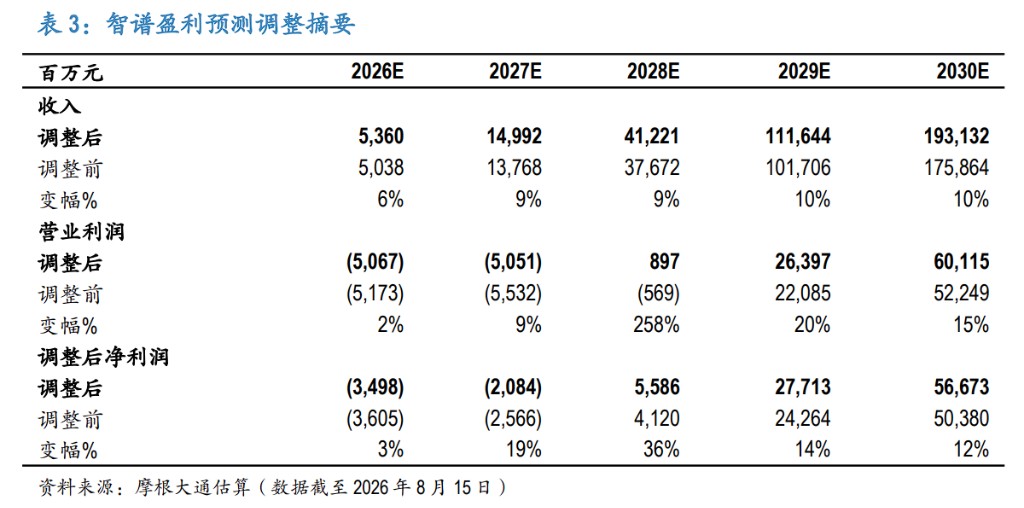
The target price of HK$1,800 is based on a 20x expected P/E ratio for 2030, discounted to December 2026 using a 15% Weighted Average Cost of Capital (WACC). The 20x P/E ratio represents a valuation premium compared to top-tier domestic internet companies, mainly reflecting the company's expected revenue CAGR of over 100% from 2026 to 2030.
MiniMax: External Positives Provide Breathing Room, M3.1 and H3 Are Two Upside Paths
JPMorgan points out that MiniMax's current M3 model has not established a clear advantage in either capability or cost-performance, leaving it squeezed from both sides: facing competition from stronger models (such as Kimi K3, GLM-5.3) on one end, and pressure from DeepSeek's long-term aggressive pricing strategy on the other.
DeepSeek's recent price hike narrowed MiniMax's cost disadvantage in substitutable workloads, supporting higher assumptions for retention rates, workload share, and pricing. However, JPMorgan explicitly states that this benefit stems from a competitor's decision and may reverse with changes in price and models.
JPMorgan positions M3.1 as MiniMax's most important company-level catalyst. The evaluation criteria are clear: either significantly enhance model capabilities or create outstanding cost-performance, establishing a more competitive position on any dimension of the Pareto curve. If M3.1 is only a mild improvement and the model remains within the Pareto frontier, the impact on the long-term view will be limited.
Hailuo H3 adds a second potential growth engine for MiniMax, with initial positive market feedback enhancing its multimodal product portfolio. As AI image, text, and video generation technology penetrates industries such as advertising, short videos, gaming, and e-commerce, the industry demand outlook is broad.
However, JPMorgan remains cautious about MiniMax's value capture ability as an independent vendor. The core challenge lies in the competitive landscape: integrated platforms like ByteDance and Kuaishou can capture value across multiple links such as model/API revenue, content creation, distribution, advertising, and user interaction, and possess existing creator and advertiser ecosystems that provide distribution and data advantages. In contrast, MiniMax needs to generate investment returns more directly through its own products and model services.
JPMorgan raised MiniMax's revenue forecast for 2027-30 by 11-21%, with specific adjustments as follows:
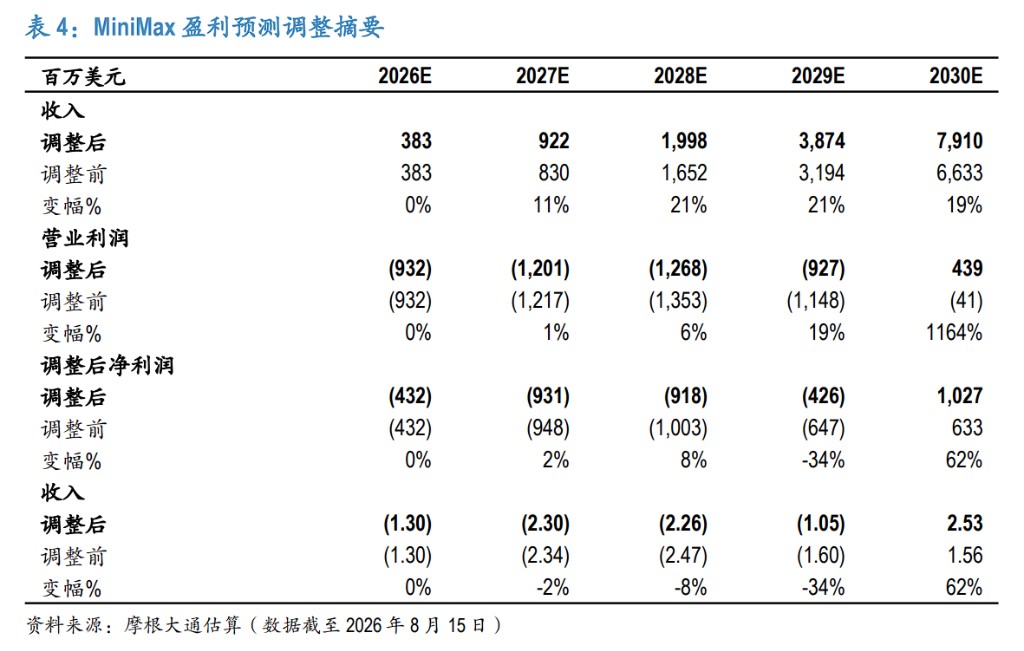
The target price of HK$260 is also based on a 20x expected P/E ratio for 2030, discounted using a 15% Weighted Average Cost of Capital (WACC).
