


From computing power supply and demand to capital binding, ENVISION GREEN's business enters a new stage
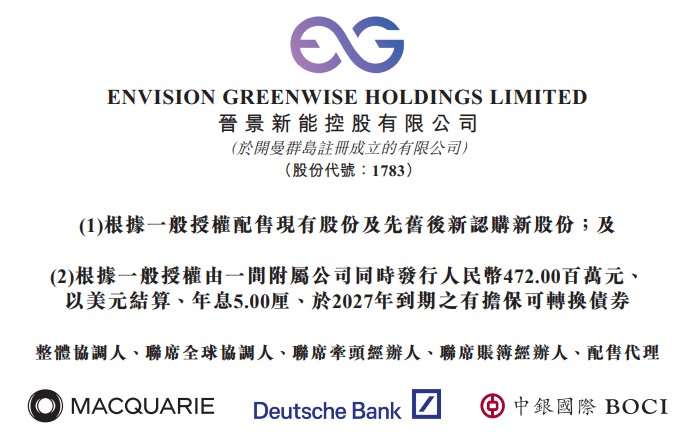
ENVISION GREEN announced a new round of share placement and convertible bond financing, raising approximately HKD 1.098 billion in total. A subsidiary of MiniMax intends to participate as a potential subscriber and underwriter in both transactions simultaneously. This move marks the extension of the relationship between the two parties from computing power supply and demand to capital binding, reflecting the strategic need of the model company to view computing power as a long-term infrastructure
On August 10, ENVISION GREEN announced a new round of share placement and convertible bond financing, with a total fundraising of approximately HKD 1.098 billion.
The most noteworthy aspect is that MiniMax's subsidiary intends to participate simultaneously in both the share placement and the convertible bond subscription as a potential subscriber and underwriter.
This indicates that the relationship between ENVISION GREEN and MiniMax is beginning to extend from a potential supply-demand relationship in computing power to a capital level. This is also the first time ENVISION GREEN has seen a model company participate from a capital perspective after continuously advancing its AI computing power layout over the past two months.
Why is MiniMax participating in ENVISION GREEN's subscription?
The most direct reason is that computing power is becoming a long-term infrastructure for model companies. Each model vendor is locking in long-term computing resources, as having computing power equates to future opportunities to generate more revenue.
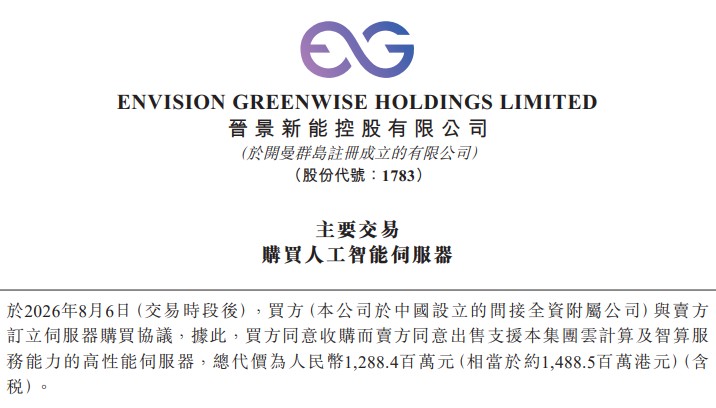
ENVISION GREEN has already made arrangements in this direction over the past few months, such as purchasing HKD 1.288 billion worth of computing power servers on August 6.
In the past, discussions about AI computing power were more focused on large model pre-training.
However, as the AI industry continues to develop, the computing power needs of model companies have expanded to include model training, post-training, reinforcement learning, multimodal, agents, and large-scale inference.
Therefore, for model companies like MiniMax, computing power is no longer a one-time procurement demand but one of the most important infrastructures in long-term operations.
Whether in China or the United States, model companies will further consider a question: as their own demand grows, can cloud service providers expand capacity in sync?
Thus, stable computing power supply itself has strategic value. This is a long-term infrastructure process, and every model vendor needs a trustworthy partner.
If it is just a short-term purchase of a batch of GPU computing power, both parties can simply sign a service contract.
However, if the computing power demand of the model company is long-term, continuous, and constantly growing, then establishing a deeper relationship with computing power infrastructure suppliers has stronger industrial rationality.
From an industry perspective, what is truly scarce about Neocloud is not just the GPUs themselves. Servers can be purchased, data centers can be built, but the ability to efficiently and stably operate large-scale GPU clusters and continuously expand with customer demand is what the industry truly needs to validate over the long term.
From the development of American model companies, it can also be seen that once a model vendor forms a stable partnership with a cloud service provider, both parties often maintain a relationship for many years The reasons behind this are not complicated: the data environment, hardware architecture, and operational maintenance system all require long-term adaptation. Once deployment is completed, changing core infrastructure suppliers also incurs significant migration costs.
Therefore, MiniMax's participation in the subscription of ENVISION GREEN's shares and convertible bonds can be understood as a signal of the deepening relationship between the demand side for models and the supply side for computing power.
What does MiniMax's participation in the subscription mean for ENVISION GREEN?
The first layer of meaning is the industrial implications behind this investment, which are more noteworthy than mere financial investment.
If it were just ordinary institutions participating in the subscription, the market might still have doubts about ENVISION GREEN's subsequent computing power operations and customer expansion capabilities. However, MiniMax itself is a demand side for computing power, and its willingness to participate in the subscription at least indicates that this transaction, in addition to capital support, also has an extra layer of recognition from the industrial side.
As mentioned above, the computing power business ultimately is not just about asset scale, but whether customers are willing to use it long-term and whether they are willing to continuously expand.
The second layer of meaning is that for ENVISION GREEN, customers and capital may begin to form a positive cycle.
Currently, we are in a phase of rapid development of open-source models. The better the quality of Chinese open-source models and the lower the inference costs, the more scenarios can utilize AI, which may ultimately lead to greater Token usage and computing power demand. This is also the "Jevons Paradox" emerging in the large model industry.
As model efficiency increases and inference prices decrease, it seems that computing power consumption would reduce, but the actual situation may be quite the opposite.
After the unit cost of intelligence decreases, many scenarios that previously did not justify the use of AI become economically viable. Enterprises can use AI for customer service, programming, marketing, data analysis, office automation, and Agent workflows, potentially leading to a larger total Token volume and total computing power demand.
For ENVISION GREEN, this change may be transmitted from two directions.
On one hand, as MiniMax's model capabilities continue to iterate, if both parties further extend their capital cooperation to long-term computing power cooperation, then the growth in MiniMax's model invocation and computing power demand is also expected to directly translate into potential business increments for ENVISION GREEN.
On the other hand, as more and more companies begin to use lower-cost open-source models to handle large amounts of work, a broader demand for computing power will also be formed.
Most enterprises do not need or have the capability to build large-scale GPU clusters. With the popularization of AI applications, they are more likely to choose to rent GPU computing power, cloud computing resources, or related AI infrastructure services.
For cloud computing and AI infrastructure service providers like ENVISION GREEN, the real long-term opportunity is not just to serve a few large model companies, but to form an increasingly large enterprise computing power market after AI capabilities become more widespread.
As the AI industry thrives, the value of ENVISION GREEN's computing power becomes easier to realize.
In the future, regardless of which model company ultimately prevails, the entire industry has a common demand: more and more stable computing resources Competition at the model layer may be very intense, and the models themselves may continue to decrease in price or even become open source. However, from an infrastructure perspective, the cheaper the models and the wider their application, the greater the computational load they may ultimately need to support.
Therefore, for AI infrastructure companies, their business logic is more akin to that of "water sellers" in the AI industry.
From the perspective of the capital market, this change will also affect a company's valuation logic.
Pure data centers or server assets are easier for the market to understand as heavy asset infrastructure; however, if these assets can bind long-term customers and generate stable income through continuous expansion, the market's focus will gradually shift from "how many assets" to "how much sustainable cash flow these assets can generate."
This is also why AI infrastructure companies ultimately need to return to a few core indicators: customer quality, contract duration, computing power utilization, and delivery capability.
MiniMax's participation in the subscription of ENVISION GREEN this time reflects that although model companies and infrastructure companies are in different positions in the industrial chain, their interests are becoming increasingly intertwined.
For the rapidly developing AI computing power market, the earlier stable relationships are established with model companies, the more opportunities there will be to continuously expand with the growth of customer demand. This is also why MiniMax's participation in the subscription is worth tracking.
Looking at peers that have already taken the lead, this path has actually provided relatively clear examples.
Overseas, CoreWeave's revenue reached USD 2.575 billion in the second quarter of 2026, a year-on-year increase of 112%, with a backlog of USD 104.2 billion, a year-on-year increase of 246%. While long-term orders are rapidly expanding, they also provide high visibility for future revenue.
The example of CoreWeave illustrates that what truly matters for AI cloud vendors is not just how many GPUs they have, but whether they can first secure long-term, certain customer demand and then continuously expand infrastructure around that demand. Long-term contracts essentially reduce the demand uncertainty faced by large-scale capital expenditures.
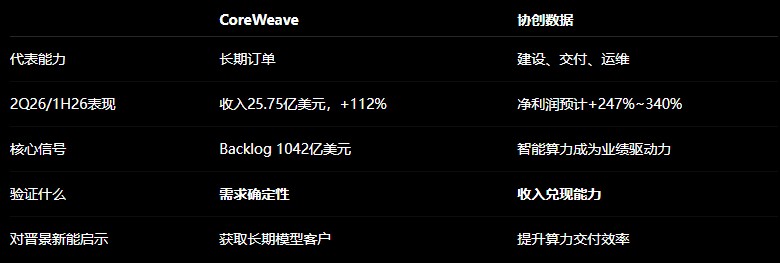
Domestic company Xiechuang Data provides another example. The company expects its net profit attributable to the parent to grow by 247%-340% year-on-year in the first half of the year, with intelligent computing power products and services becoming the core driver of performance growth. The company specifically mentioned that by enhancing computing power cluster construction, delivery, and operational capabilities, it has shortened project delivery and acceptance cycles.
Although the two companies do not have identical models, the underlying logic is consistent: long-term contracts address demand uncertainty, while operational and delivery capabilities determine how quickly these demands can be converted into revenue and profit.
From this perspective, CoreWeave and Xiechuang Data also provide two clear observation indicators for the future of ENVISION GREEN: first, whether they can continuously secure high-quality, long-term customers; second, whether they can quickly and stably deliver new servers and computing power clusters For ENVISION GREEN, the significance of MiniMax's participation in this subscription lies in this.
The company has already begun to establish capital-level connections with actual model demanders. The next step to observe is whether this relationship can continue to transform into long-term computing power demand, and whether the company can quickly convert this demand into revenue through server deployment and cluster operations.
If this path can gradually be successfully navigated, then the significance of MiniMax's participation in this subscription will not only remain as a one-time capital cooperation but may become an important node for ENVISION GREEN's AI computing power business to transition from infrastructure construction to customers and revenue realization
