


Goldman Sachs Comments on Sandisk's 'Explosive Investor Day': Long-Term Financial Guidance Far Exceeds Expectations, 100% of Excess Free Cash Flow Returned to Shareholders
Goldman Sachs believes that Sandisk's Investor Day released long-term guidance for FY28-30, with a gross margin of 80% and an operating margin of 75%, far exceeding expectations; it committed to repurchasing shares with 100% of excess free cash flow, with the remaining buyback capacity reaching $15.5 billion. Long-term customer agreements (NBM) have covered over $94 billion in contract value, providing visibility into performance. HBF high-bandwidth flash memory technology is expected to enter the AI inference market, constituting an additional upside option
Sandisk has just delivered an "Investor Day" report card that has caught Wall Street's attention, releasing a series of long-term financial targets and capital return plans that far exceeded market expectations, causing its stock price to surge nearly 14% on the day.
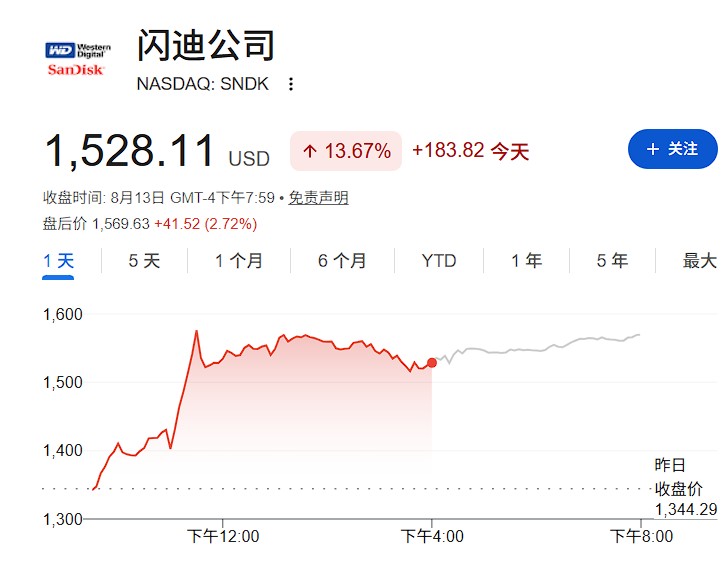
According to Zhuifeng Trading Desk, Goldman Sachs pointed out in its research report on August 13 that Sandisk not only provided long-term financial guidance far exceeding market expectations (80% gross margin, 75% operating margin), but also made a significant commitment to return 100% of excess free cash flow to shareholders. In addition, its next-generation HBF (High Bandwidth Flash) technology roadmap for AI inference brings huge upside potential to the company.
Goldman Sachs reaffirmed its "Buy" rating on Sandisk, setting a 12-month target price as high as $2,200 (based on a P/E ratio of 20 times a normalized earnings per share of $110), implying approximately 44% upside from the current stock price of $1,528.
At the same time, Goldman Sachs also pointed out that whether long-term customer agreements (NBM) can truly smooth out industry cyclical fluctuations still needs time to verify, and it is difficult to fully reflect this in valuation multiples in the short term. However, with limited incremental supply in the NAND market recently and continuous optimization of the product mix, Goldman Sachs' bullish logic on Sandisk remains solid.
Long-Term Financial Guidance Far Exceeds Expectations: FY28-30 Gross Margin 80%, Operating Margin 75%
The most shocking aspect of this Investor Day for the market was the long-term financial model for FY28-30 provided by Sandisk:
- Revenue Growth: Mid-to-high teens
- Gross Margin: 80%
- Operating Margin: 75%
- Adjusted Free Cash Flow Margin: Approximately 50%
- Capital Expenditure Intensity: Mid-single digits as a percentage of revenue
Goldman Sachs explicitly stated that the above guidance "far exceeds investor expectations" and was the core driver behind the 15% surge in the stock price on the day.
The key mechanism supporting these financial goals is the Long-Term Customer Agreement (NBM, Non-Binding Master Agreements) framework implemented by Sandisk. The core features of this framework include:
Weighted average contract term of four years, providing stronger revenue visibility;
Fixed pricing adopted in the near term, with price floors and ceilings set for the long term, balancing stability and flexibility;
Even calculated at the contract floor price, the gross margin can still reach 80%, making the economics extremely attractive.
Currently, the total contract value (TCV) disclosed by Sandisk is approximately $94 billion (including remaining performance obligations (RPO) of about $91 billion), and it has provided approximately $16.5 billion in financial guarantees to 8 customers (including three US hyperscale cloud computing providers).
The company also reiterated that approximately 50%/67% of the planned shipments for FY27/FY28 have been covered by NBM agreements, providing solid underlying support for its financial goals.
Industry-Leading Capital Return Policy: $15.5 Billion Buyback Balance, 100% of Excess Cash Flow Returned to Shareholders
Sandisk clarified three capital allocation priorities at the Investor Day:
- Continuously invest in the business to maintain technological leadership;
- Maintain a robust balance sheet, maintaining zero debt and ample cash, while continuously improving credit ratings;
- Return 100% of excess free cash flow (i.e., the remainder after deducting business reinvestment from free cash flow) to shareholders, prioritizing share Buyback.
Regarding specific Share Buy-Back Program authorization: The company's board of directors had previously authorized a $6 billion buyback plan, of which approximately $4.5 billion has been executed; subsequently, an additional authorization of $14 billion was added, bringing the total remaining buyback capacity to approximately $15.5 billion.
Goldman Sachs pointed out that this level of capital return "far exceeds announcements from peers to date" and is highly attractive to investors seeking shareholder returns.
Excellent Manufacturing Efficiency: Leveraging 13% of Industry Capital Expenditure to Drive 29% of Bit Output
Goldman Sachs stated that Sandisk emphasized its core competitive advantage in manufacturing at the Investor Day—controlling the complete manufacturing technology stack and intellectual property through its joint venture with Kioxia (the JV agreement has been extended to 2034).
Key data is impressive:
-
Between 2021 and 2025, Sandisk/Kioxia accounted for only 13% of the industry's capital expenditure, yet contributed 29% of the industry's bit output, with capital efficiency far exceeding the industry average;
-
The capital required for the industry as a whole to increase unit exabyte output is approximately 2.7 times that of Sandisk's level in CY25.
Looking ahead, the company expects to support mid-teens percentage growth in bit output while maintaining capital expenditure intensity at a mid-single-digit percentage of revenue, by further increasing the number of dies per wafer, improving production efficiency, and more efficiently utilizing equipment and cleanroom capacity.
HBF Technology: A Breakthrough for the "Memory Wall" in AI Inference Scenarios, Providing Significant Upside Option
Goldman Sachs views Sandisk's HBF (High Bandwidth Flash) technology as the most imaginative strategic highlight of this Investor Day.
Technical Background: As the context length and inference chains in AI inference tasks continue to extend (especially for agent AI workloads), the demand for memory bandwidth has surged sharply. Traditional HBM (High Bandwidth Memory, based on DRAM) faces capacity bottlenecks and high cost pressures.
Core Value Proposition of HBF:
-
Provides read bandwidth comparable to HBM, while capacity is 8 to 16 times that of HBM;
-
In Sandisk's own simulation tests, the number of GPUs required to achieve the same token output using a pure HBF architecture is only half that of a pure HBM architecture, significantly improving GPU and capital expenditure efficiency;
-
Management positions KV Cache as the "working memory" during the AI inference decoding phase, expecting that by 2032, KV Cache will account for approximately 35% of the 1.2 zettabytes (ZB) total addressable market (TAM) for AI data centers.
Product Progress: The first HBF memory product has completed tape-out, with the first batch of samples expected to be launched in 2027.
Goldman Sachs believes that HBF technology provides Sandisk with an additional upside option beyond its core NAND business, but it is still in the early stages and has not yet been fully reflected in the valuation.
