


JD: No AI arms race, no buybacks — can a 'frugal' strategy still work?
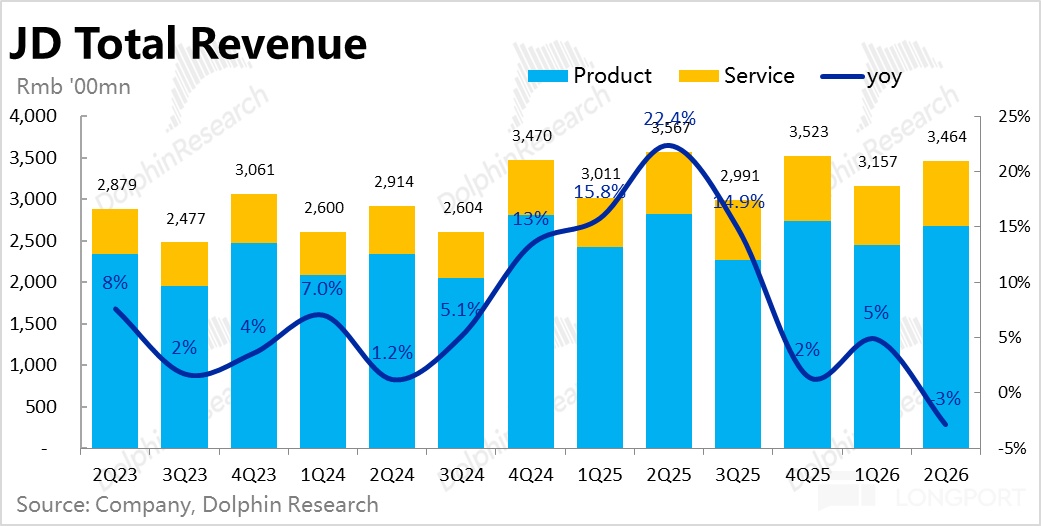
Perhaps the most 'boomer-friendly' e-comm platform in China — $JD.com.US — posted its Q2 2026 results on Aug 13 evening. Overall, the print was steady but uninspiring. Versus consensus, revenue and group profit were slightly ahead of Bloomberg, but roughly in line with, or a touch below, some bulge-bracket houses.
Trend-wise, with domestic consumption soft in Q2, total revenue turned negative YoY this quarter, which was flagged by weak retail sales and came as no surprise. While JD Retail’s profit fell YoY, group profit actually improved YoY given last year’s food-delivery price war had largely wiped out profit. The YoY comp therefore looks better at the group level.
In detail: the breakdown follows. Key points below.
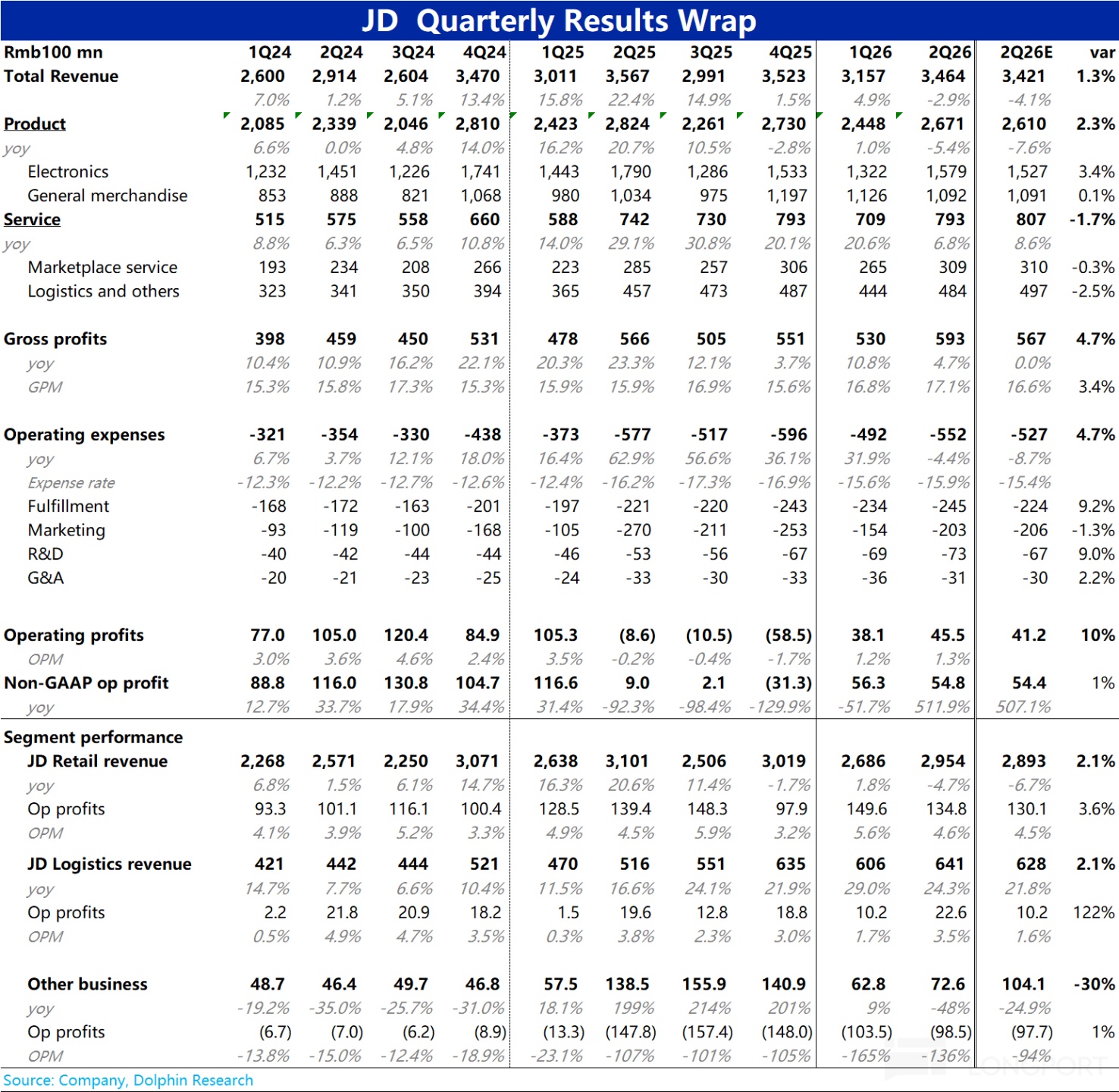
1) Revenue and profit both declined, but no shock: JD reported total revenue of approx. RMB 346.4bn, down 3% YoY, a sharper drop vs. last quarter’s -5% improving to a weaker trend this quarter. Still, it broadly matched market expectations and tracked the overall retail sales trend, so no major surprise.
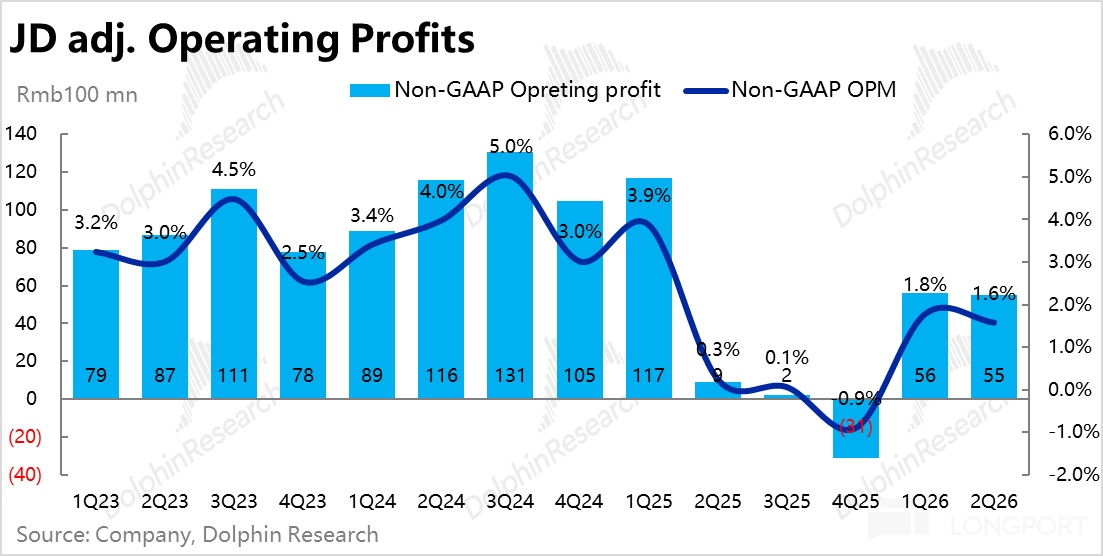
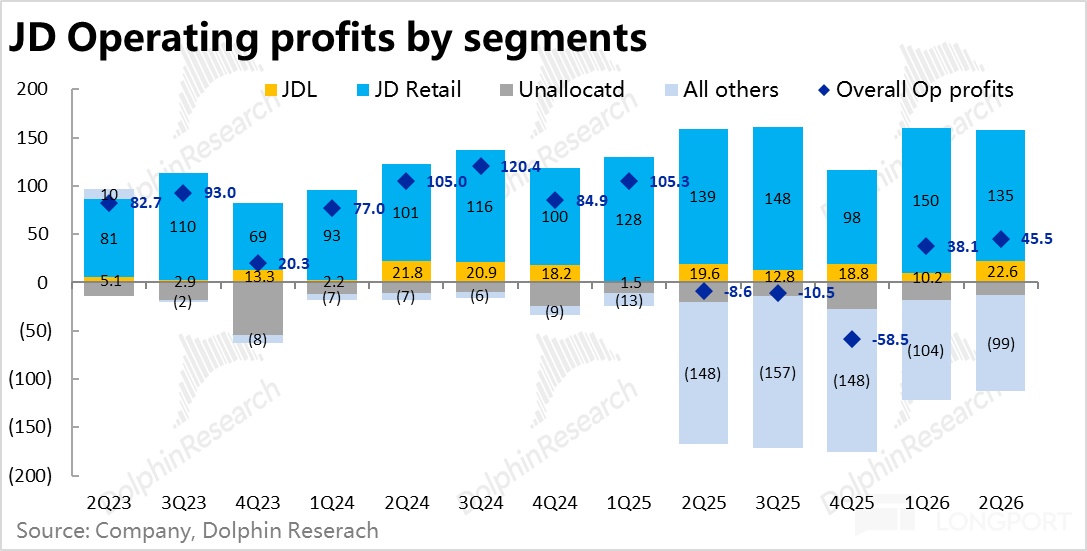
Group OP was RMB 4.55bn, adj. OP RMB 5.48bn. On an adjusted basis, it slightly beat Bloomberg but lagged some top brokers. The miss came mainly from larger-than-expected losses in new businesses, which dragged the group result.
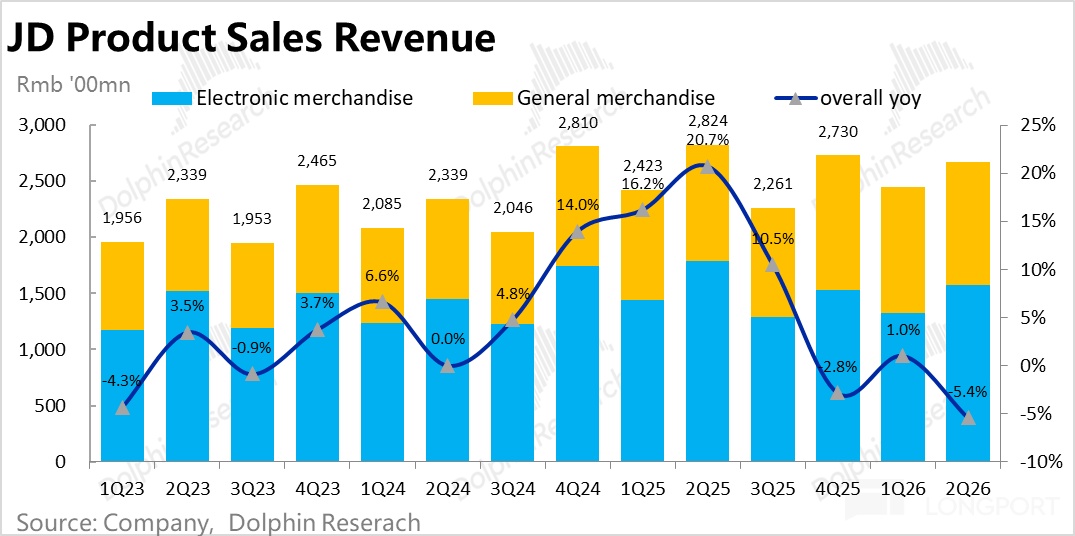
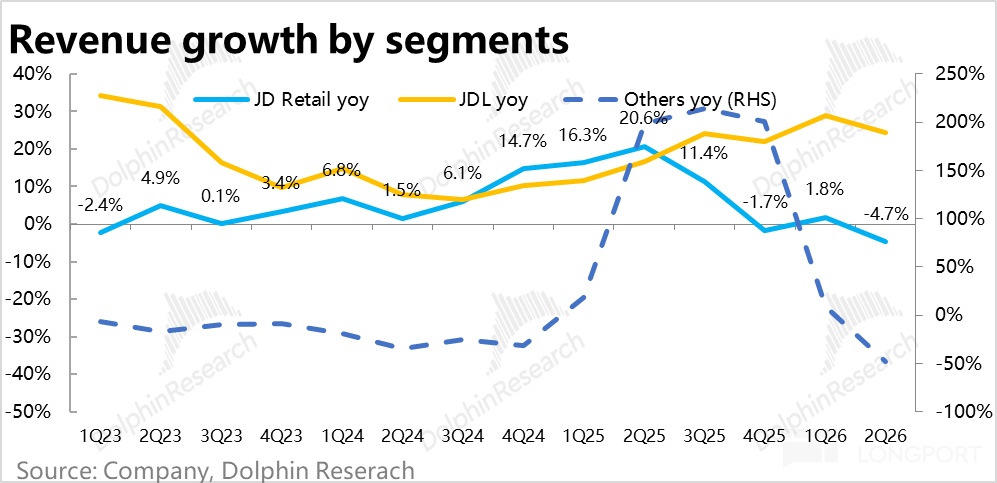
2) Sharper slowdown in general merchandise and ads: The key JD Retail segment saw revenue down ~4.7% YoY this quarter, with growth deteriorating as expected. The decline was milder than broad market estimates but broadly in line with top-tier houses.
Drilling down, the most concerning appliances and CE category deteriorated only modestly, with sales down just under 12% YoY vs. -8.4% last quarter. State subsidies likely saw a marginal rebound effect as funds began to shift back online after primarily favoring offline channels earlier.
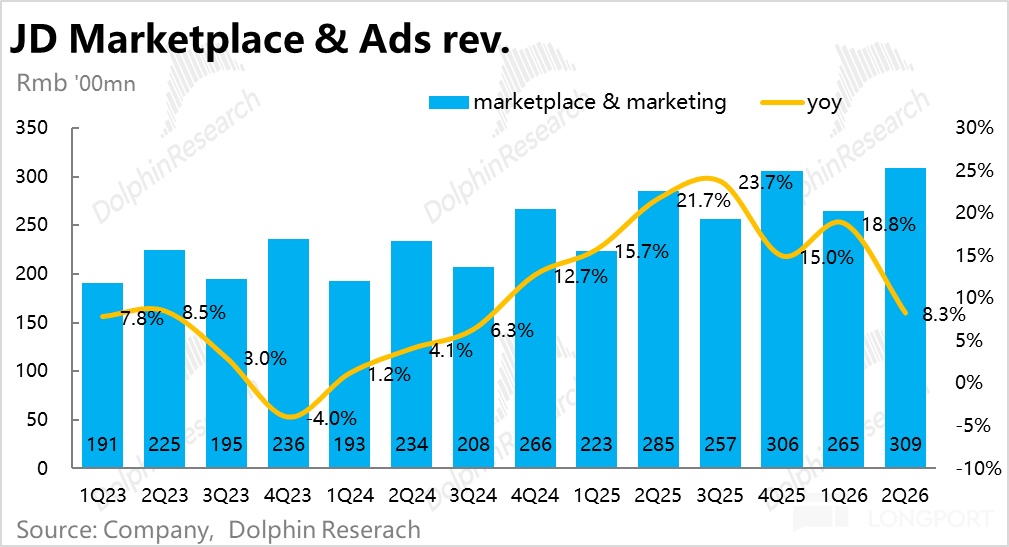
By contrast, general merchandise sales and ad services — which should be less directly hit by fading state subsidies — slowed more notably. GM growth fell from 15% to 5.6%, while ad services decelerated from ~19% to ~8%. Both dropped by about 10ppt.
While this was on many radars and has plausible drivers (weaker traffic spillover from appliances and food delivery), these two lines are JD’s mid-term growth engines. The market may question whether, even after subsidy headwinds fade, JD Retail can re-accelerate its growth run-rate (e.g., back above 10%).
3) Food-delivery war cooled; logistics and new businesses also slowed: With the high base from the food-delivery battle and order volumes falling YoY this year, logistics revenue and new businesses both decelerated this quarter.
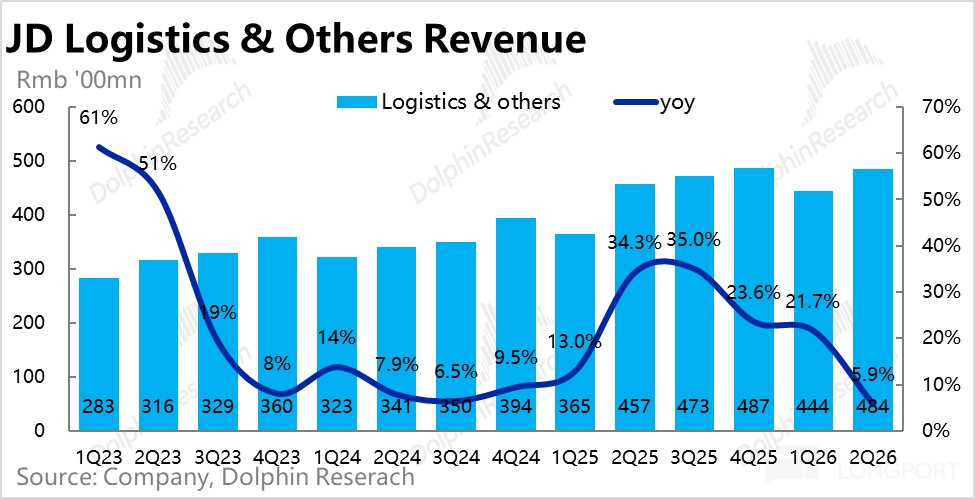
Logistics and other revenue growth slowed to 5.9%. As the food-delivery pull-through faded, growth reverted to the mid-to-high single digits seen before 2025. This is broadly a normalization.
Looking at new businesses alone, revenue rose about 15% QoQ. This implies overseas contributed more revenue this quarter.
4) Retail margin can still inch up; new-business losses slightly higher: At a high level, group profit broadly met expectations. There was no material deviation at the consolidated level.
By segment, JD Retail posted OP of nearly RMB 13.5bn, modestly above Bloomberg’s ~RMB 13.0bn. Trend-wise, it could not offset revenue contraction, with profit down about 3% YoY, thus not delivering another major beat.
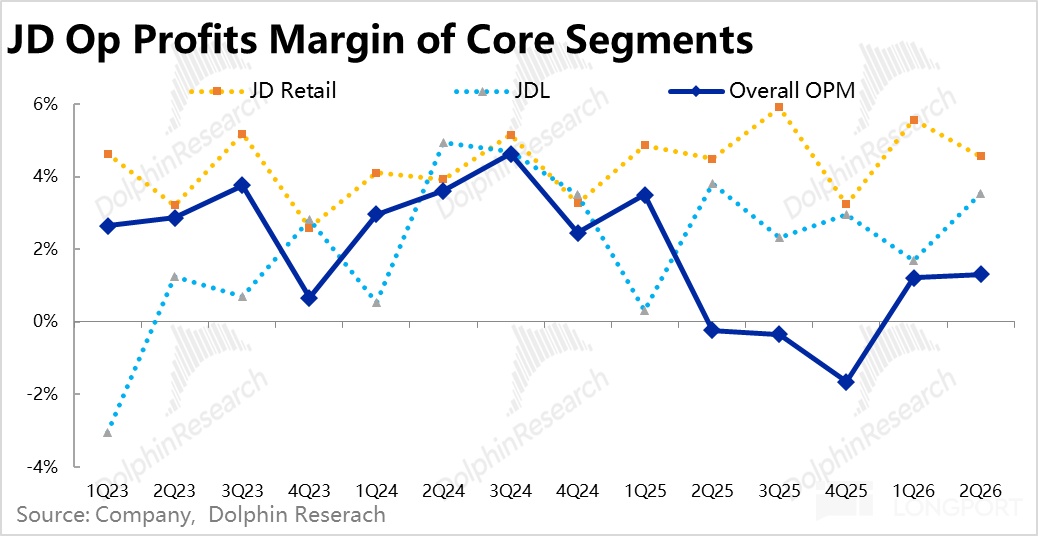
That said, margin still ticked up YoY by just under 10bps. Bulls may argue JD is lifting margins even as revenue shrinks; bears may counter that Retail’s margin upside now looks limited. Both readings reflect a narrow margin expansion.
Per management’s explanation, margin gains still came mainly from mix shifting toward higher-margin businesses and supply-chain optimization. These drivers continue to underpin the slight improvement.
For the New businesses (incl. food delivery), losses were nearly RMB 9.9bn, largely flat QoQ as we expected, and slightly worse than Bloomberg consensus losses. The drag from this bucket remains the key swing factor for group profit.
Market chatter suggests JD’s food-delivery loss likely fell ~RMB 1.0bn QoQ. That implies overseas and other initiatives stepped up by about RMB 0.5bn QoQ, which is not huge but still a headwind.
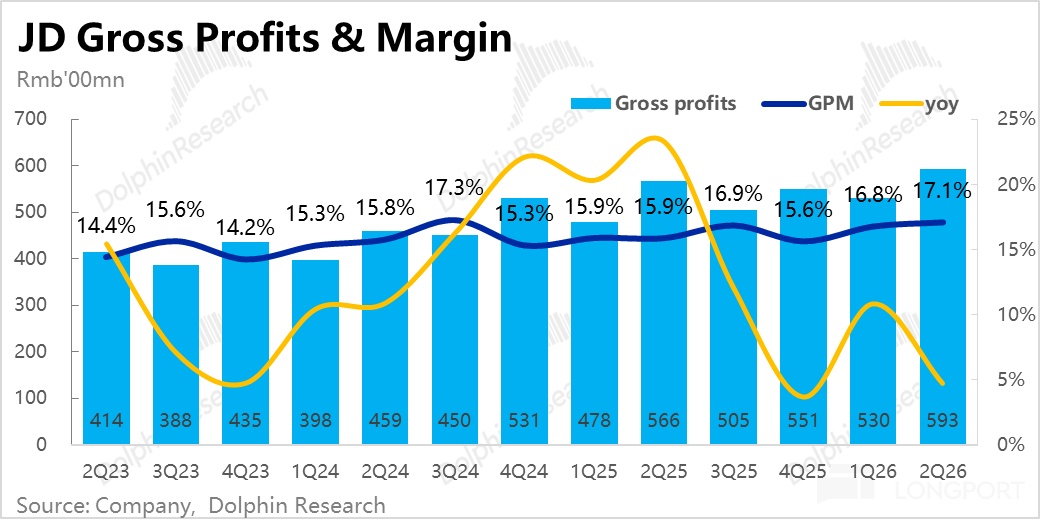
5) Costs and expenses: GPM continued to rise QoQ, from 16.8% to 17.1%, driving roughly 5% growth in GP. Mix and subsidy normalization helped.
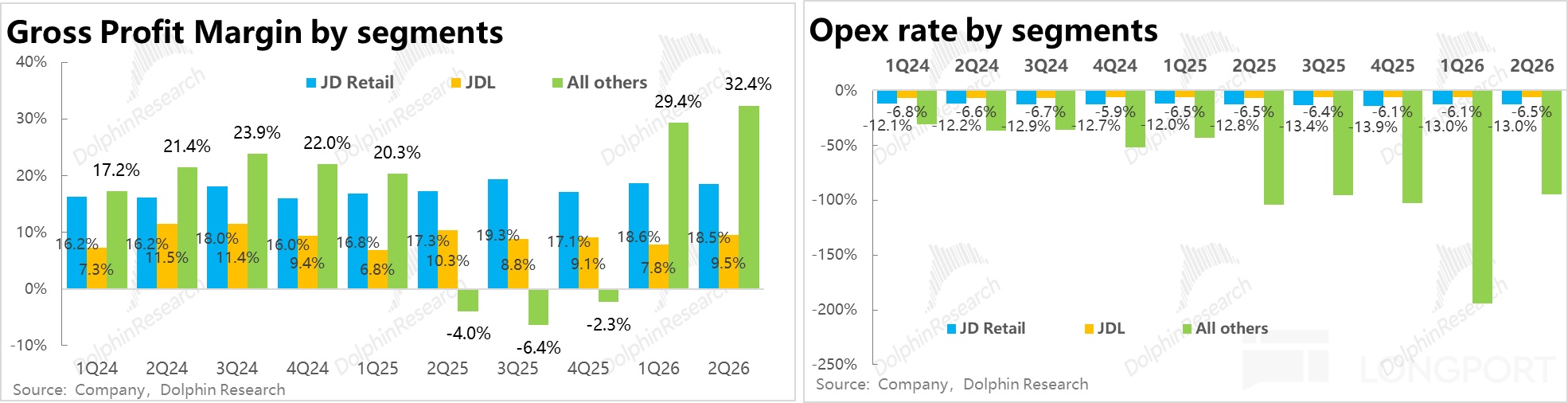
Specifically, with fewer food-delivery subsidies, GPM improved in both New businesses and Logistics, with a larger contribution from New businesses, where GPM climbed 3ppt QoQ. Retail GPM dipped ~10bps QoQ (still up 120bps YoY), suggesting limited room to squeeze more gross margin from the upstream supply chain for now.
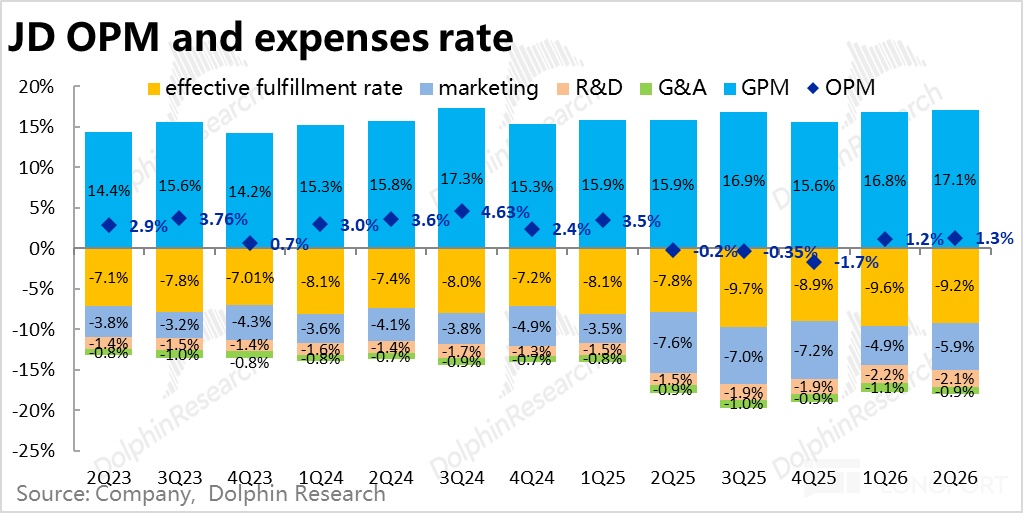
On opex, total expenses fell 4.4% YoY this quarter, a deeper cut than revenue, helping profit delivery. The main driver was a 25% YoY reduction in marketing as expected, while R&D spend still grew 38% YoY, implying JD is investing in internal AI applications even without large-scale model training.
By segment, Retail’s total expense ratio rose both QoQ and YoY by about 1ppt, indicating greater self-funded user subsidies post state-subsidy fade. This capped further margin expansion at Retail.
Group-level expense reduction mainly reflected lower investment in new businesses, down about RMB 1.8bn YoY. This was the primary lever for cost control.
6) Weaker shareholder returns; no AI splurge, focus overseas: JD used to be among the best in shareholder returns within China ADRs. Yet in 1H26, total buybacks were only about $1bn, implying an annualized yield of just ~5% on the current market cap, a clear step-down.
Unlike Alibaba or Tencent, JD has not engaged in massive AI capex, so cash-flow pressure is not high. Cash flow statement shows investment outflows of ~RMB 29.5bn this quarter, mostly into short-term investments and wealth-management products, not real capex. Choosing WMPs over returning cash to shareholders sends a poor signal.
Dolphin Research view:
1) As discussed, this print was unexciting vs. expectations. Growth slowed on macro headwinds, and while group profit looked better on smaller food-delivery losses, core Retail profit declined, so the overall result was not strong.
In short, key issues are: a) Retail revenue fell as expected, but historically Retail profit often beat by a wide margin and guidance was strong; this time was flat, hinting Retail margin expansion may be hitting a ceiling. b) Food-delivery losses narrowed, but with overseas spend, overall new-business losses barely fell. c) GM and ad growth slowed sharply; understandable, but negative for mid-term revenue outlook. d) Prefers WMPs over dividends/buybacks.
2) Outlook & logic
The print is not great — what about the road ahead? Two factors will likely determine earnings and the stock from here.
1) Can domestic e-comm sentiment inflect meaningfully in 2H? Macro retail data show Q2 was the weakest in years for both total and online retail. But June retail growth improved vs. May, with total retail rising from -0.6% to +1% and online physical from 2.6% to 3.9%.
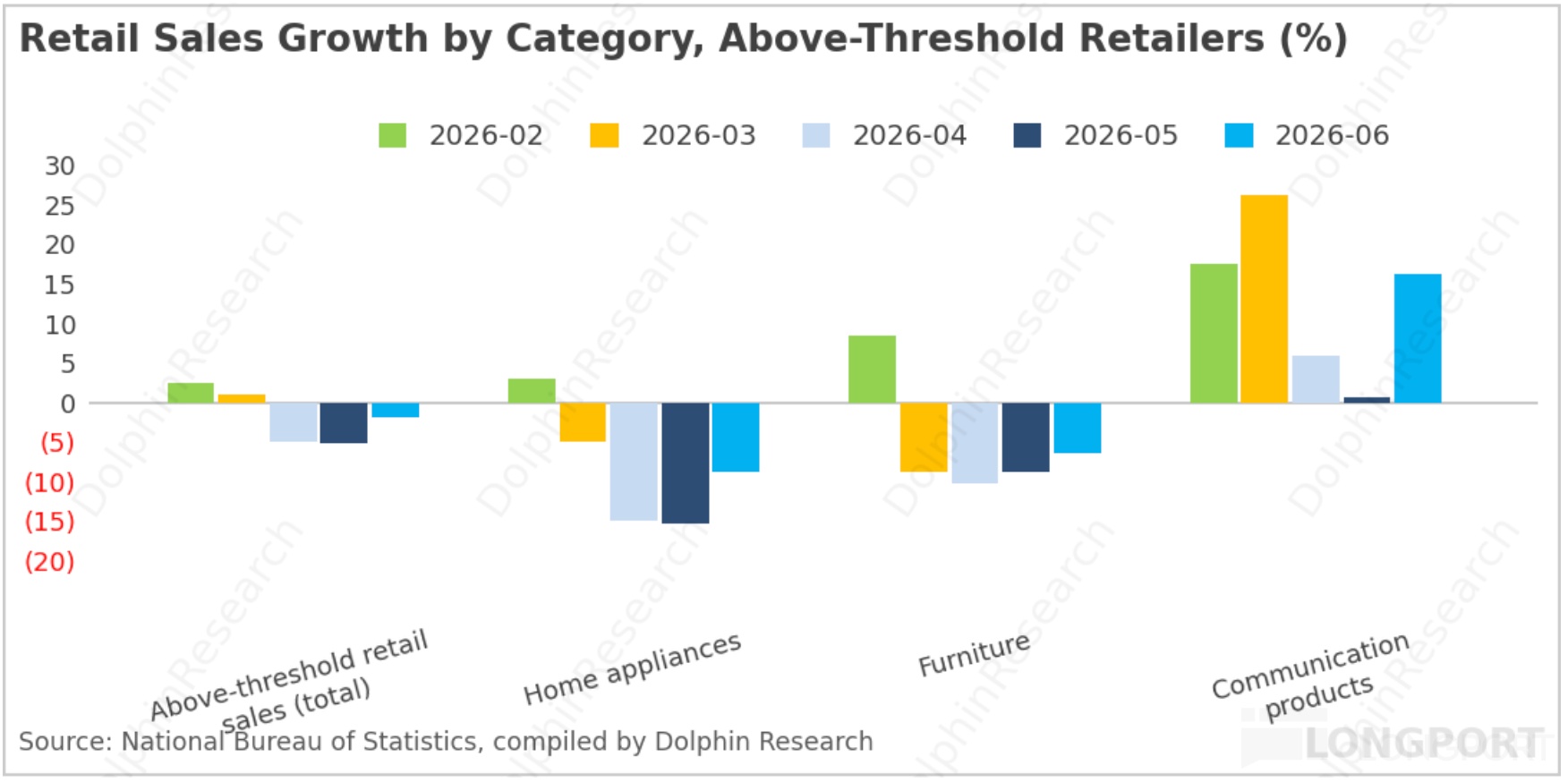
For JD’s key appliances/CE categories, NBS data show clear improvement in Jun for home appliances, furniture, and telecom products (narrower declines). The downtrend in ACE sales this quarter was also limited.
According to a foreign house, state subsidies in 2H will marginally shift back to online channels from offline. With an easing base, JD’s mid-term trend will most likely stabilize and begin to recover.
2) Another key variable is the stance on new-business investment and the path of losses, which will determine the drag on group profit. This will shape earnings quality.
As all players in the food-delivery war cut spend and improve UE, JD’s food-delivery losses will likely keep narrowing. However, with daily orders now below 20mn and unlikely to rise meaningfully without aggressive subsidies, unless JD exits food delivery entirely, losses may be structural, flattening at a 'minimum loss' level thereafter.
Given a clear ceiling for the domestic core site, diversification won’t stop. Profit elasticity partly depends on how much JD invests in Jingxi and overseas. In the near to mid term, overseas spend likely won’t fall materially, as JoyBuy is still early in its build-out, reportedly operating in ~30 cities across seven countries.
Thus, new-business losses will likely decline only gradually, with low odds of a sudden step-down. This quarter fits that pattern.
3) After several quarters of continuous upside, JD Retail’s margin did not climb further this time. For investors hoping internal efficiency gains could offset external pressure, that is disappointing.
On the bright side, JD has not joined the 'AI model arms race,' so it won’t be burdened by extreme AI capex that dents profit and cash flow. While this quarter was middling, it broadly met expectations. If domestic e-comm sentiment turns up in 2H, JD — with a relatively focused, domestic-heavy biz. mix — still offers higher earnings visibility and defensive value among China e-comm peers.
3) Valuation remains largely unchanged as the print broadly matched our expectations. For 2026, we still model Retail OP at ~RMB 56.0bn, up high single digits YoY.
We expect new-business losses (food delivery plus Jingxi and overseas) at ~RMB 36.5bn for the year, as overseas investment likely replaces the food-delivery reduction. This should not drop materially.
That implies group OP of ~RMB 19.5bn (no extra tax adjustments). On group OP vs. current market cap of ~RMB 268bn, the multiple is ~14x PE, which is rich for e-comm; on core Retail OP, the multiple is under 5x, which looks quite cheap.
Near term, we see limited earnings swing in either direction — stability first. If shareholder returns were strong, JD would suit safety-first investors. But with a weak stance on returns this time, it is hard for us to find a compelling reason to build positions now. One could trade a potential 2H e-comm recovery, but JD may not offer the most upside elasticity.
<End of text>
Dolphin Research past work on JD:
Earnings reviews
May 14, 2026 review ‘State subsidies fading? JD’s earnings power holds up’
May 14, 2026 Trans ‘JD (Trans): Q2 pressure on appliances, margin likely to improve’
Mar 6, 2026 review ‘JD: Another deep squat for the boomer? This time the rebound may be near’
Mar 6, 2026 Trans ‘JD (Trans): 1H26 appliance sales to improve’
Nov 14, 2025 review ‘JD: Even without state subsidies, still pushing on all fronts’
Nov 14, 2025 Trans ‘JD (Trans): Food delivery to be self-sustaining; overseas to see cautious, long-term investment’
Aug 14, 2025 review ‘JD: RMB 10bn profit wiped by food-delivery dreams — how long can it last?’
Aug 14, 2025 Trans ‘JD (Trans): Food delivery is a 10-year strategy; synergies emerging’
May 13, 2025 review ‘State subsidies propped up the show — time for JD to shine?’
May 13, 2025 Trans ‘JD (Trans): Food-delivery UE still hard to assess; avg. buyback price $37’
Mar 6, 2025 review ‘State subsidies helped — JD finally climbed out’
Mar 6, 2025 Trans ‘JD (Trans): ACE growth front-half strong, back-half moderate; general goods strong all year’
Deep dives
Jun 18, 2025 ‘JD’s big bet on food delivery: desperate move or careful design?’
Jun 19, 2025 ‘JD, Alibaba, Meituan all-in — is food delivery the endgame for e-comm?’
Risk disclosure and statement: Dolphin Research Disclaimer and General Disclosure
