


LENOVO GROUP, with a Market Cap of HK$440 Billion: Where Are the Profits Coming From?
LENOVO GROUP released its financial report for the first quarter of fiscal year 2026/27, reporting revenue of $26.943 billion (a 43.1% year-over-year increase) and adjusted net profit of $1.075 billion (a 176% year-over-year increase). Driven by AI businesses, revenue from infrastructure and solution services surged, pushing the stock price up by over 22% and lifting the market capitalization to a record high of HK$440 billion. All three major business segments hit historical highs; the Intelligent Devices Group achieved 27% growth despite industry weakness, demonstrating supply chain resilience
On August 13, LENOVO GROUP released its financial report for the first quarter of fiscal year 2026/27. The market reacted immediately, with the stock price rising more than 22% during trading to exceed HK$35, bringing the total market capitalization above HK$440 billion, a new historical high.
Rewinding one quarter, in late April, LENOVO GROUP’s stock price was hovering around HK$11.68, with a market capitalization of just over HK$140 billion. In three months, the market capitalization nearly quadrupled, with the cumulative gain for the year approaching threefold.
This round of revaluation in the capital markets points to a question: How is LENOVO GROUP making money now?
For a long time, LENOVO GROUP has been perceived by the outside world as a consumer electronics brand covering products such as PCs, mobile phones, and tablets. Its valuation has always carried a discount related to hardware cycles, corresponding to its Intelligent Devices Group.
With the integration of artificial intelligence technology and business operations, the other two main businesses—Infrastructure Solutions Group and Solutions & Services Group—have seen their revenues surge. The former corresponds to servers, storage, and AI computing power, while the latter is associated with maintenance, solutions, and IT services.
Consumer electronics, infrastructure, and solutions: all three businesses not only reached their respective historical highs this quarter but also integrated AI into their operations, converting it into a growth engine.
According to data disclosed by LENOVO GROUP, in the three months ended June 30, the company achieved revenue of $26.943 billion, equivalent to approximately RMB 183.4 billion, a year-over-year increase of 43.1%, setting a new quarterly historical high. Adjusted net profit was $1.075 billion, equivalent to approximately RMB 7.3 billion, a year-over-year increase of 176%, breaking through the $1 billion mark for the first time. The adjusted net profit margin also rose to 4.0%. The gross margin was 16.5%, an increase of 1.8 percentage points compared to the same period last year.
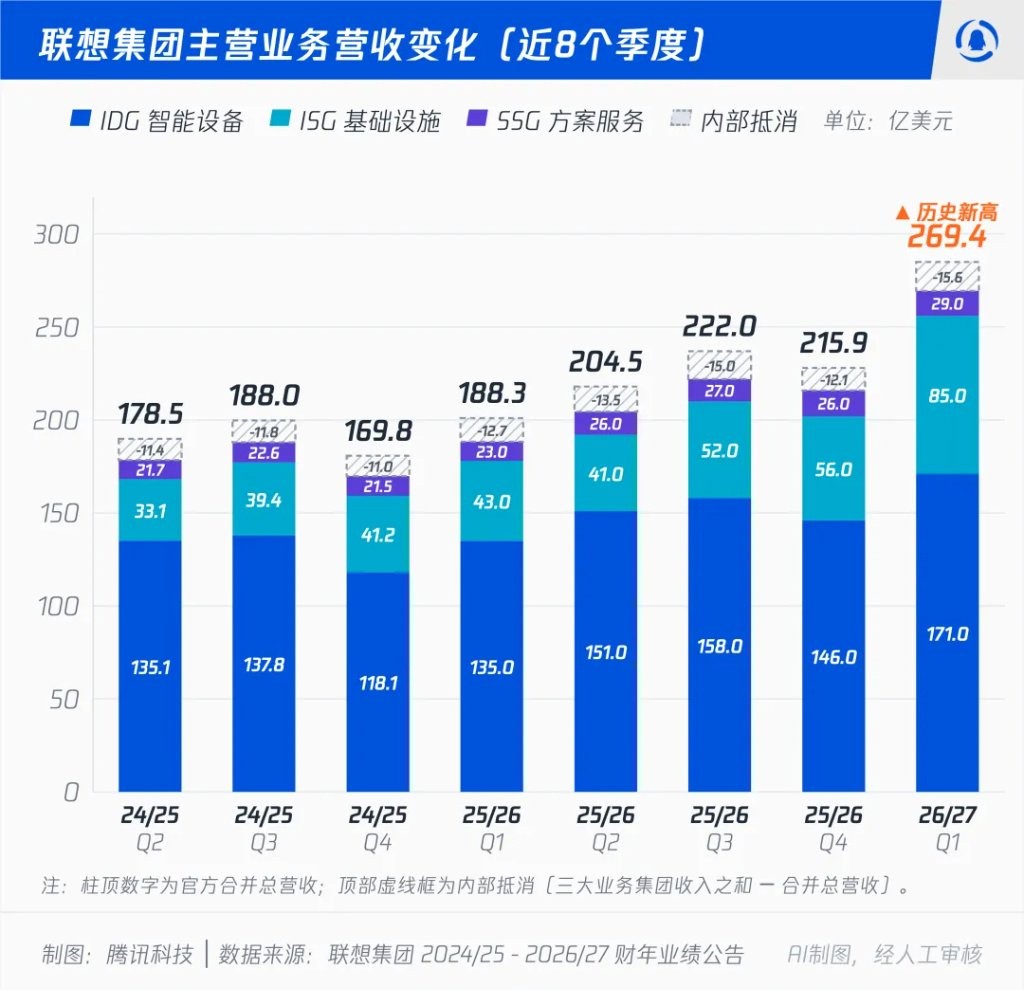
Breaking it down by business segment, the Intelligent Devices Group remains the cornerstone of revenue, contributing $17.1 billion in revenue this quarter, a 27% year-over-year increase.
It is worth noting that this 27% year-over-year growth was achieved against the backdrop of a slightly sluggish PC industry overall and soaring prices for components, led by memory.
According to IDC data, global PC shipments entered a phase of adjustment in the second quarter of 2026, declining by 4.9% year-over-year after nine consecutive quarters of growth. Storage chips remain in short supply, and costs continue to rise. In response, LENOVO GROUP emphasized that this relies on its long-established “supply chain resilience.”
In Gartner’s global supply chain rankings, LENOVO GROUP is among the top five. Meanwhile, in recent quarters, LENOVO GROUP has secured production capacity through long-term agreements with key upstream component suppliers, ensuring stable delivery rhythms amidst shortages and price hikes.
A source close to LENOVO GROUP stated that LENOVO GROUP’s supply chain is key to its growth, noting, “It has long-term cooperative relationships with major manufacturers, while others are unable to deliver goods.”
Additionally, according to data disclosed by LENOVO GROUP, its global PC market share currently stands at 24.2%, an increase of 0.5 percentage points year-over-year. This marks the tenth consecutive quarter of expanding its lead over the second-largest manufacturer, with the gap widening to 5.3 percentage points.
Compared to the Intelligent Devices Group, what truly excited the market is the second line of business: the Infrastructure Solutions Group.
According to the financial report, the Infrastructure Solutions Group generated revenue of $8.5 billion this quarter, a 98% year-over-year increase, nearly doubling. The operating profit margin improved from a loss in the same period last year to 9.1%, with operating profit reaching $777 million, a new quarterly high. Within the Infrastructure Solutions Group, AI servers are the absolute star. The report disclosed that LENOVO GROUP’s backlog of orders for AI servers reached $54 billion, a 157% quarter-over-quarter increase, covering hyperscale cloud service providers, AI clouds, and enterprise AI customers.
Public information shows that capital expenditure by Silicon Valley giants on AI continues to expand, expected to exceed $850 billion this year and reach $1.4 trillion by 2027. Much of this capital expenditure has the potential to convert into orders for LENOVO GROUP’s Infrastructure Solutions Group.
From this perspective, if the Infrastructure Solutions Group maintains the same quarter-over-quarter growth rate in the next 2-3 quarters, this business is poised to surpass the Intelligent Devices Group and become the new revenue cornerstone of the entire group.
Furthermore, the financial report revealed a key detail: excluding the impact of revenue from sales of international GPU servers in the China region during the same period last year, AI server revenue in international markets recorded triple-digit year-over-year growth. The reason for excluding “revenue from sales of international GPU servers in the China region” to assess year-over-year growth lies in the fact that this business has “gone to zero”—no overseas GPU servers were sold in the China region this quarter. Therefore, the base from the same period last year included a portion of revenue that has disappeared this year; failing to exclude it would distort the year-over-year growth of the Infrastructure Solutions Group.
From this angle, LENOVO GROUP’s AI server orders mainly come from overseas customers, and the triple-digit growth aligns precisely with the continuous expansion of capital expenditure by overseas hyperscale cloud providers.
The third line contributing to LENOVO GROUP’s revenue is the Solutions & Services Group: it contributed $2.9 billion in revenue this quarter, a 28% year-over-year increase, with an operating profit margin of 24.2%.
Although the revenue volume of the Solutions & Services Group is smaller than the other two segments, it possesses sustained growth momentum and features high gross margins. In comparison, the role of this segment is to gradually expand high-margin, recurring revenue beyond hardware, thereby enhancing the overall gross margin of the group.
The combined revenue of $26.943 billion contributed by the three business lines was the key catalyst for LENOVO GROUP’s market capitalization surge of HK$300 billion in the past quarter. Among them, the PC business maintained its market share and achieved counter-trend growth relying on its supply chain and long-term agreements; the AI server business supported near-doubling growth rates through its order backlog and volume expansion in international markets; and the services business provided support for profit margins.
The main thread running through these three business lines is AI. This is why, since the previous quarter, there has been a view that AI has become LENOVO GROUP’s new growth engine, a trend reflected in the financial data. In the first fiscal quarter, LENOVO GROUP’s AI-related revenue increased by 60% year-over-year to RMB 63.4 billion, accounting for 35% of the group’s total revenue; R&D investment also grew by approximately 30% year-over-year.
It can be said that three months ago, the market might still have been pricing LENOVO GROUP using the valuation model of a PC manufacturer. Now, the pricing framework will focus heavily on expectations for AI server orders and infrastructure profitability. The key lies in how the $54 billion backlog of AI server orders disclosed in the financial report converts into revenue.
Risk Warning and Disclaimer
The market carries risks; investment should be approached with caution. This article does not constitute personal investment advice, nor does it take into account the specific investment objectives, financial status, or needs of individual users. Users should consider whether any opinions, views, or conclusions in this article are suitable for their specific circumstances. Investment based on this content is at the user’s own risk.
