


U.S. Stock Outlook | Three Major Index Futures Rise Together, U.S. July PPI to be Announced Tonight, Lenovo's Performance Boosts HP and Dell
On August 13th, before the US stock market opened, the three major stock index futures rose together. Major European indices showed mixed results, and oil prices fell. The Japanese yen approached the 160 mark, with the market focusing on expectations of interest rate hikes by the Bank of Japan and potential intervention measures. Iran stated that it would exhaust the United States through a protracted war and criticized the US for lacking strategy
Pre-Market Market Trends
- As of August 13 (Thursday), U.S. stock index futures are all up before the market opens. As of the time of writing, Dow futures are up 0.30%, S&P 500 futures are up 0.22%, and Nasdaq futures are up 0.12%.

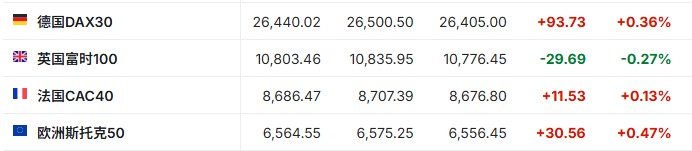
- As of the time of writing, the German DAX index is up 0.36%, the UK FTSE 100 index is down 0.27%, the French CAC40 index is up 0.13%, and the Euro Stoxx 50 index is up 0.47%.
- As of the time of writing, WTI crude oil is down 2.16%, priced at $81.47 per barrel. Brent crude oil is down 1.88%, priced at $87.13 per barrel.

Market News
The yen is once again approaching the critical level of 160, with interest rate hike expectations failing to stop the decline. Even after insiders reported that Prime Minister Fumio Kishida's government supports an interest rate hike, the yen remains near the critical level against the U.S. dollar. On Thursday, the yen stabilized, trading around 159.36 per dollar. Historically, when the exchange rate approaches 160, it usually indicates that the government may intervene to support the yen. According to insiders, the next interest rate adjustment may occur in September or October. They added that the central bank's concerns about the yen's weakness driving up prices, along with the government's desire to enhance the recent effectiveness of U.S.-Japan currency intervention, have led to a consensus on the necessity of a rate hike. Investors say this news has little impact on the yen, as the market has already anticipated that the Bank of Japan will raise interest rates. Due to Japan's significant interest rate gap with the U.S. and heavy debt burden, the yen has continued to weaken recently.
Iran claims it will exhaust the U.S. through a protracted war. In an interview aired on U.S. public television (PBS) on August 11, Major General Mohammad Reza Naqdi, an advisor to the commander of the Iranian Revolutionary Guard, pointed out that the two main objectives of the U.S. war against Iran—overthrowing the Iranian leadership and dividing Iran—have "already failed," and "victory is on Iran's side." Naqdi stated that he has seen the confusion and disorientation of the U.S. in this war, noting that "the U.S. announces a new goal every few days, turning it into a war 'without strategy'." Naqdi also emphasized that Iran will continue to achieve victories, and in over five months of combat with the U.S., Iran has not only gained experience but has also seen that the U.S. military is weaker than expected—while Iran must achieve deterrence so that enemies will never dare to attack Iran again, one way to do this is to "prolong the war" and exhaust the U.S., so that in the future, if anyone wants to attack Iran, "they will first weigh the cost they have to pay." Bank of America: In the era of AI, CPUs need to match GPUs "1:1." The wave of Agentic AI is fundamentally changing the computing architecture of data centers, significantly elevating the strategic position of CPUs. In its latest research report, Bank of America Securities raised the total addressable market (TAM) for server CPUs in 2030 to over $210 billion, an increase of more than 20% from the previous estimate of about $170 billion, and adjusted the compound annual growth rate expectation from 30% to 36%. The core logic behind this adjustment is that as AI workloads evolve from training to inference and then to Agentic AI, the role of CPUs in data center systems is upgrading from a "supporting role" to GPUs to a "control plane" orchestrated by agents. Bank of America expects the ratio of CPUs to GPUs to narrow from about 1:4 during the training era to about 1:2 in the AI inference phase, and ultimately approach 1:1 in the Agentic AI era. This means that by 2030, CPUs will account for about 10% of the overall TAM of approximately $2.2 trillion for data center systems, up from less than 7% during the training era of 2024 to 2025.
Key "strengthening" before the IPO? Reports suggest Anthropic is negotiating a $6 billion acquisition of Decart AI, aiming at optimizing AI computing efficiency. With only a few weeks left before the highly anticipated initial public offering (IPO), AI giant Anthropic PBC is accelerating its technology moat through acquisitions. According to insiders, this AI star company is in deep negotiations to acquire Israeli AI infrastructure startup Decart AI, with a deal valuation of about $6 billion. If this deal is finalized, it will become Anthropic's largest acquisition to date and its most critical "technological strengthening" move before the IPO—it's worth noting that NVIDIA was originally a potential buyer for this deal but was outmaneuvered by Anthropic as negotiations neared completion.
South Korea's central bank buys gold assets for the first time in 13 years, may continue to increase holdings. The Bank of Korea has purchased gold-related assets for the first time in 13 years to hedge against geopolitical and economic uncertainties. According to a filing with the U.S. Securities and Exchange Commission, the Bank of Korea held 679,765 shares of SPDR Gold Shares, valued at approximately $250 million, as of the end of the second quarter. The filing shows that three months ago, the bank did not hold any shares of the world's largest physically-backed gold ETF. The Bank of Korea stated that this investment is its first purchase of gold-linked assets since 2013. This purchase will not increase the bank's official gold reserves, as gold ETFs are classified as securities and are part of foreign exchange reserves. Hanwha Investment & Securities economist Choi Kyuho stated, "The Bank of Korea currently has a relatively low allocation to gold. From the perspective of aligning with global standards, there is still room for the Bank of Korea to purchase more gold. I believe they will gradually increase their gold holdings."
Individual Stock News
Lenovo's performance boosts HP (HPQ.US) and Dell (DELL.US). In pre-market trading on Thursday, HP and Dell shares rose 7% and 4%, respectively, after PC peer Lenovo reported better-than-expected first-quarter results. Lenovo's revenue for the quarter ending June 30 increased by 43.1% year-on-year to $26.94 billion, marking the highest growth rate in five years and the strongest quarter in the company's history. Factors driving the quarterly performance include strong results across all business units, with the Infrastructure Solutions Group's revenue nearly doubling (up 98% year-on-year) to $8.5 billion.
Apple (AAPL.US) reportedly negotiating to pay publishers to enhance its AI Siri. According to insiders, Apple is in talks with publishers for a new collaboration agreement aimed at using their content to provide the latest news and information, with the goal of improving the performance of its AI voice assistant Siri. Insiders revealed that Apple has been engaging with publishers over the past few months, and the proposed multi-year agreement would allow Apple to gain rights to use relevant content, thereby enhancing Siri's capabilities, which is expected to launch later this year. Some insiders indicated that Apple has proposed a variable payment scheme, paying partner publishers based on content usage. They also disclosed that Apple has discussed a potential budget of up to several hundred million dollars.
High tariffs and technical restrictions put dual pressure: Ford (F.US) will move part of Lincoln production back to the U.S. starting in 2030. Ford's CEO stated on Wednesday that the company plans to shift some Lincoln model production from China to the U.S. starting in 2030. Both gasoline and electric vehicles imported from China are subject to high tariffs. Ford confirmed that the U.S. tariff rate for the Lincoln Navigator, a major model imported from China, has reached 52.5%. Farley stated that as part of a significant production expansion initiative, Lincoln models produced in the U.S. will be sold in the domestic market, although the company did not disclose specific production locations. In addition to tariffs, automakers also face restrictions from the Connected Vehicle Rule, which prohibits the use of certain Chinese technologies and hardware in vehicles sold in the U.S. Farley noted that these two regulations jointly prompted Ford's decision, but he emphasized that tariffs are the core driving factor.
Starship's 14th test flight may arrive by the end of the month! UBS: It will be a key flight for SpaceX (SPCX.US) to accelerate growth. According to previous reports, SpaceX CEO Elon Musk announced during the company's first quarterly earnings call that the 14th test flight of Starship is scheduled for late August. UBS analyst Gavin Parsons pointed out that this test flight could mark a significant turning point—from proving that the giant rocket can operate normally to demonstrating the capabilities needed to support the company's ambitious growth plans. It is reported that Musk plans to conduct the 14th test flight of Starship before the end of August. This test flight will feature two major technological breakthroughs—launching the first batch of upgraded Starlink V3 satellites into orbit and attempting to recover the upper stage of Starship via the ground launch tower for the first time Elon Musk stated that the 14th test flight of the Starship marks a significant leap in the development of this reusable rocket. He also revealed that whether to attempt a land recovery during the 14th flight depends on the data performance from the 13th test flight and the final approval from regulatory agencies such as the Federal Aviation Administration (FAA). If approved, SpaceX will use a giant mechanical arm installed on the launch tower in Texas to capture and recover the upper stage of the Starship, which is approximately 52 meters tall, in mid-air. Previously, SpaceX has successfully used this technology multiple times to recover the Super Heavy booster (first stage).
Paramount (PSKY.US) is considering selling CNN to resolve an antitrust lawsuit from 12 states. According to reports, Paramount's Chief Legal Officer Makan Delrahim stated on Wednesday that selling CNN is one of the options to resolve the antitrust lawsuit from 12 states, which threatens the company's plan to acquire Warner Bros. Discovery (WBD.US) for $110 billion. This move shows Paramount's willingness to take actions beyond internal safeguards to save one of the most politically charged media mergers in recent years. Meanwhile, reports indicate that Paramount had discussed establishing an editorial board for CNN and implementing other safeguards to maintain its editorial independence, with related internal discussions even starting before the antitrust lawsuit was filed. The company responded cautiously: "We have always been open to internal improvements that enhance journalistic integrity."
Important Economic Data and Event Forecast
Beijing time 20:15: 2026 FOMC voting member and President of the Cleveland Federal Reserve, Loretta Mester, will deliver a speech.
Beijing time 20:30: U.S. July PPI year-on-year, U.S. initial jobless claims for the week ending August 8.
Beijing time 20:40: 2027 FOMC voting member and President of the Richmond Federal Reserve, Thomas Barkin, will speak on the economic outlook.
Earnings Forecast
Friday morning: Applied Materials (AMAT.US), Agora (API.US)
Friday pre-market: RLX Technology (RLX.US)
