


JD.com Q2 Revenue Falls Nearly 3% Year-on-Year but Still Beats Expectations; Drag from Food Delivery Business Weakens; Operating Profit Turns Profitable Year-on-Year | Financial Report Insights
In the second quarter of 2026, JD.com's revenue was RMB 346.4 billion, a slight year-on-year decrease of 2.9% but exceeding market expectations; operating profit turned from a loss to a profit of RMB 4.5 billion, with significant restoration of profitability. Core retail profit margin hit a new high during the major promotional season, while new businesses such as food delivery continued to reduce losses, and marketing expenses contracted significantly. With both profits and cash flow improving, the company is shifting from scale expansion to a development stage that places greater emphasis on efficiency and earnings quality
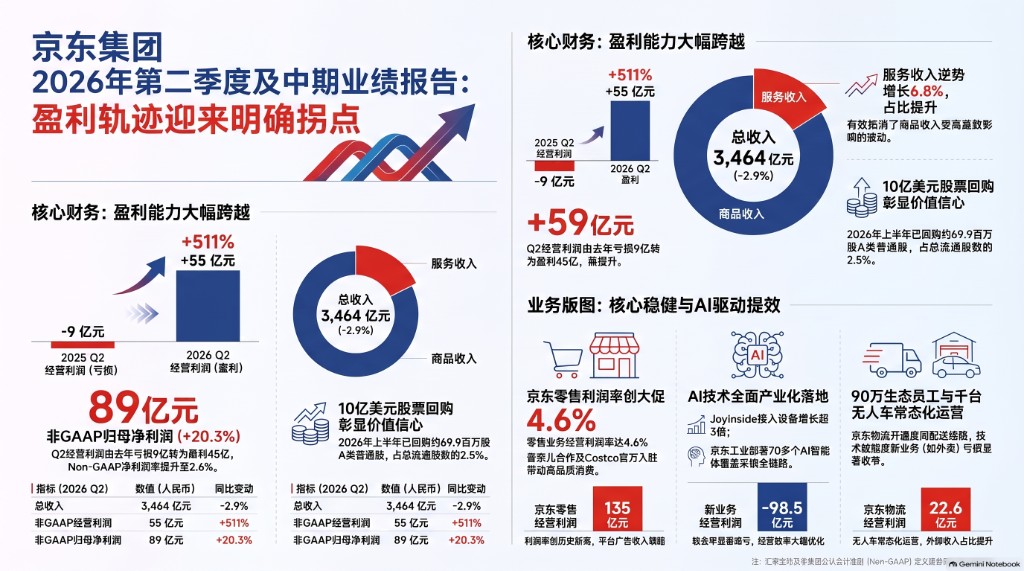
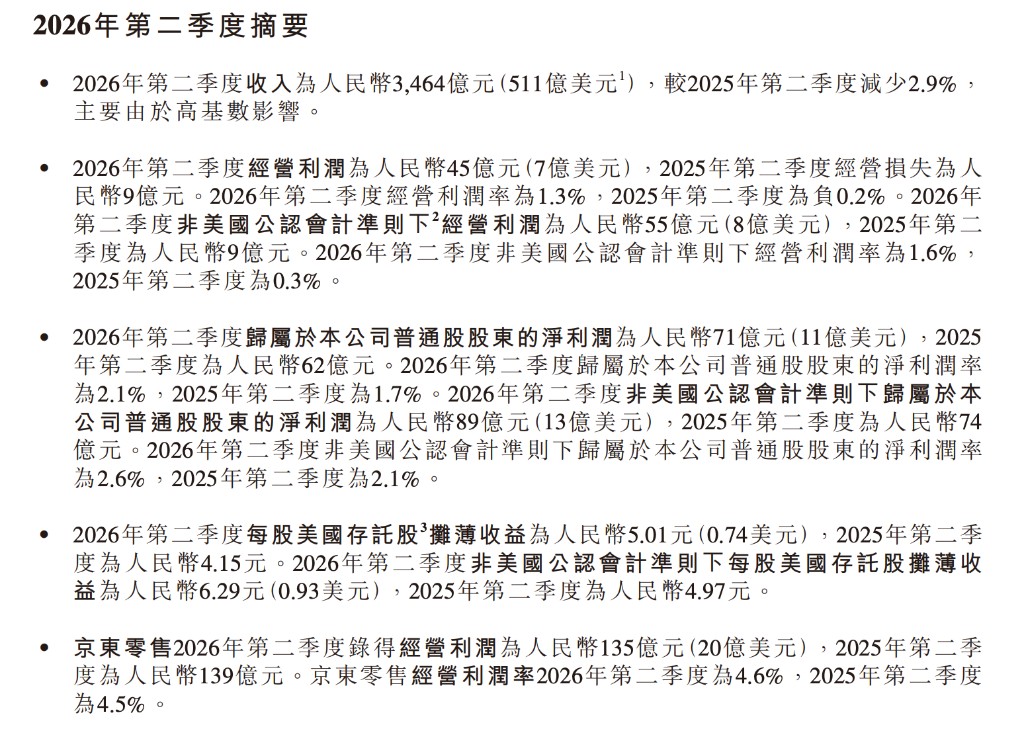
On August 13, JD.com released its financial results for the second quarter and first half of 2026. The financial report showed that revenue for the quarter was RMB 346.4 billion, a slight year-on-year decrease of 2.9%, but higher than the Bloomberg consensus expectation of RMB 342.1 billion. Although the revenue side faced pressure, the overall performance remained better than market expectations.
Compared to revenue performance, the improvement in profits was more prominent. Operating profit in the second quarter turned from a loss of RMB 900 million in the same period last year to a profit of RMB 4.5 billion, while non-GAAP operating profit also increased from RMB 900 million to RMB 5.5 billion, indicating a significant restoration of profitability. Meanwhile, cash flow improved synchronously, with the dual improvement in profits and cash becoming the core highlight of this quarter's financial report.
The improvement in profitability was mainly driven by two factors: the core retail business maintained robust profitability, while new businesses such as JD Food Delivery continued to reduce losses. In addition, the growth rate of service revenue continued to outpace product revenue, coupled with a significant contraction in marketing expenses, leading to continuous optimization of the revenue structure and further recovery in overall profit margins.
The CEO of JD.com stated, "The results for the second quarter reflect our steady and high-quality operations. Despite short-term headwinds facing revenue, we achieved strong net profit growth, marking a clear turning point in our profitability trajectory. This improvement was primarily driven by the robust profitability of JD Retail's core business and the continuing narrowing of losses at JD Food Delivery."
Revenue Under Pressure, Service Revenue Continues to Outpace Product Revenue
In the second quarter, JD.com achieved revenue of RMB 346.4 billion, a year-on-year decrease of 2.9%.
Of this, product revenue was RMB 267.1 billion, a year-on-year decrease of 5.4%. Revenue from electronics and home appliances was RMB 157.9 billion, a year-on-year decrease of 11.8%, becoming the main drag, with a relatively obvious high-base effect. In contrast, revenue from general merchandise was RMB 109.2 billion, a year-on-year increase of 5.6%, with non-standard categories continuing to grow.
Service revenue showed more resilience, increasing by 6.8% year-on-year to RMB 79.3 billion in the second quarter. Of this, platform and advertising service revenue was RMB 30.9 billion, an 8.3% year-on-year increase; logistics and other service revenue was RMB 48.4 billion, a 5.9% year-on-year increase.
Looking at the first half of the year, service revenue increased by 12.9% year-on-year, significantly faster than product revenue. The increasing proportion of high-margin service business remains an important lever for JD.com to improve revenue quality and profitability.
Retail Profit Margin Hits New High During Major Promotional Season
JD Retail's revenue in the second quarter was RMB 295.4 billion, a year-on-year decrease of 4.7%, but operating profit reached RMB 13.5 billion, with the operating profit margin rising from 4.5% to 4.6%, hitting a historical high for major promotional seasons.
Management stated that the improvement in profit margins mainly came from increased gross margins in key categories, as well as the relatively fast growth of platform and advertising revenue. During the 618 shopping festival, the transaction volume of approximately 2,000 fashion brands doubled year-on-year, and Chanel's flagship store joined JD.com, further expanding the company's layout in the fashion and luxury sectors.
JD LOGISTICS maintained relatively fast growth, with revenue of RMB 64.1 billion in the second quarter, a 24.3% year-on-year increase; operating profit was RMB 2.26 billion, with an operating profit margin of 3.5%. The instant delivery business shifted to directly serving external third-party merchants starting in the first quarter of this year, which also drove changes in the revenue structure of the logistics business.
Marketing Expenses Drop Significantly, R&D Investment Increases Against the Trend
Changes on the expense side were also evident.
In the second quarter, JD.com's marketing expenses were RMB 20.3 billion, a year-on-year decrease of 24.8%, with the proportion of revenue dropping from 7.6% to 5.9%. As new businesses such as food delivery entered the efficiency optimization phase, the company significantly contracted related marketing investments, which was one of the important sources of profit improvement.
General and administrative expenses were RMB 3.1 billion, a year-on-year decrease of 4.7%.
In contrast, R&D expenses increased by 37.7% year-on-year to RMB 7.3 billion, with the proportion of revenue rising from 1.5% to 2.1%. AI remains an important direction for R&D investment, with products such as the JoyAI large model, JD Industrial's JoyIndustrial, and JD Health's "Jingyi Qianxun" continuing to advance implementation.
Fulfillment expenses increased by 10.4% year-on-year to RMB 24.5 billion, with the proportion of revenue rising to 7.1%, mainly related to the optimization of fulfillment capabilities and increased labor input.
Food Delivery Continues to Reduce Losses, New Businesses Pass the Most Cash-Burning Stage
New businesses generated revenue of RMB 7.26 billion in the second quarter, a year-on-year decrease of 47.6%; operating loss was RMB 9.85 billion, a significant narrowing of nearly RMB 5 billion compared to RMB 14.8 billion in the same period last year.
Affected by the decline in the revenue base, the operating loss ratio of new businesses rose to 135.7%, higher than 106.7% in the same period last year, but this was mainly a ratio effect caused by revenue contraction, not a deterioration in operating efficiency. More noteworthy is that the absolute amount of losses is decreasing rapidly, with a clear trend of loss reduction.
Among them, JD Food Delivery was the main contributor to loss reduction. As the scale of investment contracts, operating efficiency improves, and revenue sources diversify, the food delivery business has gradually shifted from a high-investment expansion phase to a development stage emphasizing both efficiency improvement and structural optimization. Businesses such as Joybuy and Jingxi are steadily advancing investment as planned.
According to JD.com's announcement, in the second quarter of 2026, JD Food Delivery maintained high-quality development, with the scale of investment narrowing significantly year-on-year, and improvements driven jointly by enhanced operating efficiency and revenue diversification. During the same period, other new businesses also made steady progress. European online retail business Joybuy launched the "Summer Black Friday" major promotional activity in the second quarter. During the event, the "211 Timed Delivery" and "Delivery and Installation Integrated" services effectively drove strong sales of quality home appliances and tech products.
Management's core judgment on new businesses is changing: the strategic focus is gradually shifting from scale growth to placing greater emphasis on return on investment and the clarity of the profitability path. This shift is reshaping the resource allocation and development logic of new businesses.
Dual Improvement in Profits and Cash Flow
The magnitude of improvement on the profit side exceeded that on the revenue side.
Net profit attributable to ordinary shareholders in the second quarter increased by approximately 15% year-on-year to RMB 7.1 billion; non-GAAP net profit reached RMB 8.9 billion. The net profit margin rose to 2.6%, and non-GAAP diluted earnings per ADS were RMB 6.29, a 26.5% year-on-year increase.
Cash flow performance was also strong. Net cash flow from operating activities in the second quarter was RMB 37.8 billion, a 54.5% year-on-year increase; free cash flow was RMB 31.8 billion, a 44.6% year-on-year increase. The rolling free cash flow for the past 12 months reached RMB 31.4 billion, a substantial increase from RMB 10.1 billion in the same period last year.
As of the end of June, JD.com held a total of RMB 235.1 billion in cash and cash equivalents, restricted cash, and short-term investments, higher than RMB 225.4 billion at the beginning of the year.
While having ample cash, the company continues to return capital to shareholders through buybacks. In the first half of the year, it cumulatively repurchased approximately 69.9 million Class A ordinary shares, equivalent to approximately 34.9 million ADSs, costing about USD 1 billion, accounting for approximately 2.5% of outstanding shares; the existing buyback plan still has approximately USD 1 billion remaining.
AI Moves from "Tool" to "Expert"
AI is becoming an important lever for improving business efficiency in JD.com's next stage.
JD Industrial upgraded JoyIndustrial from an "AI tool" to an "AI expert," deploying over 70 AI agents in the first half of the year, covering procurement, fulfillment, and other links, and launching the "AI Smart Procurement Manager" service for small, medium, and micro enterprises.
JD Health upgraded its AI doctor "Dawei," with the number of users served during the 618 period increasing by nearly four times year-on-year; the cumulative number of devices connected to JoyInside increased by more than three times compared to last year's Double 11 shopping festival.
Meanwhile, Costco and JD.com reached an agreement making JD.com its sole official e-commerce partner in China, leveraging JD.com's supply chain system to carry out delivery services.
From the financial report, the core change for JD.com currently is not a return to high-speed revenue growth, but rather, while under revenue pressure, driving the release of profits and cash flow through improved profitability in the retail business, loss reduction in new businesses, expense control, and an increased proportion of service revenue.
On this basis, AI is further penetrating into supply chain, logistics, industrial, and medical businesses. For JD.com, whether it can transform its existing supply chain and fulfillment capabilities into competitive advantages in the AI era will become the focus of market attention in the next stage.
