


"The Big Short" Investor Strikes Again: NVIDIA's AI Expansion Has "Echoes of Enron," with Risks "Orders of Magnitude Higher"
Michael Burry compares NVIDIA's AI expansion to the Enron scandal, warning that its risks are "orders of magnitude higher." This criticism from "The Big Short" investor comes at a sensitive time as NVIDIA announces a $500 billion chip financing framework. Meanwhile, Burry's most profitable venture this year may not be stock trading; his blog has 300,000 subscribers, generating a theoretical annual revenue of approximately $113.7 million based on a $379 annual fee
Michael Burry, the investor known for short-selling and the real-life prototype for the movie The Big Short, has compared NVIDIA's current AI business expansion to the 2001 Enron financial scandal. He warned that the potential harm to the economy and investors far exceeds that of the Enron incident, adding a significant bearish voice to the market debate surrounding AI capital expenditure and tech stock valuation risks.
On August 13, Burry posted on social media platform X, stating, "This is much bigger than one company. The danger to the economy and to investors is orders of magnitude greater than Enron," attaching a report from the UK's The Daily Telegraph titled "Nvidia's AI push has echoes of Enron."
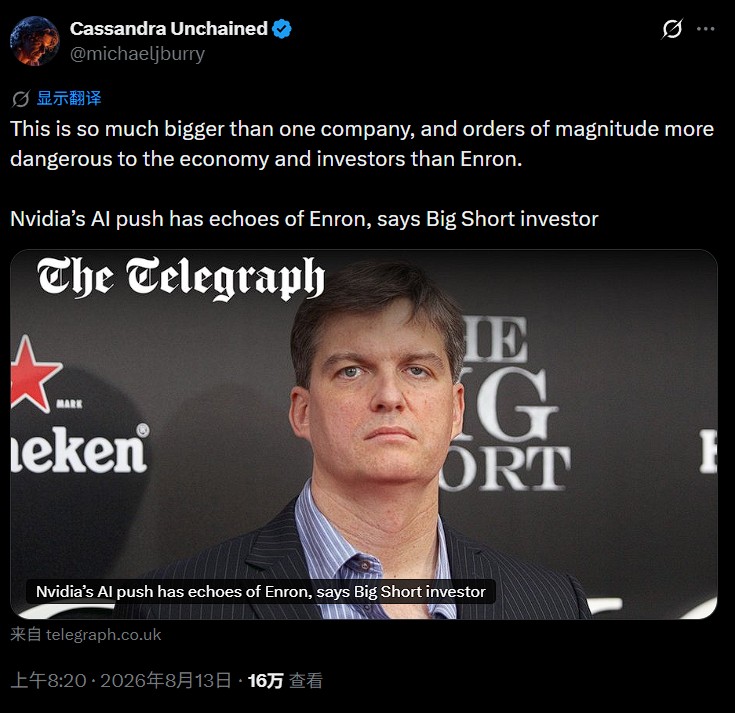
The comments spread rapidly after being reposted by AI critic Gary Marcus.
This warning arrives at a highly sensitive moment for the market. Just this week, NVIDIA announced a partnership with top Wall Street institutions to establish a $500 billion chip financing framework. Its five-year credit default swap (CDS) spreads have surged by approximately 90% year-to-date, reflecting growing concerns in the credit market about its financial structure.
This is not the first time Burry has questioned NVIDIA's financing arrangements. After NVIDIA's $500 billion financing plan sparked controversy over "circular financing," he voiced concerns about credit structuring on Substack. Now, he has taken the analogy further by pointing directly to Enron.
From "Circular Financing" to "Enron Analogy"
Burry's skepticism toward NVIDIA is not without precedent. Burry, who previously shorted mortgage-backed securities and has recently bet against AI stocks like NVIDIA, stated plainly on Substack:
"Credit structuring is a natural part of the financial system. But structuring unnatural credit to sustain momentum in the late stages of a bull market is where the real concern lies."
On August 13, he escalated the analogy to Enron. According to The Daily Telegraph, Burry reposted the article "Nvidia's AI push has echoes of Enron, says Big Short investor" on X, stating that NVIDIA's AI expansion has "echoes of Enron" and emphasizing that its potential harm far exceeds that of the Enron incident years ago.
Notably, a Wallstreetcn article previously reported that Burry disclosed his latest portfolio moves in a Substack post on July 25. The disclosure showed he had further expanded his short positions in Micron Technology, NVIDIA, and the Philadelphia Semiconductor ETF, while also adding a new short position in Caterpillar.
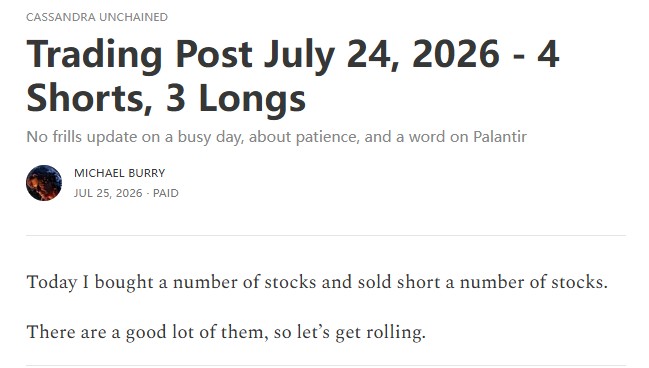
At the time, he explicitly stated that NVIDIA's current and future substantial demand does not come from end customers but is driven cyclically through off-balance-sheet financing arrangements, citing the Bank for International Settlements' 2026 annual report as evidence. He believes that in the current AI infrastructure investment boom, a large amount of capital expenditure does not correspond to real end-user demand but is self-perpetuating through opaque financing structures, posing a risk of systemic overvaluation.
Trigger Point: The $500 Billion Chip Financing Framework
Burry's warning came after NVIDIA announced a grand financing plan this week. NVIDIA partnered with Apollo, BlackRock, Blackstone, Brookfield, Goldman Sachs, and KKR, aiming to establish a chip financing framework worth up to $500 billion. Using NVIDIA AI hardware as underlying assets, the framework issues debt to institutional investors such as pension funds, insurance companies, and sovereign wealth funds. The raised funds are used for chip procurement or leasing financing by AI enterprises.
NVIDIA CEO Jensen Huang called this plan a "Grand Idea," advocating for redefining AI computing power as an investable asset. "They are now revenue-generating assets, characterized by productivity, long lifespan, replaceability, and flexibility," Huang stated.
However, there is still a distance to go before this grand idea is fully realized—no actual fundraising has been completed under the aforementioned cooperation framework, and specific terms will depend on market demand.
Regarding NVIDIA's financing framework, the market is most concerned about the long-term residual value of GPUs as collateral. Critics worry that chip technology iterates rapidly; once technology becomes obsolete, there are hardly any reliable buyers to take over, making their long-term value highly uncertain.
NVIDIA countered with actual data. A Wallstreetcn article reported that Huang stated this week that the A100 chip, launched six years ago, is still in use, with its economic life being extended to nearly 10 years, and leasing prices are still rising. The company also committed to retaining at least 25% residual value of the chips during the lease term, with NVIDIA bearing the initial losses.
Vivek Arya, an analyst at Bank of America Research, pointed out that the involvement of Wall Street financial institutions means NVIDIA can gradually exit the "vendor financing" model, with "the burden borne by the consortium rather than NVIDIA's balance sheet."
Analysts believe that Burry's "Enron-style" warning adds doubt from an iconic short seller to the suspense over "whether chips can become reliable financial assets." The final answer to the debate depends on whether AI computing demand can remain sustainable and whether chip residual values can withstand cyclical tests.
Earning Over $100 Million as a "Key Opinion Leader"
Notably, a Wallstreetcn article wrote that Michael Burry's most profitable business this year might not be stock trading, but writing blog posts.
"The Big Short" investor Michael Burry's Substack investment newsletter, "Cassandra Unchained," surpassed 300,000 subscribers in just 231 days. Based on an annual fee of $379, the theoretical annual revenue is approximately $113.7 million.
How intuitive is this figure? According to Stocktwits, if $1 million were invested separately in the top 10 performing stocks in the S&P 500 this year, the total return would be about $34 million—less than one-third of Burry's theoretical newsletter income.

300,000 Subscribers in 231 Days
In a post titled "Short & Thankful: 300," Burry disclosed that "Cassandra Unchained" had reached 300,044 subscribers and 346,680 followers. Subscribers come from all 50 U.S. states and 212 countries, with 52% located outside the United States.
Data shows that the "Cassandra Unchained" newsletter had about 218,000 followers in January this year, growing to nearly 347,000 by July, with a continuously upward growth curve.

The newsletter is priced at $39 per month or $379 per year, with a free tier also available. Burry did not disclose the specific proportion of paid subscribers. Substack's subscriber count includes both free and paid readers, and the above calculation does not deduct Substack's platform fees. Therefore, $113.7 million is the theoretical upper limit, not the actual net income.
Burry launched the newsletter in November 2025, shortly after he deregistered his hedge fund with the SEC, returned to social media, and restarted his criticism of the AI boom. The newsletter attracted over 60,000 subscribers upon launch and has since evolved into his primary platform for publishing real-time portfolio updates, valuation analysis, and detailed transaction records.
