


Cisco Posts Record Q4 Revenue, $4 Billion in AI Infrastructure Orders; Current Guidance Beats Expectations | Earnings Watch
Cisco released its earnings report, with revenue for the previous fiscal quarter rising 18% year-over-year to $17.3 billion and AI infrastructure orders reaching $4 billion. Guidance for the current fiscal year exceeded expectations, with projected revenue of $72.2–$73.4 billion. Despite strong results, the stock rose initially in after-hours trading before turning lower, weighed down by valuation digestion and high market expectations
Cisco reported fourth-quarter results and current fiscal-year guidance that showed stronger growth than Wall Street had anticipated.
After the U.S. market close on Wednesday, December 12 (Eastern Time), Cisco announced that for its fourth fiscal quarter ended July 25, 2026, revenue rose 18% year-over-year to $17.3 billion, nearly 3% above market expectations. Non-GAAP adjusted earnings per share (EPS) increased 23% year-over-year to $1.22, more than 4% above consensus. Adjusted operating profit climbed 23% year-over-year to $6.2 billion, almost 6% above expectations, with an adjusted operating margin of 35.9%.
AI was the standout theme of the quarter. Cisco’s AI infrastructure orders from hyperscale cloud providers reached $4 billion in the fourth fiscal quarter, bringing full-year fiscal 2026 AI infrastructure orders to $9.3 billion. Meanwhile, product orders rose 35% year-over-year, still up 25% even after excluding hyperscale cloud providers, indicating that demand is not solely driven by large AI customers.
Of greater interest, Cisco’s guidance for the current fiscal year came in well above analyst expectations. The company forecasts fiscal 2027 revenue of $72.2 billion to $73.4 billion, with the midpoint about 6% above market expectations. It projects adjusted EPS of $5.05 to $5.11, with the midpoint nearly 6% above consensus. For the current quarter, Cisco expects revenue of $18.0 billion to $18.2 billion and adjusted EPS of $1.32 to $1.34, both also above market expectations.
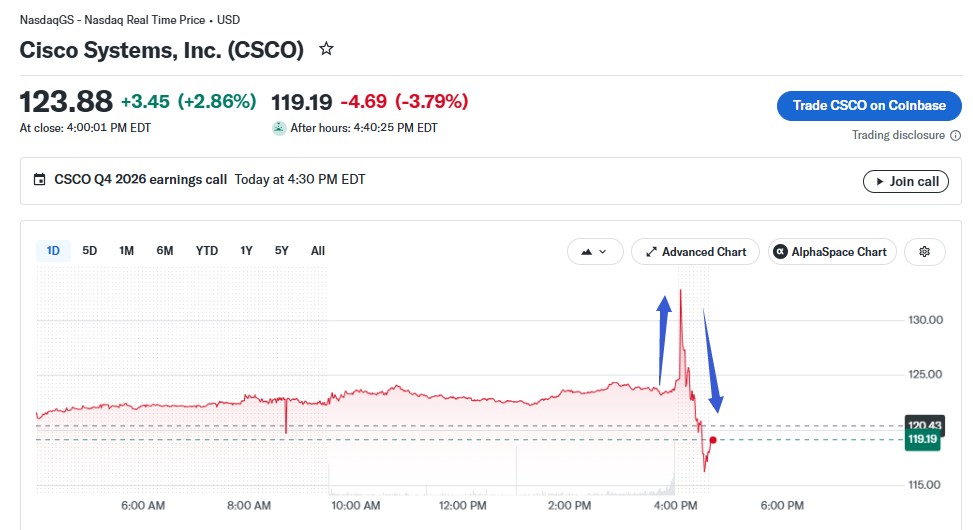
However, Cisco’s stock did not sustain its initial positive reaction after the earnings release. The shares, which had closed up nearly 2.9% on Wednesday, jumped in after-hours trading, with gains approaching 8%, before reversing to a decline of more than 6%. The move resembled a typical “strong results but already high expectations” response: the earnings report itself was hardly negative, but investors were more cautious about short-term profit-taking, valuation digestion, and the sustainability of AI orders.
Risk Disclosure and Disclaimer
Investing involves risk; please proceed with caution. This article does not constitute personal investment advice, nor does it take into account individual users’ specific investment objectives, financial conditions, or needs. Users should consider whether any opinions, views, or conclusions presented herein are suitable for their particular circumstances. Investors bear full responsibility for their own investment decisions.
